
Three Nonnegotiables Labs Need for 7-Hydroxymitragynine Tablet Testing

Confident 7-hydroxymitragynine tablet testing rests on three non-negotiables: a certified reference material produced under ISO 17034 with ISO/IEC 17025-tested characterisation and a batch-specific certificate of analysis, a multicriteria LC-MS/MS confirmation strategy rather than reliance on one mass transition, and documented calibration levels (LLOQ, LQC, MQC, HQC) backed by arrival stability and homogeneity checks. Skip any one of these and a validated assay becomes a guess dressed up in numbers.
TL;DR:
- A certified reference material for 7-hydroxymitragynine must be produced under ISO 17034, characterized by an ISO/IEC 17025 lab, and accompanied by a batch-specific certificate of analysis.
- Validation of an LC-MS/MS method requires multicriteria confirmation, including chromatographic resolution, multiple MS/MS transitions, and calibrated curve coverage from LLOQ to relevant upper concentrations.
- Calibration standards and QC samples should be prepared from well-documented stocks, with consistent homogenization, extraction, and record-keeping to ensure repeatability and traceability.
- Confirm the COA states proper identity, purity, and traceability, and verify material integrity through in-house homogeneity, stability, and identity checks before routine use.
- Avoid using unlabelled powders or extracts as standards or relying on a single transition, as these practices risk misidentification and compromise audit readiness.
7ohyea7ohyea.caSource Consistent 7OH Research Materials7ohyea provides research-grade 7OH tablets and powders, with quality assurance, domestic British Columbia sourcing, and customizable dosage options.
Explore 7OH research materialsTable of Contents
- What to demand from a 7-OH reference material producer
- How do you validate an LC-MS/MS method for 7-OH?
- Sample prep, calibration, and QC workflow for tablets and powders
- Verifying stability, homogeneity, and the COA on arrival
- Building reference materials into SOPs and audit-ready QC
- Common pitfalls and practical fixes
- Where 7ohyea fits into your reference material sourcing
- Sources
- FAQ
What to demand from a 7-OH reference material producer
A reference material is only as trustworthy as the paperwork behind it. Producers accredited to ISO 17034 operate under a quality system built specifically for reference material manufacture, and when the characterisation work itself runs through an ISO/IEC 17025-tested laboratory, the assigned value carries metrological traceability your auditors will actually accept. Without that chain, a “reference standard” is really just a well-packaged guess.
Before a lot enters your calibration workflow, the certificate of analysis should give you:
- NMR identity confirmation, not just a chromatographic retention time match
- HPLC or UPLC purity data with the assigned value and its uncertainty stated numerically
- A traceability statement linking the assigned value back to a recognized measurement chain
- Lot number, expiry date, and storage conditions printed on the same document as the assay data
Material format matters too. Solid CRMs suit long-term calibration curve work and stability studies, while solution CRMs speed up instrument suitability checks before a full run. Matrix-matched tablet or powder formats, at dosage equivalents such as 15 mg, 30 mg, or 50 mg, give you a practical starting point for stock preparation without forcing conversions from an unrelated matrix. Purity tier documentation should specify exactly which format you are receiving and at what assigned concentration.
Pro Tip:Never accept a commercial product extract or an unlabelled powder as a calibration standard, even if a vendor insists the concentration is “close enough.” Without an assigned value and stated uncertainty, you cannot defend the number in a validation report or an audit.
How do you validate an LC-MS/MS method for 7-OH?
Method validation for 7-hydroxymitragynine analysis lives or dies on confirmation strategy. Relying on a single mass transition invites false positives, particularly in tablet and powder matrices where isobaric alkaloids and structurally similar isomers can produce overlapping signals at the same nominal mass. Peer-reviewed work on kratom product testing has shown that multicriteria LC-MS confirmation, combining chromatographic separation with orthogonal MS/MS fragmentation, substantially cuts misidentification risk compared to single-transition screening.
Build your validation checklist around these checkpoints:
- Chromatographic resolution first. Confirm baseline or near-baseline separation of 7-OH from co-eluting isomers before you trust any transition ratio.
- Multiple diagnostic fragments. Monitor at least two MS/MS transitions per analyte and set ion-ratio acceptance thresholds, not just a retention time window.
- Watch the common transition. The 415→190 m/z transition appears throughout the literature, but treat it as one data point in a multicriteria decision, never as a standalone confirmation.
- Calibration range coverage. Span your curve from the assay LLOQ to a realistic upper concentration reflecting tablet dosage strength, with QC points at LLOQ, low, mid, and high levels.
- Instrument parameter starting points. Begin collision energy and cone voltage optimisation from published values in simultaneous alkaloid quantification work, then refine against your own instrument.
Precision and accuracy targets worth benchmarking: validated LC-MS/MS methods for kratom alkaloids have reported run times as fast as 25 minutes with acceptable precision and accuracy across the LLOQ-to-HQC range, and separate pharmacokinetic work on 7-OH in plasma demonstrated run times as low as 2.5 minutes using single-step extraction. Both figures are useful anchors, not fixed rules; your throughput target depends on your matrix complexity and instrument.
Matrix effects deserve their own line item. Tablet excipients and powder carriers suppress or enhance ionization differently than a clean solvent standard, so an internal standard, ideally isotopically labelled where one is available, paired with retention-time locking helps you separate a real signal shift from matrix noise.
Sample prep, calibration, and QC workflow for tablets and powders
A repeatable extraction and calibration workflow turns a reference material into usable data. Follow this sequence for tablet or powder matrices:
- Prepare primary stock. Dissolve the CRM in an appropriate solvent at a defined concentration, then store aliquots at −20°C to avoid repeated freeze-thaw cycles that degrade stock integrity over time.
- Build working dilutions. Serially dilute the primary stock to generate calibration standards spanning your LLOQ to upper working range, and prepare separate QC stocks from an independent weighing where possible.
- Homogenize the sample matrix. Grind tablets to a uniform powder or thoroughly mix bulk powder before subsampling, since uneven particle distribution skews any single aliquot’s result.
- Extract with a defined solvent system. Sonicate or vortex the homogenized matrix in your chosen solvent, then centrifuge and filter before injection to remove particulates that could foul the column or ion source.
- Prepare calibration and QC points. Spike known concentrations into blank matrix at your calibration levels and at LLOQ, LQC, MQC, and HQC, then assess recovery against your acceptance criteria for each level.
- Document everything. Record lot numbers, weighing data, dilution factors, and analyst initials on a batch record that stays with the sample from extraction through final report.
Pro Tip:Label every dilution and aliquot with preparation date and analyst initials the moment it’s made, not at the end of the run. A missing timestamp on a QC vial is one of the most common reasons labs have to repeat an entire validation batch.
Verifying stability, homogeneity, and the COA on arrival

A certificate of analysis is only useful if you check it against what actually arrives. At minimum, confirm the COA states assay purity, the identity method used (NMR is the gold standard here), assigned value uncertainty, water content or loss on drying, and explicit storage instructions with an expiry date.
Run a short in-house verification before committing the lot to routine use:
- A single identity confirmation run against your existing method to catch any gross mismatch early
- A short repeatability check across two or three days to confirm the material behaves consistently under your storage conditions
- A basic homogeneity spot check across multiple tablets or aliquots. Testing at least five random units from the lot and confirming the RSD meets your acceptance criterion catches uneven distribution before it contaminates a full validation dataset
Store solid CRMs per the COA’s stated conditions, and if you only received a solution CRM, aliquot it into single-use vials and freeze at −20°C to limit freeze-thaw variability across the material’s working life.
Building reference materials into SOPs and audit-ready QC
Your validation report and SOPs should reference the CRM by lot number every time, with the COA either linked or attached as a controlled document alongside the assigned value and its uncertainty. That level of specificity is what separates a defensible audit trail from a vague footnote.
Practical language and controls to build in:
- State composition and purity findings using the assigned value plus uncertainty, not a bare percentage
- Include a traceability declaration citing the producer’s ISO 17034 accreditation and the testing laboratory’s ISO/IEC 17025 status
- Run QC control charts at a frequency matched to your sample throughput, and set clear rejection rules when a QC point falls outside acceptance limits
- Trigger requalification whenever a new CRM lot arrives, after any storage excursion, or following major instrument maintenance
- Where controlled substances regulations apply to your jurisdiction, keep documentation aligned with applicable Canadian requirements for traceability and chain-of-custody
Common pitfalls and practical fixes
The most persistent error in 7-OH analysis is confirmation laziness: leaning on one transition because it is fast, then treating a coincidental match as proof of identity. The second most common mistake is accepting an unlabelled extract or a commercial product sample as a calibration standard because it is convenient and cheap. Neither shortcut survives a real audit.
The fixes are unglamorous but effective. Require NMR data on every COA before you accept a lot. Run a full multicriteria confirmation the first time you touch a new tablet or powder matrix, even if it slows the first batch down. Store stock aliquots in single-use volumes so no one is tempted to refreeze a partially used vial. Traceability and documented uncertainty are not paperwork for its own sake. They are what lets you stand behind a number when someone else questions it.
— Deek
Where 7ohyea fits into your reference material sourcing
There are suppliers offering research-grade 7-hydroxymitragynine tablets and powders sourced and manufactured domestically in British Columbia, which can provide qualified Canadian laboratories faster delivery and no cross-border customs delays compared to importing reference materials from overseas suppliers.
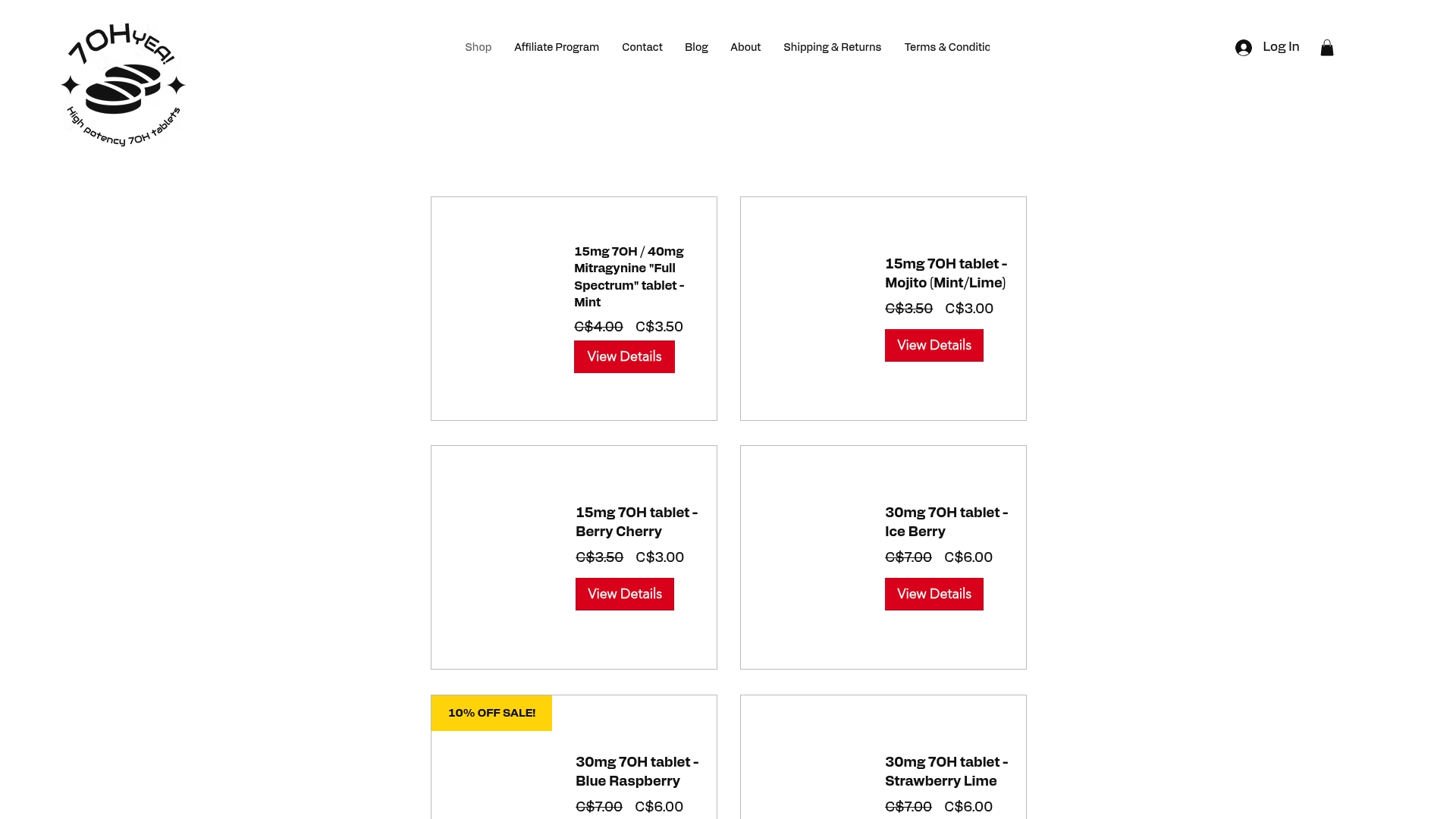
Every batch ships with a batch-specific certificate of analysis, and the product line covers the dosage and purity range labs actually need for method development: tablets at 15 mg, 30 mg, and 50 mg equivalents alongside powder options like the 81% pure 7OH powder for teams building their own dilution series from a higher-concentration stock. Catalogues sometimes include Full Spectrum tablets and Mitragynine-only formats, allowing a single supplier to cover several components of a validation project.
If your protocol calls for a specific dosage format, browse the full 7OH tablet and powder catalogue to match a product to your calibration range, or check the research guides on laboratory detection methods for extended procedure notes before placing an order.
Sources
- Avoiding false identification of 7‑hydroxymitragynine in kratom products using a multicriteria LC–MS confirmation
- Simultaneous quantification of ten key kratom alkaloids by UPLC–MS/MS (PMC)
- Analytical method validation for detection and quantification of kratom alkaloids using LC–MS/MS (2026)
- Controlled Substances Regulations (Canada)
FAQ
What certification should a 7-OH reference material have?
Look for a certificate of analysis from a producer accredited to ISO 17034, with characterisation performed by an ISO/IEC 17025-tested laboratory. The COA should include NMR identity confirmation, HPLC or UPLC purity data, and a stated uncertainty on the assigned value.
Why is a single mass transition not enough for 7-OH confirmation?
A single transition like 415→190 m/z can match isobaric or isomeric compounds present in tablet and powder matrices, producing false positives. Multicriteria confirmation combining chromatographic separation with multiple orthogonal MS/MS fragments resolves that ambiguity.
What QC levels should a validated 7-OH assay include?
A defensible method includes calibration standards spanning the assay’s LLOQ to its expected upper range, plus QC samples prepared independently at LLOQ, low (LQC), mid (MQC), and high (HQC) concentrations. Published validations report precision and accuracy data across this full range, with acceptable precision and accuracy across the LLOQ to HQC range.
Does 7ohyea provide dosage options for method development?
Yes, 7ohyea offers tablets at several standard dosage equivalents along with powder formats, letting labs match a product to their calibration range. Current pricing and available SKUs are listed on the product category page.
How should labs store 7-OH reference material aliquots?
Solid CRMs should follow the storage conditions stated on the COA, and solution CRMs are best split into single-use vials frozen at −20°C to avoid freeze-thaw degradation. Homogeneity should be spot-checked across multiple tablets or aliquots before the lot is used for calibration.