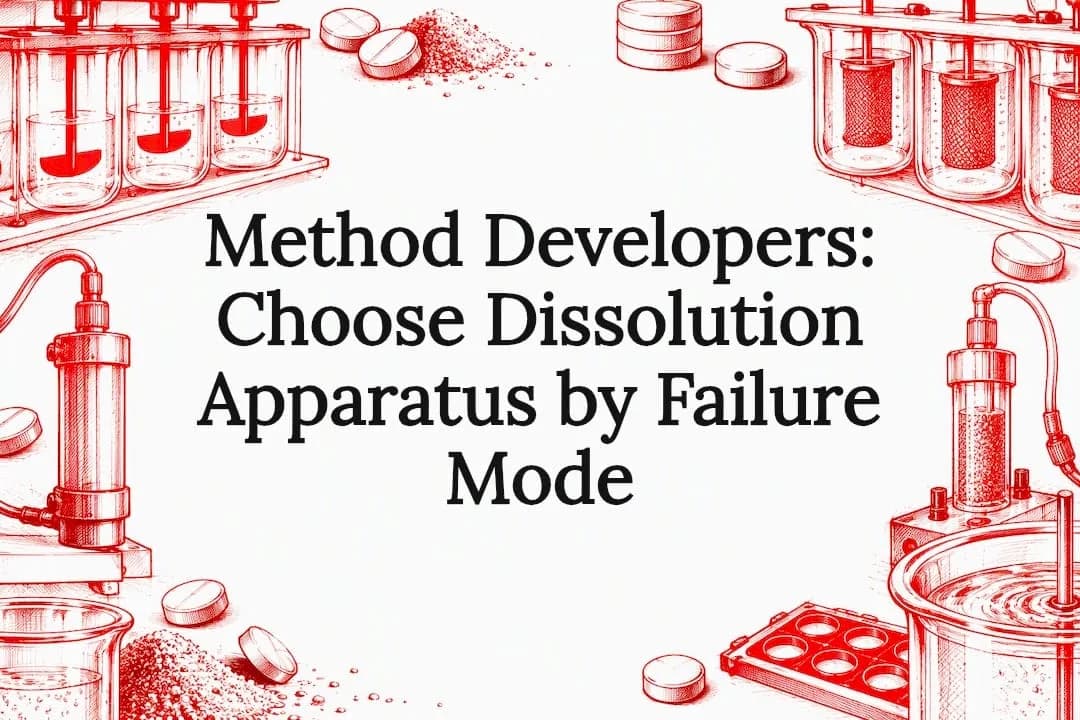
Method Developers: Choose Dissolution Apparatus by Failure Mode

For routine immediate-release tablets and capsules, Apparatus 1 (basket) or Apparatus 2 (paddle) remains the sensible starting point, typically at standard stirring speeds that align with compendial starting points. Modified-release beads and formulations needing programmable reciprocation call for Apparatus 3, while poorly soluble compounds, staged-pH protocols or low-solubility actives often justify Apparatus 4’s flow-through design. Any departure from these conventional starting parameters needs data-backed justification, not convenience.
TL;DR:
- Check the dosage form’s monograph first, then use preliminary runs to identify floating, sticking, coning, or staged pH needs before choosing an apparatus.
- Treat sinkers, altered basket mesh, and nonstandard fixtures as alternative procedures unless the compendial method permits them, and document comparative evidence and effects on discrimination.
- Confirm sink conditions experimentally; if an aqueous medium fails, use the lowest effective surfactant level and show that the method still distinguishes batches.
- PVT failures, unexplained profile shifts, or mechanical deviations call for requalification; key controls include stirring rate within ±4% and temperature within ±0.5°C.
7ohyea7ohyea.caSupport Consistent Dissolution Research7OH Canada supplies research-grade 7-hydroxymitragynine tablets and powders for analytical purposes, with customizable dosage options for diverse research protocols.
Visit 7OH CanadaTable of Contents
- Apparatus at a glance: the seven USP dissolution apparatus and when each is used
- Match apparatus to dosage form and failure modes (how to choose in practice)
- Media, volume and agitation: practical starting conditions and justification framework
- Qualification, performance verification and key mechanical controls (PVT, IQ/OQ/PQ)
- Troubleshooting common issues and mitigations
- Regulatory justification and documentation to defend apparatus choice
- Detailed comparison of apparatus advantages and limitations for specialized research compounds like 7OH tablets
- Guidance on apparatus selection considering novel or complex formulations such as full-spectrum alkaloid tablets
- Impact of tablet composition and excipients on apparatus performance and dissolution profiles
- Publisher perspective: practical notes from a research-grade supplier
- Picking research-grade tablets that support reliable dissolution work
- FAQ
- Sources
Apparatus at a glance: the seven USP dissolution apparatus and when each is used
Each of the seven compendial apparatus assemblies serves a distinct testing purpose, and USP General Chapter 〈711〉 defines the dimensional and operational tolerances for each one. Knowing the intended application of each assembly narrows the selection process considerably before any experimental work begins.
- Apparatus 1 (basket): rotating wire basket holding the dosage form, well suited to capsules, floating formulations and products prone to disintegration variability.
- Apparatus 2 (paddle): the most widely used assembly for immediate-release tablets and capsules, offering a straightforward hydrodynamic profile.
- Apparatus 3 (reciprocating cylinder): moves the dosage form through a series of vessels, useful for chewable tablets, modified-release products and beads where pH staging matters.
- Apparatus 4 (flow-through cell): continuously pumps fresh medium past the sample, ideal for poorly soluble actives, implants and products needing large effective volumes.
- Apparatus 5 (paddle over disk): adapted for transdermal systems, with the patch mounted on a disk assembly beneath the paddle.
- Apparatus 6 (rotating cylinder): another transdermal-specific configuration, replacing the basket with a cylinder holding the patch.
- Apparatus 7 (reciprocating holder): designed for transdermal systems and certain implants or specialty dosage forms requiring vertical dipping motion.
Semi-solids and some transdermal products often require special cells or sample holders beyond the standard vessel, and these exceptions are described directly in the compendial text. Noncompendial accessories such as mini-paddle and mini-vessel configurations, or peak vessels for Apparatus 4 work, have a place when a formulation’s dose or solubility profile genuinely requires a smaller working volume. USP FAQs treat these as alternative procedures requiring documented justification rather than default choices, so we recommend reserving them for cases where standard vessels cannot deliver meaningful discrimination.
Match apparatus to dosage form and failure modes (how to choose in practice)
Selecting an apparatus is less about matching a dosage-form label to a chapter number and more about observing how the formulation actually behaves in preliminary testing. A tablet that coats, floats or clings to the vessel wall tells you something that the monograph alone cannot.
- Check the compendial monograph first for any apparatus or condition already specified for the active ingredient or dosage form.
- Evaluate solubility and stability data before committing to a medium or apparatus, since a poorly soluble compound often points toward Apparatus 4.
- Assess sink conditions experimentally rather than assuming them, particularly for low-solubility actives or high-dose tablets.
- Observe for coning, sticking or floating during preliminary runs; these behaviours often dictate whether a basket, sinker or flow-through cell is the better fit.
- Select the apparatus that matches the observed behaviour and the regulatory expectation for discriminatory power.
An immediate-release tablet with straightforward disintegration usually performs well in Apparatus 2, while a coated multiparticulate or bead formulation frequently needs Apparatus 1 with a basket or Apparatus 3 for staged-pH exposure. Softgels often cone or float in a paddle vessel, which is a common trigger for sinker use, and suspensions or semi-solids may require specialized cell configurations entirely outside the basket and paddle family.
Changing mesh size on a basket, introducing a sinker or adopting a nonstandard fixture is treated as an alternative procedure unless the compendial method explicitly permits it, according to USP guidance. Document the rationale, the comparative data supporting the change and the expected impact on discriminatory power before adopting it as standard practice.
Pro Tip:Run a short preliminary observation study across two or three candidate apparatus configurations before committing to a full validation package; it is far cheaper than discovering a coning problem during a stability study.
Media, volume and agitation: practical starting conditions and justification framework
Medium selection starts with physiological relevance: a pH range reflecting gastrointestinal conditions is the default starting point, refined by the compound’s own solubility and stability behaviour. The EMA reflection paper stresses that a routine dissolution procedure must remain robust, reproducible and discriminatory, which shapes how conservatively we should approach agitation changes.
- Paddle (Apparatus 2): a conventional starting speed is a moderate stirring rate for immediate-release products.
- Basket (Apparatus 1): a typical starting point is a higher stirring speed, particularly for capsules.
- Apparatus 4 flow rates: pump delivery ranges between specified lower and upper millilitres per hour values, with several standard flow rates in millilitres per minute discussed in USP 〈711〉.
- Temperature and volume: maintained within tight tolerances to avoid introducing mechanical variability into an otherwise sound method.
Sink conditions should be demonstrated experimentally, confirming that the dissolution medium can hold several times the expected dose without approaching saturation. When sink conditions cannot be achieved with a simple aqueous medium, a surfactant addition may be justified, but the EMA paper is explicit that increasing agitation to mask poor formulation performance undermines a method’s discriminatory power. We recommend using the minimal effective surfactant concentration, documenting the rationale for its inclusion and retaining comparative data showing the chosen medium still differentiates between batches of varying quality.
Qualification, performance verification and key mechanical controls (PVT, IQ/OQ/PQ)
A dissolution apparatus that is mechanically out of tolerance will produce misleading results no matter how well the method itself was designed. Performance verification testing (PVT) using reference standards remains the most direct way to confirm that an instrument is operating within its intended specification before it generates data a reviewer will scrutinize.
- Vessel eccentricity: maintained within ±2 millimetres to avoid uneven flow patterns.
- Stirring-element depth: typically 25 ±2 millimetres from the vessel bottom.
- Stirring rate: controlled within ±4% of the set point.
- Temperature: held within ±0.5°C of the target.
- Medium volume: controlled within ±1%.
- Sampling time: controlled within ±2%.
These mechanical qualification targets, drawn from USP training materials on PVT best practices, represent the numeric tolerances regulated laboratories commonly apply during instrument qualification. Meeting them consistently is what separates a defensible method from one that will draw questions during an audit.
A PVT failure, an unexplained shift in dissolution profile or a documented deviation in a mechanical parameter should prompt requalification before further testing proceeds.
Troubleshooting common issues and mitigations
A failing dissolution method rarely needs a different apparatus; it usually needs a specific, identifiable fix.
- Coning (an undissolved mound forming beneath the paddle) often responds to a modest agitation increase, but first confirm the formulation itself isn’t simply breaking apart poorly, since masking a real formulation issue with higher speed undermines discriminatory power.
- Sticking or floating tablets are frequently resolved with an appropriately sized sinker, documented as an alternative procedure per USP FAQ guidance.
- High RSD across vessels often traces back to inadequate deaeration of the medium or inconsistent vessel alignment, both of which are correctable without changing apparatus.
- Filter adsorption, visible as unexpectedly low recovery, is addressed by pretreating filters or switching filter material rather than altering the test itself.
Sampling from the designated zone, consistent deaeration before each run and clear retest criteria tied to investigation outcomes keep a method stable without eroding its ability to detect genuine formulation differences.
Regulatory justification and documentation to defend apparatus choice
A reviewer evaluating a dissolution method wants to see the reasoning trail, not just the final conditions. The method-development dossier should capture the decisions that led to the chosen apparatus and medium.
- Preliminary assessment: solubility, stability and filtration behaviour that informed early apparatus and medium decisions.
- Choice justification: why the selected apparatus, speed and medium were chosen over alternatives, referencing observed coning, sticking or floating behaviour.
- PVT records: demonstrating the apparatus was operating within mechanical tolerance during development runs.
- Discriminatory power analysis: comparative data showing the method distinguishes between batches of varying quality, consistent with EMA’s reflection paper on robust and discriminatory methods.
Framing language such as “Apparatus 2 at 50 rpm was selected based on preliminary observations showing consistent disintegration without coning, and sink conditions were confirmed at the proposed medium volume” gives reviewers a clear, evidence-based rationale rather than an unsupported assertion.
Detailed comparison of apparatus advantages and limitations for specialized research compounds like 7OH tablets
Research tablets containing alkaloid actives such as 7-hydroxymitragynine present a dissolution profile that depends heavily on excipient choice and compression characteristics, so apparatus selection benefits from the same systematic evaluation applied to any specialty compound. Apparatus 2 (paddle) is frequently the practical starting point for a standard-format research tablet because it provides a well-characterized hydrodynamic environment and is straightforward to qualify, but a tablet that cones or disperses unevenly under the paddle may perform more consistently in Apparatus 1 with a basket, particularly if the formulation includes components prone to clumping.
Apparatus 4’s flow-through configuration becomes relevant when solubility behaviour is uncertain or when the research protocol calls for staged pH exposure to mimic sequential physiological compartments, since the continuous medium replacement avoids the saturation ceiling that a closed vessel can reach with lower-solubility alkaloid formulations. Each apparatus carries trade-offs: paddle and basket assemblies are simpler to operate and qualify but offer less control over medium replenishment, while Apparatus 4 demands more setup and pump calibration in exchange for better handling of challenging solubility profiles. The right choice depends on preliminary solubility and disintegration observations specific to the tablet lot under study, not on assumptions carried over from a different alkaloid formulation.

Guidance on apparatus selection considering novel or complex formulations such as full-spectrum alkaloid tablets
Full-spectrum alkaloid tablets, which combine multiple alkaloid components rather than a single purified active, introduce an added layer of complexity because each component may dissolve at a different rate and respond differently to agitation and medium pH. A preliminary assessment comparing dissolution behaviour across a pH range relevant to the intended research application is a sensible first step, since a medium that adequately dissolves one alkaloid fraction may leave another component under-saturated or poorly represented in the sampled aliquot.
When a full-spectrum formulation shows inconsistent or incomplete release under standard paddle conditions, increasing agitation is not automatically the right correction, since the EMA reflection paper’s caution against masking formulation differences applies equally here. A more productive path is often evaluating whether Apparatus 1’s basket configuration better contains loose or fragmenting tablet material, or whether a longer sampling schedule captures the slower-dissolving fraction without altering the fundamental test conditions. Documenting the behaviour of each alkaloid component separately, where analytically feasible, strengthens the justification for whichever apparatus and condition set is ultimately selected, and supports a more defensible method package for a formulation that does not fit a single-active template.
Impact of tablet composition and excipients on apparatus performance and dissolution profiles
Excipient selection shapes dissolution behaviour well before the apparatus itself becomes a variable worth isolating. Binders, disintegrants and fillers each influence how quickly a tablet breaks apart and how its particles distribute through the dissolution medium, and these effects can interact with apparatus choice in ways that are easy to overlook during early method development.
A tablet formulated with a fast-disintegrating system may perform predictably in Apparatus 2, while one relying on a denser binder matrix might cone or clump, pointing toward a basket configuration or a sinker as a better fit. Hydrophobic excipients can slow wetting and create localized zones of poor dissolution near the sampling probe, which is why sampling-zone placement deserves as much attention as the apparatus itself. Lubricants used in compression, if present at higher levels, can occasionally coat particle surfaces and delay dissolution onset, an effect worth checking for when a tablet underperforms relative to expectation despite an otherwise sound apparatus choice. Reviewing excipient composition alongside preliminary dissolution data, rather than troubleshooting the apparatus in isolation, tends to resolve more method problems than adjusting mechanical parameters alone.
Publisher perspective: practical notes from a research-grade supplier
Supporting laboratories with research-grade alkaloid materials has shown us how often apparatus selection hinges on small formulation details rather than broad dosage-form categories. Our tablet formulation basics guide and sample protocol resources are there for researchers refining their own dissolution workflows.
— Deek
Picking research-grade tablets that support reliable dissolution work
Consistent, batch-specific tablets make apparatus selection and method development far more straightforward, which is where our research-grade 7OH tablets and powders come in. Sourced and manufactured domestically, each batch ships with a certificate of analysis, and customizable dosage options, including 15 mg, 30 mg and 50 mg formats, let a research team select a strength that suits the apparatus and medium conditions already under evaluation rather than reverse-engineering a method around whatever happens to be on hand.
Because our materials are produced for laboratory and analytical use, researchers comparing apparatus behaviour across alkaloid tablets, including full-spectrum formulations, aim to rely on consistent composition from one order to the next, which removes a common source of unexplained variability in preliminary dissolution runs. For labs working through method-development decisions covered in this guide, our dissolution testing protocol guide offers additional detail on preliminary assessments and sample SOPs. Browse the full catalogue of research-grade tablets and powders to find the dosage format that fits your current protocol.
FAQ
What are the seven types of dissolution apparatus?
The seven compendial apparatus types are basket (1), paddle (2), reciprocating cylinder (3), flow-through cell (4), paddle over disk (5), rotating cylinder (6) and reciprocating holder (7), as defined in USP 〈711〉. Apparatus 1 through 4 cover most oral solid dosage forms, while 5 through 7 are largely reserved for transdermal and specialty formats.
What is Apparatus 5 used for in dissolution testing?
Apparatus 5, the paddle over disk method, is designed for transdermal delivery systems, with the patch mounted on a disk assembly positioned beneath the rotating paddle. It allows the medium to contact the patch surface in a manner that approximates how a transdermal product releases its active over time.
What do S1, S2 and S3 mean in dissolution testing?
S1, S2 and S3 refer to the three testing stages used to evaluate whether a batch meets dissolution acceptance criteria, with each stage specifying how many additional units are tested and what average and individual results must achieve. A batch that fails to meet criteria at S1 proceeds to S2, and if necessary S3, with progressively more units tested at each stage.
How is the dissolution medium selected?
Medium selection generally starts with a physiologically relevant pH, then adjusts based on the compound’s solubility and stability profile as confirmed through preliminary testing. When sink conditions cannot be achieved with a simple aqueous medium, a minimal effective surfactant concentration may be added, provided the rationale and comparative data are documented.
When should a sinker be used in dissolution testing?
A sinker is appropriate when a dosage form floats or clings to the vessel wall in a way that prevents consistent contact with the dissolution medium. According to USP FAQ guidance, using a sinker when the compendial method does not specify one is treated as an alternative procedure requiring documented justification.
Sources
- 〈711〉 DISSOLUTION (USP)
- Reflection paper on the dissolution specification for generic solid oral immediate release products with systemic action (EMA)