Canadian Labs: Kratom Panel Costs $6.75–$50, COA & Domestic Sourcing

Research-grade 7-hydroxymitragynine and mitragynine reference materials for Canadian laboratories typically range from modest per-gram pricing for bulk powders to higher per-unit costs for premeasured tablets, depending on assay purity and batch testing included. Before approving a purchase order, procurement teams should request the certificate of analysis, the assay method used, and a confirmed lead time from the supplier. These three documents clarify most of the price variation you will encounter.
TL;DR:
- Suppliers should provide clear documentation including assay method, certificate of analysis, and lead time to ensure price transparency and quality.
- Larger bulk powder orders typically offer lower per-gram costs due to fixed testing and handling expenses being spread across more material.
- Domestic sourcing in Canada reduces import duties, customs delays, and logistical uncertainties, leading to faster and more predictable delivery times.
- A pilot order and independent verification of COA are essential steps before committing to large-scale purchases to confirm quality and protocol fit.
- Retesting and additional laboratory verification, especially for purity and stability, can significantly increase overall costs beyond the initial purchase price.
7ohyeaSource Research-Grade 7OH Materials7ohyea provides research-grade 7OH tablets and powders, with domestic British Columbia sourcing and quality assurance for Canadian laboratories.
Explore 7OH materialsTable of Contents
- What determines the price: cost drivers for research-grade 7OH and mitragynine
- Typical price ranges and example buy scenarios for Canadian labs
- Buying considerations: quality checks, paperwork and procurement best practices
- Ordering, lead times and logistics for Canadian deliveries
- Regulatory and compliance notes for Canadian labs
- Detailed breakdown of laboratory fees versus material costs
- Overview of insurance or liability coverage related to testing
- Payment options and typical payment timelines in Canada
- Additional costs: retesting and confirmatory testing
- How labs should weigh price versus analytical fit
- How 7OH Canada meets Canadian lab procurement needs
- Sources
- FAQ
What determines the price: cost drivers for research-grade 7OH and mitragynine
Quotes for 7-hydroxymitragynine and mitragynine reference materials vary for reasons that are mostly traceable once you know what to look for. Formulation matters too. A premeasured tablet, built to a specific dosage such as 15 mg, 30 mg, or 50 mg, carries manufacturing and quality control costs that a raw powder does not, since each batch must be verified for dosage consistency rather than bulk concentration alone.
Third-party batch testing, typically by HPLC or GC-MS, adds a fixed cost to every production run regardless of order size, which is why certificates of analysis are rarely free line items hidden inside a quoted price. Order size changes the economics further: larger batches spread packaging, stability testing, and traceability documentation across more units, lowering the effective per-unit cost. Finally, domestic production versus imported supply affects both price and timeline. Materials produced and sourced within Canada avoid the duties, brokerage fees, and customs delays that come with cross-border shipments.
- Higher assay purity increases unit cost due to tighter manufacturing and verification requirements.
- Premeasured tablets cost more per unit than bulk powder because of dosage-consistency testing.
- Batch testing and COA production are largely fixed costs, so they weigh more heavily on small orders.
- Domestic sourcing avoids import duties and reduces the chance of customs-related delays.
Pro Tip:Ask every supplier for their assay method by name (HPLC or GC-MS) rather than accepting “lab tested” as a standalone claim; the method tells you how reliable the stated purity figure actually is.
Typical price ranges and example buy scenarios for Canadian labs
Pricing structures differ meaningfully depending on the format and quantity you order, and understanding the logic behind each scenario helps you compare quotes on equal footing rather than by sticker price alone.
- Analytical standard vial: A small reference vial intended for calibration or method development should come with a batch-specific COA included in the price, since the fixed testing cost applies regardless of volume.
- Small tablet packs: Premeasured tablets at 15 mg, 30 mg, or 50 mg dosages carry packaging and consistency-testing costs that make per-unit pricing higher than bulk powder, even though the convenience suits protocols needing standardized doses.
- Bulk powder purchases: Ordering in gram or kilogram quantities, such as 43% pure Mitragynine “Full Spectrum” powder or 81% pure 7OH powder. It spreads fixed testing and handling costs across more material, generally producing a lower per-gram price than small-format purchases.
- Comparing quotes fairly: Request the assay method, impurity profile, and stability data alongside the price so you are comparing equivalent research-grade material rather than figures that look similar on paper but differ in what they actually certify.
A useful habit is to normalize every quote to a per-milligram-of-active-alkaloid basis before comparing suppliers, since dosage formats and purity percentages otherwise make direct comparison misleading.
Buying considerations: quality checks, paperwork and procurement best practices
Before a purchase order clears, your lab should have a short, non-negotiable documentation checklist. A batch-specific certificate of analysis should state the assay method, the impurity profile, and expiry or stability data tied to that specific lot, not a generic product sheet reused across shipments. Identity confirmation and impurity limits matter as much as the headline purity figure, since a material can carry an impressive percentage while still failing on moisture content or residual solvent levels that affect downstream assay performance.
Procurement teams should treat vendor qualification as a process rather than a single check. A pilot order, followed by blinded verification inside your own lab against the supplier’s COA, is the most reliable way to confirm that a new source meets your protocol’s requirements before committing to bulk volumes. Once materials arrive, proper storage, clear labelling, and consistent record keeping protect both the integrity of the reference material and your lab’s audit trail.
- Request batch-specific COA, assay method, impurity profile, and expiry or stability data for every lot.
- Confirm identity, impurity limits, and moisture or solvent content before accepting a shipment.
- Run a pilot order and verify results independently before scaling to bulk purchases.
- Maintain clear storage conditions, labelling, and record keeping for every reference material received.
Pro Tip:Keep a running log of COA documents by lot number; when a result looks unusual months later, that log lets you trace it back to a specific batch rather than guessing.
For labs still deciding which alkaloid standard fits their protocol, a closer look at the analytical differences between mitragynine and 7-hydroxymitragynine can help clarify which reference material matches your study design.
Ordering, lead times and logistics for Canadian deliveries
Domestic suppliers based in British Columbia typically offer shorter and more predictable lead times than overseas sources, since shipments move entirely within Canadian carrier networks rather than passing through customs clearance and brokerage steps. That predictability matters for labs working against study timelines, where a delayed shipment can push back an entire testing schedule.
Domestic sourcing carries a few practical advantages worth weighing when you compare suppliers, including several CBD benefits that are influencing Canadian procurement behavior:
- Fewer border delays, since domestic shipments skip customs clearance entirely.
- No broker fees added to the invoice, unlike many imported research chemical shipments.
- More predictable transit times, which simplifies scheduling around study deadlines.
- Simpler paperwork, since cross-border documentation requirements do not apply.
Labs importing reference materials from outside Canada may also want to know that a customs remission order for investigation drugs, placebos, and emergency drugs exists, allowing recovery of certain duties when filing conditions and time limits are met. Confirming documentation requirements with your supplier before the shipment leaves origin speeds up the eventual claim, if one applies to your order.
Regulatory and compliance notes for Canadian labs
Canadian labs procuring alkaloid reference materials should be aware of a few regulatory touchpoints, without treating this as a substitute for legal advice from institutional compliance staff. Health Canada’s precursor control regulations allow exemptions for preparations or mixtures of Class A or Class B precursors when the mixture poses little risk of diversion and the precursor cannot easily be extracted from it. An exemption certificate may apply under specific sections of the framework depending on how the preparation is formulated.
Separately, statutory lists under Canadian regulations identify specific controlled precursors and related substances that labs should check their reference materials against as part of standard due diligence.
- Confirm whether your specific preparation or mixture qualifies for a precursor exemption before import.
- Keep supplier attestations and COAs on file as part of your compliance record.
- Consult institutional legal or regulatory affairs staff when a shipment’s status is unclear.
- Review customs remission conditions early if your order involves cross-border shipment.
Detailed breakdown of laboratory fees versus material costs
A quoted price for reference material rarely reflects the full cost of using it in a validated study, and separating material cost from laboratory fees helps budget more accurately. The material cost covers the alkaloid itself: the powder or tablet, its packaging, and the batch-specific COA that should already be included in a legitimate research-grade quote. That figure is what most suppliers list as the purchase price.
Laboratory fees sit on top of that and cover work your own facility, or a contracted third-party lab, performs after the material arrives. These typically include confirmatory testing to verify the supplier’s stated purity against your own instrumentation, method validation work if the reference material is being incorporated into a new analytical protocol, and any stability or degradation testing your study design requires over time. Unlike the material cost, laboratory fees scale with the complexity of your protocol rather than with order size, so a small purchase intended for rigorous method validation can carry laboratory costs that exceed the material price several times over.
Budgeting for both categories separately, rather than treating the purchase price as the full cost of a research input, avoids the common mistake of underestimating what a reference material actually costs to put into productive use. A lab buyer’s guide to 7-hydroxymitragynine pricing breaks down how these two cost categories typically interact across different order sizes.
Overview of insurance or liability coverage related to testing
Laboratories handling research-grade alkaloid reference materials should confirm how their existing liability and general research insurance policies treat controlled or precursor substances, since coverage details vary by institution and insurer rather than following a single national standard. Most academic and contract research labs already carry some form of general liability and professional indemnity coverage; the relevant question is whether that policy explicitly extends to handling, storage, and disposal of precursor-class materials, or whether it requires a specific rider.
Institutional risk management or legal affairs offices are generally better positioned than a supplier to confirm what a given policy covers, since insurance terms depend on the lab’s own institutional arrangement rather than on the product being purchased. It is worth raising this question before a first order arrives rather than after, particularly for labs new to handling precursor-controlled reference materials. Keeping supplier COAs, attestations, and compliance documentation on file supports this conversation, since insurers and auditors alike tend to ask for the same paper trail that regulatory compliance already requires.

Payment options and typical payment timelines in Canada
Most Canadian suppliers of research-grade reference materials accept standard business payment methods: credit card, e-transfer, and in some cases purchase order terms for institutional buyers such as university labs or government research facilities. Direct online card payment is typically the fastest route for small orders, with the order processed and shipped once payment clears, usually within one to two business days for domestic transactions.
Institutional buyers working through purchase order systems should expect a longer timeline, since internal approval and invoicing workflows add processing time on the buyer’s side rather than the supplier’s. It is worth confirming with your supplier whether they accommodate net-30 or similar institutional payment terms before placing a large order, since not every research chemical supplier offers invoiced terms to new accounts. For recurring purchases, establishing an account relationship with agreed payment terms upfront tends to shorten processing time on subsequent orders, since the paperwork is already on file.
Additional costs: retesting and confirmatory testing
The quoted purchase price rarely represents the full cost of bringing a reference material into active use, and retesting is the most common additional expense labs encounter. Even with a supplier’s COA in hand, many labs choose to run confirmatory testing in-house or through a contracted third-party laboratory to independently verify assay purity before incorporating the material into a validated method. This step protects against batch-to-batch variation and gives your lab its own documented verification rather than relying solely on supplier-provided data.
Retesting costs depend on the analytical method required. Confirmatory HPLC or GC-MS runs add laboratory time and instrument cost on top of the material price, and these fees scale with how many parameters are being verified, identity, purity, and impurity profile together cost more to confirm than a single-parameter check. Stability retesting, needed when a reference material is stored for extended periods before use, is another cost worth budgeting for if your study timeline spans several months. Factoring these additional verification costs into your budget from the outset avoids the common surprise of a research project running over on laboratory fees that were never part of the original purchase quote.

How labs should weigh price versus analytical fit
The lowest price per milligram is rarely the right metric to optimize for. A reference material that costs slightly more but arrives with a transparent, batch-specific COA and a clearly stated assay method will save your lab more time and risk than a cheaper source that leaves purity and impurity data vague. Domestic sourcing tends to reduce logistical risk on top of that, since shorter, more predictable delivery windows make repeat orders easier to schedule around study timelines.
My recommendation is straightforward: run a pilot order with any new supplier, verify the results against your own instrumentation, and only then commit to bulk purchasing. Traceability and reproducibility matter more to a research outcome than shaving a few dollars off a quote.
— Deek
How 7OH Canada meets Canadian lab procurement needs
7OH Canada specializes in research-grade 7-hydroxymitragynine tablets and powders built specifically for laboratory analytical use, with customizable dosage options at 15 mg, 30 mg, and 50 mg to fit different research protocols. Materials are sourced and produced domestically in British Columbia, which supports faster, more predictable delivery for Canadian labs without the customs steps that come with imported reference standards.
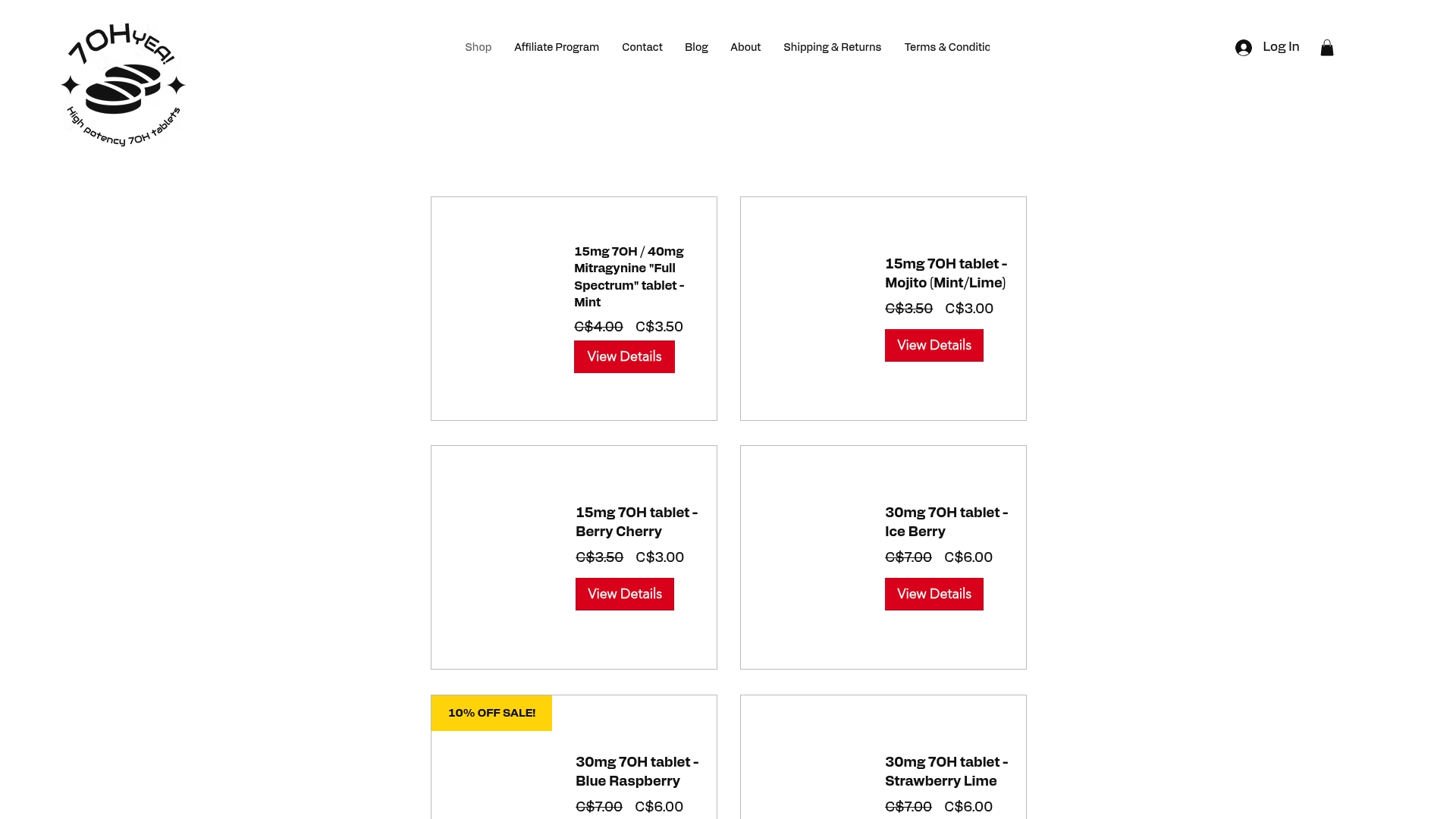
| What you get | Detail |
|---|---|
| Format options | Tablets and powders, including Full Spectrum and single-alkaloid formulations |
| Dosage customization | 15 mg, 30 mg, and 50 mg tablet options available |
| Sourcing | Domestic production and sourcing from British Columbia |
| Use case | Research and analytical laboratory use only, not for human consumption |
If your lab needs a batch-specific COA, an assay method breakdown, or a confirmed lead time before approving a purchase order, browse the current product catalogue or visit the 7OH Canada site to request a quote directly.
Sources
Key references: Health Canada’s precursor exemption guidance, federal statutory precursor lists, the customs remission order for investigation drugs, and internal 7OH Canada purchasing pages for current product and pricing detail.
FAQ
What is a realistic price range for research-grade 7OH in Canada?
Pricing depends heavily on format and purity: bulk powders such as 81% pure 7OH powder are priced at $50 CAD, while premeasured tablet formats and lower-assay powders such as 43% pure Mitragynine “Full Spectrum” powder at $6.75 CAD reflect different cost structures. Always confirm the assay method and COA inclusion before comparing prices across suppliers.
Does every order come with a certificate of analysis?
A legitimate research-grade supplier should include a batch-specific COA with every order, since it documents the assay method, purity figure, and impurity profile for that specific lot. If a supplier cannot provide one, treat that as a reason to look elsewhere.
How long does domestic shipping typically take compared with imports?
Domestic suppliers based in British Columbia generally offer shorter, more predictable delivery windows than overseas sources, since shipments avoid customs clearance and brokerage delays entirely. Imported materials may also qualify for customs duty remission under specific conditions, though domestic sourcing avoids that process altogether.
Do Canadian labs need a special exemption to purchase these materials?
Some preparations or mixtures may qualify for a precursor exemption under Health Canada’s framework when the mixture poses little diversion risk, but requirements vary by formulation. Labs should confirm their specific case with institutional compliance staff rather than assuming a blanket exemption applies.
Why do small orders sometimes cost more per unit than bulk purchases?
Certificate of analysis production and batch testing are largely fixed costs that apply regardless of order size, so they weigh more heavily on small purchases. Buying in bulk, such as gram or kilogram quantities of powder, spreads those fixed costs across more material and typically lowers the effective per-unit price.