Before you place an order, require three documents without exception:
A Certificate of Analysis (COA) showing lot‑specific assay results and a full impurity profile
A Safety Data Sheet (SDS) for handling, storage, and disposal
A stated claim of metrological traceability, ideally referencing ISO/IEC 17025 (testing lab competence) or ISO 17034 (reference material producer competence)
A COA without a traceability statement tells you what a supplier measured. It does not tell you whether that measurement means anything outside their own lab.
The AOAC SMPR 2015.008 guidance sets the bar for mitragynine and 7‑hydroxymitragynine analytical methods, and it’s a useful benchmark when you’re vetting a supplier’s claims. For related alkaloid materials used in method development and calibration work, 7OH Canada is worth having on your shortlist alongside dedicated reference material suppliers.
Key Takeaways
Reliable mitragynine quantification depends on pairing an ISO‑traceable CRM or high‑purity primary standard with a full COA, SDS, and a documented traceability statement.
Point | Details |
Choose CRM or high purity | Prioritize ISO‑traceable materials for any result that requires quantitative accuracy. |
Require three documents | Insist on a COA with lot assay, an SDS, and a stated traceability claim before ordering. |
Match concentration to method | LC‑MS/MS, UHPLC, and DART‑HRMS each call for different working concentration ranges. |
Watch for diastereomer co‑elution | Include isomer-specific standards when your method can’t fully separate related compounds. |
Verify before bulk purchase | Order a small qualifying lot and check lot codes, accreditation, and expiry data first. |
Related alkaloid sourcing | 7OH Canada offers research-grade 7‑hydroxymitragynine tablets and powder with batch documentation for lab protocols. |
Table of Contents
Chemical identifiers and specs for your procurement record
Mitragynine carries CAS number 4098-40-2. Your LIMS entry should also capture the molecular formula, common synonyms, and machine-readable identifiers like InChI and InChIKey strings, which the IUPAC InChI guidance treats as the authoritative format for interoperable chemical records. These strings let your lab cross-reference a standard against independent chemical databases instead of relying solely on a supplier’s product name.
Purity expectations vary by intended use. A CRM designation, where available, adds a documented uncertainty value on top of that assay.
Choosing between powder and certified solution ampules
Neat powder and certified solutions solve different problems, and picking the wrong one wastes both time and budget.
Neat powder (mg quantities) suits labs running custom dilution series, building their own calibration ranges, or working with isotopically labelled materials that aren’t sold pre-diluted.
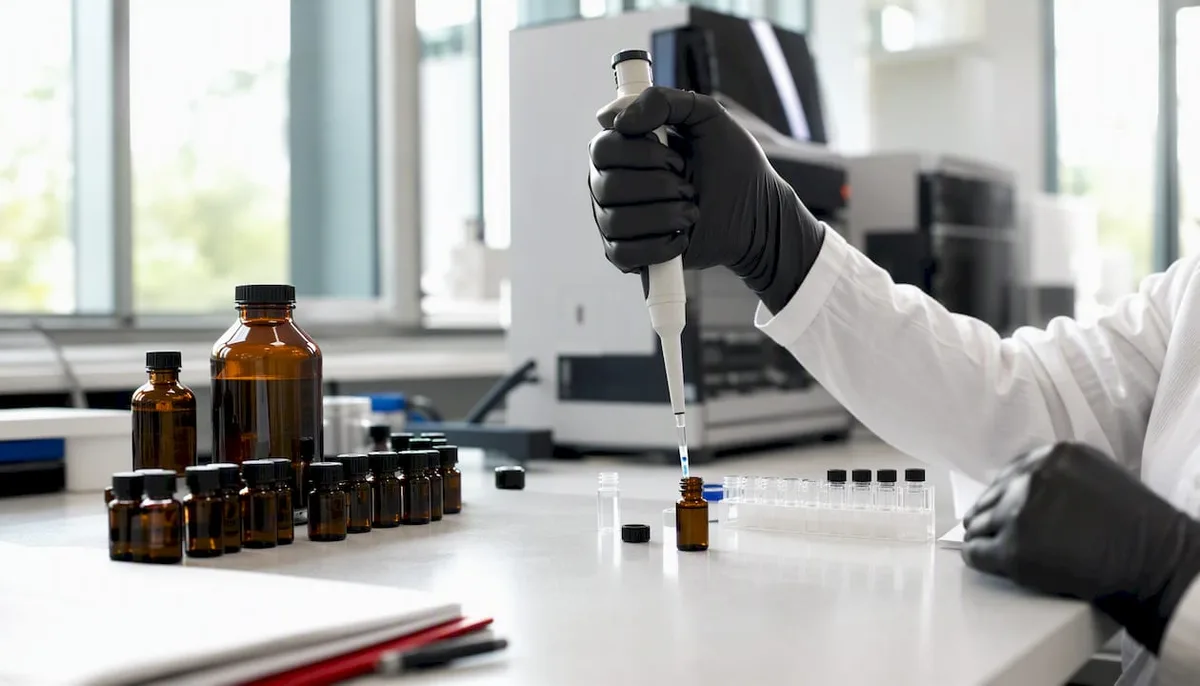
Certified solutions, commonly supplied as 100 µg/mL in methanol in sealed ampules, suit labs that want a ready-to-use working standard with no weighing error introduced at the bench.
Powder gives you flexibility across multiple methods; solution ampules give you consistency across multiple analysts running the same protocol.
Check packaging closely before you commit to a vendor. Amber vials protect light-sensitive material, crimp-sealed ampules reduce evaporation and contamination risk, and every unit should carry a lot number that ties directly back to its COA.
Pro Tip:Order one ampule and one powder lot from a new supplier before committing to bulk quantities. Run both against an existing validated standard to confirm agreement before you build a study around the new material.
What documentation actually proves a standard is fit for use
A purity percentage on a product label means very little without the paperwork behind it. Verifying the COA includes the characterisation method and a clear traceability statement is essential groundwork for your QA records, not an optional extra.
A usable COA includes:
Lot number matching the physical container
Expiry or retest date
Assay method used (e.g., HPLC-UV, LC-MS/MS) and the numerical result
Full impurity profile, not just a single purity figure
Uncertainty or expanded uncertainty value, where the producer states one
CRM status is not the same as a purity claim. A certified reference material carries documented traceability through an ISO 17034-accredited producer, and any lab issuing the COA under ISO/IEC 17025 accreditation adds a second layer of credibility. Voluntary industry programmes, like the American Kratom Association’s GMP Standards Program, can signal decent manufacturing practices for consumer-facing products, but they audit facilities and labelling, not analytical traceability. Treat them as a supplementary signal, never a substitute for ISO documentation.
Before accepting a shipment, run through this quick verification:
Confirm the COA lot code matches the physical label on the container.
Check whether the issuing lab holds current ISO/IEC 17025 accreditation.
Compare the stated assay method against your own method’s requirements.
If the material will anchor a regulatory or published result, consider an independent third-party assay to confirm agreement.
Matching the standard to your analytical method
The right concentration depends entirely on what instrument and method you’re running, and calibration ranges published in the literature are a practical starting point.
For LC‑MS/MS bioanalysis, a validated method reported an LLOQ of 1 µg/L for mitragynine diastereomers, with linearity holding to 2000 µg/L and QC recovery between 90% and 109% across low-level quality controls. That range tells you the working solution concentrations you’ll need sit well below what a typical certified ampule provides straight out of the box, so plan your dilution scheme before the standard arrives.
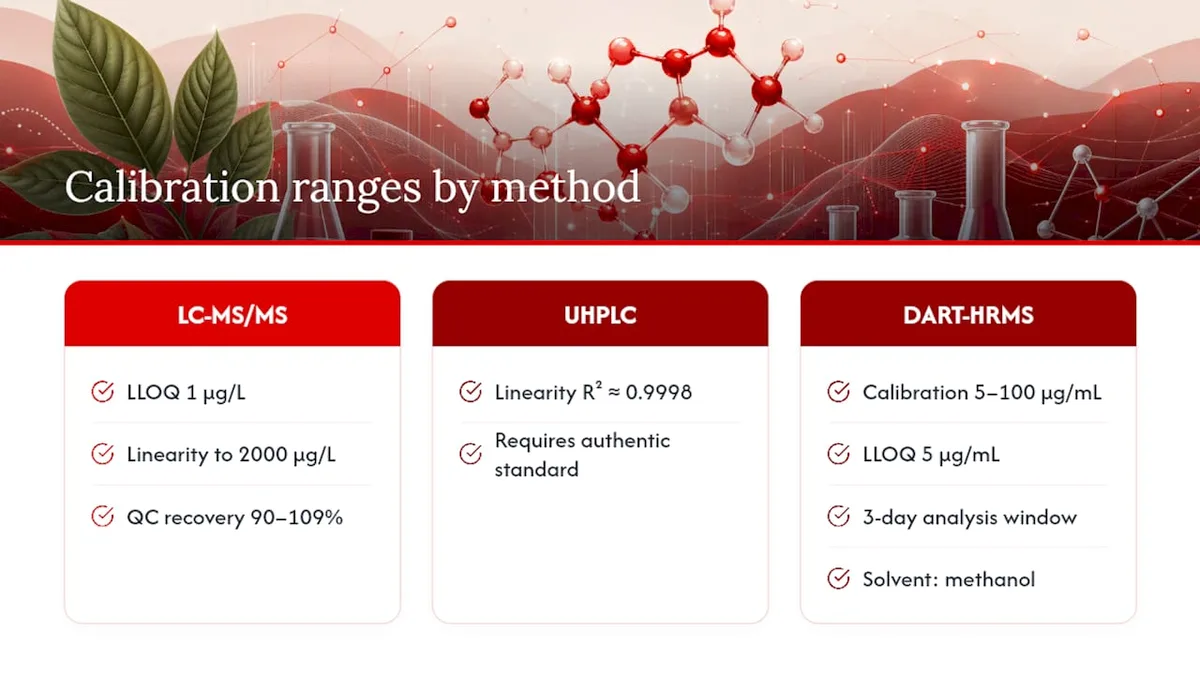
For UHPLC quantification, calibration built around a certified mitragynine standard has shown linearity as high as R² ≈ 0.9998, confirming that peak identity and quantification both depend on an authentic, well-characterised standard rather than a retention-time match alone.
For DART‑HRMS, a validated approach built calibration curves from 5 to 100 µg/mL in methanol across a three‑day analysis window, maintaining an LLOQ of 5 µg/mL with an isotopically labelled internal standard.
Pro Tip:If mitragynine‑d3 is available for your budget, use it as your internal standard by default. It corrects for matrix effects and integration drift far more reliably than an unrelated analogue, and skipping it means you’ll need to fully validate whatever substitute you choose.
Isomer coverage deserves separate attention here. Forensic work has shown mitragynine co-elutes with related diastereomers like speciociliatine and speciogynine in routine methods, and improved separation has revealed samples where levels sat below routine cutoffs once diastereomers were properly resolved. If your method can’t separate these isomers, a single-standard calibration risks misquantification. Budget for isomer-specific standards where your method’s resolution can’t rule out co-elution.
Storing and handling your standards without losing potency
Store mitragynine standards cool, dark, and desiccated, and always defer to the vendor’s SDS for exact temperature and expiry figures rather than assuming a blanket rule across suppliers. Powder generally tolerates ambient shipping better than dilute solutions, while some certified ampules ship with cold packs depending on solvent and concentration.
Working solutions in methanol don’t last indefinitely. Multi-day calibration series in published DART‑HRMS work relied on solutions prepared and used within a defined analysis window rather than solutions held for weeks on the bench. Treat any diluted working standard as a short-term preparation and re-verify it against a fresh reference point if a study runs long.
On receipt:
Match the lot code on the container against the COA before anything goes into inventory.
Inspect ampule seals and vial caps for damage or signs of leakage.
Log the material into your LIMS and quarantine it until the COA has been verified.
Dispose of expired or contaminated material according to the SDS, and confirm solvent compatibility before combining any leftover standard with lab waste streams.
Pro Tip:Keep a running log of opened-ampule dates alongside your COA archive. When a result gets questioned months later, “the standard was six weeks past its practical working life” is a much better answer than a guess.
A step-by-step checklist for ordering reference standards
Before you commit budget to a purchase order, work through this sequence:
Confirm the COA includes lot-specific assay data and an impurity profile, not just a purity headline.
Verify the issuing laboratory’s ISO/IEC 17025 accreditation status.
Confirm the physical form and concentration match your method’s calibration range.
Request stability and expiry data for both the neat material and any pre-made solutions.
Confirm shipping conditions (cold chain vs. ambient) and any market restrictions stated on the vendor’s page.
Ask whether isotopically labelled internal standards, like mitragynine‑d3, are available or can be sourced alongside the primary standard.
A few sourcing habits separate reliable vendors from risky ones:
Favour suppliers willing to sell a small qualifying sample lot before you commit to bulk purchasing.
Ask whether COAs are available in machine-readable form for easier LIMS integration.
Cross-check that the supplier’s stated CAS number and synonyms match your own procurement record exactly.
For labs also working with 7‑hydroxymitragynine or need closely related alkaloid materials for comparative studies, 7OH Canada’s research-grade sourcing guide walks through what to check before ordering related compounds, and it’s a reasonable parallel checklist to run alongside your mitragynine standard verification.
A researcher’s take on getting this right the first time
When absolute quantification matters, the decision is straightforward: pick an ISO‑traceable CRM or a high‑purity primary standard with a full COA and a documented traceability statement, and don’t compromise on that even under budget pressure. If your lab genuinely can’t afford a CRM for every study, validate a cheaper primary standard against a certified material or an accredited third-party assay before you let it anchor a published or regulatory result. Skipping that validation step is where most quantification disputes originate, and it’s the one shortcut that comes back to bite labs during review.
Where to source related alkaloid materials for your lab
If your protocols extend beyond mitragynine into 7‑hydroxymitragynine or other related alkaloids, sourcing consistent, well-documented material matters just as much as it does for your primary reference standard. 7OH Canada supplies research-grade 7‑hydroxymitragynine tablets and powders manufactured domestically, with customizable dosages, including 15mg, 30mg, and 50mg options, built for laboratory protocols rather than personal use.
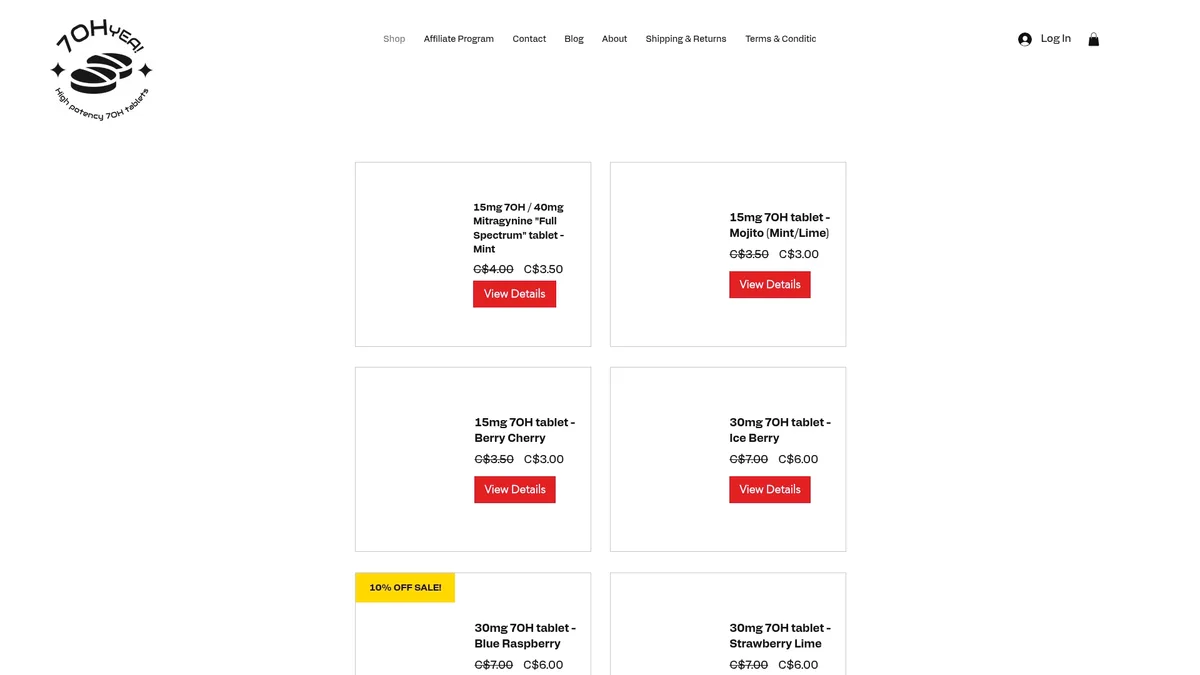
Before ordering, ask any related-alkaloid supplier three things: whether batch COAs are available per lot, whether small qualifying lots are offered before a bulk commitment, and what turnaround looks like for custom concentrations. 7OH Canada’s 83% pure powder product page lists purity specifications directly, which makes it easier to fold into a procurement comparison against other reference materials. If your study calls for fixed-dose tablet formats instead, review the full product catalogue and reach out with your protocol’s concentration and turnaround requirements to confirm availability before you finalize a purchase order.
Sources
AOAC SMPR 2015.008 (mitragynine analytical method requirements)
Published LC‑MS/MS bioanalytical method with LLOQ 1 µg/L (PubMed ID 19577523)
DNA barcoding and chemical profiling of Mitragyna speciosa (PMC13074985)
FAQ
What is the best mitragynine reference standard for quantitative work?
What documentation should a mitragynine standard come with?
Expect a Certificate of Analysis with lot-specific assay and impurity data, a Safety Data Sheet, and a stated traceability claim referencing ISO/IEC 17025 or ISO 17034.
What CAS number identifies mitragynine?
Mitragynine’s CAS number is 4098-40-2, and this should appear on every COA and procurement record for the compound.
Why does isomer separation matter for mitragynine testing?
Mitragynine can co-elute with diastereomers like speciociliatine and speciogynine, and poor separation risks under-quantification or misidentification without isomer-specific standards.
Where can labs source related alkaloid reference materials?
Suppliers like 7OH Canada offer research-grade 7‑hydroxymitragynine and related alkaloid materials with customizable dosages and batch documentation suited to laboratory protocols.