Convert Mitragynine to 7OH: Canadian Labs Methods, COA, Health Canada

Yes, mitragynine can be converted to research-grade 7-hydroxymitragynine using established oxidation chemistry, but conversion alone does not produce usable material. Validated purification, orthogonal identity testing, and a certificate of analysis are required before the product qualifies for controlled studies, and Canadian research teams must confirm Health Canada clearance before producing or possessing the substance. Labs without that validated capacity are generally better served by procuring traceable, COA-backed material instead of building the process from scratch.
TL;DR:
- Acid masking of mitragynine’s indole nitrogen raised reported PIFA yield to about 71%, while Oxone routes yielded 50% to 55% under specified conditions.
- A clean chromatogram cannot establish identity; release requires mass spectrometry checked against authentic standards, independent NMR confirmation, impurity reporting, and documented stability.
- Canadian labs need a dealer’s license or formal exemption before synthesis or possession; complete exemption applications target decisions within 70 calendar days.
- Labs lacking validated purification, testing, and regulatory capacity can shorten timelines by procuring traceable material with a certificate of analysis.
7ohyea7ohyea.caSource 7-OH for Laboratory Research7OH Canada supplies research-grade 7-hydroxymitragynine tablets and powders for analytical purposes, with domestic sourcing from British Columbia.
Visit 7OH CanadaTable of Contents
- Published oxidation methods for converting mitragynine to 7-OH
- Setting up the reaction: solvents, quench, extraction, and purification
- Confirming identity: LC-MS/MS, NMR, and the certificate of analysis
- Regulatory checkpoints before synthesis or possession
- Troubleshooting and optimizing the conversion
- Choosing between in-house synthesis and certified procurement
- How we supply research-grade 7-OH for laboratory use
- FAQ
- Sources
Published oxidation methods for converting mitragynine to 7-OH
Several reagent classes have been reported for oxidizing mitragynine at the C-7 position, and each comes with its own selectivity profile and handling demands. Choosing among them means weighing yield, impurity burden, and how much equipment and expertise your lab already has on hand.

Phenyliodine bis(trifluoroacetic), or PIFA, is among the most studied options. In a 2022 asymmetric total synthesis report, masking the indole N-4 nitrogen with trifluoroacetic acid suppressed competing N-4 oxidation and pushed yield from roughly 50% up to about 71% under the described conditions. That single change in protonation state illustrates how sensitive this oxidation is to the reaction environment.
Other routes carry their own trade-offs:
- PIFA with TFA masking: strong C-7 selectivity once the N-4 lone pair is pronated, with moderate to good isolated yields in synthesis contexts.
- Oxone (potassium peroxymonosulfate): effective at generating the oxidized product with cold addition and subsequent column purification, with isolated yields reported in the 50% to 55% range under certain conditions.
- TBHP, hydrogen peroxide, or MCPBA with palladium catalysis: can push yields higher in optimized protocols, but the catalyst requires careful handling and close monitoring to avoid over-oxidation past 7-OH.
- Fenton reagent and photooxidation: documented in patent literature and process reports; each generates a distinct impurity fingerprint and demands its own quench and extraction sequence.
None of these methods is interchangeable with another without re-validating the downstream purification. A method that performs well at milligram scale can behave very differently once you scale the reaction, so selection should account for available safety infrastructure as much as reported yield.
Setting up the reaction: solvents, quench, extraction, and purification
A typical workflow moves through four stages, and each one has its own failure points worth planning for in advance.
Reaction setup usually runs in acetonitrile or acetone with a small percentage of water, though tetrahydrofuran and water mixtures appear in patent-disclosed methods describing PIFA and Fenton-based routes. Low temperature control, often near 0 degrees Celsius, limits over-oxidation and side-product formation during the oxidant addition.
- Quench: for acid-mediated oxidations, a saturated sodium bicarbonate wash neutralizes residual oxidant before workup begins.
- Extraction: liquid-liquid extraction with ethyl acetate or dichloromethane, followed by a brine wash and drying over sodium sulphate, then concentration under reduced pressure.
- Initial purification: normal-phase silica flash chromatography with a basic modifier, such as 2% triethylamine in the eluent, removes the bulk of polar impurities and unreacted starting material.
- High-purity isolation: phase-separation chromatography or preparative HPLC when the research protocol demands tighter purity specifications than flash chromatography alone can deliver.
Scale changes the safety calculus considerably. PIFA, Oxone, and peroxide-based oxidants all carry their own storage and handling requirements, and any peroxide-forming solvent should be tested before use rather than assumed stable on the shelf.
Pro Tip:Never accept a clean LC trace as proof of identity. Isolate the compound, purify it fully, and run orthogonal characterization before it enters any study protocol.
Confirming identity: LC-MS/MS, NMR, and the certificate of analysis
A batch only qualifies as research-grade once it clears a defined analytical package, not once the reaction looks complete on a chromatogram.
Validated UPLC-MS/MS methods for 7-hydroxymitragynine report a lower limit of quantitation of 10 ng/mL, with a linear range extending to 4,000 ng/mL and intraday and inter-day precision under 15%. That level of sensitivity makes UPLC-MS/MS a practical release method for most analytical labs, and it mirrors quantitation approaches used in published pharmacokinetic studies of 7-OH formation, which tracked mitragynine disappearance and 7-OH appearance using characteristic multiple reaction monitoring transitions.
A defensible release package includes:
- MRM transitions matched against authentic reference standards for both mitragynine and 7-OH, never relied on alone without a standard for comparison.
- NMR confirmation, with proton and carbon resonances checked against literature spectra and raw spectra retained on file.
- A documented COA, listing declared purity by weight, the analytical methods used, the impurity profile, batch number, date, and analyst sign-off.
- Stability documentation, recording storage conditions and any observed degradation over the material’s shelf life.
Skipping any one of these steps leaves a gap between what the reaction produced and what the lab can defensibly call research-grade material. Our laboratory detection methods overview covers the instrumentation side of this in more detail, and our purity levels guide breaks down how acceptance thresholds typically get set.
Regulatory checkpoints before synthesis or possession
Canadian research teams need administrative clearance well before the first reaction goes into a flask, and the paperwork deserves as much planning time as the chemistry.
- Health Canada exemptions: the agency aims to decide on scientific research exemption requests within 70 calendar days once all required documents are submitted; incomplete or non-routine requests have no fixed timeline.
- CDSA scope: the Controlled Drugs and Substances Act defines “produce” broadly enough to include synthesizing or chemically altering a substance, so research intent does not remove the requirement for a dealer’s licence or formal exemption.
- Submission preparation: assemble a project description, evidence of facility controls, personnel qualifications, standard operating procedures, and a clear statement of intended use before contacting the Exemptions Section.
- Institutional sign-off: involve biosafety officers and legal counsel early, since exemptions are scope-specific to the substance, the activity, the facility, and the personnel named in the application.
Lab work should wait until authorizations are confirmed in writing. Treating a pending application as a formality creates legal exposure that falls on the institution, not just the individual researcher.
Troubleshooting and optimizing the conversion
Most of the variability labs run into traces back to a handful of adjustable factors, and small changes often move the needle more than switching reagents entirely.
- Masking the N-4 nitrogen with TFA or a similar acid suppresses unwanted N-4 oxidation and favours clean C-7 formation, consistent with the yield improvement reported in total synthesis work.
- Compare isolated spectra against literature values before calling any batch suitable for research use; a crude reaction mixture’s LC signal is not sufficient evidence on its own.
- Move from silica flash to preparative HPLC once the impurity profile or purity threshold demands it, particularly when scaling beyond gram quantities.
- Run small triplicate mini-preps and keep detailed run sheets, since batch-to-batch variability often shows up only when you compare multiple runs side by side.
Pro Tip:Build a small optimization matrix, varying oxidant equivalents, temperature, and acid-masking together, before committing to a scaled-up run.
Oxidant residues and spent peroxide solutions require proper neutralization and disposal through institutional hazardous waste channels, not standard lab sink disposal.
Choosing between in-house synthesis and certified procurement
If your lab already runs preparative chromatography and validated analytical methods, and can secure the necessary Health Canada authorizations, in-house synthesis is a defensible and flexible route that gives you full control over the process. It does ask for real investment in equipment, regulatory submissions, and staff time before the first validated batch comes off the bench.
For teams without that standing capacity, procuring COA-backed material from a traceable supplier shortens the timeline considerably and strengthens the audit trail a regulated study needs. Either path still requires documented analytical evidence and institutional sign-off before the material touches a controlled experiment.
— Deek
How we supply research-grade 7-OH for laboratory use
We source and manufacture research-grade 7-hydroxymitragynine domestically, which means labs may skip the customs paperwork and delays that come with cross-border chemical shipments. Every batch ships with a certificate of analysis, and we offer purity and dosage options designed to fit various research protocols, rather than a one-size-fits-all format.
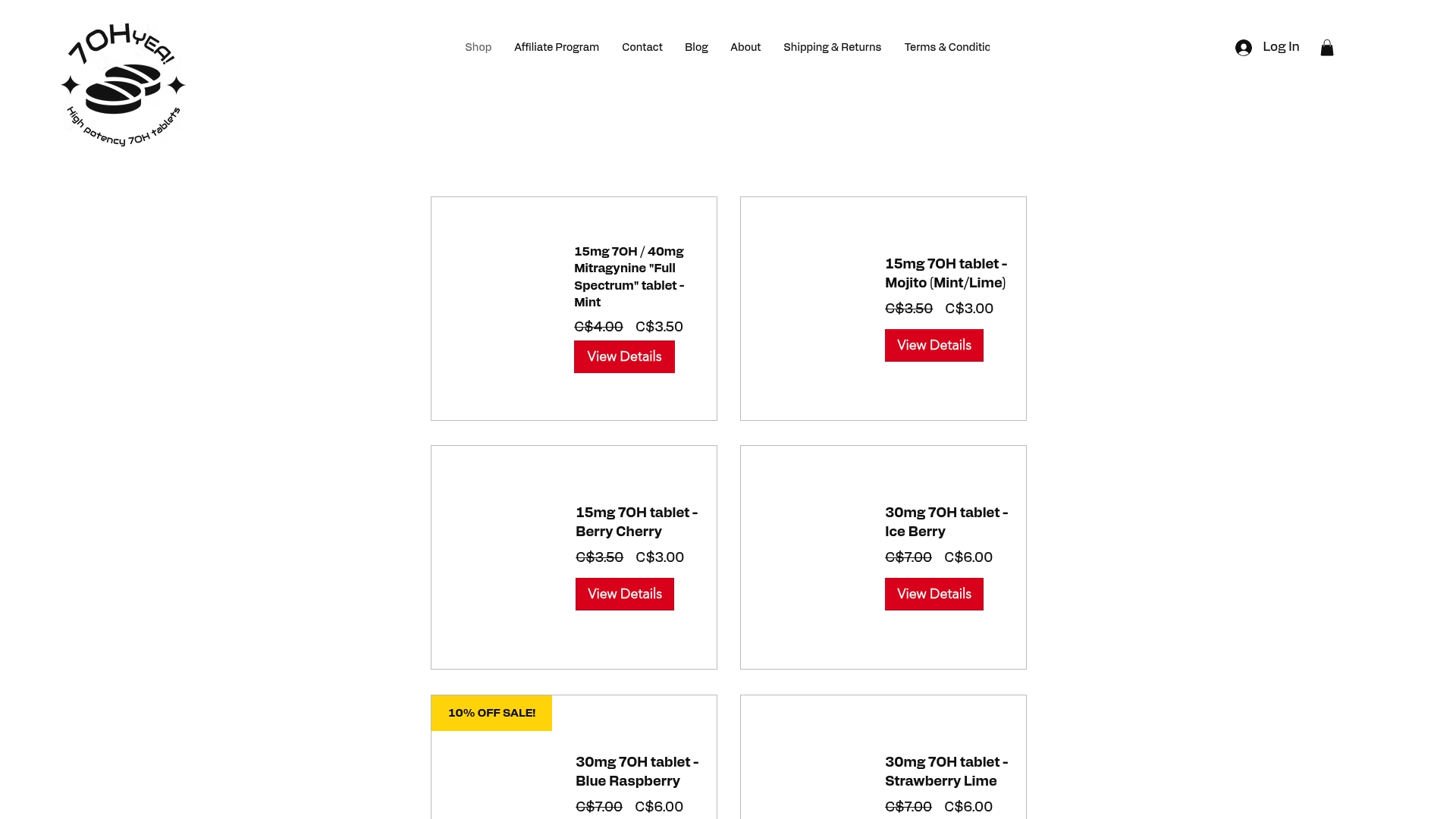
Our catalogue includes:
- 81% pure 7OH powder for labs running their own dilution or formulation protocols.
- 50 mg 7OH tablets and other dosage increments for studies that call for a standardized unit format.
- 99% Pure SR17018 Powder for research teams working with alternative opioid receptor agonists alongside 7-OH.
We can provide raw chromatograms, NMR spectra, and full COAs on request for any batch, and we recommend confirming your institutional and regulatory approvals before placing an order. For a full look at what’s available by purity and format, visit our research-grade product catalogue and reach out with your documentation requirements.
This article is general information, not a substitute for advice from a qualified lawyer. Consult a qualified legal professional about your own circumstances before acting on anything here.
FAQ
What is the difference between mitragynine and 7-OH?
Mitragynine is the primary alkaloid in the kratom plant, while 7-hydroxymitragynine is an oxidized derivative formed at the C-7 position. Our comparison of mitragynine and 7-hydroxymitragynine breaks down the structural and analytical differences researchers typically need to account for.
Can 7-OH be made in a standard analytical lab?
The oxidation chemistry itself, using reagents like PIFA or Oxone, is achievable in a well-equipped synthesis lab, but isolating research-grade material also demands chromatographic purification and orthogonal analytical confirmation. Labs lacking that validated capacity typically find procurement from a COA-backed supplier faster and more reliable.
What analytical methods confirm 7-OH identity and purity?
LC-MS/MS or UPLC-MS/MS with characteristic MRM transitions, cross-checked against authentic reference standards, forms the core of identity confirmation, and Validated UPLC-MS/MS methods report a lower limit of quantitation of 10 ng/mL with intraday and inter-day precision under 15% and accuracy within 96.5–104.0%. NMR spectral comparison against literature values provides a second, independent confirmation layer.
Do Canadian labs need Health Canada approval to produce 7-OH?
Yes. The Controlled Drugs and Substances Act defines “produce” to include synthesis, so a dealer’s licence or formal exemption is generally required before producing or possessing the substance, and Health Canada aims to decide on complete scientific research exemption requests within 70 calendar days.
What should a certificate of analysis for research-grade 7-OH include?
A complete COA lists declared purity by weight, the analytical methods used to establish it, the impurity profile, batch number, production date, and analyst sign-off, with raw chromatograms and spectra retained on file. Our purity levels guide for analytical labs outlines the acceptance thresholds labs commonly apply when reviewing a COA.
Sources
- Canada
- Controlled Drugs and Substances Act - Justice Laws Website
- 7‑Hydroxymitragynine Is an Active Metabolite of Mitragynine and a Key Mediator of Its Analgesic Effects
- Asymmetric total syntheses of mitragynine, speciogynine, and 7‑hydroxymitragynine
- Development and validation of a UPLC‑MS/MS method for the determination of 7‑hydroxymitragynine in rat plasma