Research-grade 7-hydroxymitragynine (7OH) is available in Canada as precisely calibrated tablets, giving laboratory teams the dosing control their protocols demand. 7ohyea offers three standard tablet strengths: 15mg, 30mg, and 50mg of pure 7OH alkaloid per tablet, each formulated to meet research-grade purity standards and verified through third-party Certificates of Analysis. These tablet strengths align with the quantities preferred in laboratory research, as products are available in 15mg, 30mg, and 50mg options. These are not bulk powder approximations. Each tablet delivers a defined quantity of isolated alkaloid, making them the preferred format for studies where reproducibility is non-negotiable.
For researchers building or refining analytical workflows, the key advantages of calibrated tablet forms are straightforward:
Defined alkaloid concentration per unit: Each tablet contains a stated milligram quantity of pure 7OH isolate, not a percentage of a plant extract.
Third-party lab verification: Batch Certificates of Analysis confirm purity and content uniformity before products ship.
Multiple strength options: 15mg tablets suit lower-dose titration studies; 30mg tablets cover mid-range protocols; 50mg tablets support higher-concentration analytical work.
Domestic sourcing: Products are manufactured and quality-tested in British Columbia, reducing transit variability and supporting faster delivery to Canadian labs.
Research-only designation: All formulations are labeled and sold strictly for analytical and laboratory use, not for human consumption.
7ohyea’s catalog also includes 77% and 93% pure 7OH powders for teams that need to prepare their own dosage forms or reference standards. Whether your protocol calls for a fixed tablet or a weighed powder aliquot, the starting material carries documented purity.
How calibrated dosage forms and purity standards are achieved
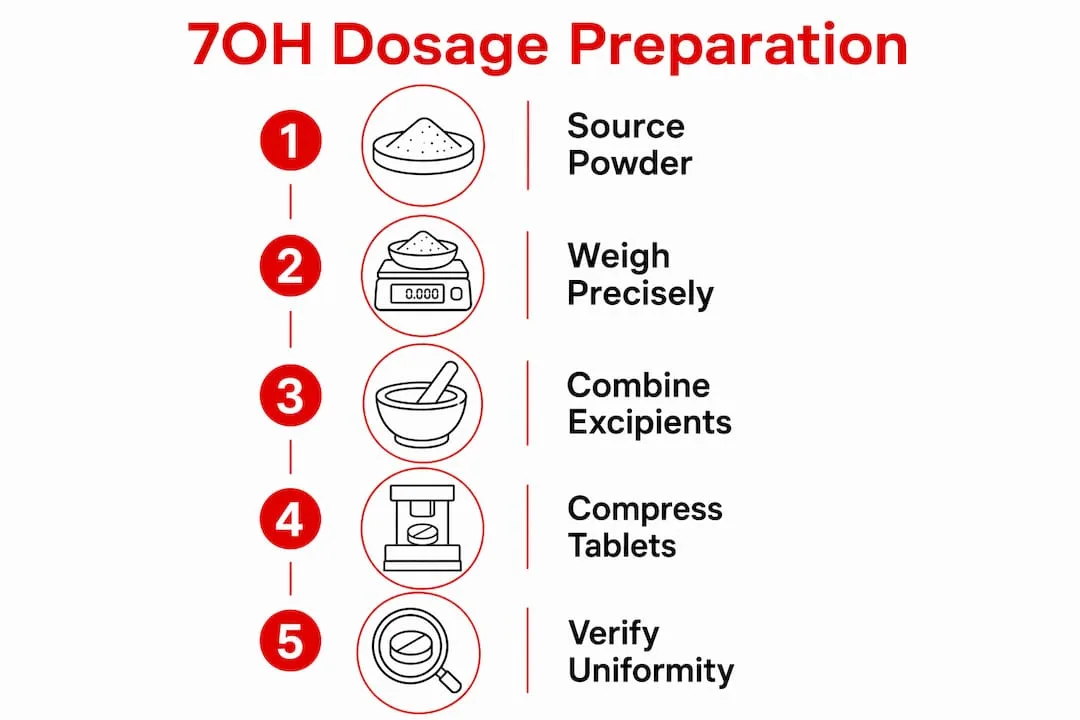
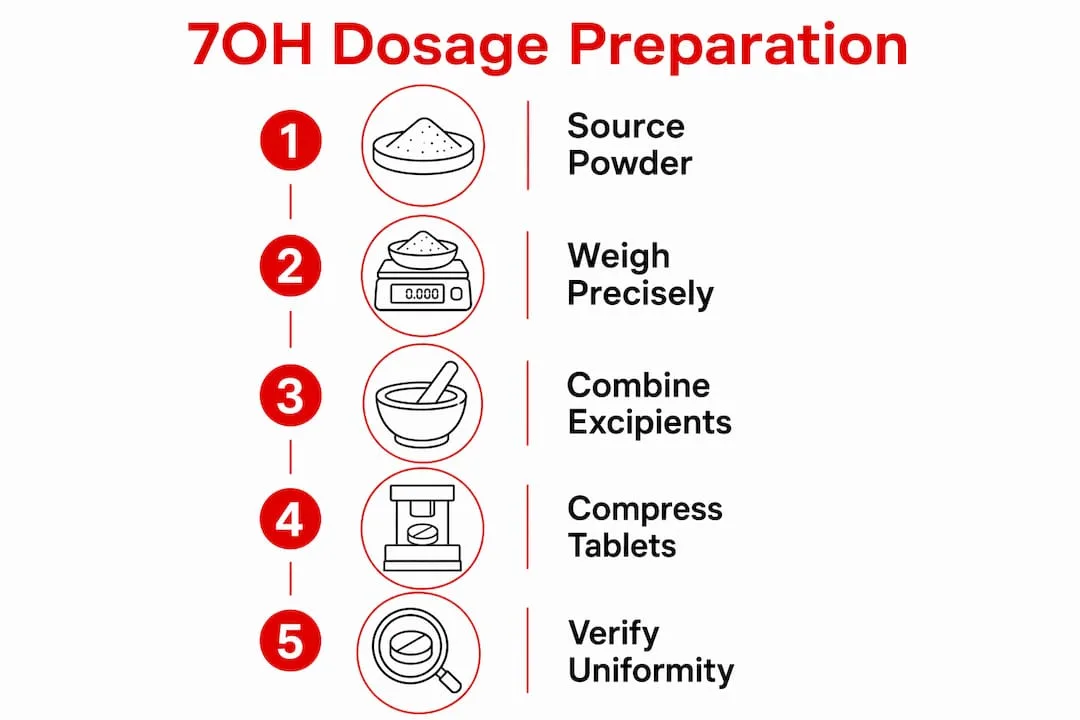
Producing a tablet that reliably delivers 15mg or 30mg of a potent isolated alkaloid is a manufacturing challenge, not just a formulation one. The process begins with API microdispensing, where a precise quantity of active pharmaceutical ingredient is deposited onto or into a tablet base, with inline drop-counting controls providing real-time confirmation of each unit dose. This approach, demonstrated for narrow therapeutic index drugs including warfarin, meets content uniformity requirements as specified by the U.S. Pharmacopeia.
For 7OH tablets specifically, high-purity 7OH isolate is combined with excipients such as microcrystalline cellulose, which act as binders and fillers to stabilize the alkaloid and allow consistent compression. Critical material attributes including particle size and flowability are controlled during manufacturing to produce uniform tablets with predictable disintegration behavior. The result is a tablet where the stated dose is the actual dose, not an estimate.
The table below shows the standard tablet strengths available through 7ohyea—15mg, 30mg, and 50mg per tablet—alongside their primary research applications:
Tablet Strength | Pure 7OH per Tablet | Typical Research Application |
15mg | 15mg isolated alkaloid | Low-dose titration, baseline studies |
30mg | 30mg isolated alkaloid | Mid-range analytical protocols |
50mg | 50mg isolated alkaloid | Higher-concentration dose studies |
Content uniformity is the metric that separates research-grade tablets from consumer-grade products. A batch that passes U.S. Pharmacopeia content uniformity testing confirms that each tablet in the lot falls within an acceptable deviation range from the stated dose, which is the standard 7ohyea applies to its production batches.
Pro Tip:When selecting between tablet strengths, consider that 7OH is an isolated alkaloid with no entourage effect from other plant compounds. Its potency per milligram is substantially higher than that of unrefined kratom powder, so even a 15mg tablet represents a concentrated dose. Build your protocol around the lowest strength that satisfies your analytical requirements, then scale up only with documented justification.
Where Canadian research teams source reliable 7OH products
Domestic sourcing from British Columbia gives 7ohyea a logistical advantage that matters in practice. Shipments stay within Canada’s regulatory environment from manufacture to delivery, avoiding the customs delays and documentation complications that accompany cross-border research chemical imports. For labs working on time-sensitive protocols, that reliability is a real operational factor.
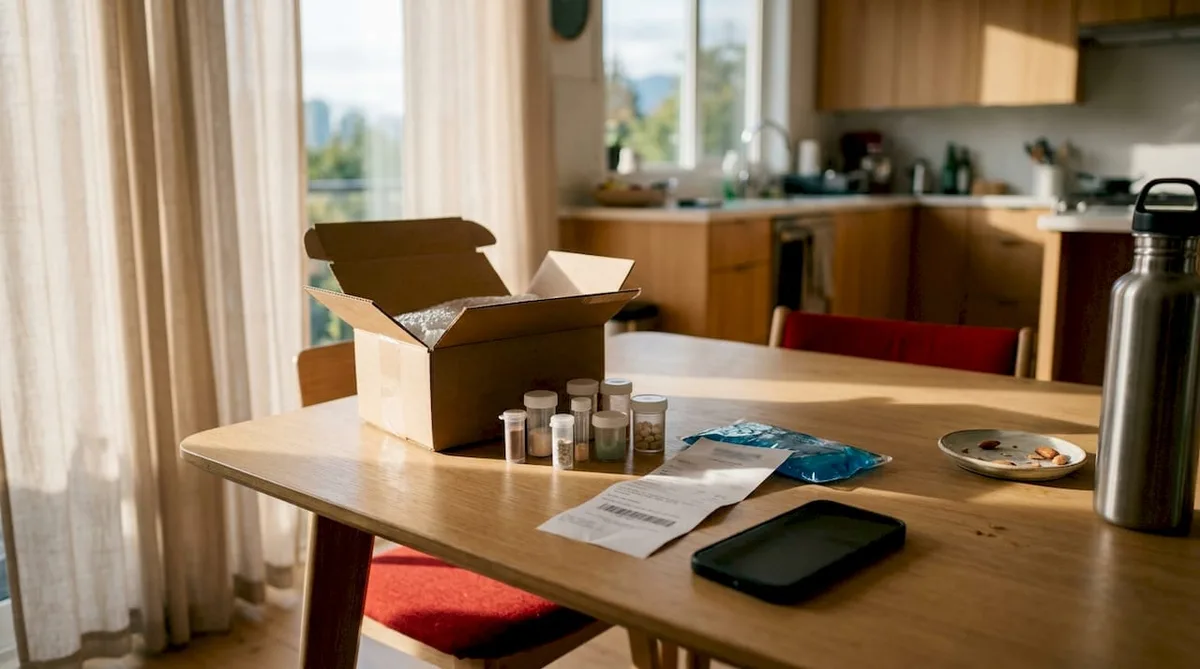
Every batch that leaves the facility carries documentation of its quality testing. Batch testing for consistency covers purity, alkaloid concentration, and physical tablet attributes, with results available to purchasing researchers on request. This traceability supports the chain-of-custody records that many institutional review processes require.
Key attributes to look for when evaluating any supplier of research-grade 7OH in Canada:
Purity certification: Third-party Certificates of Analysis with named testing laboratories, not self-reported figures.
Dosage variety: Multiple tablet strengths (15mg, 30mg, 50mg) and powder purity grades (77%, 83%, 93%) to match diverse protocol requirements.
Domestic manufacturing: BC-based production reduces transit risk and supports faster restocking for ongoing studies.
Research-only labeling: Clear designation that products are for analytical use only, which is a compliance requirement, not a marketing choice.
Responsive support: Direct access to product documentation and technical details for researchers managing institutional procurement.
7ohyea also carries 43% pure Mitragynine Full Spectrum powder and a 100mg Mitragynine tablet for teams conducting comparative alkaloid studies alongside 7OH work. Having reference materials from the same supplier and the same quality framework simplifies cross-study comparisons.
Integrating consistent 7OH dosages into laboratory workflows
Reproducibility in analytical research depends on more than selecting the right tablet strength. It requires a documented workflow from receipt of materials through to data recording, with each step designed to minimize variability. Standardized 15mg and 30mg tablets reduce one major source of error at the outset, but storage, handling, and verification procedures determine whether that precision carries through to your results.
Storage conditions that protect dosage integrity
7OH tablets should be stored in a cool, dry environment with controlled humidity and temperature. Exposure to moisture or heat can degrade the alkaloid, altering the effective concentration and compromising the reliability of any data generated from affected batches. Sealed, airtight containers stored at room temperature away from direct light represent the minimum standard; refrigerated storage is appropriate for long-term archiving of reference samples.
Verifying dosage accuracy before use
For studies where dosage accuracy is critical, gravimetric verification of tablet weight against the manufacturer’s stated specification provides a rapid first-pass check. Tablets that fall outside the expected weight range warrant further investigation before use. For higher-stakes analytical work, dissolution testing or HPLC quantification of the alkaloid content against a certified reference standard gives direct confirmation of the stated dose.
Safety and risk management when handling 7OH
7OH is a potent isolated alkaloid, and its concentration demands the same handling precautions applied to other high-potency research compounds. Standard laboratory PPE including gloves and eye protection applies during any manipulation of tablets or powders. Avoid generating dust from powder forms, and work in a ventilated space when handling bulk quantities.
Best practices for reproducible dosing across repeated experiments:
Document lot numbers and Certificate of Analysis reference codes for every batch used in a study.
Store working stock separately from archive samples to prevent cross-contamination.
Use calibrated analytical balances for any gravimetric verification; do not rely on visual tablet inspection alone.
Record storage conditions alongside experimental data so that any degradation-related anomalies can be traced.
Dispose of unused materials according to your institution’s research chemical waste protocols.
Pro Tip:Maintain a chain-of-custody log that records who received each batch, when it was opened, how it was stored, and when it was consumed or disposed of. Institutional audits and publication peer review increasingly scrutinize material provenance, and a complete log protects both your data and your lab’s compliance standing. Standardized 15mg and 30mg 7OH tablets are preferred options for reducing dosing variability in complex study protocols.
Legal and regulatory considerations for research-grade 7OH in Canada
The legal status of 7-hydroxymitragynine in Canada places it in a category that permits acquisition and use for analytical and laboratory research, provided that use is strictly non-consumptive. Canadian regulatory frameworks require that research-grade 7OH be labeled, documented, and handled in ways that clearly distinguish it from consumer products. This is not a technicality. It is the condition under which research-grade sourcing is permissible, and it shapes every aspect of how 7ohyea structures its sales and documentation.
Researchers acquiring 7OH for institutional studies should be aware of the following compliance requirements:
Research-only designation: Products must be used solely for analytical, laboratory, or scientific purposes. Human consumption is explicitly excluded and constitutes a violation of the terms under which research-grade materials are sold.
Documentation at acquisition: Purchase records, Certificates of Analysis, and supplier documentation should be retained as part of the lab’s material records. Many institutions require these for internal compliance audits.
Licensing considerations: Depending on your institution’s classification of research chemicals, additional internal approvals or ethics board notifications may apply before acquiring 7OH for a new study.
Labeling compliance: All 7ohyea products carry clear research-use-only labeling, which satisfies the basic documentation requirement at the point of receipt.
Risk management alignment: Handling protocols should align with your institution’s chemical safety guidelines, treating 7OH as a high-potency compound regardless of its regulatory classification.
The FDA has published assessments of 7-hydroxymitragynine’s pharmacological profile and toxicological concerns, and Canadian researchers working in contexts that intersect with federal health policy should review that literature as part of their protocol development. The regulatory picture continues to evolve, and staying current with Health Canada guidance on research chemicals is part of responsible institutional practice.
Advanced insights on customizing 7OH doses for analytical research
Custom 7OH dosage design draws directly from the methods developed for narrow therapeutic index drugs, where a small deviation from the target dose produces a measurable change in outcome. Precision manufacturing research has demonstrated that personalized tablet doses of 1mg and 2mg warfarin can be produced with content uniformity meeting U.S. Pharmacopeia standards using API microdispensing and inline feedback controls. The same principles apply when formulating 7OH tablets at 15mg, 30mg, or 50mg: the manufacturing workflow must control for particle size, flowability, and compression force to achieve consistent results across a production run.
The shift from bulk powder to isolate tablets is not just a convenience choice. Isolate tablets eliminate the batch-to-batch alkaloid variability inherent in unrefined plant material, giving researchers a starting point with documented purity rather than an estimated concentration. That distinction matters most in studies where dose-response relationships are the primary variable.
Emerging ultra-compact tablet press technology enables on-demand production of tablets with customized dose strengths, controlling hardness, friability, and disintegration time while achieving precise dosing at the point of care. This capability, demonstrated in pharmaceutical research, opens the door to real-time dose adjustments and tapered regimens that would previously have required a compounding pharmacy.
Key benefits of customizable dosing for research applications:
Tailored dose increments: Studies requiring titration or tapering protocols benefit from access to multiple fixed strengths rather than relying on tablet splitting, which introduces dosing error.
Reduced inter-experiment variability: Consistent tablet composition across batches means that differences in outcomes can be attributed to experimental variables, not material inconsistency.
Scalable quantity: Bulk purchasing options from 7ohyea allow research teams to secure sufficient material from a single lot, eliminating mid-study batch changes.
Formulation flexibility: For teams that need a strength not covered by standard tablets, 7ohyea’s high-purity powders (77%, 83%, and 93% pure) provide the starting material for custom formulation work.
Protocol-specific customization: Whether a study calls for a single fixed dose or a graduated series, having access to multiple calibrated strengths from one supplier simplifies protocol design.
The parallel to pharmaceutical-grade manufacturing is deliberate. Research that produces publishable, reproducible data requires materials held to the same standard as the drugs those studies inform.
The future of 7OH research and custom dosing in Canada
Canadian research interest in precisely dosed alkaloid formulations is growing, and the infrastructure to support it is developing in step. Advances in microdispensing technology and real-time dose verification are moving from pharmaceutical manufacturing into research laboratory settings, making on-demand production of custom tablet strengths increasingly practical for institutional labs. What currently requires a specialized supplier relationship may, within a few years, be achievable with compact equipment operating within the lab itself.
Regulatory evolution will shape how quickly that transition happens. Health Canada’s approach to research chemicals has historically followed international precedents, and as other jurisdictions develop clearer frameworks for research-grade alkaloid materials, Canadian policy is likely to align. Researchers who build rigorous documentation practices now, including material traceability, handling logs, and compliance records, will be better positioned to operate under any updated framework.
The benefits that future innovations will deliver for 7OH research specifically:
Expanded dose range options: Manufacturers will likely offer a wider range of fixed tablet strengths, reducing the need for powder-based custom formulation.
Real-time dose verification: Inline analytical tools integrated into tablet production will provide per-unit confirmation of alkaloid content, raising the bar for what “research-grade” means in practice.
Improved stability formulations: Advances in excipient science will extend shelf life and reduce sensitivity to storage conditions, making long-term studies more reliable.
Standardized reference materials: Greater availability of certified 7OH reference standards will support inter-laboratory comparisons and publication-quality data.
Broader institutional adoption: As documentation and compliance frameworks mature, more Canadian universities and contract research organizations will incorporate standardized 7OH formulations into their alkaloid research programs.
7ohyea’s current catalog, anchored by its BC-sourced, lab-tested tablets and powders, positions it well for this trajectory. The combination of domestic manufacturing, multiple purity grades, and research-only positioning aligns with where the field is heading.
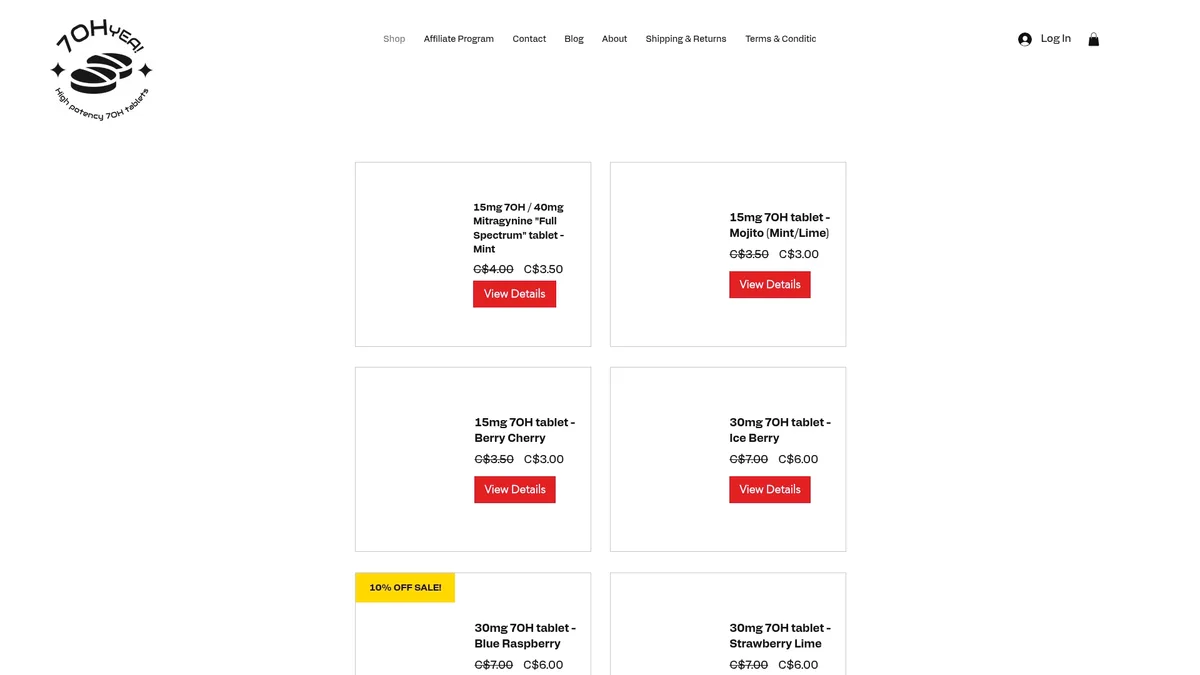
7ohyea offers the full range of calibrated 7OH tablet strengths and high-purity powders for Canadian research teams, all backed by third-party Certificates of Analysis and shipped domestically from British Columbia. Whether your protocol calls for a 30mg tablet or a bulk powder for custom formulation, the catalog covers the most common research requirements. Visit 7ohyea.ca to review current product availability, request documentation, or place an order for your lab.
Key Takeaways
Calibrated 7OH tablet strengths from a domestically sourced, third-party-tested Canadian supplier give research teams the dosing precision, traceability, and regulatory alignment their protocols require.
Point | Details |
Standard tablet strengths | 7ohyea offers 15mg, 30mg, and 50mg tablets of pure 7OH isolate for research use, matching the preferred quantity options in laboratory research. |
Purity verification | Every batch carries a Certificate of Analysis from third-party laboratories confirming alkaloid concentration. |
Domestic sourcing advantage | BC-based manufacturing keeps products within Canada’s regulatory framework and supports faster lab delivery. |
Storage and handling | Controlled humidity and temperature storage preserves tablet potency; chain-of-custody logs protect data integrity. |
Legal compliance | Research-grade 7OH in Canada is permitted for analytical use only; documentation and research-only labeling are required at acquisition. |