
What is reference material traceability, and why does it matter?
Metrological traceability is the property of a measurement result whereby it can be related to a reference through a documented, unbroken chain of calibrations, each contributing to measurement uncertainty. That definition, drawn from the International Vocabulary of Metrology (VIM/JCGM 200:2012), is the foundation every Canadian laboratory must build on in 2026.
The practical consequence is direct: a result without a traceable chain is scientifically indefensible, regardless of how carefully the measurement was performed. Accreditation bodies, regulators, and clients all require that your results connect, link by link, to SI units or recognized national standards.
Key entities shaping this requirement in Canada include:
VIM/JCGM 200:2012 — the globally accepted vocabulary defining metrological traceability
ISO Guide 35:2006 — the foundational standard for certified reference material (CRM) production and certification
ISO 17034 and ISO/IEC 17025 — quality system standards required of Canadian reference material producers
Standards Council of Canada (SCC) Reference Material Producers Accreditation Program — the national accreditation framework for CRM producers
Reactor Materials Testing Laboratory (RMTL) — a Canadian association supporting reference material production and traceability efforts
SI units — the ultimate anchor for most traceability chains in analytical chemistry
Without these anchors, comparability across laboratories, time periods, and borders collapses.
How ISO Guide 35:2006 governs certified reference material certification
ISO Guide 35:2006 sets the procedural and statistical principles that govern how CRMs are produced, characterized, and certified. It is the document that transforms a well-made material into a scientifically defensible reference standard.
The guide’s core principles cover:
Homogeneity assessment — verifying that property values are uniform across all units of a batch, so every vial or portion delivers the same certified value
Stability assessment — demonstrating that the material’s properties remain within defined limits over time and under specified storage conditions
Characterization methods — requiring the use of validated, fit-for-purpose measurement procedures with documented uncertainty contributions
Statistical evaluation — mandating rigorous statistical treatment of characterization data, including analysis of variance and uncertainty propagation
Traceability statements on certificates — CRM certificates must carry explicit traceability chains, sources of uncertainty, and measurement procedures
A CRM certified under ISO Guide 35 gives your laboratory a defensible starting point for its own traceability claims. The certificate is not just documentation; it is the first link in the chain you are responsible for extending to your own results.
How does the SCC accreditation program work for Canadian producers?
Canadian reference material producers must satisfy a structured accreditation framework before their CRMs carry recognized authority. The Standards Council of Canada administers the Reference Material Producers Accreditation Program, which assesses conformance to ISO 17034 and ISO/IEC 17025.
The accreditation process follows three stages:
Application and documentation review — the producer submits quality system documentation, traceability plans, and uncertainty budgets for initial assessment
On-site assessment — SCC assessors evaluate laboratory competence, equipment calibration records, and the completeness of calibration chains
Ongoing surveillance — periodic reassessments confirm that quality systems remain effective and that new batches continue to meet accreditation criteria
Producers must demonstrate that their quality systems address traceability documentation, measurement uncertainty adherence, and batch consistency for every material they certify. Accreditation is not a one-time achievement; it requires continuous evidence that each production run maintains the same standard.
For Canadian laboratories purchasing CRMs, SCC accreditation of the producer is one of the clearest signals that the material’s traceability claims are independently verified rather than self-declared.

How to establish and maintain traceability chains in your laboratory
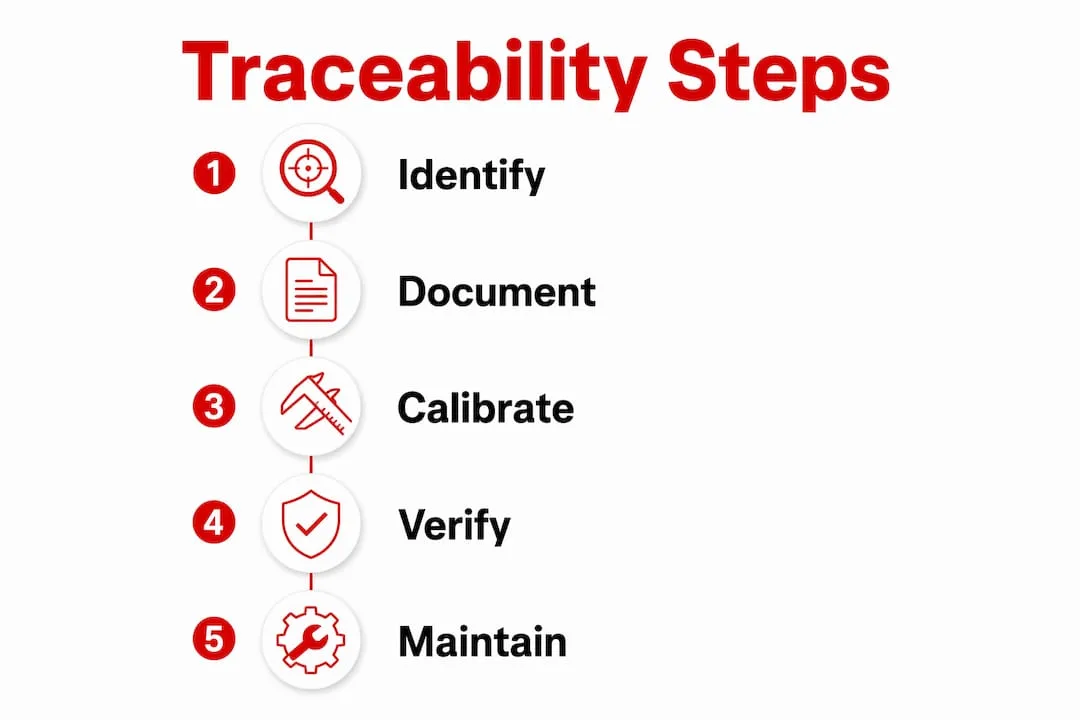
Establishing traceability is a laboratory responsibility, not something a CRM certificate accomplishes automatically. Merely using a calibrated instrument is insufficient; the full measurement system and every link in the calibration chain must be documented, with uncertainty evaluated at each step.
Practical implementation requires attention to several interconnected areas:
Calibration chain documentation — record every link from your working standard back to the CRM, and from the CRM to its stated reference (SI unit or recognized national standard), including dates, methods, and personnel
Uncertainty budgets — propagate uncertainty contributions from each calibration step through to the final result; a chain with undocumented uncertainty gaps fails audit scrutiny
Batch consistency verification — confirm that each new lot of a CRM delivers property values consistent with the certificate before it enters routine use; matrix effects and concentration range must be considered
Commutability assessment — reference materials must behave like actual samples to prevent systematic bias; a material traceable to primary standards can still introduce error if it does not commute with your sample matrix
Chain-of-custody records — document storage conditions, expiry dates, and handling history for every reference standard in your inventory
Traceability statements on calibration certificates — calibration certificates must identify all standards used, associated uncertainties, and calibration dates, fulfilling ISO/IEC 17025 requirements
CRM certificate review — verify that the traceability chain documentation on each CRM certificate includes references used, measurement procedures, and uncertainty sources as required by ISO/TR 16476:2016
Traceability to non-SI units or conventional scales adds a layer of complexity. Conversion factors and their associated uncertainties must appear explicitly in the CRM certificate and in your own documentation.
Pro Tip:Compile a single traceability dossier for each measurand your laboratory reports, linking the working calibrant to the CRM certificate, the CRM to its national or international reference, and every uncertainty contribution in between. Auditors increasingly expect this end-to-end demonstration rather than a collection of individual calibration certificates. Canadian labs pursuing SCC accreditation find that a pre-assembled dossier cuts assessment time considerably.
Which Canadian organizations support reference material traceability?
Canada has a network of bodies and resources that laboratory professionals can draw on to meet traceability requirements, from accreditation support to technical guidance.
Standards Council of Canada (SCC) Reference Material Producers Program — administers accreditation for Canadian CRM producers, publishes program requirements, and provides assessor contact information for laboratories seeking producer verification
Reactor Materials Testing Laboratory (RMTL) — a Canadian association that supports reference material production and traceability efforts, providing resources and networking opportunities for quality professionals across the country
National Research Council of Canada (NRC) — produces and certifies reference materials for Canadian laboratories, offering CRMs with documented traceability to SI units and supporting inter-laboratory comparisons
Eurachem guides — internationally recognized guidance documents on traceability in chemical measurement and reference material selection, widely used by Canadian accreditation assessors and laboratory quality managers
ISO 33403:2024 and ISO 33405:2024 — the current ISO standards governing reference material use and characterization, replacing earlier guides and directly applicable to Canadian laboratory practice in 2026
NIST Standard Reference Materials (SRMs) — available to Canadian laboratories as higher-order calibration materials when domestic equivalents are unavailable, with certified values traceable to SI units
Canadian Association for Laboratory Accreditation (CALA) and SCC — both bodies assess laboratory competence under ISO/IEC 17025, with traceability documentation forming a central element of every assessment
Staying connected to this network gives your laboratory early access to updated guidance, proficiency testing opportunities, and peer review that strengthens your traceability program over time. The 7ohyea blog also covers evolving traceability standards affecting reference material use in Canadian analytical laboratories, particularly for alkaloid and research-grade materials.
Key Takeaways
Metrological traceability requires a documented, unbroken calibration chain from every measurement result back to SI units or recognized standards, with uncertainty evaluated at each link.
Point | Details |
Traceability is a result property | The measurement result must be traceable, not just the instrument or the certificate. |
ISO Guide 35 governs CRM certification | Homogeneity, stability, characterization, and uncertainty statements are all mandatory on CRM certificates. |
SCC accreditation signals verified quality | Canadian producers assessed under ISO 17034 and ISO/IEC 17025 provide independently verified traceability claims. |
Commutability affects real-world accuracy | A CRM traceable to primary standards can still introduce bias if it does not behave like your actual sample matrix. |
Audit-ready dossiers reduce assessment risk | Compiling end-to-end traceability documentation per measurand satisfies SCC and ISO/IEC 17025 auditor expectations. |
7ohyea: research-grade reference materials sourced in Canada
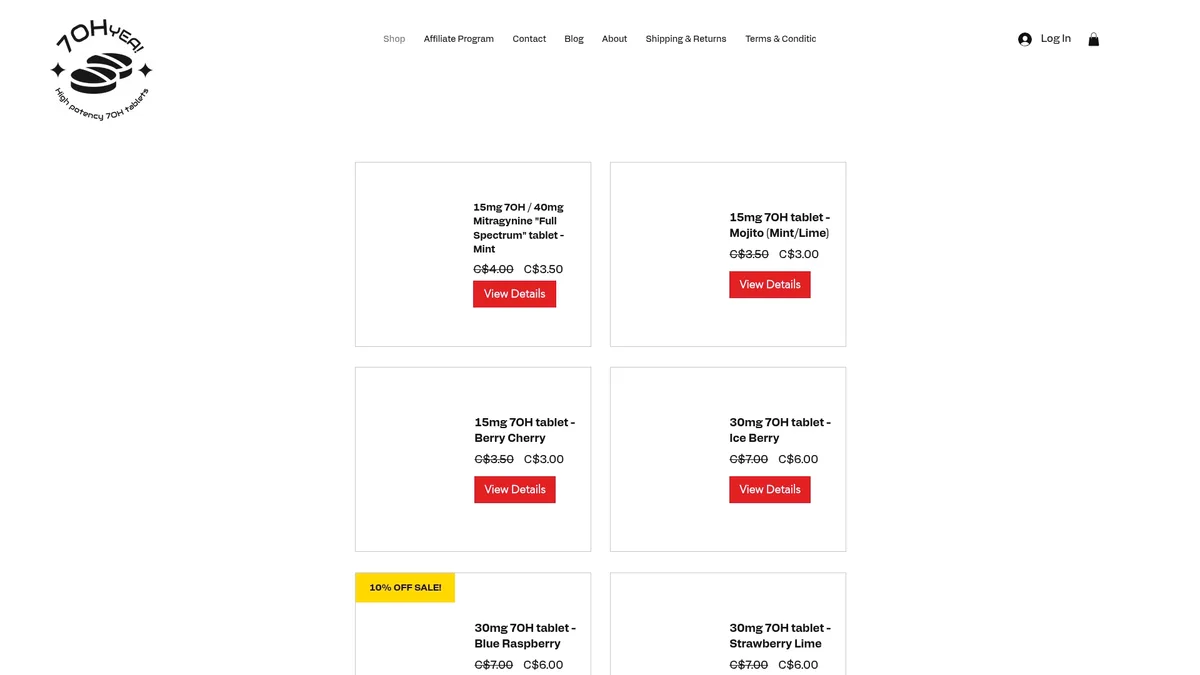
For laboratories requiring consistent, well-characterized alkaloid reference materials, 7ohyea supplies research-grade 7-hydroxymitragynine (7OH) tablets and powders manufactured in British Columbia. Each formulation is produced with documented purity specifications, supporting the traceability and quality control requirements that Canadian analytical laboratories depend on. Dosage options at 15mg, 30mg, and 50mg accommodate diverse research protocols, and all materials are intended strictly for analytical and laboratory use, not for human consumption. Fast domestic shipping and Certificates of Analysis support your chain-of-custody and audit documentation directly. Visit 7ohyea to review current product specifications and place an order.