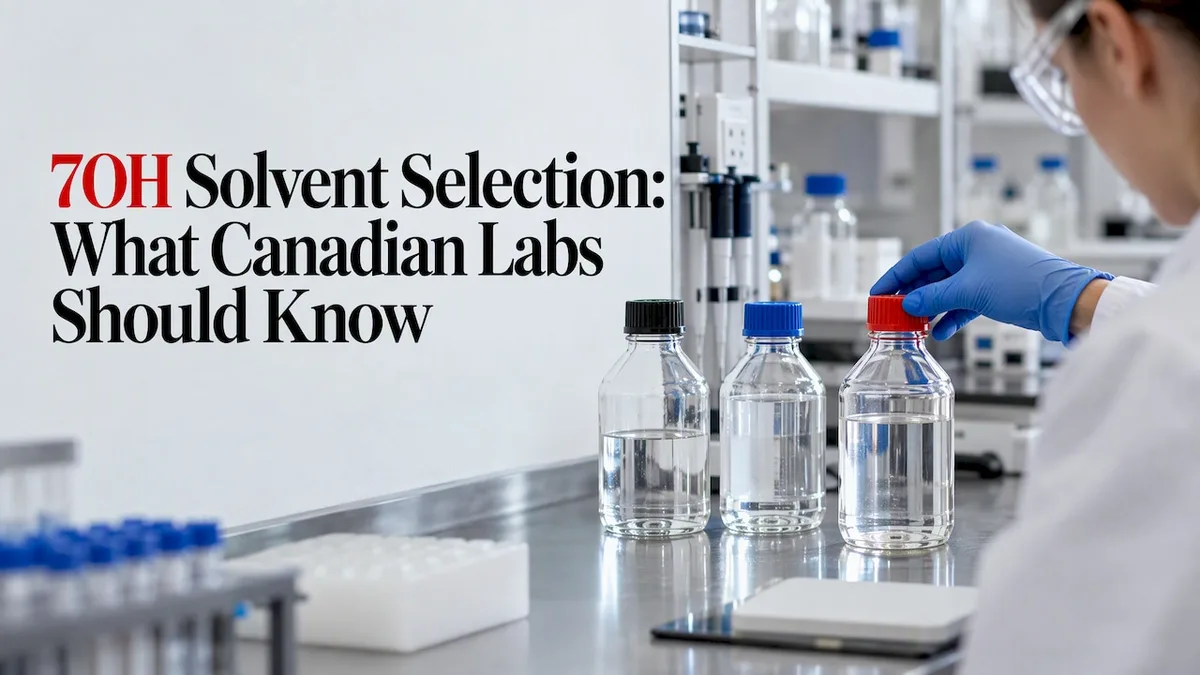
7OH Solvent Selection: What Canadian Labs Should Know

The U.S. Drug Enforcement Administration said on July 1, 2026 that it intends to temporarily place 7-hydroxymitragynine (7-OH) and three related substances in Schedule I. Suddenly everyone’s asking how this molecule is handled, tested and written up. The unglamorous answer starts with a question most headlines skip: which solvent do you dissolve it in before you measure anything?
That choice decides whether an analytical result is real or an artifact. Here’s what’s been announced, what the science debate looks like, and what it means for Canadian labs. Our products are for research use only, not for human consumption.
7ohyea7ohyea.caSupport Reliable 7OH Analysis7OH Canada provides research-grade 7OH tablets and powders for analytical purposes, with customizable dosage options for diverse research protocols.
Explore research materialsTL;DR
- Solvent choice in 7OH analysis is about stability and clean data, not convenience. 7-OH was the least stable alkaloid in a major 2023 review.
- Strong acid, strong base and heat are the usual culprits behind misleading results.
- Residual solvents are a separate quality question, governed by ICH Q3C guidance that Health Canada publishes.
- Canadian labs also owe solvent waste and labelling rules their attention, not just the chromatograph.
- Regulation is moving fast in the U.S. Nothing here is legal advice.
Table of Contents
- Quick facts
- Why is everyone suddenly talking about 7OH?
- What did the headlines get wrong?
- What does solvent selection actually mean?
- Why is 7-OH a fussy molecule?
- Methanol, ethanol or acetonitrile?
- Do online forum tips count as evidence?
- What are residual solvents, and who sets the limits?
- Is the solvent a Canadian safety and paperwork problem too?
- What’s the Canadian legal picture?
- What does this mean for readers?
- Perspective: why we treat solvent choice as a quality issue
- Where can Canadian labs source reference material?
- FAQ
- So who’s really responsible for getting the number right?
- Sources
Quick facts
| Item | Where it stands |
|---|---|
| Product use | Research use only, not for human consumption |
| U.S. status | DEA announced intent to temporarily schedule 7-OH above a threshold on July 1, 2026 |
| Canadian context | Health Canada has warned about kratom and its alkaloids since 2020 |
| Key analytical risk | pH and temperature sensitivity of the molecule |
| Residual solvent guidance | ICH Q3C(R9), 2024 |
Why is everyone suddenly talking about 7OH?
Because regulators finally put a number on it. The FDA recommended scheduling concentrated 7-OH products in July 2025, and the DEA followed with its notice of intent in July 2026. The DEA’s own release says the action targets highly concentrated, synthetic 7-OH, and it frames the compounds as having no accepted medical use.
The details have kept shifting. Trackers and secondary outlets disagree on dates and thresholds, and we can’t confirm a final order from the sources we’ve reviewed. Check the Federal Register and the Congressional Research Service summary for the current state of play.
Here’s the part that matters for this article. When a substance is under scrutiny, the numbers attached to it get scrutinized too. A purity figure only means something if the method behind it holds up. And a method only holds up if the solvent doesn’t quietly change the sample.
What did the headlines get wrong?
Most coverage treats 7-OH as one thing. It isn’t. Three misreadings keep popping up.
Myth: 7-OH on a label means 7-OH in the bottle. Fact: a 2026 academic paper that quantified 7-OH in commercial products found inconsistencies between labelled and measured concentrations. It also reported artifacts consistent with semisynthetic origin. That’s a measurement story as much as a regulatory one.
Myth: the DEA is going after kratom leaf. Fact: the notice targets concentrated, synthetic forms above a threshold. HHS and FDA have said they don’t intend to regulate natural leaf that lacks enhanced 7-OH levels. That’s the U.S. position, not a Canadian one.
Myth: a lab result is a lab result. Fact: the same sample can read differently depending on what it sat in, how acidic it was and how warm it got. Which brings us to the solvent.
What does solvent selection actually mean?
It means picking the liquid that dissolves your sample so you can measure it, without changing what you’re measuring. A sample diluent is the solvent used to prepare the sample for injection into a chromatograph, the instrument that separates a mixture into its parts.
Chromatography Online’s guide to sample diluent selection lists what a good diluent does:
- It dissolves the analyte (the thing you’re measuring), plus impurities and degradation products.
- It supports a clean, sharp peak on the chromatogram.
- It doesn’t interfere with the detector response.
- It doesn’t interact with the container surface.
- It doesn’t push the compound to degrade.
That last point is where 7-OH gets interesting.
Why is 7-OH a fussy molecule?
It breaks down more easily than its relatives. In the 2023 review by Citti and colleagues, 7-OH was the least stable alkaloid tested, and all the tested alkaloids were acid-labile at pH 2 and 80 °C. Acid-labile just means acid makes them fall apart. pH is the scale that tells you how acidic or alkaline a liquid is.
The same review warns that strongly acidic or alkaline conditions and high temperatures can compromise analytical results. So a solvent system that’s perfectly fine for a sturdy compound can wreck a delicate one.
We’ve written about the practical side of this in our piece on the 98.7 minute half-life and 7-OH artifact risk. The short version: stability is a variable you control, not a footnote.
Methanol, ethanol or acetonitrile?
There’s no universal winner, and anyone claiming one is selling something. Here’s what the published literature says.
| Solvent | What the sources say | Watch for |
|---|---|---|
| Methanol / ethanol | Alcoholic solvents are commonly used for kratom alkaloids, often at a 10:1 ratio to plant material, per the Citti review | Matching the diluent to the mobile phase so peaks stay sharp |
| Acetonitrile | A 2015 MDPI study reported advantages over methanol in gradient LC-MS/MS: lower back pressure, higher sensitivity, fewer ghost peaks | Cost and disposal, covered below |
| Acidic or alkaline mixtures | Flagged as risky for labile alkaloids | Degradation that looks like a real impurity |
Two plain-language notes. A gradient program changes the solvent mix during a run. LC-MS/MS is a chromatograph paired with a mass spectrometer, which identifies compounds by weight.
The Waters primer on chromatographic solvent requirements adds a general checklist: high purity, detector compatibility, non-reactive, low viscosity. That’s vendor guidance, so treat it as a sensible baseline rather than a 7-OH-specific rule.
For our own solubility figures, see our page on 7OH solubility data for research-grade lab use.
Do online forum tips count as evidence?
No. Search for this topic and you’ll hit forum threads and old extraction posts swapping advice about which solvent is “safest” or “cheaper.” Some are decades old. Anecdotes about a kitchen-table process don’t tell an analytical chemist how a validated method behaves.
One popular thread asks whether a vendor tests for solvents at all. That’s the right instinct. It points at residual solvents, a different question from the diluent.
What are residual solvents, and who sets the limits?
Residual solvents are leftovers from manufacturing that remain in a finished material. They’re not the diluent you pick for analysis. They’re what you test for.
The benchmark is ICH Q3C. The current version, Q3C(R9) from 2024, says residual solvents are typically determined by chromatography such as gas chromatography, and that methods should be validated under the current ICH Q2 guideline. It adds that if only Class 3 solvents are present, properly validated loss on drying may be used instead.
The guideline also says residual solvents give no therapeutic benefit and should be removed as far as practical to meet specifications and good manufacturing practice. Health Canada’s description of Q3C(R5) recommends favouring less toxic Class 3 solvents where practical.
A caveat worth stating plainly: ICH Q3C was written for pharmaceutical products. Research-grade materials aren’t pharmaceuticals, so labs use it as a reference framework, not a legal requirement for these materials.

Is the solvent a Canadian safety and paperwork problem too?
Yes, and it’s the part that gets ignored. Once you’ve chosen a solvent, you own its hazards and its waste.
The University of Western Ontario’s hazardous materials handbook, revised in September 2025, sets out sensible habits that many Canadian labs mirror:
- Split organic solvent waste into halogenated and non-halogenated streams.
- List full chemical names on waste labels. Acronyms and short forms confuse identification.
- Package incompatible chemicals separately.
In Canada, hazard communication runs through WHMIS, the Workplace Hazardous Materials Information System. Health Canada’s technical guidance describes it as the national system that uses labels and Safety Data Sheets to communicate workplace hazards. Your institution’s safety office has the final word on your lab.
It’s a small thing, but acetonitrile versus methanol is also a waste-stream decision. Pick with disposal in mind.
What’s the Canadian legal picture?
Canada first, as it should be. The Controlled Drugs and Substances Act (CDSA) is the federal law that controls substances that alter mental processes and carry potential for harm, except where regulated or exempted. Health Canada’s October 2020 advisory says kratom and its alkaloids have potential for abuse and dependence, and it lists risks including liver toxicity and seizures. Read that advisory yourself.
We haven’t found a Canadian scheduling announcement for 7-OH that mirrors the DEA’s. If one arrives, it’ll be on Health Canada’s pages first. We won’t guess at the outcome.
The U.S. context is second. The FDA’s July 2025 recommendation and the DEA’s July 2026 notice cover concentrated 7-OH products above a threshold. Final orders can differ from notices, so verify with the Federal Register.
None of this is legal advice. If you’re unsure how a rule applies to your lab, ask your institution’s compliance office or a lawyer.

What does this mean for readers?
If you run or supervise analytical work in Canada, three things stand out.
- Treat the solvent as part of the method. Document the diluent, its grade, its pH and the temperature. A result you can’t reproduce isn’t a result.
- Separate two questions. What the sample sits in during analysis is one. What’s left over from manufacturing is the other. They get different tools and different guidance.
- Plan the paperwork. Full chemical names, correct waste streams, current Safety Data Sheets. Regulators and auditors ask about these long before they ask about your chromatogram.
If you’re comparing 7-OH with its parent alkaloid on the bench, our explainer on mitragynine versus 7-hydroxymitragynine for Canadian labs covers the analytical differences. For methods, see laboratory detection methods for 7-hydroxymitragynine in Canada.
Perspective: why we treat solvent choice as a quality issue
We supply research-grade material to laboratories, so we see how often a disputed number traces back to sample handling rather than the material. Our view is blunt: a certificate of analysis is only as good as the method behind it.
That’s why we point buyers to batch-specific certificates of analysis and to our guidance on tablet testing nonnegotiables. It’s also why we think the loudest regulatory headlines are the wrong place to look for quality. The quiet details, such as diluent, pH, temperature and residual solvent screening, decide whether a lab’s data stands up.
We also believe the industry should say out loud what these materials are: for research use only, not for human consumption. We’d rather lose a sale to that clarity than win one without it.
— John
Where can Canadian labs source reference material?
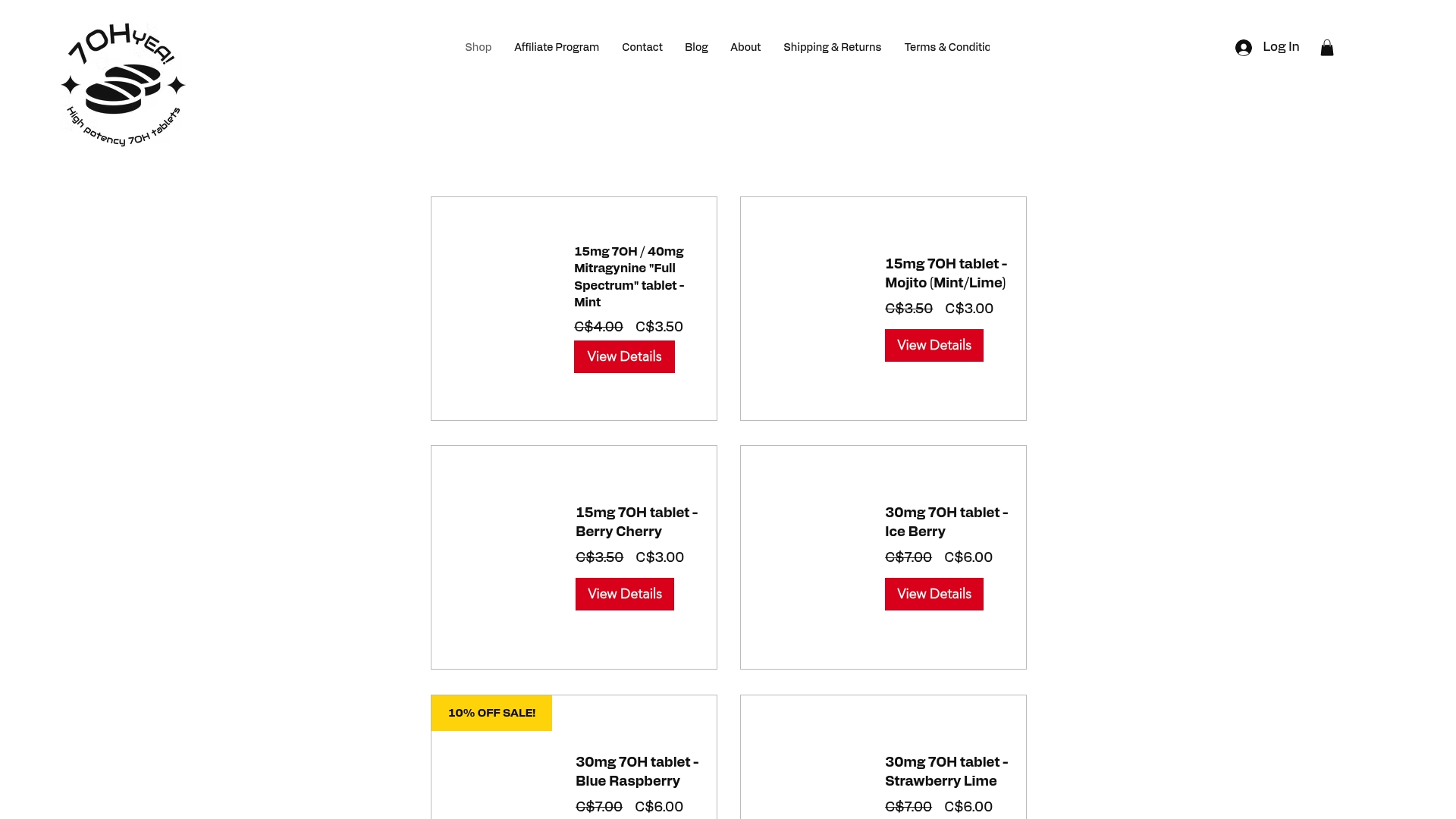
We’re a Canadian supplier of research-grade 7-hydroxymitragynine and related alkaloid reference materials, with batch-specific certificates of analysis and domestic sourcing from British Columbia. Our 81% pure 7OH powder is listed at 50 CAD, one-off, and our full range is on the main site. Everything we sell is for laboratory research only, not for human consumption.
If you’re building a method and want to know about purity grades first, read our guide to 7-hydroxymitragynine purity levels for analytical labs.
FAQ
Which solvent is best for 7OH analysis?
No single solvent wins. The literature favours matching the diluent to your method: it should dissolve the analyte, keep peaks clean and avoid degradation. Alcohols are common in kratom alkaloid work, and acetonitrile has reported advantages in some LC-MS/MS gradients. Validate your own choice.
Why does pH matter so much?
Because 7-OH is delicate. A 2023 review found it was the least stable alkaloid tested, and that acid and heat can compromise results. A shifted pH can create degradation products that look like real impurities.
Do residual solvent limits apply to research chemicals?
ICH Q3C is written for pharmaceuticals, so it isn’t a binding rule for research-grade material. Many labs still use it as a reference. Ask your institution how it wants residual solvents handled.
How should solvent waste be handled in a Canadian lab?
Follow your institution’s hazardous waste program and WHMIS requirements. University handbooks typically separate halogenated from non-halogenated waste, require full chemical names and keep incompatibles apart.
Is 7OH scheduled in Canada?
We haven’t found a Canadian scheduling notice for 7-OH. Health Canada has issued kratom warnings, and the CDSA is the controlling law, so check Health Canada for current status. We can’t give legal advice.
So who’s really responsible for getting the number right?
Regulators set the rules, suppliers provide the material and labs own the method. Where do you think the weak link in 7-OH data is: the supplier, the lab or the headlines? Tell us in the comments and share this with a colleague who’s debating diluents.
Sources
- DEA: temporarily schedule 7-OH and related substances (July 1, 2026)
- Congressional Research Service: Temporary Control of 7-OH
- Quantitative analysis of 7-hydroxymitragynine in commercial products (2026)
- Key Factors in Sample Diluent Selection for HPLC Assays
- Kratom: The analytical challenge of an emerging herbal drug (2023)
- Screening and Identification of Mitragynine and Metabolites (MDPI, 2015)
- Waters: Alternative Method Development Techniques
- ICH Q3C(R9) Guideline (2024)
- Health Canada: ICH Q3C(R5) description
- UWO Hazardous Materials and Waste Management Handbook
- Health Canada: WHMIS technical guidance
- Health Canada: list of acts and regulations
- Health Canada: unauthorized products advisory (October 2020)
7ohyeaAsk About 7OH Research MaterialsEmail us with questions about research-grade 7OH tablets and powders, customizable dosage options, or domestic sourcing from British Columbia.77ohyea
Email us7ohyea@gmail.com