Tablet Calibration Standards: What Canadian Labs Need Now

The U.S. Drug Enforcement Administration said on July 1, 2026 that it intends to temporarily place 7-hydroxymitragynine (7-OH) in Schedule I, along with three related kratom-derived substances. That’s why analytical labs are suddenly talking about paperwork. When a compound lands in the headlines, the first question isn’t about the compound. It’s whether your measurements, your standards and your records can survive a hard look.
So here’s the plain answer to “tablet calibration standards”: they’re the documented reference points a lab uses to prove its instrument reads a tablet correctly. This article explains what they are, which Canadian bodies set the bar, and what your records need to show. Everything we sell is for research use only, not for human consumption.
7ohyea7ohyea.caSupport Your 7-OH Research7OH Canada supplies research-grade 7-hydroxymitragynine tablets and powders for analytical purposes, sourced domestically from British Columbia.
Explore research materialsTL;DR
- A calibration standard is a sample with a known amount of the target compound, used to build the curve that turns instrument signals into numbers.
- In Canada, the benchmark for calibration and testing labs is ISO/IEC 17025, and accreditation runs through the Standards Council of Canada (SCC).
- A certified reference material (CRM) carries certified values, stated uncertainty and traceability. A plain reference material may not.
- A calibration certificate is only valid on the day it was issued, so recalibration records matter as much as the certificate.
- None of this is legal advice, and we aren’t predicting what regulators will do next.
Table of Contents
- Quick facts
- Why is everyone talking about 7-OH again?
- What did the headlines get wrong?
- What actually is a calibration standard?
- Is a reference material the same as a certified one?
- Which standards govern calibration in Canada?
- How do you build a calibration curve that holds up?
- What records should be sitting in the binder?
- What does this mean for readers?
- Where does uniformity fit in?
- Perspective: why paperwork is the product
- Looking for research-grade materials with documentation?
- FAQ
- Sources
Quick facts
| Question | Short answer |
|---|---|
| What’s the news? | The DEA announced on July 1, 2026 its intent to temporarily schedule 7-OH in the U.S. (CRS update dated October 26, 2026) |
| What’s the key Canadian standard? | ISO/IEC 17025 for testing and calibration labs |
| Who accredits labs in Canada? | The Standards Council of Canada |
| Who issues Canadian CRMs? | The National Research Council of Canada (NRC) |
| Are our products for people? | No. Research use only, not for human consumption |
Why is everyone talking about 7-OH again?
Because the U.S. just moved from talk to a formal notice. According to the Congressional Research Service, the DEA planned to adopt a recommendation from the Department of Health and Human Services. The CRS summary says it would apply above a concentration threshold, so the definition of what counts is itself a measurement question.
That’s the part headlines skipped. A rule written around a concentration limit depends on someone, somewhere, measuring that concentration correctly.
This didn’t come out of nowhere. On July 29, 2025, the FDA recommended that the DEA classify 7-OH as a Schedule I controlled substance, according to a law firm’s briefing on the joint press conference. The CRS notes that DEA tried something similar in 2016, then withdrew the notice after comments from stakeholders. History says notices can change. We won’t guess how this one ends.
What did the headlines get wrong?
Myth: a scheduling notice is a lab problem only for people who work with 7-OH. Fact: any lab that quantifies alkaloids in a solid dose form now has a reason to tighten its documentation. Concentration thresholds make accuracy the story.
Myth: a U.S. notice changes Canadian law. Fact: it doesn’t. A U.S. federal notice applies in the United States. We haven’t confirmed a matching Canadian announcement, so we won’t claim one exists. Check Health Canada’s own pages for anything current, and talk to a lawyer about your specific situation.
Myth: calibration is a box you tick once. Fact: the National Research Council of Canada says a calibration certificate is valid only at the time of execution. Long-term stability isn’t assumed. That’s a fair point and one many labs gloss over.
What actually is a calibration standard?
Think of it as a ruler with a certificate. Regulators define it more formally. Japan’s drug regulator describes a calibration standard as a sample spiked with the analyte to a known concentration, used to generate calibration curves. The analyte is simply the compound you’re measuring.
In practice, the lab prepares several standards at different known levels. It runs them through the instrument, such as an HPLC (high-performance liquid chromatography, a method that separates compounds in a liquid) system. It plots signal against concentration. That plot is the calibration curve. Then unknown tablet samples are read against it.

The tablet part matters. A tablet isn’t just the compound. It has binders, fillers and coatings, which can change how a sample behaves during preparation. The Standards Council of Canada notes that reference materials are essential for assessing trueness but can underestimate the variation seen in real test samples. So the standard you pick should resemble what you’re actually testing.
Is a reference material the same as a certified one?
No, and the gap is where audits get uncomfortable.
The NRC describes a reference material as a sufficiently homogeneous, well-established material used to calibrate apparatus or assess a method. A certified reference material has one or more values certified by a traceable procedure, with uncertainty at a stated confidence level.
The NRC says its CRMs are traceable to the International System of Units and used for instrument calibration, method validation and quality control.
The U.S. National Institute of Standards and Technology draws the same line. Its standard reference materials have certified values, stated uncertainties and traceability. A non-certified reference material has measured values that may not support traceability.
Primary standards, working standards and calibration solutions
Three terms get blurred, so here’s a quick split.
- Primary or compendial standard: the higher-order comparator.
- Working (secondary) standard: the one used day to day. Health Canada says secondary standards should be prepared like the primary material and standardized against a compendial or primary reference standard.
- Calibration solution: a physical form, not a rank. The NRC’s 2026 qNMR-CD, a sealed caffeine solution supplied as a CRM, is meant for direct use as an external calibration standard. A solution can be a CRM, or it can’t.
If you’re buying materials and the paperwork vocabulary feels slippery, our guide to ISO 17034 versus ISO 17025 separates the producer standard from the testing-lab standard.
Which standards govern calibration in Canada?
The short answer is ISO/IEC 17025. The Standards Council of Canada runs a Testing and Calibration Laboratories Accreditation Program based on it. Health Canada’s own Cannabis Laboratory is accredited to ISO/IEC 17025, which tells you the benchmark isn’t theoretical.
For calibration certificates, the NRC’s Calibration Laboratory Assessment Service (CLAS) assesses specific calibration capabilities. It requires ISO/IEC 17025 compliance for accredited calibration certificates.
There’s a U.S. angle too. An FDA document says a certificate carrying an accreditation body logo from a lab accredited to ISO/IEC 17025 for that calibration is sufficient evidence of traceability. Where SI traceability isn’t possible, the same document points to consensus standards or well-characterized materials.
One honest limit: ISO/IEC 17025 accredits labs, not tablets. It doesn’t say your tablet is good. It says your measurement process is credible.

How do you build a calibration curve that holds up?
This is where science plays a supporting role. The headline rule from the international guideline ICH Q2(R2) is simple: quantitative methods need an appropriate calibration model, whether linear, non-linear or multivariate, as part of establishing the reportable range. Pick a model, justify it, show the data.
The older ICH Q2(R1), adopted by Health Canada, adds that the method and supporting data should be presented when estimating detection limits from a calibration curve.
We’re not going to write a procedure for you. Your lab’s SOPs and your accreditation body govern that. What matters for readers is the principle: if a number appears on a report, the curve behind it needs to be on file.
What records should be sitting in the binder?
The Standards Council of Canada says validation must show reliability and accuracy, typically against independent known references to keep metrological traceability. It also expects indexed records summarizing validation data, including equipment, reagents and calibration.
Health Canada’s guidance on validating analytical methods in cannabis testing is written for another product class. Still, its logic travels well: documented validation plans, data and reports, plus routine quality controls, with sample preparation and instrument settings both in scope.
A practical checklist of what an auditor tends to ask to see:
- The certificate or certificate of analysis for every standard, with lot numbers.
- The calibration curve, its model and its fit data.
- Instrument calibration certificates with dates.
- Validation reports for the method.
- Routine quality-control results.
- A record of when recalibration happened, and why.
That last line is the one people skip. Since certificates only describe a moment, your own schedule fills the gap.
What does this mean for readers?
Here’s the plain version, with no legal advice attached.
If you run a Canadian lab. Expect more questions about how you measure concentration, not fewer. Make sure your standards are traceable, your curves are documented and your recalibration records are current. Our walkthrough on reference material traceability covers the paperwork side in detail.
If you buy research materials. Ask for batch-specific certificates of analysis. Ask what the purity figure was measured against. If a seller can’t answer, that tells you something.
If you’re just following the news. The U.S. notice is real, dated and sourced. What it means for Canada is unconfirmed, and nobody can honestly say how it ends. Be wary of anyone who sounds certain.
All of our materials are for laboratory research only, not for human consumption.
Where does uniformity fit in?
Calibration tells you the instrument is honest. It doesn’t tell you the tablets are uniform. Those are separate questions, and mixing them up produces confident, wrong reports. If your work involves tablets, our piece on blend uniformity and PAT approaches explains the sampling side. Calibrate first, then sample well.
Perspective: why paperwork is the product
We think the 7-OH debate is being fought at the wrong level. Most of the noise is about the compound. Not enough is about whether anyone can measure it reliably.
We supply research-grade tablets and powders sourced and made in Canada, and we provide batch-specific certificates of analysis with them. We think that’s the minimum, not the selling point. A lab that can’t trace a standard can’t defend a result, whatever the product.
Our view is blunt: buy from suppliers who show their documentation, keep your own records tighter than you think you need to, and treat headlines as a reason to audit yourself. We’d rather lose a sale to a lab that wants more paperwork than win one from a lab that doesn’t ask. For our take on sourcing standards domestically, see our note on bulk alkaloid standards in Canada.
— John
Looking for research-grade materials with documentation?
If your lab needs reference-grade alkaloid materials, our full range of research products is made and shipped from Canada, so there are no cross-border fees.
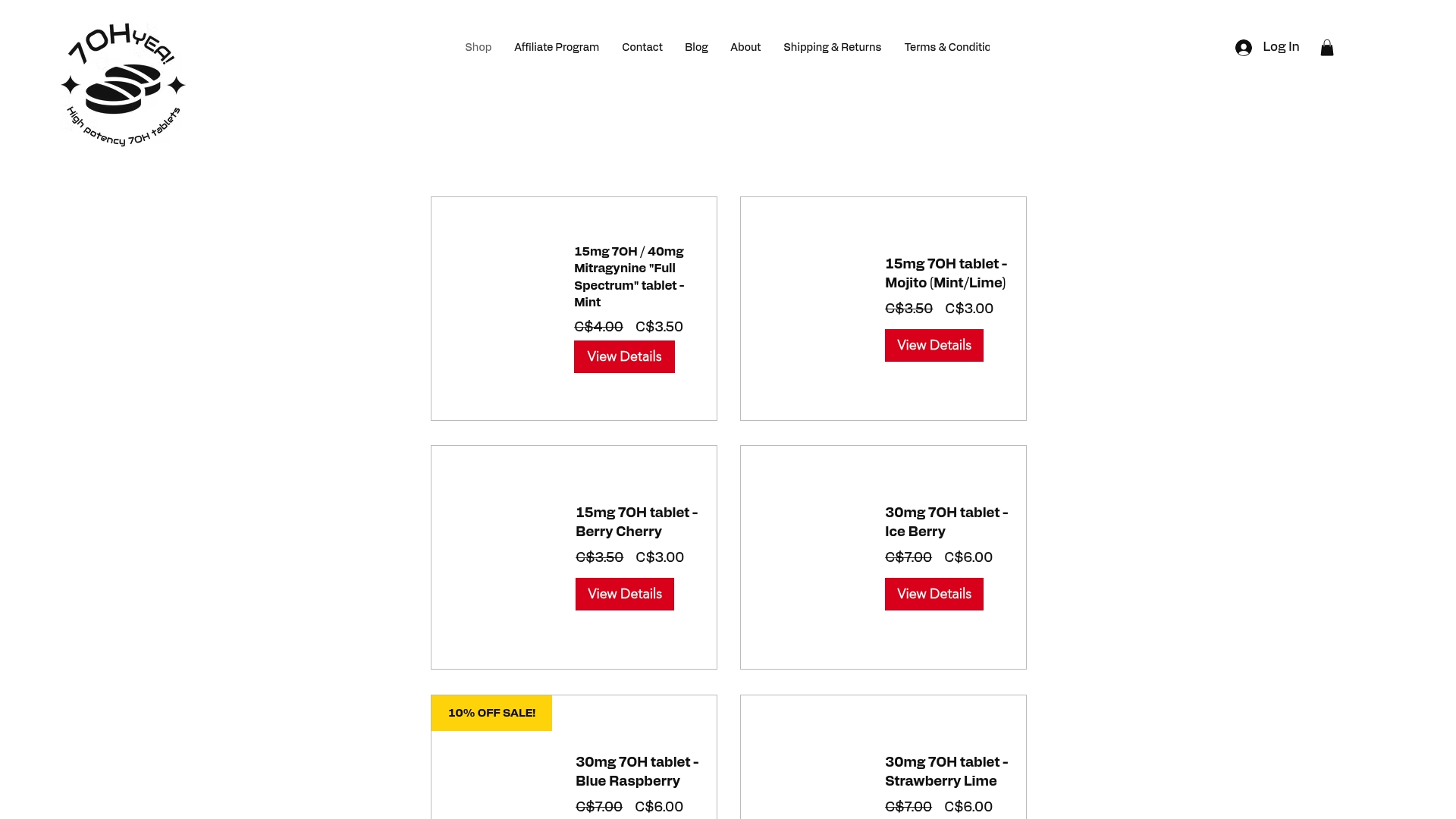
For powders, the 81% pure 7OH powder is listed at 50 CAD, and the 99% pure SR17018 powder at 48 CAD. Bulk purchasing is available for research teams. Everything is sold for analytical and laboratory use only, not for human consumption.
FAQ
What is the ISO standard for equipment calibration?
ISO/IEC 17025 is the international standard for testing and calibration laboratories. In Canada it’s applied through the Standards Council of Canada’s accreditation programs. It covers the lab’s competence and traceability, not the product being tested.
Do I need a certified reference material, or is a reference standard enough?
It depends on what you need to prove. A CRM adds certified values, stated uncertainty and traceability, which matters for regulated or audited work. A non-certified reference material may suit routine checks, but it might not support a traceability claim.
How long is a calibration certificate good for?
The NRC says the certificate is valid only at the time of execution. Long-term stability can be added at a client’s request if it’s documented well. Set your own recalibration interval and keep records of it.
Is a U.S. DEA notice binding in Canada?
No. It applies in the United States. We haven’t confirmed an equivalent Canadian announcement, so check Health Canada’s pages and speak with a lawyer about your situation.
So here’s our question for you: if regulators set concentration limits, should every lab that measures these compounds be required to show traceable standards? Tell us what you think.
Sources
- Temporary Control of 7-OH and Other Kratom-Related Substances, Congressional Research Service
- FDA Announces Plan to Restrict 7-OH Opioid Products, Venable
- PMDA guideline on bioanalytical method validation
- SCC, Test Method Verification and Validation requirements
- NRC, Recommended practices for calibration laboratories
- NRC, Certified reference materials
- NIST, Reference materials
- Health Canada, Quality guidance addendum
- NRC, qNMR-CD caffeine calibration solution CRM
- SCC, Calibration accreditation program
- Health Canada, Cannabis Laboratory
- NRC, Requirements for calibration certificates issued by CLAS laboratories
- FDA, guidance on calibration traceability
- ICH Q2(R2), Validation of analytical procedures
- Health Canada, ICH Q2(R1) guidance
- Health Canada, Validating analytical methods in cannabis testing
7ohyeaAsk About 7-OH MaterialsEmail 7OH Canada with questions about research-grade 7-hydroxymitragynine tablets and powders for analytical purposes.77ohyea
Email us7ohyea@gmail.com