7OH Spiking Solutions for Analytical Labs: A Practical Guide

In an analytical laboratory, a 7OH spiking solution is a carefully prepared solution of 7-hydroxymitragynine reference material that you add to a blank matrix, a sample extract or a calibration series at a known concentration, so that you can measure recovery, matrix effects and method accuracy. This guide covers how to build, verify and store those solutions, and where the common mistakes occur. It is written for analytical chemists, QC staff and research teams working with kratom alkaloids in Canada. The materials we discuss are for laboratory use only and are not intended for human consumption.
7ohyeaChoose Research-Grade 7OH Materials7OH Canada supplies research-grade 7OH tablets and powders for analytical purposes, with customizable dosage options and domestic sourcing from British Columbia.
Explore 7OH materialsTL;DR
- A spiking solution is only as reliable as the reference material behind it: ask for a batch-specific Certificate of Analysis and confirm identity and purity before you weigh anything.
- Prepare a concentrated stock, then dilute to working spiking solutions in the solvent your method tolerates, and record every weight, volume and lot number.
- 7-OH is easy to misidentify in complex kratom matrices, so multi-criteria LC-MS/MS confirmation matters more than a single transition.
- Spike at several levels (low, mid, high) into blank matrix, and compare against post-extraction spikes to separate recovery from matrix effect.
- Regulation of 7-OH is moving quickly, so check current federal and provincial requirements before ordering or shipping.
Table of Contents
- What a spiking solution does in a 7-OH method
- Start with the right reference material
- Building the stock and working solutions
- Designing the spike experiment
- Avoiding false identification of 7-OH
- Know what your sample should contain
- Stability, storage and handling
- Perspective: why we treat spiking solutions as a quality question
- Why the pharmacology matters for your analytical design
- Compliance and ordering in Canada
- Choosing materials for your spiking programme
- Order research-grade 7OH reference materials
- Common mistakes and how to avoid them
- FAQ
- Sources
What a spiking solution does in a 7-OH method
Spiking is the backbone of method validation. You add a known amount of analyte to a matrix that does not contain it (or contains a known amount), and then see how much you get back. For 7-hydroxymitragynine, that matrix might be a blank botanical extract, a finished tablet matrix, a plasma or urine pool, or even hair. A published LC-MS/MS method for mitragynine and 7-hydroxymitragynine in hair, for example, validated its calibration curve, accuracy, precision, recovery and matrix effect using drug-free hair samples spiked with the analytes. The same logic applies to any matrix.
A spiking solution typically serves four purposes:
- Calibration standards: a series of known concentrations that defines the response curve.
- Quality control samples: independent low, mid and high spikes that show the method performs across its range.
- Recovery experiments: the same spike added before and after extraction, so you can quantify losses in sample preparation.
- Matrix-effect assessment: a comparison of response in matrix against response in neat solvent, which reveals ion suppression or enhancement.
Because every one of these depends on the nominal concentration of the spike, the accuracy of the spiking solution sets the ceiling on the accuracy of the whole method.
Start with the right reference material
A spiking solution cannot be better than the powder it came from. Before you prepare anything, check the following on the supplier’s documentation:
- Identity: the Certificate of Analysis should state how identity was confirmed, not only that it was.
- Purity: a percentage purity lets you correct the weighed mass to the true analyte mass. A material that is 81% pure is not 100% analyte, and the difference carries straight into your concentrations.
- Batch traceability: the lot number on the vial should match the lot on the CoA, and you should record it in your notebook.
- Form: powders suit stock preparation by weight, whereas tablets suit studies that need a defined unit dose of the formulation itself.
The purity correction is simple but often forgotten. If your target is a 1.00 mg/mL stock of 7-hydroxymitragynine and your powder is 81% pure, you weigh 1.00 mg divided by 0.81 for each millilitre of final volume, about 1.23 mg. Document the purity value and the CoA date in the same record.
We supply an 81% pure 7OH powder at 50 CAD and a 43% pure mitragynine full spectrum powder at 6.75 CAD, each with a batch-specific CoA, which suits teams that need both analytes in the same study. For readers comparing the two alkaloids first, our guide to mitragynine versus 7-hydroxymitragynine for Canadian labs explains how they differ in the lab.
Building the stock and working solutions
The following workflow suits most LC-MS/MS laboratories. Adjust solvents and concentrations to your validated method.
Step 1: Weigh and dissolve
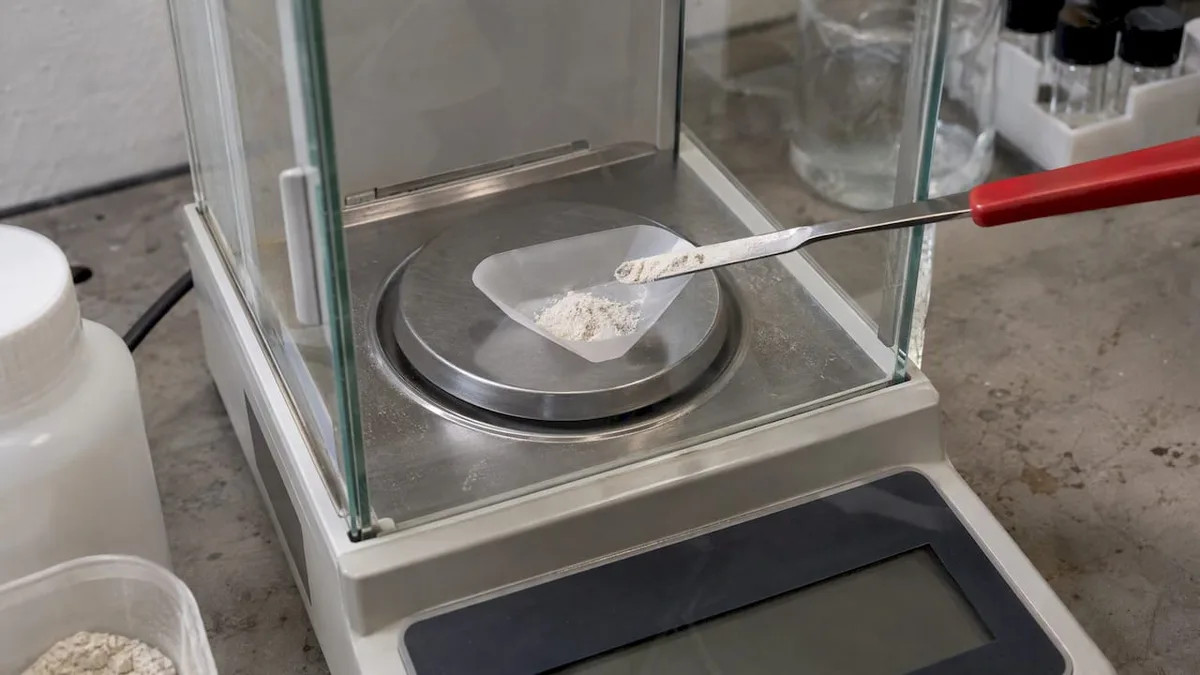
Use a calibrated analytical balance, an anti-static device if your powder is prone to static, and Class A volumetric glassware. Dissolve the corrected mass in a solvent that fully dissolves the alkaloid and is compatible with your mobile phase. Methanol is a common choice for alkaloid stocks, but confirm solubility and stability for your own lot rather than assuming it.
Step 2: Make a primary stock and an independent check stock
Prepare two separate stocks from separate weighings. Use one for calibrators and the other for QC spikes. If the two disagree by more than your acceptance limit when you compare responses, you have found a weighing or dilution error before it contaminates a whole validation batch.

Step 3: Dilute to working spiking solutions
Build an intermediate solution, then dilute to the levels you need. Keep the spike volume small relative to the sample volume, often a few percent at most, so the spiking solvent does not alter the matrix or the extraction chemistry. A typical plan uses three QC levels:
| Level | Purpose | Where it sits in the range |
|---|---|---|
| Low QC | Tests accuracy near the lower limit of quantification | About 3 times the LLOQ |
| Mid QC | Tests the centre of the curve | Around the geometric middle |
| High QC | Tests the upper end and carry-over | Roughly 75 to 80% of the top calibrator |
These placements are common laboratory practice rather than a fixed rule, so follow the guidance your own quality system or regulator requires.
Step 4: Label and record
Every vial should carry the analyte, concentration, solvent, preparation date, expiry date, preparer’s initials and parent stock identifier. Your notebook should capture the CoA purity, lot number, balance ID, and the exact masses and volumes used.
Designing the spike experiment
The most informative design uses three sets of samples at each level.
- Set A, neat standards: analyte in clean solvent.
- Set B, post-extraction spike: blank matrix is extracted first, then spiked with the analyte.
- Set C, pre-extraction spike: blank matrix is spiked, then extracted.
Comparing B with A gives you the matrix effect. Comparing C with B gives you the extraction recovery. Comparing C with A gives the overall process efficiency. Running six or more independent matrix lots is better than one, because matrix effects vary from source to source.
A stable isotope-labelled internal standard, if you have one for your method, corrects for much of the variability in extraction and ionisation. Add it to every sample at a constant concentration, separately from the analyte spike.
Avoiding false identification of 7-OH
Spiking only helps if you are measuring the right compound. Kratom matrices contain many structurally related alkaloids, and 7-OH can be mistaken for something else. Recent work on avoiding false identification of 7-hydroxymitragynine reports that relying on accurate mass or a common transition such as m/z 415 to 190 alone can produce false positives, and recommends multi-criteria LC-MS/MS confirmation with retention time matching and full fragmentation pattern analysis.
In practice, your spike gives you the benchmark: run the spiked reference alongside the unknown and require the unknown to match retention time and ion ratios within your set tolerances. Chromatographic separation from mitragynine and from isomeric alkaloids should be demonstrated, not assumed.
Know what your sample should contain
When you design spiking levels, you need a realistic idea of what is in the real samples. A forensic report from the Center for Forensic Science Research and Education notes that authenticated leaf material contains only trace 7-OH, while some commercial extract products show profiles only achievable through synthetic routes. A separate study in the Journal of AOAC International, Elevated 7-Hydroxymitragynine Levels Found in Products Misbranded as Kratom, points the same way.
For your validation this means two things. A leaf matrix needs a low-end calibration range with a very low LLOQ, while a concentrated product matrix may need dilution or a much higher upper limit. Choose spike levels that bracket the concentrations you actually expect, and verify dilution linearity if samples exceed the curve.
Stability, storage and handling
Alkaloid solutions can degrade through oxidation, light exposure, pH shifts and adsorption to container walls. We do not make stability claims for your particular solvent system, so test it. A simple stability programme includes:
- Bench-top stability: working solutions held at room temperature for the duration of a typical run.
- Autosampler stability: extracts held at the autosampler temperature for the longest expected queue.
- Freeze-thaw stability: if you store spiked matrix frozen.
- Long-term stock stability: stock stored at your chosen temperature, compared with a freshly prepared stock at intervals.
Use amber glass or protect vials from light, minimise headspace, and consider silanised glass or polypropylene if you see adsorptive losses at low concentrations. Always allow vials to reach room temperature before opening to avoid condensation.
Perspective: why we treat spiking solutions as a quality question
We see requests for 7-hydroxymitragynine reference materials from teams at very different stages, from a lab building its first LC-MS/MS method to a group running a comparative study across several alkaloids. The same problem appears again and again: the method was careful, but the starting material was documented loosely, so nobody could say with confidence what the nominal spike concentration really was.

That is why we focus on domestic sourcing from British Columbia, batch-specific Certificates of Analysis and dosage options (15 mg, 30 mg and 50 mg in tablets) that let a protocol specify exactly what it needs. Fast domestic shipping and no border fees matter too, because a validation delayed by a stuck parcel is a validation that drifts. Our products are strictly for analytical use, and we would rather lose a sale than see a protocol built on an assumption we cannot support.
If your work compares 7-OH with related compounds, our guides on mitragynine pseudoindoxyl versus 7OH and MGM-15 versus 7-OH set out the pharmacological differences you will want in mind when choosing spike targets.
— Deek
Why the pharmacology matters for your analytical design
7-OH is a minor constituent of the plant, but a potent one. A pharmacological study in the Journal of Pharmacology and Experimental Therapeutics compared mitragynine and 7-hydroxymitragynine at the mu-opioid receptor, and earlier work in Life Sciences described 7-hydroxymitragynine’s antinociception, tolerance and withdrawal effects, reporting it as considerably more potent than mitragynine in preclinical models. For the analyst, the practical consequence is that small absolute amounts of 7-OH can be biologically significant, which is why detection limits and low-level accuracy deserve attention, and why handling should follow your institution’s chemical hygiene plan. Wear appropriate protective equipment, weigh powders in a ventilated enclosure, and keep materials secured and logged.
Public health bodies have also raised concerns about concentrated 7-OH products sold to consumers. The U.S. FDA’s public health notice on 7-OH products is one example, and clinicians have documented severe early-onset withdrawal after use of the semisynthetic derivative mitragynine pseudoindoxyl. Our materials are not for ingestion by people or animals, and nothing in this guide describes or encourages such use. If you or someone you know is using 7-OH or kratom products and is struggling with dependence or withdrawal, speak to a physician, pharmacist or a provincial addictions service rather than a laboratory supplier.
Compliance and ordering in Canada
Rules around 7-OH are changing in several jurisdictions. A supplier’s July 2026 note on federal 7-OH scheduling in the United States describes related compounds being controlled there and the public record on 7-OH itself being reopened. That is a U.S. matter, and it does not describe Canadian law, but it shows how quickly the landscape can shift, particularly if your lab collaborates across the border. For Canadian purposes, Health Canada’s page on buying and using drug and health products safely is a starting point, and your institution’s compliance office or legal counsel should confirm what applies to your lab, your province and any shipment you plan to send abroad. Our own overview, 7OH vs 7-hydroxymitragynine: potency, risks and Canadian law, summarises our position, though it is not legal advice.
Keep with each purchase: the invoice, the CoA, a record of intended analytical use, and your storage and disposal log. These documents also make audits much easier.
Choosing materials for your spiking programme
Which material suits which job depends on what the method needs.
| Need | Material to consider | Why |
|---|---|---|
| Primary calibrator for 7-OH | 81% pure 7OH powder | Weighable stock, purity correction from CoA |
| Mitragynine alongside 7-OH | 43% pure mitragynine full spectrum powder | Co-analyte for selectivity and ratio studies |
| Related ligand studies | 99% pure SR17018 powder | High-purity reference for comparative work |
| Defined unit-dose formulation work | 7OH tablets in 15, 30 and 50 mg options | Fixed amount per unit for formulation and content studies |
The 99% pure SR17018 powder is listed at 48 CAD. If you are new to the compound, the complete research guide to 7-hydroxymitragynine for Canada is a good place to begin.
Order research-grade 7OH reference materials
If you are building or revalidating a method, you can browse our 7-hydroxymitragynine and related alkaloid products, all supplied for laboratory use with batch-specific Certificates of Analysis, from Canadian sourcing in British Columbia. Bulk purchasing is available for research teams, so you can keep a single lot across a long validation.
Common mistakes and how to avoid them
- Ignoring purity: weighing 100% of the powder mass as analyte overstates the concentration.
- One stock for everything: calibrators and QCs prepared from the same weighing hide systematic error.
- Large spike volumes: adding too much organic solvent changes the matrix and the extraction.
- Single-transition confirmation: this is where false positives come from, as described above.
- No stability data: an unstable stock produces a slow drift that looks like an instrument problem.
- Poor records: without lot numbers and masses, you cannot reconstruct a result later.
FAQ
What is a 7OH spiking solution?
It is a solution of 7-hydroxymitragynine reference material at a known concentration, added to blank matrix or sample extracts to test a method. Labs use it for calibration, QC samples, recovery and matrix-effect studies.
How many spike levels should I use?
Most validations use at least low, mid and high QC levels, plus a calibration series across the working range. Your regulatory or institutional guidance sets the exact requirement, so follow that document when it differs from common practice.
Do I need to correct for powder purity?
Yes. Divide the target analyte mass by the purity fraction on the Certificate of Analysis to get the mass to weigh. For a powder that is 81% pure, you weigh roughly 1.23 mg for every 1.00 mg of analyte you want.
How do I make sure the peak is really 7-OH?
Do not rely on accurate mass or one transition. Use multi-criteria LC-MS/MS confirmation: retention time against your spiked reference, several transitions with ion ratios, and separation from related alkaloids.
Sources
- Avoiding False Identification of 7-Hydroxymitragynine in Kratom Products Using a Multicriteria LC–MS Confirmation
- LC–MS-MS method for mitragynine and 7-hydroxymitragynine in hair
- Mitragynine and 7-Hydroxy Mitragynine NPS Discovery report, CFSRE
- Elevated 7-Hydroxymitragynine Levels Found in Products Misbranded as Kratom
- Pharmacological Comparison of Mitragynine and 7-Hydroxymitragynine
- Antinociception, tolerance and withdrawal symptoms induced by 7-hydroxymitragynine
- Hiding in Plain Sight: 7-OH Products, U.S. FDA
- Severe Early-Onset Withdrawal Following Intentional Use of Mitragynine Pseudoindoxyl
- Federal 7-OH Scheduling: What It Means for Your Orders
- Buying and using drug and health products safely, Health Canada
7ohyeaAsk About 7OH Research MaterialsEmail 7OH Canada with questions about research-grade 7OH products for analytical purposes and their available dosage options.77ohyea
Email us7ohyea@gmail.com