7OH Tablet Disintegration: What the Headlines Miss

Searches for 7OH tablets have exploded because regulators on both sides of the border are suddenly paying attention to them. Most of the coverage is about bans and warnings. Almost none of it explains a quieter question that labs actually ask: what happens when a tablet meets liquid, and how do you test that properly?
That question is called disintegration. This article explains it in plain language, sorts the news from the noise, and spells out what it all means for Canadian researchers. Everything we sell is for research use only, not for human consumption.
7ohyeaSupport Your 7OH Lab ResearchExplore research-grade 7OH tablets and powders for laboratory and analytical use, with customizable dosage options sourced in British Columbia.
Explore research materialsTL;DR
- Disintegration testing checks how a tablet breaks apart in a liquid under set conditions. It’s a quality-control test, not a measure of anything a product does in a body.
- Disintegration and dissolution are different tests. Mixing them up is the most common mistake in online chatter.
- In the U.S., the FDA has moved hard against 7-OH products. In Canada, Health Canada’s long-standing position is that kratom products are unauthorized for sale.
- 7OHyea products are research-grade materials for laboratory and analytical use only, not for human consumption.
- Nobody can say for certain how the rules will end up. Be wary of anyone who claims they can.
Table of Contents
- Quick facts
- Why is everyone suddenly talking about 7OH tablets?
- What did the headlines get wrong?
- What does disintegration testing actually measure?
- Disintegration vs dissolution: why the mix-up matters
- Why would a lab care about tablet form at all?
- What’s the legal picture in Canada?
- What’s the U.S. context?
- Why do these rules matter to a disintegration question?
- What this means for readers
- Our perspective: the boring test that deserves more respect
- Where to find research-grade materials
- FAQ
- Sources
Quick facts
| Item | Where things stand |
|---|---|
| Topic | Disintegration testing for 7-hydroxymitragynine (7OH) research tablets |
| What it is | A lab test of how a tablet breaks apart in a liquid medium |
| Not the same as | Dissolution, which measures how much active material goes into solution over time |
| Reference standard | USP general chapter 701, harmonized with European and Japanese pharmacopoeias |
| Canadian position | Health Canada: kratom and its alkaloids are unauthorized for sale (notice of October 2020) |
| U.S. position | FDA recommended Schedule I for 7-OH on July 29, 2025 |
| Our products | Research use only. Not for human consumption |
Why is everyone suddenly talking about 7OH tablets?
Because the U.S. government made them a target. On July 29, 2025, the FDA recommended to the DEA that 7-OH be placed in Schedule I, according to a legal analysis of the joint press conference. Schedule I is the most restrictive category under the U.S. Controlled Substances Act.
The story kept moving. In December 2025, the FDA announced that the U.S. Marshals Service had seized about 73,000 units of 7-OH products, valued at roughly $1 million. And Medscape has reported that the DEA took a step toward placing concentrated 7-OH products under Schedule I while leaving most natural leaf kratom out of it.
That’s a lot of heat. And the word tablet shows up in nearly every headline, which is how a niche lab term like disintegration ends up in search results.
What did the headlines get wrong?
Let’s do this myth by fact, because the coverage blurs a few things.
Myth: 7-OH is just kratom. Fact: 7-hydroxymitragynine is one alkaloid (a naturally occurring plant compound) found in kratom leaf, and only in trace amounts there. The FDA’s concern is about concentrated products where it’s added or enriched. The U.S. agency’s warning letters describe it as a potent mu-opioid agonist, meaning it activates the same type of receptor that opioids do. We’ve covered the difference in more detail in our piece on 7OH versus 7-hydroxymitragynine.
Myth: a tablet is a tablet. Fact: how a tablet is made decides how it behaves in a test. Binders, fillers and compression force all change how fast it falls apart. That’s why labs ask for batch-specific documents rather than trusting a label.

Myth: disintegration tells you how a product works. Fact: it doesn’t. It tells a lab whether a solid form breaks into pieces within a set time in a set liquid. That’s a manufacturing consistency check.
Myth: a ban in the U.S. is automatically a ban in Canada. Fact: it isn’t. Canada has its own rules, and we’ll get to them next.
What does disintegration testing actually measure?
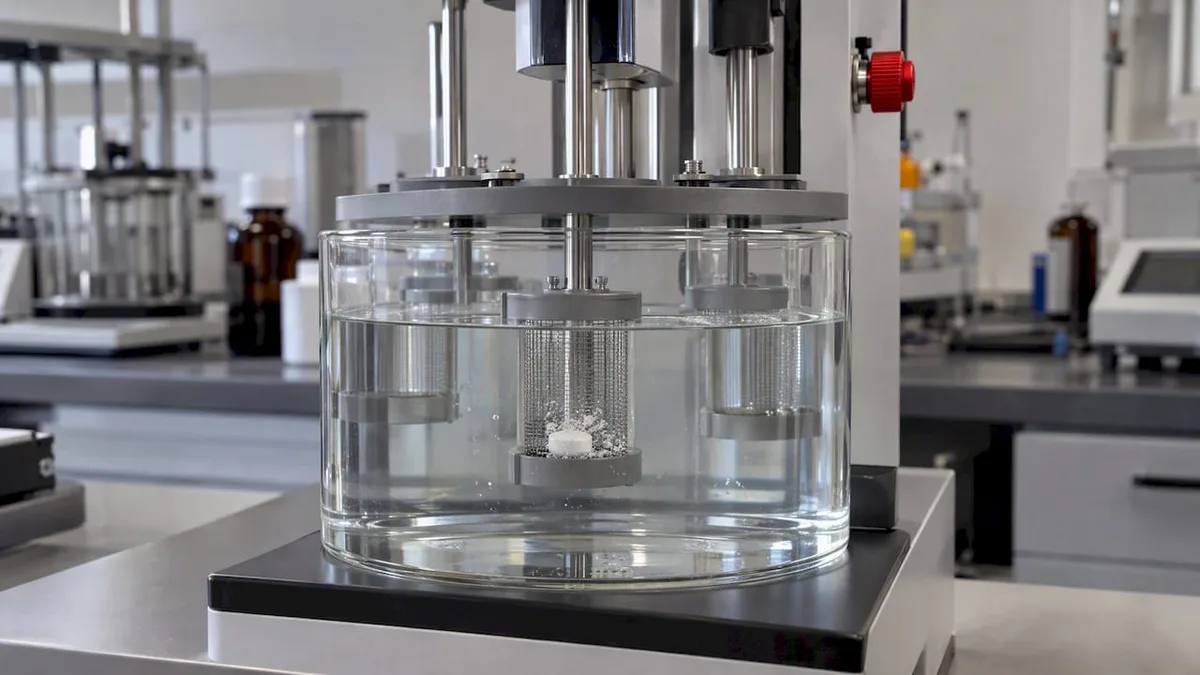
Picture a tablet dropped into a beaker of liquid held at a controlled temperature. A standard apparatus moves it up and down. The lab records how long it takes to break up until no solid pieces remain, apart from insoluble fragments of coating or capsule shell.
That’s the whole idea. It’s simple, cheap and repeatable, which is exactly why it’s a staple of tablet quality control.
The benchmark lab people cite is USP general chapter 701 on disintegration. That chapter is harmonized with the European Pharmacopoeia and the Japanese Pharmacopoeia, so the texts are interchangeable. The international regulators’ Q4B process also produced an annex on the disintegration test chapter, which tells you how seriously the field takes a method that looks this basic.
We’re not going to walk through a bench protocol here. If you’re a qualified researcher, your method should come from the pharmacopoeial text and your own institution’s SOPs (standard operating procedures), not from a blog post.
Disintegration vs dissolution: why the mix-up matters
These two words get swapped constantly. They shouldn’t be.
- Disintegration: the tablet breaks into smaller pieces.
- Dissolution: the material in those pieces actually goes into solution, and you measure how much and how fast.
A tablet can fall apart quickly and still release material slowly. The reverse can’t really happen. So a pass on disintegration is a first gate, not a verdict.
This is also where the chemistry gets a little awkward for this particular alkaloid. A 2014 in vitro study of kratom alkaloids found that 7-hydroxymitragynine degraded in simulated gastric fluid, by up to 27 percent, compared with intestinal fluid. For an analytical chemist, that means the choice of test medium isn’t a detail. It can change what your numbers say about the compound’s stability.
One more caution from the literature. Mitragynine, the main kratom alkaloid, is described as poorly water-soluble in a 2025 paper on pharmaceutical liquids and kratom bioactive dissolution. Solubility problems make dissolution work harder, which is one reason disintegration alone never tells the full story.
Why would a lab care about tablet form at all?
Two practical reasons. Consistency and traceability.
A tablet gives a pre-formed, uniform unit. A powder gives flexibility. Researchers choose between them depending on the study, and we’ve laid out the trade-offs in our powder versus tablets protocol guide.
If you choose tablets, you want to know how they were built. Our overview of tablet formulation basics for research labs covers the ingredients and design choices behind that.
And you want testing you can trust. We’ve written about three nonnegotiables for 7-hydroxymitragynine tablet testing, starting with documentation you can check yourself.
Here’s a recent twist worth knowing. A 2026 analysis by Avula and colleagues, indexed in search results, reports that tablet products marketed as 7-OH showed an unusual ratio of mitragynine to 7-OH. We haven’t been able to review the full paper for this article, so treat the details as unconfirmed. The takeaway is still useful: labels on consumer-market products don’t always match what’s inside, which is exactly why independent analysis matters.

What’s the legal picture in Canada?
Canada first, since that’s where you are.
Health Canada’s position is long-standing. In a public notice dated October 21, 2020, the department said kratom products are unauthorized and may pose serious health risks, and it described past seizures from retail locations. The notice lists side effects including drowsiness, nausea, vomiting, seizures and liver toxicity.
We haven’t found a newer Health Canada announcement that is specific to 7-OH tablets, and we won’t pretend otherwise. If one lands, read it directly.
What does that mean for how products are sold? Ours are labelled for laboratory and analytical work only. That’s a compliance posture, not a loophole, and it doesn’t turn into legal advice for your situation. If you’re unsure where your project stands, ask your institution’s compliance office or a lawyer who works in controlled substances.
What’s the U.S. context?
The second layer is American, and it moves faster.
- June 25, 2025: the FDA posted warning letters to firms selling 7-OH products, including one to Hydroxie, LLC.
- July 29, 2025: the FDA recommended Schedule I to the DEA.
- December 2025: the seizure of roughly 73,000 units, which the FDA described as unapproved new drugs.
- 2026: reporting on a DEA proposal aimed at concentrated 7-OH, with natural leaf kratom treated differently.
What hasn’t been confirmed in the sources we used is a final scheduling outcome. We won’t predict one. Check the DEA and Federal Register for current status before you rely on anything here.
Why do these rules matter to a disintegration question?
Because regulators and labs are both circling the same issue: knowing exactly what’s in a product. Regulators worry about unverified, concentrated products sold to the public. Researchers worry about unverified materials contaminating their data.
The science side has its own debate. Some researchers stress that 7-hydroxymitragynine is far more potent than its parent compound, which is why pharmacology reviews on kratom alkaloids put a premium on analytical purity and careful measurement. That review reports a binding affinity of 47 nM at human mu-opioid receptors for 7-hydroxymitragynine. In plain terms, it sticks tightly to that receptor in lab assays.
Note what that doesn’t prove. It’s receptor data. It says nothing about what any commercial product does, and we make no such claims.
What this means for readers
Here’s the short version, depending on who you are.
If you’re a researcher or analytical chemist in Canada:
- Treat disintegration as one quality check among several, alongside identity, purity and dissolution.
- Ask for batch-specific certificates of analysis, and read them.
- Keep records. Regulatory attention is rising, and good documentation protects your work.
- Check your institution’s rules before ordering any controlled or sensitive alkaloid.
If you’re a curious reader who stumbled in from a headline:
- Disintegration isn’t a health test. It’s a lab test.
- Our materials are for research use only, not for human consumption.
- If you or someone you know is struggling with opioid or kratom-related dependence, talk to a doctor, pharmacist or your provincial health line. This site is not the place for that advice.
If you follow the policy fight:
- U.S. action doesn’t equal a Canadian ban.
- Health Canada’s published stance is still the reference point here.
- Wait for official notices rather than social media summaries.
Our perspective: the boring test that deserves more respect
We think the loudest part of this debate is also the least useful. Everyone is arguing about bans, and almost nobody is asking whether the material on the bench is what the label says it is.
From where we sit, supplying research-grade materials from British Columbia, three things matter most. The first is documentation: every batch should come with its own certificate of analysis. The second is honesty about purpose: these are analytical materials, and we say so plainly. The third is a lab culture that treats simple tests like disintegration as real data, not box-ticking.
We also think the industry has earned some of the heat. When products get sold with vague labels and loud marketing, regulators step in. Researchers who want continued access to analytical alkaloids have every reason to prefer suppliers who welcome scrutiny.
That’s our view. You’re free to disagree, and we’d like to hear why.
— John
Where to find research-grade materials
If you’re a qualified lab sourcing analytical materials, you can browse our research-grade 7OH and related alkaloid catalogue. Our 81% pure 7OH powder is listed at 50 CAD, and the catalogue also includes reference materials for related alkaloids. Everything is sold for laboratory and analytical use only, not for human consumption, and we’re based in Canada, so there are no border fees.
FAQ
Is disintegration the same as dissolution?
No. Disintegration measures whether a tablet breaks apart in a liquid within a set time. Dissolution measures how much of the material goes into solution and how quickly. A lab typically needs both for a complete picture.
Does a fast disintegration time say anything about a product’s effects?
No. It’s a manufacturing quality check, not a measure of any effect. We don’t make claims about effects, and our products are for research use only, not for human consumption.
Is 7-OH legal in Canada?
We can’t give legal advice. Health Canada’s published position is that kratom products and their alkaloids are unauthorized for sale. If you’re planning research, check with your institution’s compliance office or a qualified lawyer.
When will the 7-OH ban start in the U.S.?
We can’t tell you, and nobody should claim certainty. The FDA recommended Schedule I in July 2025 and reporting in 2026 describes a DEA proposal, but a final outcome isn’t confirmed in the sources we reviewed. Check the DEA and the Federal Register for current status.
Where can I read the actual testing standard?
Start with USP general chapter 701, which is harmonized with the European and Japanese pharmacopoeias. Your institution may require a specific edition or method, so confirm that first.
So here’s our question for you: should regulators treat a lab-labelled tablet differently from a consumer-market one, or does the label stop mattering the moment the product is concentrated?
Sources
- FDA Announces Plan to Restrict 7-OH Opioid Products (Venable analysis)
- FDA Seizes 7-OH Opioids to Protect American Consumers
- DEA Targets Synthetic 7-OH Products With Schedule I Proposal (Medscape)
- FDA warning letter to 7Tabz Retail, LLC, June 25, 2025
- FDA warning letter to Hydroxie, LLC, June 25, 2025
- USP general chapter 701, Disintegration
- Q4B Annex 5, Disintegration Test General Chapter
- In vitro ADME properties of mitragynine, 7-hydroxymitragynine and mitraphylline (PubMed)
- Pharmaceutical liquids and Mitragyna speciosa bioactive dissolution (2025)
- Kratom Alkaloids: Interactions With Enzymes, Receptors, and Cellular Barriers (Frontiers in Pharmacology)
- Health Canada: Unauthorized products may pose serious health risks, October 21, 2020
7ohyeaQuestions About 7OH Research?Email us with questions about research-grade 7OH materials and their laboratory and analytical use.77ohyea
Email us7ohyea@gmail.com