7OH Tablet Excipients: What Else Is in a Research Tablet

A 7-hydroxymitragynine (7OH) tablet is never only 7OH. Alongside the alkaloid, it carries excipients: binders, fillers, disintegrants, lubricants and sometimes flavour or colour components that give the tablet its shape, hardness and dissolution behaviour. For an analytical lab, those inactive ingredients matter as much as the stated alkaloid content, because they can change extraction recovery, add chromatographic peaks and shift the weight-to-dose relationship you rely on. This guide explains the common excipient classes, how each can affect an analytical run, and what to ask for before you order research-grade tablets in Canada.
Everything here concerns laboratory and analytical use. 7OH products are not intended for human consumption, and nothing below is guidance on taking them.
7ohyea7ohyea.caKnow the Tablet Matrix7OH Canada supplies research-grade tablets and powders for analytical purposes, with dosage options to support different laboratory protocols.
Explore research materialsTL;DR
- Excipients are the non-alkaloid components of a tablet (binder, filler, disintegrant, lubricant, and any flavour or colour). They make up most of the tablet’s mass at low alkaloid loadings.
- Different excipients can affect extraction efficiency, matrix effects in LC-MS and the way a tablet dissolves, so the formulation should be known before you validate a method.
- Ask for a batch-specific Certificate of Analysis and a full ingredient list, and run an excipient-only blank where you can.
- In Canada, 7OH is not authorized as a food, supplement or natural health product, so these materials belong in lab workflows only.
Table of Contents
- Why excipients matter in a research tablet
- The common excipient classes
- How excipients affect your analytical method
- A practical checklist before you buy
- Our perspective on excipients
- Where to find research-grade materials
- The Canadian regulatory context
- Working with a tablet matrix: a short validation outline
- FAQ
- Sources
Why excipients matter in a research tablet
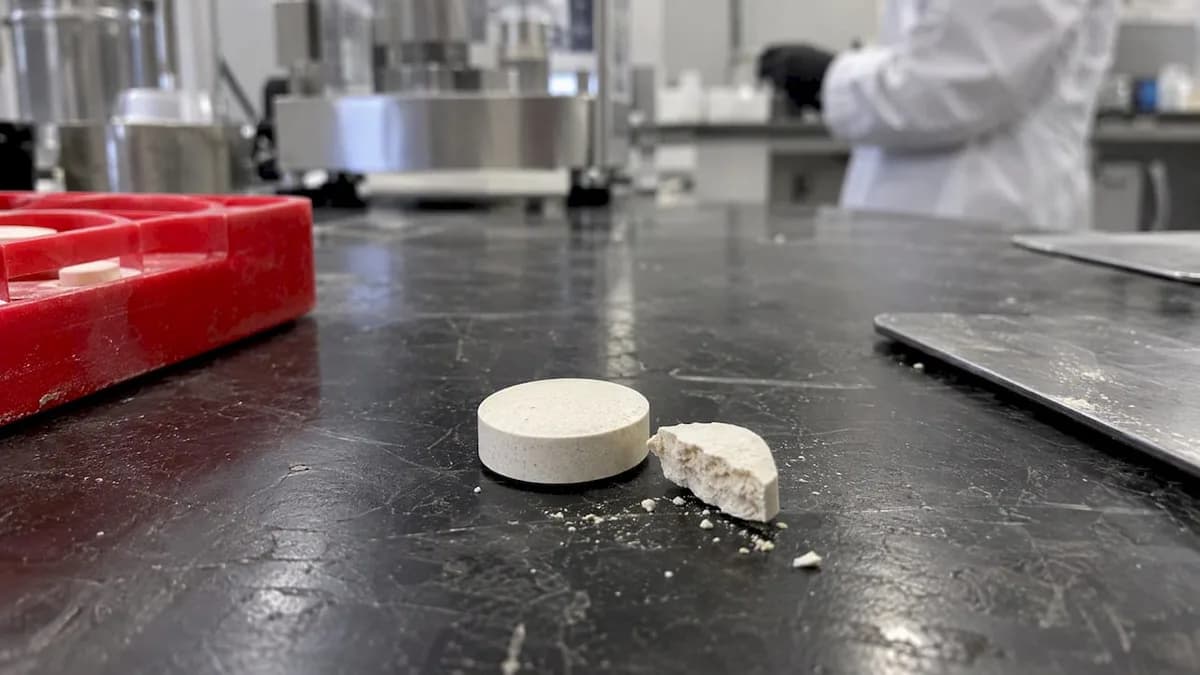
A tablet containing 15 mg of 7OH may weigh several hundred milligrams in total. The rest is formulation. When you crush, dissolve and extract that tablet for analysis, everything in it comes along into your sample vial unless your preparation removes it.
That has three practical consequences:
- Recovery. A binder that swells or gels in your extraction solvent can trap alkaloid and lower apparent recovery.
- Matrix effects. Co-extracted components can suppress or enhance ionization in mass spectrometry, which distorts quantitation if your calibration was built on neat standards.
- Interference. Flavour compounds, dyes and degradation products can produce peaks near your analyte, which matters when you need to separate 7OH from closely related indole alkaloids.
The AOAC standard method performance requirements for Mitragyna speciosa alkaloids set a limit of quantitation of 0.005% (50 ppm) for 7OH and call for a method that separates it from other relevant alkaloids, with 90 to 110% recovery in the 0.01 to 0.1% range. A method that meets those numbers on a clean standard can still miss them on a finished tablet if the matrix has not been characterized. That is why excipient control is a quality-assurance question and not a cosmetic one.
The common excipient classes
No single published recipe applies to every 7OH tablet, and formulators differ. The classes below are the ones found across pharmaceutical tablet design generally, and a review of orally disintegrating tablet formulation and quality control notes that drug and excipient properties should not affect tablet properties considerably, which is the design goal for any tablet.
| Class | Purpose | Typical examples | Analytical watch-point |
|---|---|---|---|
| Filler / diluent | Adds bulk so a small alkaloid amount forms a workable tablet | Microcrystalline cellulose, lactose, mannitol, dibasic calcium phosphate | Insoluble fillers leave residue; filter or centrifuge before injection |
| Binder | Holds particles together | Starch, gelatin, povidone, sucrose | Can gel or swell in solvent and trap analyte |
| Disintegrant | Helps the tablet break apart | Croscarmellose sodium, sodium starch glycolate | Swelling polymers can clog filters |
| Lubricant / glidant | Prevents sticking in the press | Magnesium stearate, silicon dioxide | Hydrophobic film can slow dissolution and leave lipid-like background |
| Flavour, sweetener, colour | Product identification and palatability of the dosage form | Mint, lemon or orange flavour systems, dyes | Organic compounds that may co-elute or add ionization noise |
Kratom-based tablets in particular are commonly described as densely packed powder held with a binding agent such as gelatin, starch, silicified microcellulose or sucrose, according to retail descriptions that circulate online. For published formulation work, an Ohio university thesis on extraction, characterization and tablet formulation of Mitragyna speciosa notes that a lack of published literature is the most challenging part of working with any kratom-based formulation. In practice, that means you should verify the matrix for the specific product you hold rather than assume a generic one.
Fillers and binders
Microcrystalline cellulose is a very common direct-compression filler. It is insoluble in water but disintegrates tablets by swelling and capillary action, as work on liquid penetration in directly compressed tablets describes. For an analyst, that means the tablet will fall apart readily in aqueous media, but the cellulose stays as suspended solid. Methanol or acetonitrile extractions followed by centrifugation and 0.22 µm filtration usually leave it behind, though you should confirm alkaloid recovery against a spiked blank.

Sugars such as sucrose or mannitol dissolve in aqueous-organic extracts and are largely invisible to UV detection, yet they can foul an electrospray source over a long sequence. A divert valve that sends the early, unretained solvent front to waste is the usual answer.
Lubricants and flow agents
Magnesium stearate is present at low percentages, but it is hydrophobic. The same literature on tablet penetration points out that it can inhibit aqueous uptake. If you run dissolution-style experiments on whole tablets, a lubricant-rich surface will change your timing compared with a different batch. For solvent extraction of crushed tablets, the effect is smaller, but stearate residues can build up on columns, so a guard column is cheap insurance.
Flavours, colours and sweeteners
Research tablets are sometimes made in distinguishable flavour or colour variants so that lots and strengths are easy to tell apart on a bench. Our own catalogue includes variants such as the 15 mg 7OH / 40 mg Mitragynine Full Spectrum tablet in Mint and the 50 mg 7OH tablet in Orange. Those labels are practical identifiers, and a careful lab treats the flavour system as one more component to account for in a blank, since volatile and semi-volatile organics can appear in full-scan LC-MS data.
How excipients affect your analytical method
Chromatographic separation
Mitragynine and 7OH are closely related, and the UPLC-MS/MS method quantifying ten key kratom alkaloids was developed for standardization and quality control of raw and commercial kratom products. It illustrates why selectivity is built around the alkaloids themselves. Excipients add a second axis of potential interference that a leaf-extract method never had to consider. If you adapt a botanical method to a formulated tablet, repeat selectivity checks with the full tablet matrix.
Confirmation and false identification
A 2026 paper in the Journal of the American Society for Mass Spectrometry examines avoiding false identification of 7-hydroxymitragynine in kratom products with multicriteria LC-MS confirmation. The lesson for tablet work is that retention time alone is not enough. Use retention time, precursor and product ion ratios, and a matched reference standard together, particularly when the sample contains unknown flavour or colour compounds.

Stability and in-sample conversion
Mitragynine can convert to 7OH under oxidative conditions, and the literature on suspected adulteration of commercial kratom products with 7-hydroxymitragynine shows why labs must tell native content from artifacts. Excipients with peroxide impurities (povidone is a known example in pharmaceutical science) can in principle create oxidative conditions in a tablet over time. Storing samples cool, dry and protected from light, and extracting promptly, limits that risk. For the conversion chemistry from a lab perspective, see our note on converting mitragynine to 7OH.
A practical checklist before you buy
Use this list whenever you evaluate a research tablet, from any source:
- Request a batch-specific Certificate of Analysis. It should identify the lot and report the alkaloid content by a named method. Our guide to the three nonnegotiables for 7-hydroxymitragynine tablet testing covers what a usable certificate contains.
- Ask for the full ingredient list. If a supplier cannot say what the non-alkaloid components are, you cannot prepare a representative blank.
- Ask whether the testing lab is independent of the manufacturer, and whether it tested the finished tablet or only the raw powder.
- Check the stated strength against tablet mass. Weigh a few tablets, and calculate the expected alkaloid fraction so you know your dilution scheme before the first injection.
- Buy enough of one lot. Switching lots mid-study can introduce a different excipient batch, which is a variable you did not plan for.
- If excipients are a problem, consider powder. A neat powder removes the formulation matrix altogether, at the cost of handling and weighing steps.
Tablet or powder?
Tablets give you pre-portioned, easily identified units and consistent weight, which suits repeated-measure protocols. Powders give you the cleanest matrix and flexible weighing, which suits method development and reference work. Purity matters in both cases, and our overview of 7-hydroxymitragynine purity levels for analytical labs explains how stated percentages relate to what you can reasonably expect on a bench.
Our perspective on excipients
We sell research-grade 7OH and related alkaloid materials to labs, and the question we hear most from careful analysts is some version of “what else is in it?” It is the right question. A tablet is a formulated product, and a lab that treats it as pure alkaloid in a convenient shape will eventually see a recovery number it cannot explain.
Our view is that excipient transparency should travel with the batch certificate, so that a researcher can design a blank before the first run. We source and manufacture domestically in British Columbia, which shortens delivery and removes border fees, and we pair products with batch-specific Certificates of Analysis. We also offer different dosage options, such as 15 mg, 30 mg and 50 mg, so teams can match tablet strength to the working range of their method and avoid heavy dilution steps that magnify matrix effects.
Our advice is simple: confirm the matrix for the exact product you hold, validate recovery with a spiked blank, and keep one lot for the whole study. If a question about a specific formulation is not answered on a product page, ask us before ordering.
— Deek
Where to find research-grade materials
If you are setting up a method or a study, you can browse our full range of 7OH tablets, Full Spectrum tablets, MGM-15, mitragynine and SR17018 materials. For matrix-free work, the 81% pure 7OH powder is listed at $50 CAD (one-off), and the 43% pure Mitragynine Full Spectrum powder at $6.75 CAD (one-off). Pricing for tablets is shown on the individual product pages. All of it is sold for analytical and laboratory purposes only.
The Canadian regulatory context
Canadian labs should keep the legal framing in view. Health Canada’s notice on unauthorized products that may pose serious health risks states that products without a Drug Identification Number (DIN) or Natural Product Number (NPN) are not authorized for sale, and that unassessed products may contain undeclared ingredients. 7-hydroxymitragynine and kratom are not approved as foods, supplements or natural health products in Canada. Health Canada’s broader guidance on buying and using drug and health products safely explains why hidden ingredients in unreviewed products are a concern.
That is the reason we describe every item as research-grade, for analytical use and not for human consumption, and the reason excipient documentation matters: a lab should know exactly what it has on its bench. Regulation is moving, in Canada and elsewhere. For instance, California’s public health department says kratom and 7-OH cannot lawfully be marketed in the United States as a drug, supplement or food additive. Check current rules for your institution and jurisdiction before ordering, and for an overview of our own reading of the topic, see 7OH vs 7-hydroxymitragynine: potency, risks and Canadian law.
If you are building a detection workflow, our summary of laboratory detection methods for 7-hydroxymitragynine in Canada is a sensible companion read, and the mitragynine vs 7-hydroxymitragynine comparison explains the analytes you will be separating.
Working with a tablet matrix: a short validation outline
A modest validation plan catches most excipient problems early:
- Prepare an excipient-only blank, if the formulation is known, and inject it to look for peaks near the 7OH retention time.
- Spike the blank at the low, middle and high end of your range, including a level near the 0.005% LOQ target if your study needs it.
- Compare against a neat standard to calculate recovery and matrix effect. Recoveries outside 90 to 110% in the relevant range signal a preparation problem.
- Test filtration and centrifugation, since swelling polymers and cellulose can adsorb analyte on some filter membranes.
- Run a bracketing standard every 10 or so injections to detect drift from source fouling.
- Document the lot number of every tablet used, so your results can be tied to a specific Certificate of Analysis.
None of this is exotic, yet it is the step most often skipped when a team moves from neat standards to finished tablets.
FAQ
What excipients are in 7OH tablets?
It depends on the manufacturer and the product. Tablets of this kind generally contain a filler, a binder, a lubricant and sometimes a disintegrant or flavour system. Ask the supplier for the ingredient list of your specific lot, and do not assume it matches another brand.
Can excipients interfere with 7OH quantitation?
Yes. Co-extracted components can suppress ionization, add peaks near your analyte or reduce recovery. Running a spiked blank and checking recovery against the 90 to 110% range described in the AOAC requirements tells you whether your preparation is sound.
Is a powder better than a tablet for analytical work?
For method development and reference work, powder gives the cleanest matrix. Tablets suit repeated protocols that need consistent, identifiable units. The choice depends on your method rather than on which form is better in general.
Are 7OH tablets legal to buy in Canada?
Health Canada does not authorize 7-hydroxymitragynine or kratom as food, supplements or natural health products. Our materials are sold only for laboratory and analytical use, not human consumption. Check your institution’s rules and current federal and provincial requirements before ordering.
Sources
- AOAC SMPR for alkaloids of Mitragyna speciosa
- Health Canada: Unauthorized products may pose serious health risks
- Health Canada: Buying and using drug and health products safely
- Extraction, Characterization, and Tablet Formulation of the Mitragyna Speciosa Kratom
- Formulation and Quality Control of Orally Disintegrating Tablets
- Effect of Microcrystalline Cellulose on Liquid Penetration in and Disintegration of Directly Compressed Tablets
- Simultaneous quantification of ten key Kratom alkaloids by UPLC-MS/MS
- Avoiding False Identification of 7-Hydroxymitragynine in Kratom Products
- Suspected Adulteration of Commercial Kratom Products with 7-Hydroxymitragynine
- California Department of Public Health: Kratom and 7-OH
7ohyeaAsk About Research TabletsEmail 7OH Canada with questions about research-grade 7OH tablets, powders, dosage options, or analytical use.77ohyea
Email us7ohyea@gmail.com