Isopaynantheine Reference Standard: Why MS/MS Alone Can Mislead

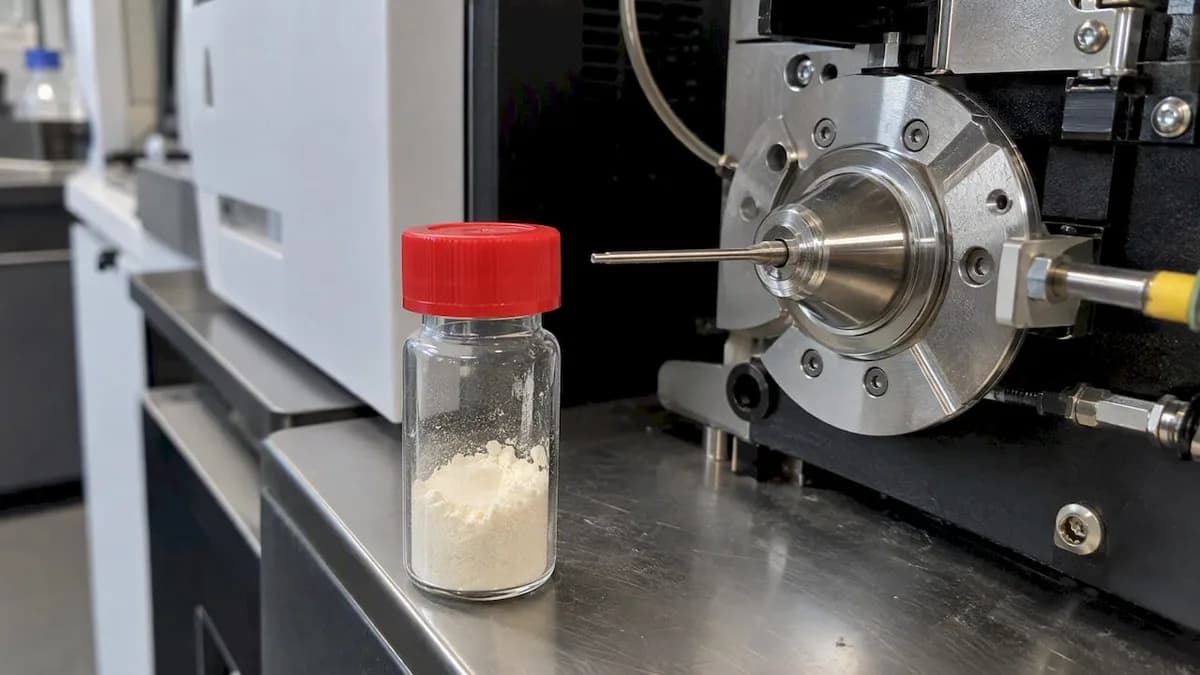
Isopaynantheine (C23H28N2O4, PubChem CID 101804033) is a minor Mitragyna speciosa alkaloid, and an isopaynantheine reference standard is what makes its identification and quantification defensible. A reference standard helps support compound identification and calibrated results. Because MS/MS alone may not separate it from its diastereomer paynantheine, confirm identity with chromatographic resolution and, where doubt remains, NMR.
TL;DR:
- A validated UPLC tandem mass spectrometry method with an Acquity BEH C18 column spans 1–200 ng/mL and takes about 22.5 minutes per sample.
- Prepare 1 mg/mL methanol stocks, store aliquots at −20°C, and set quality control levels at 1, 2.5, 100, and 180 ng/mL.
- Validate against ICH M10 using matrix matched calibrators, accuracy and precision checks, carryover testing, stability checks, and demonstrated separation of the diastereomers.
- Request full 1H and 13C NMR spectra, high resolution mass spectrometry, and circular dichroism data when findings are unexpected or matrices are new.
- Because a labeled standard may not exist, assess surrogate internal standards by calculating response factors and checking slope parallelism before routine use.
7ohyeaStrengthen Alkaloid Identification7OH Canada supplies research-grade alkaloid tablets and powders for analytical purposes, with customizable dosage options for diverse research protocols.
Explore research-grade materialsTable of Contents
- What do we know about isopaynantheine’s identity and occurrence?
- Why can MS-only workflows misidentify isopaynantheine?
- Which methods give definitive identification and quantification?
- How do we prepare stocks, calibrators and QC samples?
- What belongs in the validation checklist and the report?
- When should you require orthogonal confirmation?
- Where can you obtain research-grade alkaloid materials?
- FAQ
- Sources
What do we know about isopaynantheine’s identity and occurrence?
Isopaynantheine is a minor indole alkaloid of Mitragyna speciosa, and it has drawn pharmacological interest: kratom alkaloid probe work identified it as a kappa-opioid receptor (KOR) agonist, first reported in vivo in 2021. Accurate identification therefore matters beyond chemistry, since pharmacology and toxicology conclusions depend on knowing exactly which compound was measured.
The identifiers you should record against any standard are these:
- Formula: C23H28N2O4
- PubChem CID: 101804033
- Class: minor indole alkaloid of Mitragyna speciosa
- Reported activity: KOR agonist in pharmacological studies
Legacy characterization data for kratom alkaloids can be incomplete or inconsistent with current expectations. Researchers working on this problem emphasis full 1H and 13C NMR spectra together with HRESIMS and ECD data for unequivocal identification, rather than reliance on historical literature alone. A modern standard supplied with that spectroscopic package is the practical way to anchor your method.
Why can MS-only workflows misidentify isopaynantheine?
Isopaynantheine and paynantheine are diastereomers that differ only in the orientation of an interior hydrogen atom. They share identical ion transitions, so a transition-based method alone may not distinguish them. Work on kratom alkaloid profiling names diastereomer differentiation as a primary challenge and notes that MS/MS alone is often insufficient for confident identification.
The failure modes and fixes are consistent across the literature:
- GC/MS without derivatization often fails to resolve these diastereomers, as comparative chromatographic work showed.
- HPLC and SFC resolved the major kratom components in the same comparison. UPLC with a suitable column can achieve chromatographic separation, as the validated method below demonstrates.
- Reported identifications should include retention times and a chromatogram showing the separation.
Pro Tip:Inject paynantheine and isopaynantheine standards individually and as a mixture before running samples, and record the retention time gap. If the two peaks are not resolved in that mixture, do not report either compound from MS data alone.
Which methods give definitive identification and quantification?
For structural confirmation, run full 1H and 13C NMR plus HRESIMS and ECD. Decision-tree approaches built from these datasets distinguish paynantheine, isopaynantheine and epiallo-isopaynantheine through key chemical shifts and Cotton effects, which makes the supplier’s spectra directly checkable against your own.

For routine quantification, UPLC-MS/MS is the working method. A validated ten-alkaloid method achieved chromatographic separation of diastereomers on an Acquity BEH C18 column with an acetonitrile and aqueous ammonium acetate gradient (pH 3.5). Its linearity spans 1–200 ng/mL, with a total analysis time of about 22.5 minutes per sample.
What to document when you adopt or transfer such a method:
- Ion transitions, cone voltages and collision energies for each analyte, as reported in the original quantification study
- Representative chromatograms showing the diastereomer pair resolved
- Column, mobile phase composition, gradient and run time
- The calibration range you validate in your own matrix
If your column cannot deliver the separation, move to an HPLC variant with different selectivity or to SFC, which has also resolved these compounds.
How do we prepare stocks, calibrators and QC samples?
Published bioanalytical practice is consistent, and one UPLC-MS/MS study is a useful template: primary stocks in methanol at 1 mg/mL, calibration dilutions in acetonitrile and water (50:50 v/v) across 1–200 ng/mL, and quality control standards at four levels (LLOQ, LQC, MQC, HQC). Isolation work reports the same 1 mg/mL methanol stocks, stored at −20°C, in the characterization paper.
- Weigh the standard accurately and dissolve it in methanol to prepare a primary stock solution.
- Vortex until fully dissolved, then aliquot into amber vials and store at −20°C with the batch COA recorded on each aliquot.
- Dilute the primary stock into acetonitrile/water (50:50 v/v) to prepare working stocks.
- Build calibration points across 1–200 ng/mL from the working stocks.
- Prepare QC samples independently of a separate weighing: 1 ng/mL (LLOQ), 2.5 ng/mL (LQC), 100 ng/mL (MQC) and 180 ng/mL (HQC).
- For biological or product extracts, spike calibrators and QCs into a matched blank matrix.
Pro Tip:Vortex every thawed aliquot before dilution and discard it after one freeze–thaw cycle. Stock integrity is the cheapest variable to control and the hardest to diagnose after the fact.
What belongs in the validation checklist and the report?
Follow ICH M10, which calls for matrix matching and defined acceptance criteria for accuracy and precision. Matching the calibration matrix to the study samples is what keeps quantification reproducible.
Validation should cover:
- Accuracy and precision at the QC levels used in the method
- Selectivity, including demonstrated resolution of paynantheine from isopaynantheine
- Carryover after the highest calibrator in the validated range
- Stability of stocks, working solutions and processed samples
- Robustness to small changes in mobile phase pH and column lot
Internal standards need care. A compound-specific stable-isotope-labelled standard may not exist for this analyte, so tutorial guidance on calibration advises evaluating surrogate internal standards, calculating response factors and checking slope parallelism before routine use.
A complete report includes the COA, chromatograms showing separation, validation tables, the full set of analytical parameters, and any NMR or HRESIMS confirmation data.
When should you require orthogonal confirmation?
My position is simple: screening can live on chromatography plus MS/MS, but any result that will be published, defended or acted on should rest on a standard with spectroscopic documentation. Reruns after a disputed identification cost far more than the standard did.
Escalate to NMR or HRESIMS whenever peak resolution is marginal, the matrix is new, or the finding is unexpected. Ask every supplier for the COA and spectra up front, and treat a refusal as your answer.
— Deek
Where can you obtain research-grade alkaloid materials?
7ohyea supplies research-grade alkaloid materials for laboratory use only, not for human consumption. We source domestically in British Columbia, issue batch-specific certificates of analysis, and offer tablet and powder forms across several purities, so teams can match format to protocol.
Whichever supplier you use, request NMR and HRESIMS spectra and a COA before accepting any standard. Our purity guidance for analytical labs and reference standard checklist explain what to ask for. When you are ready, browse our full product range or start from our main page.
FAQ
What is an isopaynantheine reference standard used for?
It is used to confirm compound identity and to calibrate quantitative methods. Without it, retention time and ion transitions cannot be tied to a verified structure.
Can LC-MS/MS alone identify isopaynantheine?
Not reliably. Isopaynantheine and paynantheine are diastereomers with identical ion transitions, so identification requires chromatographic separation or orthogonal methods such as NMR, as reported in kratom alkaloid profiling.
How should I prepare and store an isopaynantheine stock solution?
Dissolve the standard in methanol to 1 mg/mL and store primary stocks at −20°C. Dilute working solutions in acetonitrile and water, as in published UPLC-MS/MS practice.
What calibration range is typical for isopaynantheine?
Validated UPLC-MS/MS work for kratom alkaloids shows linearity from 1–200 ng/mL. QC samples are prepared at LLOQ, LQC, MQC and HQC levels.
Which guideline governs validation?
Use ICH M10 for bioanalytical method validation, including matrix matching and acceptance criteria for accuracy and precision.
Sources
7ohyeaDiscuss Your Research NeedsContact 7OH Canada to ask about research-grade alkaloid formulations, dosage options, and materials for analytical purposes.77ohyea
Email us7ohyea@gmail.com