7-Hydroxymitragynine Impurities: What the Latest Studies Found
The 7-OH story went mainstream fast. In July 2025 the US Food and Drug Administration (FDA) recommended scheduling concentrated 7-hydroxymitragynine as a controlled substance, and headlines have debated the compound ever since. Buried under the noise is a quieter question that matters more to a lab: what else is in the vial?
That’s the impurity question. Peer-reviewed work now shows that concentrated 7-OH products can carry unexplained peaks, label mismatches and likely process byproducts. For analytical teams, that’s the reason a batch-specific certificate of analysis (COA) isn’t optional paperwork. Our 7-OH materials are research-grade, supplied for laboratory and analytical use only, and not for human consumption.
7ohyeaExplore 7OH Research MaterialsExplore research-grade 7OH materials for analytical work, with domestic sourcing from British Columbia and customizable dosage options.
VisitTL;DR
- Researchers have repeatedly found 7-OH levels in commercial products far above what leaf naturally holds, plus extra chromatographic peaks that don’t appear in leaf.
- Likely cause: extra chemical processing that oxidizes mitragynine. The identity and risk of the byproducts are still unknown.
- Accurate mass alone can misidentify 7-OH. Good labs pair retention time with fragmentation.
- A useful COA states the method, the validation limits and the batch. Our materials ship with batch-specific COAs.
- All our products are for research use only, not for human consumption.
Table of Contents
- Quick facts
- Why are people suddenly talking about 7-OH impurities?
- Myth vs fact: is 7-OH just “natural kratom”?
- What have analytical studies actually found?
- What did the headlines get wrong?
- Can a lab even be sure it’s looking at 7-OH?
- Is the impurity a byproduct or contamination?
- What should a lab look for on a COA?
- What’s the legal picture for Canadians and Americans?
- What this means for readers
- Where our materials fit
- Our take
- FAQ
- Sources
Quick facts
| Item | Where things stand |
|---|---|
| Use of our products | Research and analytical use only, not for human consumption |
| 7-OH in leaf | Trace amounts, tied in part to post-harvest oxidation |
| 7-OH in concentrated products | Much higher, per 2016 and 2025 studies |
| Main analytical trap | Overlapping signals at the same accurate mass |
| US regulatory step | FDA scheduling recommendation, 30 July 2025; DEA review follows |
| Canadian context | Check Health Canada’s current pages directly; rules on this compound are moving |
Why are people suddenly talking about 7-OH impurities?
Because the science caught up with the shelf. For years the debate was about kratom leaf. Now it’s about concentrated 7-OH tablets and powders, which are a different thing from leaf.
In the FDA’s 2025 assessment, the agency said high-7-OH products likely involve additional chemical processing that oxidizes mitragynine. In plain terms: these aren’t ground-up leaf. They’re made in a process, and processes leave fingerprints.
That’s where impurities come in. An impurity is anything in a sample that isn’t the thing on the label: leftover starting material, reaction byproducts, residual reagents, metals or microbes.
Myth vs fact: is 7-OH just “natural kratom”?
Myth: a high-7-OH product is simply concentrated leaf.
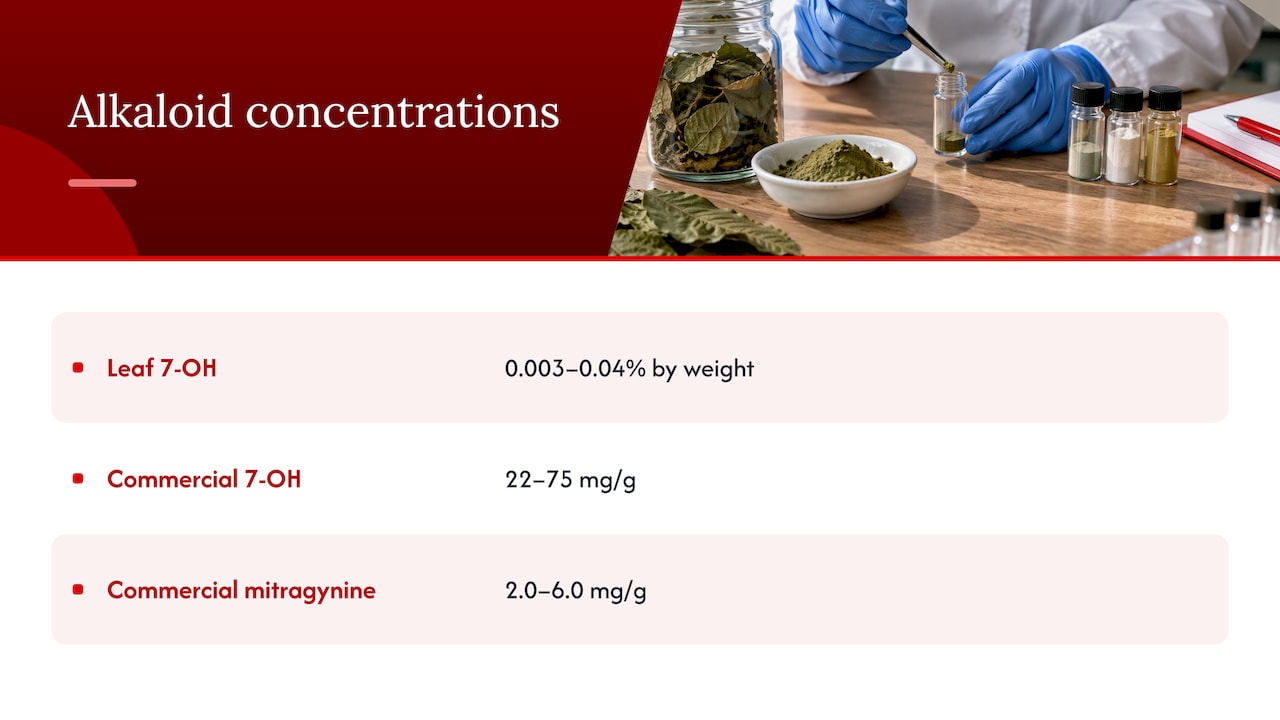
Fact: leaf holds only trace 7-OH. A 2025 study by Brown and colleagues described post-harvest oxidation as a source of trace 7-OH in leaf, citing levels of 0.003 to 0.04% by weight. The same team measured 22 to 75 mg of 7-OH per gram in the commercial products they analyzed, while mitragynine sat at only 2.0 to 6.0 mg per gram.
That’s the reverse of what leaf looks like. It’s also why the term “natural” does little work in a lab report.
What have analytical studies actually found?
Three findings keep coming up.
Levels that don’t match the leaf
A 2016 study led by Lydecker compared products against reported natural-leaf values. Seven of eight capsule formulations had 109 to 520% higher 7-OH concentrations than the cited leaf range. The authors read several high values as probable adulteration, meaning 7-OH had likely been added or generated, not simply extracted.
That was 2016. The pattern hasn’t gone away.
Labels that miss the mark
The 2025 Brown study found measured 7-OH concentrations 5 to 28% above label claims. One brand’s tablets measured 107% of the front-label claim and 128% of the back-label claim, on the same product.
For a lab, that gap is the whole story. If your protocol depends on a stated amount, an unverified label is a variable you didn’t choose.
Peaks nobody can name
Brown et al. also saw chromatograms dominated by 7-OH that lacked several common leaf alkaloids and showed extra peaks absent from native leaf. The authors considered them likely process byproducts, while noting their identities and risks were unknown. A 2026 paper from Avula and colleagues likewise reported over-oxidized byproducts in commercial products, which gives clues about how the materials were made.
To be clear about what this doesn’t show: no study has established the full impurity profile of every marketed product. A 2025 survey by Hill and colleagues suggested manufacturing from purified mitragynine and possible exposure to reagents or reaction byproducts, but it didn’t chemically characterize each product. Treat it as a pointer, not a verdict.
What did the headlines get wrong?
Two things, mostly.
First, headlines lump “kratom” and “7-OH” into one bucket. The chemistry says they’re different materials with different composition, and the lab data back that up.
Second, headlines treat a detected peak as a confirmed identity. That’s shakier than it sounds, and the 2026 work by Sheehan and colleagues is the best example.
Can a lab even be sure it’s looking at 7-OH?
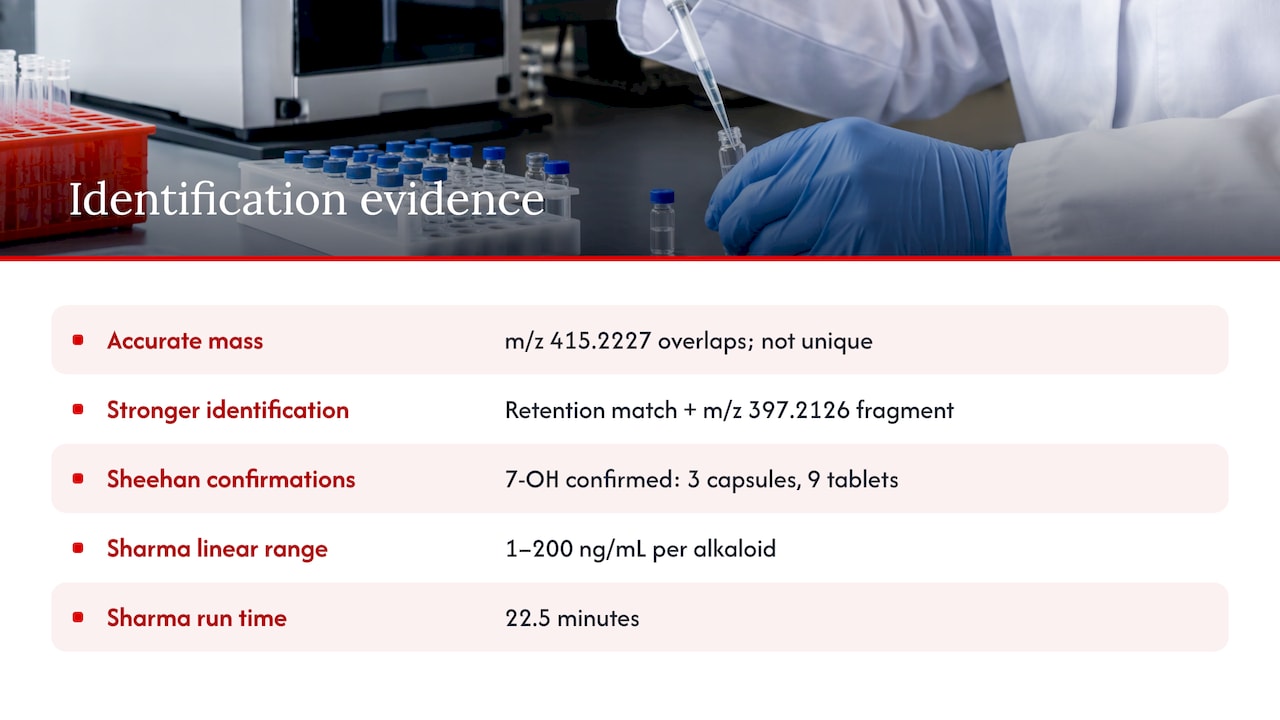
Not always, and that’s a real debate. Sheehan et al. used UHPLC-HRMS (a high-resolution liquid chromatography and mass spectrometry setup) on 38 commercial products plus authentic leaf. They found overlapping signals at m/z 415.2227, which means accurate mass alone isn’t an adequate identifier for 7-OH. In other words, something else can masquerade as it.
Their fix is practical. Combine retention-time agreement with a diagnostic fragment (a dehydration fragment at m/z 397.2126) instead of leaning on the common 415 to 190 transition alone. They confirmed 7-OH in three capsules and all nine tablets under that multicriteria approach, and they were upfront that their numbers were semiquantitative, not validated regulatory measurements.
A separate approach comes from Sharma and colleagues. In 2019 they validated a UPLC-MS/MS method for ten kratom alkaloids, using chromatographic separation for diastereomers (molecules that share a formula but differ in 3D shape) and compounds sharing transitions. The linear range was 1 to 200 ng/mL per alkaloid, with a 22.5 minute run.
There’s also a 2026 ChemRxiv preprint on a QuEChERS-LC-MS/MS method covering 42 tablets. It hasn’t been peer reviewed, so it’s a lead, not settled science. If you want the longer methods discussion, we cover it in our guide to laboratory detection methods for 7-hydroxymitragynine in Canada.
Is the impurity a byproduct or contamination?
That’s the hardest call in the field, and the evidence isn’t uniform.
Lydecker’s team reported that mitragynine and 7-OH stock solutions stayed stable for six months, and that cited checks found no conversion of mitragynine to 7-OH in chloroform or during silica-gel chromatography. That matters because it argues the high 7-OH in a product isn’t being created by the analysis itself.
On the flip side, Avula et al. reported 7-OH degrading to 3-dehydromitragynine under simulated gastric conditions. That’s a chemistry observation about stability, and it’s a reminder that 7-OH isn’t a static analyte. Sample handling and storage matter in a lab.
Bottom line: byproduct, adulterant and degradant can look alike on a chromatogram. Only orthogonal evidence (two different ways of measuring) tells them apart.
What should a lab look for on a COA?
A COA that says “99% pure” and nothing else is a headline, not data. Here’s a working checklist, built around the one published performance standard for this area.
The AOAC SMPR 2015.008 document says methods should quantify mitragynine and 7-OH and separate other relevant indole alkaloids across plant material, extracts and finished products. It sets a 7-OH single-laboratory validation range of 0.01 to 0.5%, a limit of quantitation no higher than 0.005% (50 ppm) and a limit of detection of 15 ppm.
Those figures were written for natural-product testing, so concentrated materials usually need dilution to land inside a validated range. Still, they give you a yardstick. Ask of any COA:
- Is it batch-specific? The batch number should match the material in your hands.
- What method was used? Look for chromatographic separation plus fragmentation, not accurate mass alone.
- Are the limits stated? LOD, LOQ and range tell you what the lab could and couldn’t see.
- Are related alkaloids reported? Mitragynine and other leaf alkaloids show how the material was made.
- Does the unknown-peak picture add up? Extra peaks should be flagged, not ignored.
If you’d like a fuller walk-through, see our piece on three nonnegotiables for 7-hydroxymitragynine tablet testing and our overview of purity levels for analytical labs.
One more reading tip: it helps to know what “lab tested” does and doesn’t mean on a Canadian label. This explainer on what lab-tested means in Canada covers the logic of verifying product composition.
What’s the legal picture for Canadians and Americans?
Canada first. We aren’t offering legal advice, and the rules are moving, so go to Health Canada’s own pages for the current position on 7-hydroxymitragynine and kratom products. We can’t point to a single dated Canadian notice we’d call settled here, and we won’t guess at outcomes. What we can say is where our own products stand: they’re sold for laboratory and analytical use only, and we describe them as supplied in line with Canadian legal guidelines for lawful lab use.
Now the US. On 30 July 2025, the FDA announced it was recommending that concentrated 7-OH be placed in Schedule I. The Drug Enforcement Administration (DEA) would then review the recommendation and run a public rule-making process, which can take months. The FDA said the step would apply to concentrated 7-OH, not to kratom leaf products. A recommendation isn’t a final rule, and we won’t predict how the process ends.
What this means for readers
If you work in a lab, the practical takeaways are short.
- Treat identity as something you prove. Accurate mass alone isn’t enough, per the 2026 data.
- Don’t trust labels at face value. Published work has found measured values both above and well off label claims.
- Ask for the paperwork. A batch-specific COA with method and limits is the baseline.
- Watch the regulatory calendar. US scheduling and Canadian guidance can change sourcing rules quickly.
- Keep it in the lab. These materials are for research use only, not for human consumption.
If you’re a curious reader outside a lab, the headline lesson is simpler: the impurity question is a chemistry question, and it has no confirmed answers yet.
Where our materials fit
We supply research-grade 7OH tablets and powders, plus related mitragynine alkaloid reference materials, from Canadian sourcing in British Columbia. Each comes with a batch-specific certificate of analysis, and we offer bulk purchasing for research teams. Domestic sourcing means fast shipping and no border fees.
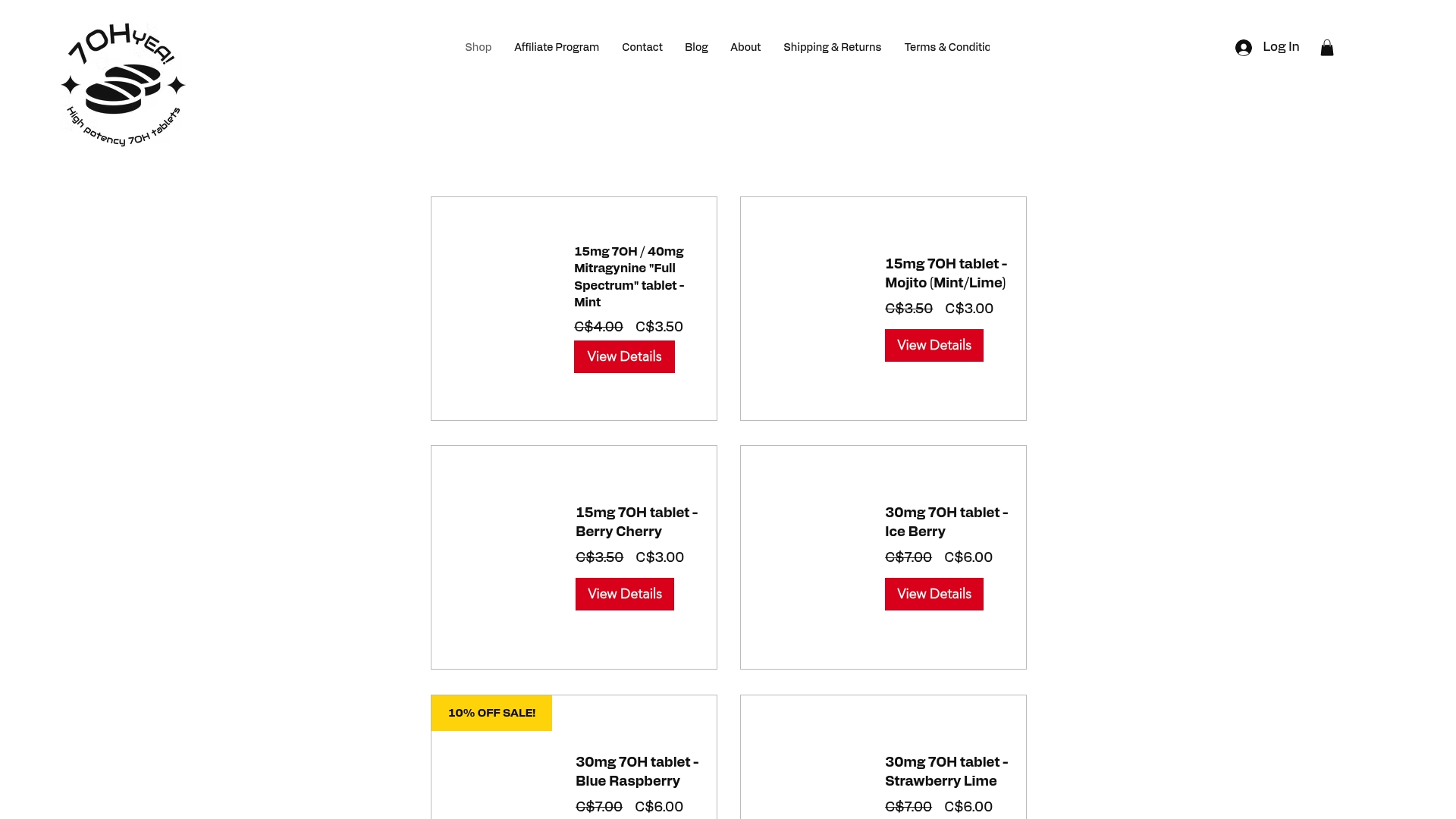
Our 81% pure 7OH powder is listed at 50 CAD, and our 43% pure mitragynine “Full Spectrum” powder at 6.75 CAD. Everything we sell is for laboratory and analytical use only, not for human consumption.
Browse the full range on our 7OH research materials page, or read how we frame the compound in 7OH vs 7-hydroxymitragynine.
Our take
We think the impurity debate is the most useful thing to happen to this field in years. It forces everyone to show their data.
Our position is simple. A research material is only as good as the paper that travels with it, which is why we ship batch-specific certificates of analysis and keep our sourcing domestic. Your lab shouldn’t have to wonder where a batch came from or how it was measured.
We also think the field is better when suppliers speak plainly: our products are for research use only, not for human consumption. That’s the line, and we’d rather state it loudly than blur it.
John
FAQ
What are the most common impurities reported in 7-OH products?
Published studies describe extra chromatographic peaks absent from leaf, over-oxidized byproducts and missing leaf alkaloids. The identities and risks of many of these peaks remain unknown. Elemental impurities such as lead and arsenic have also been reported in some kratom products generally.
Why can’t a lab just rely on accurate mass to identify 7-OH?
Because overlapping signals at the same m/z can mimic it. The 2026 Sheehan study recommends combining retention time with diagnostic fragmentation to avoid false identification.
Does a high-purity claim guarantee no impurities?
A purity number only means something alongside its method, limits and batch. Read the whole COA, including how related alkaloids and unknown peaks were handled.
Are your products for human consumption?
No. Our 7OH tablets, powders and related alkaloid materials are for laboratory and analytical research use only, and are not intended for human consumption.
Is this legal advice?
No. The article reports announced actions and published studies. For your situation, check Health Canada’s current guidance or speak with a qualified lawyer.
So here’s our question for you: when a supplier hands you a COA, what’s the one line you check first? Tell us in the comments.
7ohyeaDiscuss Your Research NeedsEmail us to discuss research-grade 7OH materials and the customizable dosage options available for analytical work.77ohyea
Email us7ohyea@gmail.comSources
- Elevated 7-Hydroxymitragynine Levels Found in Products (Brown et al., 2025)
- Suspected Adulteration of Commercial Kratom Products with 7-Hydroxymitragynine (Lydecker et al., 2016)
- Avoiding False Identification of 7-Hydroxymitragynine (Sheehan et al., 2026)
- FDA assessment of 7-hydroxymitragynine (2025)
- De Facto Opioids: Characterization of Novel Products (Hill et al., 2025)
- Simultaneous quantification of ten key kratom alkaloids (Sharma et al., 2019)
- AOAC SMPR 2015.008 alkaloid method requirements
- Quantitative analysis of 7-hydroxymitragynine in commercial kratom products (Avula et al., 2026)
- Medscape: FDA Seeks Schedule I Status for 7-OH, 30 July 2025