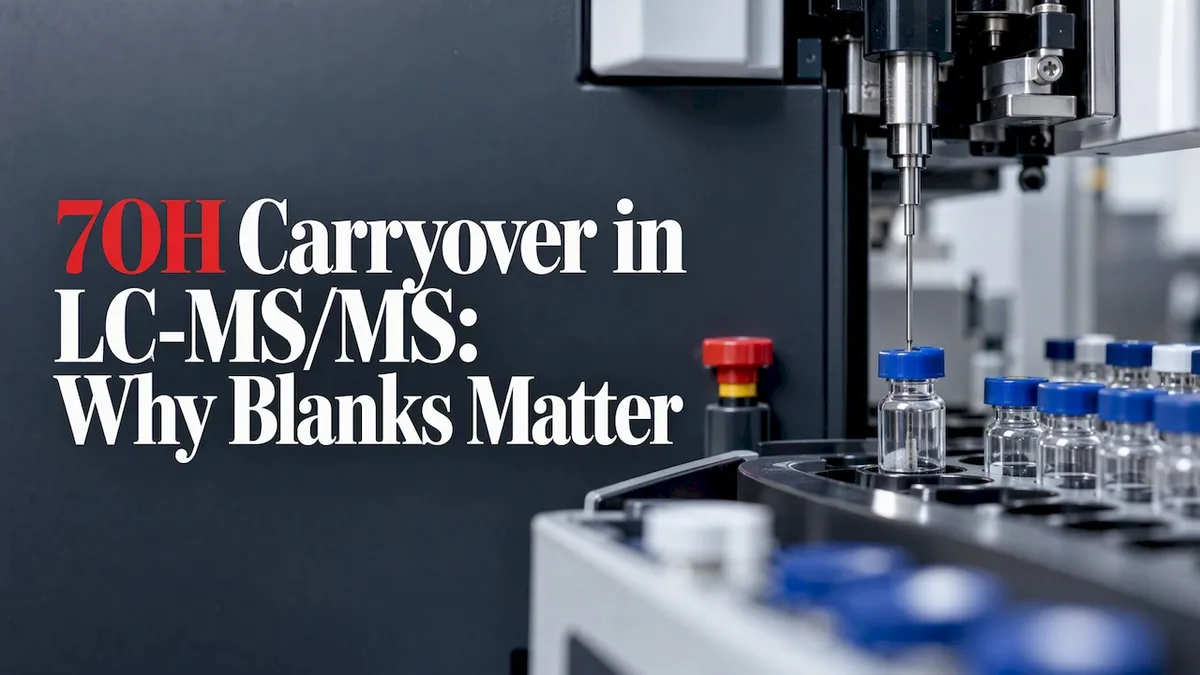
7OH Carryover in LC-MS/MS: Why Blanks Matter

The 7OH debate is loud right now. In July 2025, the U.S. FDA recommended that the DEA classify 7-hydroxymitragynine as a Schedule I controlled substance, and the argument over this compound hasn’t cooled since. More scrutiny means more labs measuring it, and measuring it badly is easy. The sneakiest problem is carryover: a ghost of the last sample showing up in the next one. This article explains what that means for 7OH, how to test for it, which limits regulators use, and what to do about it. Our products are for research use only, not for human consumption.
7ohyea7ohyea.caSupport More Reliable 7OH Analysis7OH Canada offers research-grade 7OH tablets and powders in customizable dosage options for laboratory analytical purposes.
Explore research materialsTL;DR
- Carryover is analyte from one injection turning up in the next, and it can make a blank look like a positive.
- Validation guidance says to inject blanks right after your highest standard, then compare the blank response to fixed limits.
- Under the 2011 EMA guideline, the limit is 20% of the lowest standard’s response, and 5% for the internal standard.
- 7OH is a sticky, fragile alkaloid, so wash steps and sample handling matter as much as the column.
- Document everything, including the fixes. Regulators care about how you interpreted your data.
Table of Contents
- Quick facts
- Why is everyone suddenly talking about 7OH measurement?
- What does carryover actually mean?
- How do labs test for 7OH carryover?
- What limits should a validated method meet?
- Where does 7OH carryover come from?
- How do you cut carryover down?
- What should the report say?
- What did the headlines get wrong?
- What does this mean for readers?
- Where can labs source reference materials?
- FAQ
- Sources
Quick facts
| Item | What to know |
|---|---|
| Topic | Carryover in LC-MS/MS methods for 7-hydroxymitragynine (7OH) |
| Typical test | Blank injected after the highest calibration point |
| EMA 2011 limit | Blank response at or under 20% of the LLOQ response, 5% for internal standard |
| Common culprits | Autosampler needle, loop, valves, column, ion source |
| Product status | Our materials are for laboratory research only, not for human consumption |
| Legal note | This is not legal advice. Check current Health Canada notices |
LLOQ means lower limit of quantification, the smallest concentration your method can measure reliably. ULOQ is the upper limit, the highest standard on your curve.
Why is everyone suddenly talking about 7OH measurement?
Because the compound moved from a niche alkaloid to a headline. 7-hydroxymitragynine (7OH) is one of the alkaloids, natural plant compounds, associated with the kratom plant. When regulators in the U.S. started talking about scheduling, labs, regulators and journalists all wanted numbers. And numbers are only as good as the method behind them.
Here’s the quiet part nobody puts in a headline: a number from an LC-MS/MS run (liquid chromatography paired with tandem mass spectrometry, a machine that separates compounds and then weighs their fragments) can be wrong without looking wrong. Carryover is one of the classic ways that happens.
We sell research-grade materials, so we have a stake in this. Reference materials are only useful if the method downstream can be trusted.
What does carryover actually mean?
Carryover is when test substance from a preceding sample enters the next injection. The Handbook of LC-MS Bioanalysis describes two routes: solvent lingering in a “dead” space in the system, or analyte sticking to parts of the instrument.
The same chapter notes that regulators worry about carryover and contamination because they change how study data gets interpreted. That’s the real stake. A blank that isn’t blank can turn a non-detect into a detect, or inflate a low-concentration sample.
Myth: “If the blank looks clean, we’re fine”
Fact: a clean-looking blank in one run says little. Carryover depends on what ran before it. A blank after a low sample can look spotless while a blank after your top standard shows a peak. That’s why validation guidance tests the worst case on purpose.
Myth: “Carryover and contamination are the same thing”
Fact: they aren’t. Carryover follows the previous injection and typically fades over successive blanks. Contamination, from dirty solvents or a tainted vial, tends to show up regardless of order. Thermo Fisher’s knowledge base recommends telling the two apart before you start fixing things, since the fixes differ. That’s a vendor view, so treat it as practical advice rather than a rule.

How do labs test for 7OH carryover?
The core idea is simple: run a high sample, then run a blank, and look.
The ANSI/ASB Standard 036, a U.S. forensic toxicology validation standard from 2019, says labs assess carryover by analyzing blank matrix right after a high-concentration sample or reference material. For quantitative assays, the study may be limited to the highest calibration point. It also says carryover must be evaluated for methods meant for confirmation or quantitation, unless the lab handles it in its QA/QC practices.
The EMA bioanalytical guideline is similar. Carryover should be minimised during method development and assessed during validation by injecting blanks after a high sample or a ULOQ standard.
In practice, a lab’s 7OH check usually has three parts:
- Inject the highest calibration standard.
- Inject one or more blank matrix samples straight after.
- Compare any blank signal at the 7OH retention time against the acceptance limits.
That’s it. It takes minutes, and it can save a whole study.
What limits should a validated method meet?
Under the EMA 2011 guideline, carry-over in a blank following the ULOQ shouldn’t exceed 20% of the LLOQ response for the analyte. For the internal standard, the ceiling is 5% of its response. Both numbers come from the same EMA document.
The newer ICH M10 guideline (adopted 2022, effective 2023) adds a useful principle: validation assessments should be relevant to the sample-analysis workflow. In plain terms, test carryover the way you’ll actually run samples.
We haven’t confirmed which guideline your institution or sponsor expects, and that varies. Check your own SOPs and any contract requirements before you lock the criteria.
Where does 7OH carryover come from?
The usual suspects are the parts of the system that touch your sample. A 2020 troubleshooting paper on LC-MS carry-over says it can come from analyte adsorption or viscosity, and lists the autosampler needle, loop, lines, seals, valves, the column and the MS ion source as candidate sites.
A 2019 paper quantifying ten kratom alkaloids found carryover could sit in the MS ion source, including transfer tubes and capillaries. Fixes there included sonication in solvent mixtures such as water/methanol or isopropanol, and replacing components when cleaning didn’t work.
The lookalike problem
There’s a second trap that gets mistaken for carryover. Kratom alkaloids can share ion transitions, meaning the machine’s “fingerprint” fragments overlap. The same paper says such alkaloids need chromatographic separation to confirm peak purity, or samples may be over-quantified for certain alkaloids.
So a stubborn peak in a blank isn’t always leftover 7OH. It could be a related alkaloid eluting nearby. Check retention time and transition ratios before you blame the autosampler. For a deeper look at how 7OH and its parent compound differ, see our guide on mitragynine versus 7-hydroxymitragynine.
How do you cut carryover down?
Start with the wash. The 2019 kratom alkaloid study handled 7OH carryover with intensive autosampler needle washes. It used a strong wash of acetonitrile, water and isopropyl alcohol (70:10:20, v/v) and a weak wash of acetonitrile, water and methanol (1:1:1, v/v) between injections. That’s one lab’s recipe, not a universal one. Treat it as a starting point to test against your own system.
A few other levers worth knowing:
- Chromatography. One published kratom method used a C18 column with a 10 mM ammonium acetate buffer at pH 3.5 and acetonitrile to separate the alkaloids. That’s a vendor application note, so use it as a reference point.
- Autosampler temperature. In the ten-alkaloid study, the autosampler was held at 10°C, and the kratom alkaloids were stable there for up to 48 hours.
- Injection order. Run samples from low to high where you can, and add blanks after high ones.
- Hardware. If a wash won’t clear it, suspect worn seals, valves or ion source parts.
What about sample stability?
This is the part headlines skip. A 2019 thesis-era study found 7OH was acid-labile (it breaks down in acid) and the least stable of the five alkaloids it examined. That matters because an unstable analyte can produce confusing blanks and drifting results that look like carryover but aren’t.
We dug into this in our piece on 7OH degradation and artifact risk. Short version: know whether your 7OH signal is the compound you started with or something it turned into, and don’t let a handling artifact masquerade as an instrument problem.
What should the report say?
Write it down. The WHO’s Annex 6 guideline on bioanalytical method validation says carryover results and mitigation strategies must be documented in the bioanalytical report to justify reported concentrations. If carryover turns up during study sample analysis, labs must document the impact on accuracy and precision and explain what they did, such as not randomizing samples or inserting blank samples.
A review of LC-MS/MS use in toxicology adds a batch-level habit: batch acceptance includes checking for clean blanks and transition ratios within tolerance.
A tidy report usually includes:
- The carryover test design and the blank order
- The measured blank response as a percentage of LLOQ and internal standard
- Any wash or hardware changes you made, and why
- A note on how study samples were ordered
If you want a wider view of what labs need in place for 7OH, our posts on laboratory detection methods for 7-hydroxymitragynine in Canada and tablet testing essentials cover the surrounding workflow.
What did the headlines get wrong?
Three things, mostly.
“The science is settled.” It isn’t. The Venable legal analysis of the FDA announcement points out that the evidence base differs from earlier emergency scheduling cases, which followed patterns of multiple deaths and law enforcement submissions. The regulatory path was described as uncertain, and we won’t guess how it ends.
“A lab result is a lab result.” It isn’t. Two labs can report different 7OH numbers from the same material if one has uncontrolled carryover and the other doesn’t. Method quality is the story behind the number.
“7OH and kratom are the same.” They’re related but not interchangeable. Kratom is a plant material with a mix of alkaloids, and 7OH is one of them. Mixing the terms up muddies both the law and the analysis.
What does this mean for readers?
For Canadian labs, the practical message is calm and unglamorous.
- Test carryover on day one. Don’t leave it to the end of validation.
- Pick your acceptance criteria early. The 20% and 5% EMA figures are a widely used reference, though your sponsor or institution may set its own.
- Keep the paperwork. If anyone challenges a result later, your blank data and mitigation notes are the defence.
- Watch the regulatory news. What’s been announced in the U.S. is a recommendation to the DEA, not a final rule, as of the sources we reviewed. For Canada, check Health Canada’s current notices yourself. This article isn’t legal advice.
And a reminder: our materials are sold for laboratory research only. They’re not for human consumption, and nothing here suggests otherwise.
Our take
We think carryover is the most underrated quality issue in 7OH analysis. Everybody asks about purity on the certificate. Fewer ask whether the method downstream can tell a true low result from a leftover peak.
That’s why we focus on research-grade materials with batch-specific certificates of analysis, made in Canada and shipped domestically. A reference material you can trust makes it far easier to separate a material problem from an instrument problem.
When a lab sees an odd peak in a blank, the first question is whether it’s the standard, the system or the method. A well-documented material removes one of the three suspects. That’s the job we want to do.
John
Where can labs source reference materials?
If you’re building or revalidating a 7OH method, you’ll need standards and test materials with clear documentation. Our 81% pure 7OH powder is listed at $50 CAD, and our catalogue also includes related mitragynine materials for chromatographic work. You can see the 81% pure 7OH powder here.
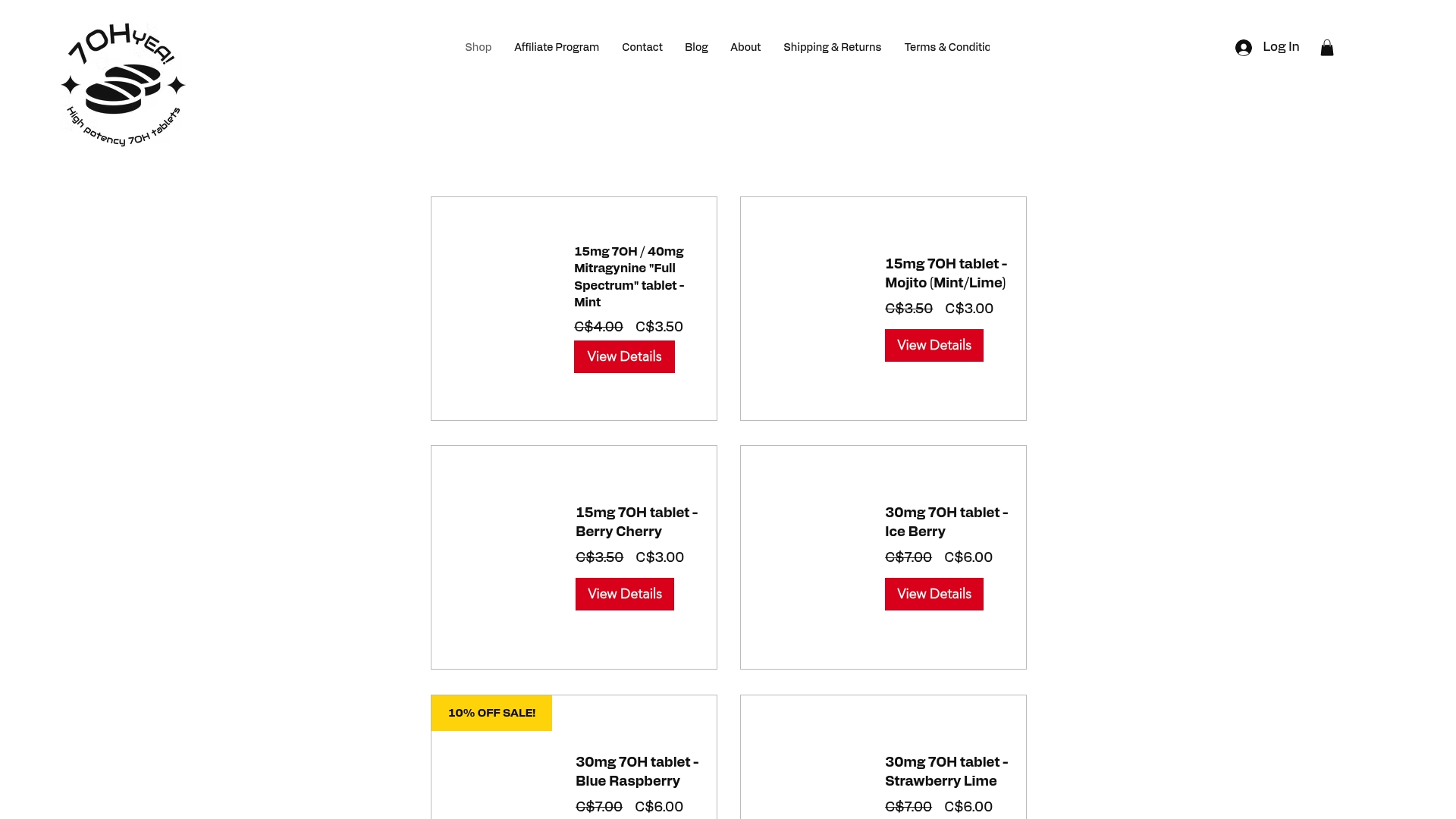
If your validation also needs a related alkaloid to check separation, our 43% pure mitragynine full spectrum powder is listed at $6.75 CAD. All of it is for research use only, not for human consumption. Batch details come with certificates of analysis, so ask for the one matching your lot.
FAQ
What is carryover in HPLC and LC-MS?
It’s analyte from one injection that shows up in the next, either because solvent lingers in a dead space or because the compound sticks to parts of the system. It matters because it can distort the measurement of the following sample.
How much carryover is acceptable?
Under the EMA 2011 guideline, a blank after the highest standard shouldn’t exceed 20% of the LLOQ response for the analyte or 5% of the internal standard response. Your lab, sponsor or regulator may set stricter or different criteria, so confirm which applies.
Where should I look first when 7OH keeps showing up in blanks?
Start with the autosampler: needle, loop, lines and seals, then valves, the column and the ion source. Also check whether a related alkaloid with overlapping transitions is eluting close by, since that can look like carryover.
Does carryover have to be reported?
Yes, in regulated bioanalysis. WHO Annex 6 expects carryover results and mitigation steps in the report, along with the impact on accuracy and precision if it appears during sample analysis.
Is 7OH legal in Canada?
We can’t give legal advice, and rules can change. Check Health Canada’s current notices and speak to a qualified professional before purchasing or handling any such material.
So here’s our question for you: should method validation for 7OH carry its own carryover standard, or are the general bioanalytical guidelines enough? Tell us what your lab does.
Sources
- Handbook of LC-MS Bioanalysis, carryover chapter
- ANSI/ASB Standard 036, 2019
- EMA Guideline on bioanalytical method validation, 2011
- ICH guideline M10 on bioanalytical method validation
- Troubleshooting carry-over in LC-MS analysis
- Simultaneous quantification of ten key kratom alkaloids
- Kratom alkaloid stability study
- Quantitation of kratom components from urine, application note
- WHO Annex 6, bioanalytical method validation
- Review of LC-MS/MS use in toxicology
- Thermo Fisher, Carryover and Contamination
- Venable, FDA announces plan to restrict 7-OH products
7ohyeaAsk About 7OH Research MaterialsEmail 7OH Canada with questions about research-grade tablets and powders for laboratory analytical purposes.77ohyea
Email us7ohyea@gmail.com