Custom Purity 7OH for Canadian Labs: Verify the Batch COA First

Custom purity 7OH refers to the assay percentage of 7-hydroxymitragynine in a powder, or the declared milligram content per tablet, and reputable suppliers specify both on a batch certificate of analysis. Before ordering, request the batch COA and confirm the assay method, ideally HPLC or UPLC-MS/MS, so the declared purity matches what a third-party lab actually measured.
TL;DR:
- Tablets suit repeatable dosing at declared strengths of 15, 30, or 50 mg, while powders allow custom scaling and analytical calibration.
- Before ordering, require a batch certificate that names the analyte, assay, method, lab, matching lot, and relevant contaminant screening, such as metals and solvents.
- Store samples refrigerated at 4°C or below or at controlled room temperature, and avoid heat and strongly acidic or basic conditions that speed degradation.
- For custom batches, state the target assay and acceptable tolerance in the order, then verify the shipment’s lot number against its certificate.
- Confirm current institutional and national rules before ordering concentrated isolates, and follow lab procedures for protective equipment, storage, and documented chemical waste disposal.
7ohyeaFind 7OH Formats for Lab Work7OH Canada offers research-grade 7OH tablets and powders in customizable dosage options for laboratory analytical work.
Visit 7OH CanadaTable of Contents
- Calibrated dosage formats and typical purity levels available to labs
- How purity is measured: reading certificates of analysis and assay methods
- Stability and storage: what lab teams must control to preserve 7OH integrity
- Sourcing and quality assurance practices for research-grade 7OH
- Integrating custom-purity 7OH into laboratory workflows and specifying custom doses
- Legal and regulatory considerations for working with concentrated 7OH research materials
- Advanced insights: synthesis routes behind high-purity 7OH
- Protocols for handling and preparing 7OH samples in the lab
- Comparing tablets and powders across research applications
- Disposing of 7OH research materials in compliance with regulations
- Safety equipment and handling precautions for working with 7OH
- Publisher perspective: supporting reproducible research with configurable purity
- Ordering custom-purity 7OH for your research protocol
- FAQ
- Sources
Calibrated dosage formats and typical purity levels available to labs
Laboratories working with 7-hydroxymitragynine generally choose between two formats: fixed-milligram tablets and assay-percentage powders. Each serves a distinct purpose in a research protocol, and the right choice depends on whether a study prioritizes reproducibility across replicates or flexibility in dose titration.
Tablets are manufactured to a declared milligram strength, with 15 mg, 30 mg, and 50 mg among the common calibrated strengths researchers encounter in supplier catalogues. Because each unit carries a fixed amount of active compound, tablets reduce the variability that comes from weighing out powder for every trial, which matters when a protocol calls for repeated dosing across many samples or subjects. The tradeoff is less granularity: a researcher who needs 22 mg per unit cannot get there with a 15 mg or 30 mg tablet without splitting doses, which introduces its own measurement error.

Powders are reported differently. Rather than a fixed mg per unit, suppliers declare an assay percentage representing the proportion of 7-hydroxymitragynine (or, in full-spectrum products, mitragynine alongside it) in the material. Assay percentages come from supplier product listings and should always be verified against the accompanying COA rather than taken at face value from a product label.
Choosing between the two formats comes down to what the protocol demands:
- Tablets suit studies that need consistent, reproducible dosing across many trials with minimal prep time.
- Powders suit studies that require precise per-gram control, custom dose scaling, or compatibility with specific solvent systems during sample preparation.
- Full-spectrum powders suit comparative research into alkaloid interactions rather than isolated-compound pharmacology.
- High-assay powders suit work where minimizing matrix interference is a priority, such as mass spectrometry calibration.
Neither format is inherently superior. A lab running a multi-week dosing study will likely default to tablets for the operational simplicity, while one developing a new analytical method will often prefer powder for the flexibility to weigh exact quantities.
How purity is measured: reading certificates of analysis and assay methods
A certificate of analysis is only useful if the researcher reading it knows what to check. A COA that looks professional but omits key fields tells you less than a plain one that includes everything relevant.
At minimum, a usable COA for 7-hydroxymitragynine should include:
- The analyte name stated explicitly as 7-hydroxymitragynine, not a generic “kratom extract” label.
- The assay percentage, expressed as a specific number rather than a range or a marketing claim.
- The analytical method used to generate that number, such as HPLC or UPLC-MS/MS.
- The testing laboratory’s name and, ideally, its accreditation status.
- A lot number that matches the physical packaging the material ships in.
- A contaminant panel covering heavy metals, residual solvents, and microbial load where applicable.
The method matters as much as the number itself. HPLC and UPLC-MS/MS are validated, widely accepted approaches for alkaloid quantification, and a validated UPLC-MS/MS method for determining 7-hydroxymitragynine in biological matrices demonstrates the kind of analytical rigour a COA should reflect, with a defined linear range and a low limit of quantification suitable for verification work. Royal Society of Chemistry publications on assay development further illustrate how purity characterization for 7-OH and related compounds continues to be refined. A COA citing one of these established methods gives a researcher more confidence than one that simply states “tested” without naming a technique.
Watch for a few red flags. A COA that lacks the testing laboratory’s name, omits a lot number, or skips contaminant screening entirely is incomplete, and incomplete documentation makes it difficult to trace a problem back to its source if one ever arises. Adulteration has been documented in commercial kratom-derived products before: a Journal of Medical Toxicology report describes suspected adulteration of commercial products with 7-hydroxymitragynine, underscoring why labelled content and actual detected content do not always match without independent verification.
Pro Tip:Keep a running file of COAs by lot number so you can cross-reference assay drift across shipments from the same supplier over time.
Stability and storage: what lab teams must control to preserve 7OH integrity
7-hydroxymitragynine is chemically less stable than mitragynine, and storage conditions directly affect whether a sample still matches its COA by the time it reaches the bench. An accelerated stability study found that MG-OH degrades significantly at elevated temperatures and under acidic or basic extremes, while remaining comparatively stable at moderate pH when refrigerated at 4°C or below, or at moderate temperatures for periods of at least eight hours.
One accelerated stability study found 7-hydroxymitragynine degrades meaningfully under heat and pH extremes, while holding stable at moderate pH when refrigerated at 4°C or below. That distinction shapes how a lab should plan sample handling from the moment a shipment arrives.
Practical storage rules follow directly from that finding:
- Store powders and prepared solutions refrigerated or at controlled room temperature rather than at ambient conditions that fluctuate.
- Avoid preparing or storing samples at strongly acidic or strongly basic pH, since both extremes accelerate degradation.
- Seal vials to minimize oxygen headspace, and consider desiccants or oxygen scavengers for materials intended for long-term storage.
- Match solvent choice and pH during sample preparation to the ranges associated with the compound’s known stability window.
For time-sensitive work, plan the analytical run promptly after opening a vial rather than letting prepared solutions sit on the bench.
Sourcing and quality assurance practices for research-grade 7OH
Procurement decisions for 7-hydroxymitragynine should rest on documentation, not on marketing language. A batch-specific COA from a named, third-party laboratory is the minimum bar, and accreditation to ISO/IEC 17025 adds a further layer of confidence because it signals the lab operates under a recognized quality management standard for testing competence.
Beyond the headline assay number, a thorough procurement process requests lot traceability (so a specific shipment can be matched to its specific test results), the declared analytical method, and a contaminant panel covering heavy metals, residual solvents, and microbial contamination where relevant to the material’s intended use.
A practical procurement checklist looks like this:
- Confirm a batch-specific COA is provided with the shipment, not a generic template reused across lots.
- Verify the analytical method is named explicitly rather than left as “lab tested.”
- Check whether the testing lab carries third-party accreditation such as ISO/IEC 17025.
- Match the lot number on the COA against the lot number on the physical packaging.
- Ask whether the supplier can provide additional test data on request, such as a broader contaminant screen, for a study with stricter documentation requirements.
A supplier that readily shares this information without resistance is generally a more reliable long-term partner than one that treats testing documentation as proprietary or withholds it until after purchase.
Integrating custom-purity 7OH into laboratory workflows and specifying custom doses
Ordering custom-purity material works best when the request is specific rather than open-ended. Vague language like “high purity” or “research grade” leaves room for interpretation; a precise specification does not.
A workable order request includes language such as: “81% 7OH assay, an agreed tolerance, COA required with lot number, HPLC or UPLC-MS/MS method stated, turnaround within [supplier’s stated timeframe].” Specifying a tolerance band matters because no production batch hits an exact percentage every time, and a tolerance tells the supplier what variance is acceptable for the protocol.
Once material arrives, converting assay percentage into usable quantities is straightforward arithmetic. For tablets, the math is already done for you: a 50 mg tablet is formulated to deliver 50 mg of active compound per unit, assuming the COA confirms that declared strength.
Incoming quality checks should follow a short routine:
- Confirm the lot number on the COA matches the lot number on the shipment packaging.
- Store the material according to the stability guidance appropriate to its form before any prep work begins.
- For critical applications, run a spot assay in-house or send a sample to a lab using a validated UPLC-MS/MS method to independently confirm the declared purity before relying on it for downstream work.
- Log the COA, lot number, and receipt date in a traceable record tied to the eventual study output.
Pro Tip:Build the tolerance band into your experimental design up front rather than assuming every batch will hit the exact labelled percentage.
Legal and regulatory considerations for working with concentrated 7OH research materials
Regulatory attention on concentrated 7-hydroxymitragynine extracts and synthetic derivatives has grown internationally, and the regulatory status of these materials can shift over time, so a researcher’s first step should always be checking current institutional and national guidance rather than relying on what was true a year ago. The WHO Expert Committee on Drug Dependence has reviewed kratom and its alkaloids, noting that 7-hydroxymitragynine shows increased potency relative to mitragynine and recommending that kratom and its alkaloids remain under surveillance rather than facing immediate reclassification.
Before procuring or storing concentrated material, confirm approvals with your institution’s compliance or biosafety office. This step exists independently of what a supplier’s own compliance language states, since institutional policy and national regulation take precedence over any single vendor’s assurances.
A distinction worth keeping in mind for regulatory purposes is the difference between trace amounts of 7-hydroxymitragynine naturally present in whole-leaf kratom material and concentrated isolates manufactured specifically to elevate that percentage. Regulatory frameworks increasingly treat these differently, since a concentrated isolate presents a different risk and oversight profile than a trace constituent of a botanical product. A few points to keep in view:
- Confirm with your institutional compliance office before any concentrated extract is ordered or stored on-site.
- Check current national and regional guidance rather than assuming last year’s rules still apply.
- Treat whole-leaf trace content and concentrated isolates as regulatory categories, not interchangeable terms, when documenting a protocol.
Advanced insights: synthesis routes behind high-purity 7OH
Patent and analytical literature document methods for converting mitragynine into 7-hydroxymitragynine, and these semisynthetic routes can yield material at purity levels well above what whole-leaf extraction alone typically achieves. That background is useful for interpreting a COA, since it explains why some high-assay powders are produced through conversion chemistry rather than direct isolation from plant material.
Semisynthetic origin can leave analytical fingerprints that a careful lab should watch for, including oxidation byproducts or isobaric artifacts that coelute with the target compound on less selective methods. A COA built on a validated, selective method such as UPLC-MS/MS is better positioned to distinguish these artifacts from the declared analyte than a less specific technique would be. This section is offered as background for interpreting documentation, not as procedural guidance, and readers seeking more on conversion chemistry and its Canadian regulatory context can consult our overview of mitragynine-to-7OH conversion.
Protocols for handling and preparing 7OH samples in the lab
A basic standard operating procedure for 7-hydroxymitragynine sample handling starts before the vial is even opened. Confirm the COA and lot number match the shipment, record receipt conditions, and move the material directly into appropriate storage rather than leaving it on a bench at ambient temperature.
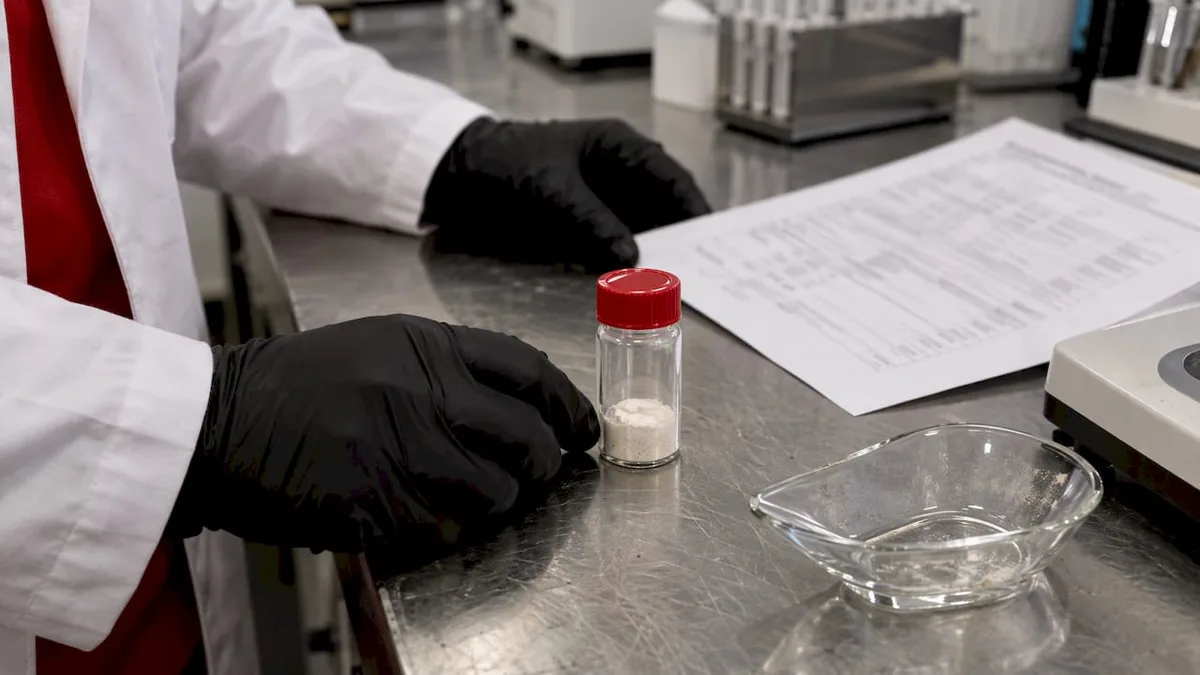
When preparing a working solution, select solvent and pH based on the stability ranges discussed earlier, and avoid extremes that accelerate degradation. Weigh powders on a calibrated analytical balance, record the exact mass used, and calculate the resulting active compound quantity based on the COA’s declared assay percentage rather than an assumed round number.
Document every preparation step: mass weighed, solvent and volume used, final concentration, preparation date, and analyst initials. This record becomes essential if a later assay shows unexpected variance, since it lets you trace whether the issue originated in the original material or in sample preparation.
Comparing tablets and powders across research applications
Tablets and powders serve different research needs, and neither format replaces the other across all applications. For dose-response studies requiring consistent, repeatable administration across many trials, tablets reduce weighing error and prep time, since each unit already carries a declared milligram strength. For analytical method development, calibration curve construction, or studies requiring precise fractional-milligram quantities, powders offer the granularity tablets cannot.

Full-spectrum powders, which retain a broader alkaloid profile such as the 43% mitragynine full-spectrum formulation, suit comparative alkaloid-interaction research, while high-assay isolates like 81% 7OH powder suit work where minimizing background matrix interference matters most, such as mass spectrometry reference standards. The right choice depends less on which format is “better” and more on what the specific protocol is trying to measure.
Disposing of 7OH research materials in compliance with regulations
Post-research disposal of 7-hydroxymitragynine materials should follow your institution’s chemical waste management protocols, which typically require logging the substance, quantity, and disposal method before any material leaves the lab. Never dispose of concentrated extracts down a drain or in regular waste streams, since institutional and environmental regulations generally classify research chemicals of this kind as controlled waste requiring documented handling.
Coordinate with your environmental health and safety office on the appropriate disposal vendor or on-site neutralization procedure, and retain disposal records alongside your original COA and usage logs. This creates a complete chain of custody from receipt through disposal, which matters both for regulatory compliance and for any audit of research material handling that your institution may conduct.
Safety equipment and handling precautions for working with 7OH
Standard laboratory personal protective equipment applies when handling concentrated 7-hydroxymitragynine: nitrile gloves, safety glasses, and a lab coat at minimum, with a fume hood or ventilated enclosure recommended when weighing fine powders to avoid inhalation of airborne particulate.
Work on a dedicated, cleanable surface, and avoid eating, drinking, or applying cosmetics in the handling area. Keep a spill kit appropriate for fine powders nearby, and train anyone handling the material on your institution’s specific exposure response protocol. Because 7-hydroxymitragynine is a potent alkaloid, treat accidental skin or eye contact seriously and follow your institution’s standard chemical exposure procedure rather than improvising a response.
Publisher perspective: supporting reproducible research with configurable purity
We approach 7OH purity the way researchers do: as a documentation problem first and a product problem second. Sourcing material domestically from British Columbia lets us keep turnaround fast and avoid the delays that cross-border shipments of research chemicals often introduce, and we provide batch-specific certificates of analysis.
Every product we offer is intended strictly for laboratory and analytical use, never for human consumption, and we expect researchers to confirm institutional approval before procurement.
If you are planning an order, request the COA first, specify your required assay and tolerance, and confirm your lab’s compliance sign-off before material ships.
— Deek
Ordering custom-purity 7OH for your research protocol
Once you know the assay percentage or tablet strength your protocol requires, ordering is the easy part. Our category page for 7OH products lists our tablet and powder options, and we provide batch-specific COAs.
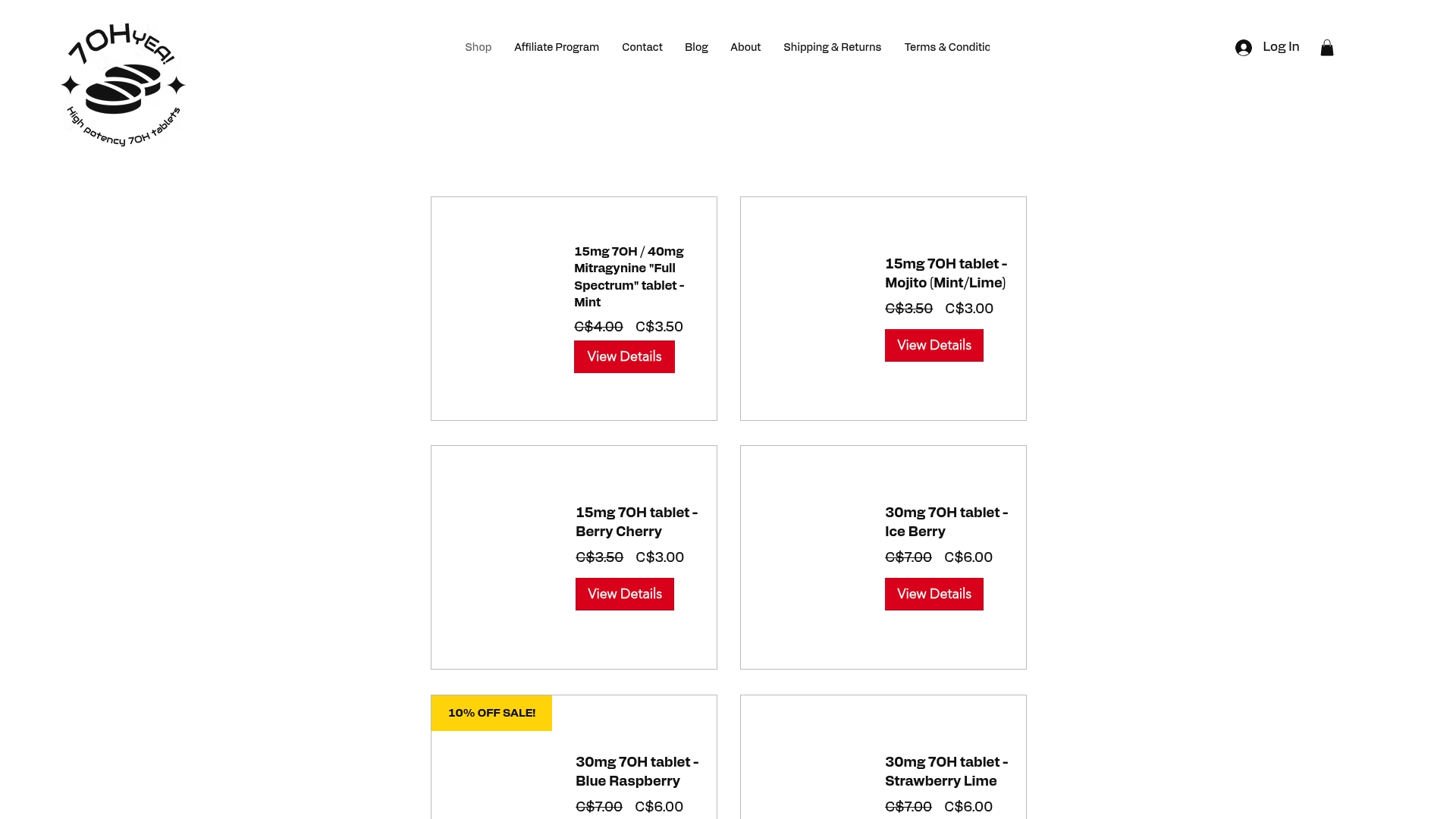
For a quick reference, our 15 mg 7OH tablet and our 81% 7OH powder represent the two ends of the format spectrum covered in this article: fixed-milligram reproducibility on one side, assay-percentage flexibility on the other.
- Browse the full product category for current tablet and powder options.
- Request a batch COA before purchase to confirm assay method and lot traceability.
- Specify your desired tolerance when ordering custom-purity powder for a specific protocol.
All products we sell are intended for laboratory and analytical research use only, and we encourage confirming your institutional approval before placing an order.
This article is general information, not a substitute for advice from a qualified doctor. Consult a qualified healthcare professional about your own circumstances before acting on anything here.
FAQ
Can you buy 7OH in Canada?
Research-grade 7-hydroxymitragynine products are available from Canadian suppliers for laboratory and analytical use, though regulatory status can evolve, so confirming current national and institutional guidance before ordering is essential. Products intended for human consumption fall under a different and more restrictive regulatory framework than those sold strictly for research purposes.
Will 7OH show up on a drug test?
Standard workplace drug panels typically do not screen for 7-hydroxymitragynine specifically, but specialized toxicology testing using methods such as UPLC-MS/MS can detect it in biological samples. Detection depends entirely on the test method used, not on a universal screening standard.
How is 7-hydroxymitragynine synthesized?
Patent and analytical literature describe semisynthetic routes that convert mitragynine, the primary kratom alkaloid, into 7-hydroxymitragynine through oxidation chemistry, and these conversion methods can yield high-purity isolates. This article summarizes that background for COA interpretation only and does not provide procedural synthesis instructions.
How long does 7OH take to kick in?
Onset timing for 7-hydroxymitragynine in research contexts depends on the administration route, dose, and study design used, and no single figure applies universally across protocols. Researchers should refer to their specific study’s pharmacokinetic design rather than a general estimate, since published onset data vary by methodology.
What does a purity percentage on a 7OH powder COA actually mean?
The stated purity should always be confirmed against a batch-specific COA using a validated method such as HPLC or UPLC-MS/MS rather than taken from a product label alone.
Sources
- Suspected Adulteration of Commercial Kratom Products with 7 …
- Kratom, mitragynine, 7-hydroxymitragynine - Expert Committee on Drug Dependence Information Repository
- Stability of Mitragynine and 7-Hydroxymitragynine
- Doi
- Pubs
7ohyeaAsk About Research-Grade 7OHEmail 7OH Canada to ask about research-grade tablets and powders, customizable dosage options, and quality assurance for analytical work.77ohyea
Email us7ohyea@gmail.com