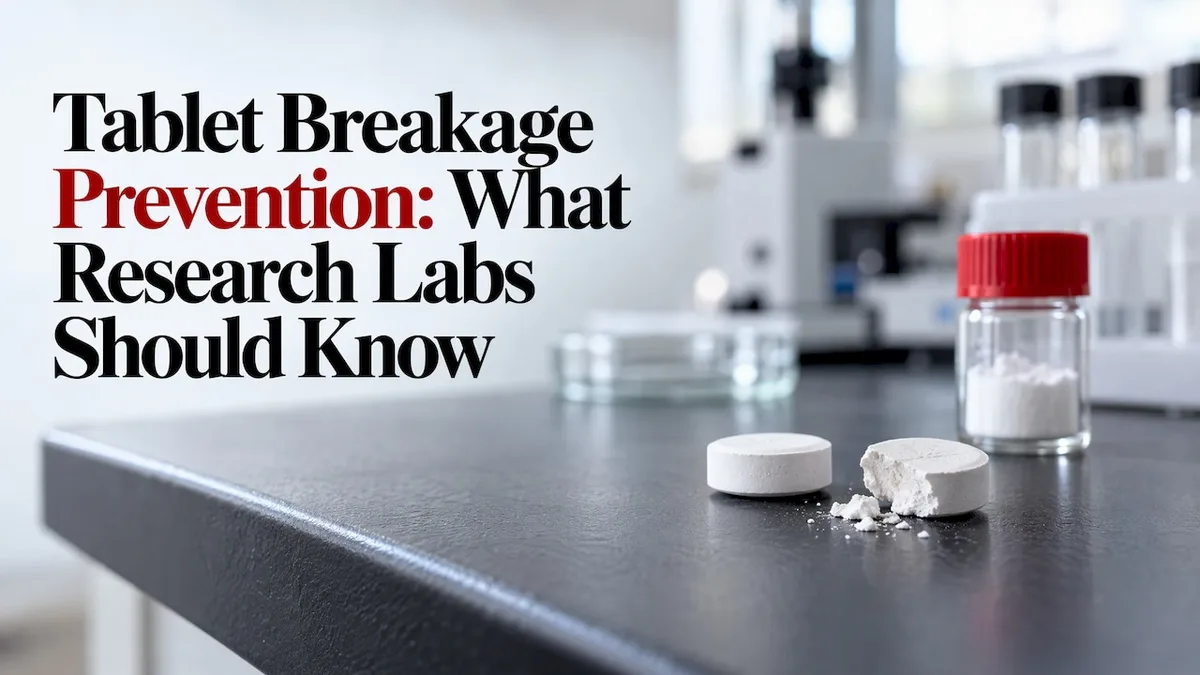
Tablet Breakage Prevention: What Research Labs Should Know

On July 1, 2026, the US Drug Enforcement Administration said it intends to temporarily place 7-hydroxymitragynine (7-OH) in Schedule I, according to a Congressional Research Service briefing. Suddenly every lab that works with this alkaloid is counting its reference material. A tablet that crumbles in transit or chips in a vial isn’t a minor annoyance anymore. It’s lost material you may not be able to replace on short notice.
Here’s the plain version: tablets break because of how they’re made, moved and stored, and most of it is preventable. Our products are research-grade materials for laboratory and analytical use only. They are not for human consumption.
7ohyeaChoose Research-Grade 7-OH Materials7OH Canada provides research-grade 7-OH tablets and powders for analytical purposes, with customizable dosage options for different research protocols.
VisitTL;DR
- Breakage comes from formulation, compression and handling, usually in combination, not from one villain.
- Passing a standard friability test doesn’t guarantee a tablet survives coating or transport.
- Two different tests matter: breaking force (how hard it is to fracture) and friability (how well it resists chipping and abrasion).
- Soft landings, short drops and sensible packaging cut damage more than people expect.
- Batch-specific certificates of analysis help you tie any breakage back to a specific lot.
Table of Contents
- Quick facts
- Why is everyone suddenly talking about 7-OH tablets?
- What did the headlines get wrong about tablets?
- Myth: a tablet that passes friability can’t break
- What actually makes a tablet break?
- Can you just press harder?
- How do you measure whether a tablet is tough enough?
- How do labs catch breakage early?
- What does handling and packaging change?
- Is a broken tablet the same as a split tablet?
- What this means for readers
- Our perspective
- Where can you get research-grade tablets and powders?
- FAQ
- Sources
Quick facts
| Item | Detail |
|---|---|
| Topic | Preventing chipping, capping and fracture in research tablets |
| Who it’s for | Analytical chemists, lab managers, research teams in Canada |
| Friability limit in ICH Q4B Annex 9(R1) | Mass loss of not more than 1.0%, unless the dossier says otherwise |
| Key weakness of friability tests | Passing doesn’t always predict coating-stage damage |
| Use | Research use only, not for human consumption |
Why is everyone suddenly talking about 7-OH tablets?
Because regulators are. The US announcement is still an announcement of intent. The CRS briefing explains that DEA must publish notice in the Federal Register at least 30 days before temporary scheduling takes effect, and that bills introduced in August and September 2026 would write 7-OH into Schedule I by statute. Whether any of it lands as described is unconfirmed, and we won’t guess.
The backdrop is the FDA’s July 2025 push. As Medscape reported, the agency recommended Schedule I status for concentrated 7-OH, while saying that trace amounts in the kratom leaf wouldn’t be affected.
Canada looks different, and it’s worth saying so plainly. According to BCIT’s Natural Health and Food Products Research Group, Health Canada has yet to license a kratom product under the Natural Health Products Regulations. That’s a statement about licensing, not a verdict on every research chemical. Nothing here is legal advice. If your lab needs certainty about its own position, ask a lawyer.
What did the headlines get wrong about tablets?
The coverage treats a tablet as a simple object: a thing that’s either there or it isn’t. In a lab, a tablet is a pressed powder compact, and its mechanical integrity is a quality attribute like any other.
The headlines also blur two separate questions. One is what a substance is and how it’s regulated. The other is whether the physical material in your vial is what the label says it is, in the form you ordered. This article is only about the second question. It’s the one a reference-material buyer can control.
Myth: a tablet that passes friability can’t break
Fact: it can. A 2022 study on piracetam tablets found that every batch lost less than 0.15% weight in friability testing. Yet the batch made at 13 MPa of roll-compaction pressure still developed chipped edges during pilot-scale film coating. Batches made at 4 and 5 MPa showed no edge defects.
A pass on paper and a chipped edge in practice can coexist. That’s the first reason to look beyond a single number.
What actually makes a tablet break?
Three things, working together.
The tablet itself. A 2018 study of commercial tablet defects points to low tensile strength and brittle formulations. It also names magnesium stearate, a common lubricant, which can weaken the bonds between particles.
The process. Tensile strength, the force per area a compact withstands before it splits, depends on powder density, compaction force and speed, moisture, excipients (the non-active ingredients) and tablet dimensions. Change one and the others shift.
The journey. The same study found that impacts during collection after compression and during coating-pan transfers cause damage. Bigger drop heights and repeated impacts make it worse.
The AIChE’s 2023 coating-process paper puts it neatly: breakage risk sits at the intersection of material properties, formulation, process conditions and equipment geometry. No single fix covers all four.
Can you just press harder?
No, and this is the most common misunderstanding.
More compression force doesn’t mean a tougher tablet. The 2018 study reports that excessive force can cause cracking or lamination, where a tablet splits into layers, and can impair disintegration. A formulation rich in microcrystalline cellulose, a plant-derived filler, can offer some resistance to defects, but it’s not a cure-all.
Lubricant is the other trap. A wet-granulation formulation study notes that too much lubricant can reduce compactability and tablet strength. A 2006 compression-physics review adds a longer list of variables that affect compaction quality: moisture, particle size distribution, crystal form, binder and lubricant levels, and tableting speed.
The takeaway for a buyer is simple. Tablet quality is designed, not forced. If you want to see how compression choices play out for this specific alkaloid, our piece on 7OH tablet compression and what the headlines missed goes deeper.
How do you measure whether a tablet is tough enough?
Two tests do most of the work, and they answer different questions.
Breaking force
Breaking force is the load needed to fracture a tablet in a set plane, usually measured by squeezing it between platens. USP chapter <1217> on tablet breaking force stresses that acceptable strength depends on intended use and the release mechanism. There’s no universal magic number.
If you’re setting a spec for your own lab, our guide on tablet hardness testing and reproducible specs covers the method details.
Friability
Friability is resistance to chipping and abrasion. USP <1216> describes tumbling tablets in a rotating cylinder and calculating the percentage of weight lost.
For Canadian labs, ICH Q4B Annex 9(R1) is the useful reference. It says the USP, European and Japanese friability procedures may be treated as interchangeable in Canada under the annex’s conditions. It sets a limit of not more than 1.0% mass loss for a single determination, or a mean of not more than 1.0% across three, unless the dossier says otherwise.
Our friability testing protocol guide walks through running it in a research setting.
Why one test isn’t enough
The 2018 study saw tablets in the commonly used 1.7 to 2.0 MPa tensile strength range still show significant breakage under repeated impacts. USP <1217> notes that coating, packaging and printing impose considerable stresses of their own. So use breaking force and friability together, and add a realistic handling test if your tablets travel.
How do labs catch breakage early?
You don’t need exotic equipment to start. The 2018 researchers simply dropped tablets and inspected them visually after 1, 5 and 10 drops, noting chips and breaks. They then used X-ray microtomography, a 3D scanning method, to look for internal defects that the eye misses.
That gives a practical template. Pick a drop height that matches your real handling, inspect at set intervals, and log the result against the lot number. The AIChE team found breakage probabilities in their conditions were well described by the Vogel-Peukert breakage model, which suggests damage follows predictable patterns rather than random bad luck.

The same 2006 review adds that instrumented presses and compaction simulators help with troubleshooting and scale-up. Those are production tools, but they explain why a reputable supplier can trace a problem to a cause.
What does handling and packaging change?
A lot, and it’s the cheapest part to fix.
The 2018 study found that the first tablets into an empty container land on harder surfaces and fall farther. A softer landing surface may cut the impact force. Translate that to the bench: fill containers gently, don’t pour from height, and don’t let vials rattle half-empty.
Packaging is the other lever. If you store reference tablets for months, closures and containment matter for physical protection as well as security. For a sense of how regulated packaging gets evaluated, this overview of child-resistant packaging rules and buyer checks is a handy parallel.
Temperature and moisture swings also change how a tablet holds together, since moisture is one of the compaction variables listed above. Keep storage steady and sealed.
Is a broken tablet the same as a split tablet?
No. Some pharmaceutical tablets are made with a score line so they can be divided on purpose. Health Canada’s notice on tablet scoring says proposed scoring differences for subsequent-entry products must address dose support, safe handling and release characteristics. It also says splitting can compromise modified-release control.
That’s about medicines. Our research tablets aren’t medicines and aren’t for human consumption. In a lab, any break you didn’t plan is a deviation to record, not a feature.
What this means for readers
If you buy research tablets in Canada, here’s the short list.
- Treat breakage as a quality signal. A cracked or chipped tablet may mean a formulation or handling problem. Record it by lot.
- Don’t trust one number. The piracetam study shows friability can pass while edges still chip later.
- Ask for lot-level documentation. Batch-specific certificates of analysis let you link what you see to a specific production run.
- Plan stock around the news. The DEA move is an announcement, and the outcome isn’t confirmed. Reasonable labs keep adequate, well-stored reference material and watch official notices from Health Canada, the DEA and the FDA.
- Keep your own paperwork straight. Whether and how you can hold and use any material depends on your own legal position. Get proper advice.
If your work also depends on tablet consistency, our guides on content uniformity and dissolution testing for analytical labs cover the next checks in the chain.
Our perspective
We think physical integrity gets too little attention in the 7-OH conversation. People argue about scheduling, and fair enough. But a lab can’t run a clean protocol on a tablet that arrived in pieces.
That’s why we focus on domestic supply from British Columbia. Shorter distance means fewer handoffs, fewer drops and no border-crossing delays. It’s a logistics advantage, and logistics is where a lot of breakage happens.
It’s also why every batch ships with its own certificate of analysis. When a result looks off, you should be able to trace it to a lot, not shrug and guess.
Our tablets and powders are research-grade, built for laboratory and analytical work only, and we say so every time. If breakage is a worry for your protocol, tell us what you’re running. Powders are available too, for teams who’d rather weigh their own material.
John
Where can you get research-grade tablets and powders?
We supply research-grade 7-hydroxymitragynine tablets and powders, plus related alkaloid reference materials such as mitragynine, MGM-15 and SR17018, made and sourced in Canada for analytical use only, not for human consumption. Bulk purchasing is available for research teams, and dosage options can be customized to fit your protocol.
Browse the full range on our 7OH research product page, or start from the 7OHyea home page.
FAQ
What’s the difference between capping and chipping?
Capping is when the top or bottom of a tablet separates in a layer. Chipping is when edges break off during handling or coating. Both trace back to formulation, compression and handling, as the 2018 defect study describes. Log them separately because their causes differ.
Does a higher breaking force always mean a better tablet?
Not necessarily. USP <1217> says acceptable strength depends on the intended use and release mechanism. Overcompression can also cause cracking or lamination, so more force isn’t automatically better.
Which friability limit applies in Canada?
ICH Q4B Annex 9(R1) lists a mass loss of not more than 1.0% for a single determination, or a mean of 1.0% across three, unless the dossier specifies otherwise. It also treats the USP, European and Japanese procedures as interchangeable in Canada under its conditions.
Can tablets be damaged in transit even if they test well?
Yes. The piracetam study found acceptable friability alongside chipped edges after coating, and the 2018 study saw breakage under repeated impacts at common strength levels. Gentle handling and steady storage help.
Are your tablets for human consumption?
No. They’re research-grade materials for laboratory and analytical use only.
So here’s our question for you: as regulators keep moving, should labs be asking suppliers for physical-quality data on tablets as hard as they ask for purity data? Tell us what you think.
7ohyeaAsk About Tablet Breakage ResearchContact 7OH Canada with questions about research-grade 7-OH tablets and powders for laboratory and analytical purposes.77ohyea
Email us7ohyea@gmail.comSources
- Congressional Research Service: Temporary Control of 7-OH
- Medscape: FDA Seeks Schedule I Status
- BCIT: Kratom imposters
- Piracetam roll compaction study, 2022
- Understanding tablet defects in commercial manufacture, 2018
- AIChE 2023: Risk factors for tablet breakage in film coating
- Formulation design of granules prepared by wet granulation
- Compression physics in formulation development, 2006
- USP <1217> Tablet Breaking Force
- USP <1216> Tablet Friability
- ICH Q4B Annex 9(R1)
- Health Canada: Notice on tablet scoring
- Child-resistant packaging rules and buyer checks