7OH Tablet Hardness: What the Headlines Skip

7-hydroxymitragynine (7OH) has been in the news since the U.S. FDA recommended on July 30, 2025 that the compound be placed in Schedule I. Most coverage was about the substance. Almost none of it asked a lab-side question: when a research tablet is pressed, how do you measure whether it’s physically sound? That’s tablet hardness, and it’s less simple than the word sounds. Our products are for research use only, not for human consumption.
7ohyeaExplore 7OH Research Materials7OH Canada supplies research-grade 7OH tablets and powders for analytical purposes, with customizable dosage options for different research protocols.
VisitTL;DR
- “Hardness” in tablet testing really means breaking force: how much force it takes to fracture a tablet, usually reported in newtons (N) or kilopond (kp).
- There’s no single pass/fail number. Pharmacopoeias leave the acceptable range to each product’s own specification.
- Hardness is not purity, content uniformity, friability or dissolution. Each is its own test.
- A hardness number only means something if the method, the sample size and the tablet orientation are reported with it.
- For Canadian buyers, the regulatory picture is moving. Confirm current status with Health Canada before ordering anything.
Table of Contents
- Quick facts
- Why is everyone suddenly talking about 7OH tablets?
- What does the law say for Canadians?
- Myth or fact: is “hardness” the same as strength?
- How do labs actually measure tablet hardness?
- Is there an official “right” hardness for 7OH tablets?
- What changes a tablet’s hardness?
- What the headlines got wrong about hardness
- Does hardness tell you if a tablet will split evenly?
- How does hardness fit with friability and dissolution?
- What this means for readers
- Where do we fit in?
- Our view on hardness
- FAQ
- Sources
Quick facts
| Item | Detail |
|---|---|
| Topic | Tablet hardness (breaking force) for 7OH research tablets |
| Typical units | Newtons (N) or kilopond (kp); 1 kp is about 9.8 N |
| Standard method | Tablet crushed between two platens until it fractures |
| Universal limit? | No. Set per product specification |
| Related tests | Friability, content uniformity, dissolution |
| Status of our products | Research use only, not for human consumption |
| Regulatory note | FDA scheduling recommendation announced July 30, 2025; not a final rule on its own |
Why is everyone suddenly talking about 7OH tablets?
Because regulators got loud. In the summer of 2025 the FDA said it wanted 7-hydroxymitragynine scheduled in the United States. The coverage that followed leaned on one framing, a concentrated compound sold in many forms, and left the details of how products are made out of the story.
The United Nations Office on Drugs and Crime also flagged in August 2025 the emergence of kratom-related products containing 7-hydroxymitragynine. Its notice discusses testing of marketed products and the concern over their potency.
Here’s what the headlines mostly didn’t cover: the manufacturing side. How a tablet is pressed, how consistently, and how it’s tested are questions a lab has to answer before a result can be trusted. That’s where hardness comes in.
What does the law say for Canadians?
We’ll be careful here, because this is the part of the story where confident takes go wrong.
In Canada, the status of 7-hydroxymitragynine is something to confirm directly with Health Canada, and the rules can change. We aren’t lawyers, and nothing here is legal advice. If you’re a lab buying research materials, check Health Canada’s current guidance and talk to your institution’s compliance office.
The U.S. picture is clearer on what was announced. The FDA’s July 30, 2025 statement was a recommendation to the DEA. A recommendation isn’t the same as a final scheduling decision, and we won’t guess how it ends. If you’ve seen a headline claiming a ban is already settled everywhere, that’s a claim to check against the primary notice.
Myth or fact: is “hardness” the same as strength?
Myth. The word is a bit of a trap. The USP’s chapter on tablet breaking force defines breaking force as the force needed to make a tablet fail in a specific plane. It also notes that “hardness” is common in pharmaceutical writing but misleading, since in materials science hardness means resistance to surface indentation.
So when a lab report says a tablet’s hardness is a certain number, it’s really describing how hard you have to squeeze to snap it. It isn’t telling you how “strong” the active ingredient is, how pure it is, or what’s in it.
Quick translation of the jargon:
- Breaking force: the force at which a tablet fractures.
- Friability: how much a tablet crumbles or loses weight when tumbled. The USP’s friability chapter measures it as percentage weight loss in a rotating drum, with a mean loss of not more than 1.0% considered acceptable for most products.
- Content uniformity: whether each tablet carries about the same amount of the analyte.
- Dissolution and disintegration: how a tablet breaks apart in liquid, which is a different question from how hard it is to snap dry.
A tablet can be very hard and still be inconsistent in content. It can also be softer and perfectly uniform. The tests don’t substitute for each other.
How do labs actually measure tablet hardness?
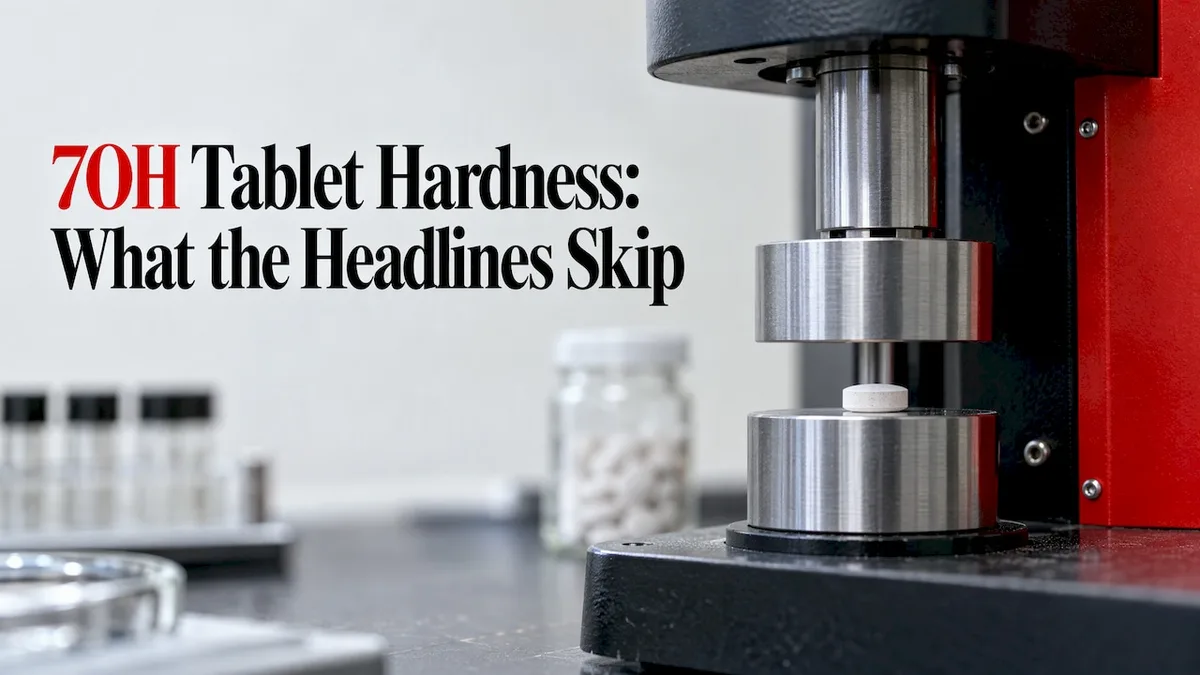
The basic setup is simple. A tablet sits between two platens, one moves toward the other, and the instrument records the force at the moment of fracture.
The details are where results diverge. Here’s what the standards pay attention to:
- Units. The European Pharmacopoeia’s resistance to crushing test reports results in newtons, as a mean, a minimum and a maximum. Older instruments and many lab notebooks use kp, and 1 kp is roughly 9.8 N. Mixing them up is the easiest way to misread a certificate.
- Sample size. The same European method is performed on 10 tablets. One tablet tells you almost nothing about a batch.
- Orientation. Tablets should be oriented consistently between the jaws. If a tablet has a score line, the orientation relative to it matters.
- Loading rate. Testers apply force at a controlled rate, because how fast you squeeze changes the number you get. We cover this in more depth in our guide to setting reproducible specs for tablet hardness testing.
The point for researchers is simple. A bare number like “hardness: 80” is incomplete. A proper entry says the unit, the number of tablets, the instrument, the orientation and the rate.
Is there an official “right” hardness for 7OH tablets?
No, and anyone who quotes one as if it were universal is overselling.
Pharmacopoeias don’t set a single hardness limit for tablets. The Japanese Pharmacopoeia, for example, requires tablets to meet dosage-unit uniformity and dissolution or disintegration requirements but doesn’t include a separate hardness method. The USP’s breaking force chapter says breaking force works both as a development guide and as a quality control specification, and that an acceptable value has to consider the intended use.
In other words, the range comes from the product’s own specification. One industry testing supplier describes typical ranges that differ by tablet type, with immediate-release tablets generally between 40 and 100 N and chewable or effervescent types softer. Treat those as orientation, not as a rule that applies to any particular research tablet.
For a research lab, the practical takeaway is this: the right question isn’t “is this number good?” It’s “is this number consistent from batch to batch, and was it measured the same way each time?”

What changes a tablet’s hardness?
Hardness isn’t a property of the active ingredient alone. It’s the result of how the tablet was made.
Academic course material on tablet evaluation lists several drivers: the binder’s quality and quantity, the compression force, the amount of granules in the die and the gap between the upper and lower punches. In plain terms, press harder and use more binder, and you usually get a harder tablet.
That’s why two tablets with the same labeled content can break at very different forces. It’s also why we keep pointing readers back to formulation. Our overview of tablet formulation basics for research-grade 7OH labs walks through the building blocks, and our piece on 7OH tablet compression looks at what the headlines missed.
What the headlines got wrong about hardness
A few shortcuts keep circulating online, especially in forum threads and retail roundups. Here’s the sorted version.
Claim: a harder tablet is a better tablet. Not necessarily. The USP says an acceptable value depends on intended use. Harder isn’t a quality score.
Claim: hardness tells you what’s inside. It doesn’t. It’s a mechanical measurement. Content is a separate question, handled by content uniformity and analytical testing. Our content uniformity guide explains how that works.
Claim: one hardness number settles it. One number from one tablet can mislead. Methods call for several tablets and a spread, with a minimum and a maximum.
Claim: all hardness testers measure the same thing the same way. They don’t. Method details such as loading rate and tablet orientation change results, and even the way tensile strength is calculated from the force has limits. USP notes in its chapter that the diametral compression approach is an indirect test, so treat calculated strength figures as estimates.
Does hardness tell you if a tablet will split evenly?
Not by itself.
Whether a tablet breaks cleanly along a line depends on its shape, its score and how the force is applied, and those are exactly the things breaking force methods ask you to control by orienting the tablet consistently. A tablet that snaps at a high force may still fracture at an angle. Hardness gives you the force. It doesn’t give you the fracture pattern.
And even a clean split doesn’t tell you whether the two halves carry matching amounts of analyte. That’s a content uniformity question. Researchers who want halves or fragments for analysis should rely on a uniformity assay, not a visual check or a hardness number. The same logic applies to blends. Our write-up on blend uniformity in tablets covers why uniformity starts before the press.
We don’t have a published study that links hardness to split accuracy for 7OH tablets specifically, so we won’t claim a relationship. If you see one asserted without a source, be skeptical.
How does hardness fit with friability and dissolution?
Think of three separate questions about the same tablet:
| Question | Test | What it reports |
|---|---|---|
| Does it survive being squeezed? | Breaking force | Force at fracture, in N or kp |
| Does it survive handling and tumbling? | Friability | Percentage weight loss |
| Does it release its contents into liquid as expected? | Dissolution or disintegration | Time or percentage released |
A tablet can look fine on one and poor on another. A full quality picture uses all of them, plus content uniformity. We’ve written protocol guides for the neighbouring tests: tablet friability testing for research labs and dissolution testing for analytical labs.
What this means for readers
If you’re a Canadian researcher or lab buyer, here’s the short version.
- Read hardness as a mechanical measure only. It says nothing about purity, content or how a material behaves outside a lab.
- Ask for the method with the number. Unit, sample size, instrument, orientation and loading rate. A single bare figure isn’t enough for a reproducible record.
- Keep hardness separate from other results. Friability, content uniformity and dissolution each answer a different question.
- Check the regulatory status yourself. Confirm the current position with Health Canada, and with your institution’s compliance team, before ordering. We’re not offering legal advice, and we won’t predict what regulators will do.
- Remember the use case. These materials are for analytical and laboratory work, not for human consumption.
Where do we fit in?
We supply research-grade 7-hydroxymitragynine tablets and powders for analytical purposes, sourced domestically from British Columbia. Batch-specific certificates of analysis come with our products, and the line includes MGM-15, mitragynine and SR17018 tablets alongside powders. Everything we sell is intended for laboratory use only, not for human consumption.
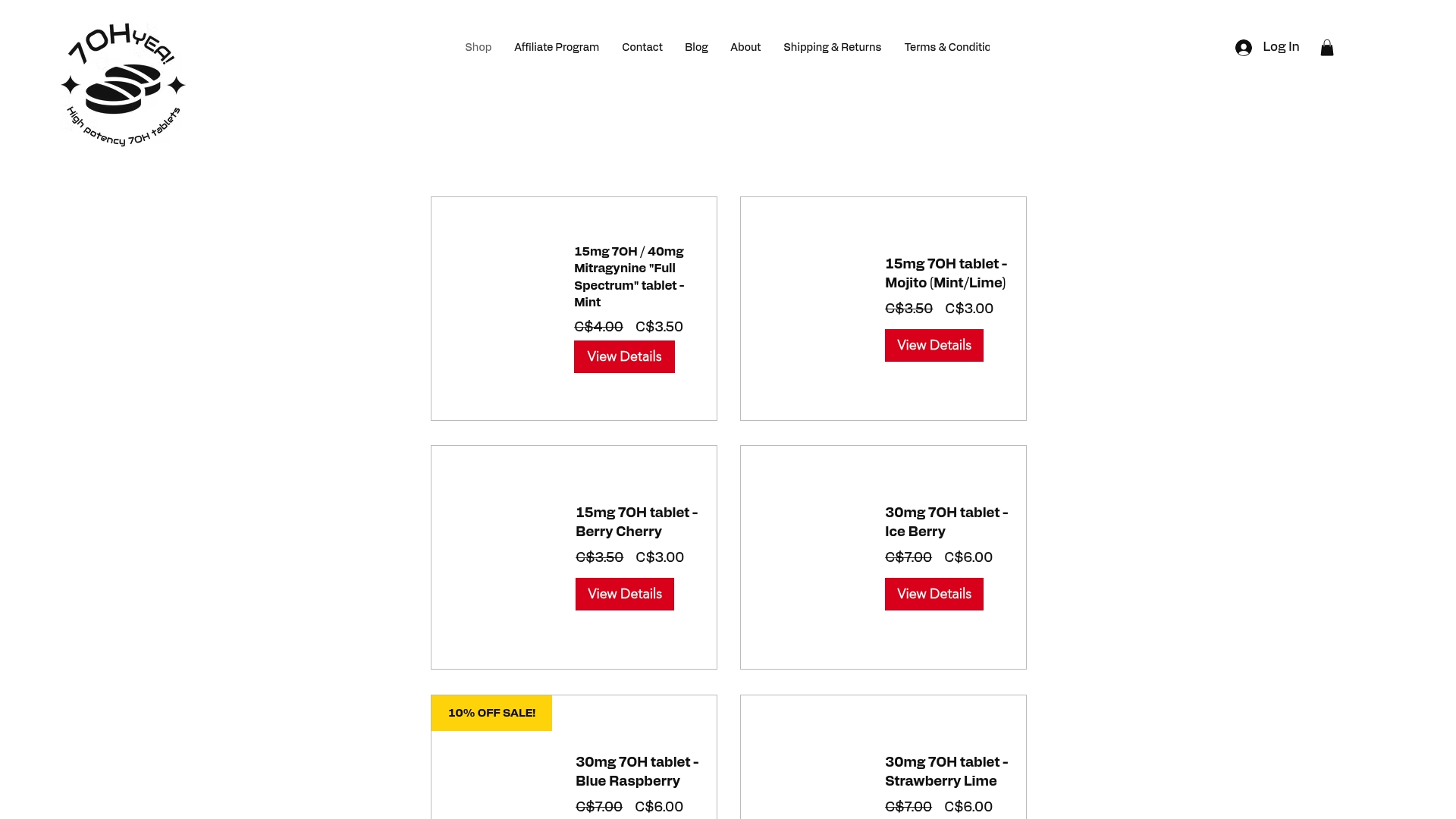
Our powders carry listed prices: the 43% pure mitragynine “Full Spectrum” powder is 6.75 CAD, the 81% pure 7OH powder is 50 CAD, and the 99% pure SR17018 powder is 48 CAD, each one-off. Tablet pricing is on the product pages. Labs working through a protocol can browse the full range of research-grade 7OH products and order through the site.
Because we operate in Canada, orders don’t cross a border, which means no border fees. Research teams can also ask us about bulk purchasing.
Our view on hardness
Hardness is the most over-read number in tablet testing. People treat it like a grade. It’s a measurement, and a measurement is only as useful as the method behind it.
We think research labs are better served by a batch record than by a single figure. That means a certificate of analysis tied to the batch you actually receive, and a clear method for anything you test yourself. Domestic production in British Columbia means shorter transit and a closer paper trail, which suits labs that need their records to line up.
Our view is simple: be strict about the method, be honest about what each test can and can’t say, and keep research materials in research settings. That’s the standard we hold our own products to, and the one we’d hold any supplier to.
John
FAQ
Is tablet hardness the same as tablet strength?
No. Hardness in this context means breaking force, the force that fractures the tablet. It doesn’t describe how much active compound a tablet holds. Content is measured by separate analytical and uniformity tests.
What units are used for tablet hardness?
Newtons (N) and kilopond (kp) are the common ones, and 1 kp is about 9.8 N. The European method reports a mean, minimum and maximum in newtons across 10 tablets. Always record the unit with the number to avoid confusion.
Is there a standard hardness range for 7OH tablets?
No official range exists specifically for them. Pharmacopoeias leave the acceptable range to each product’s specification. General figures for other tablet types are reference points, not limits for any specific research tablet.
Does a harder tablet mean a higher-quality tablet?
Not on its own. The USP says an acceptable breaking force has to consider the intended use of the product. Quality is judged across several tests, including friability, content uniformity and dissolution, plus the batch’s certificate of analysis.
Is 7OH legal in Canada?
We can’t give legal advice, and the rules can change. Check Health Canada’s current guidance and your institution’s compliance office. In the U.S., the FDA’s July 30, 2025 scheduling recommendation was an announcement to the DEA, not a settled outcome.
So what’s your take: should hardness ever be quoted without its method? Tell us in the comments.
7ohyeaAsk About 7OH Tablet ResearchEmail us with questions about research-grade 7OH tablets and powders, dosage options, or analytical materials for your laboratory work.77ohyea
Email us7ohyea@gmail.comSources
- FDA Seeks Schedule I Status for ‘Legal Morphine’ (Medscape, July 30, 2025)
- Emergence of potent kratom-related products containing 7-hydroxymitragynine (UNODC, August 2025)
- USP <1217> Tablet Breaking Force
- USP <1217> Tablet Breaking Force (USP-NF)
- USP <1216> Tablet Friability
- Resistance to crushing of tablets
- The Japanese Pharmacopoeia
- Standard Tablet Hardness Range
- Evaluation of Tablets Part 1