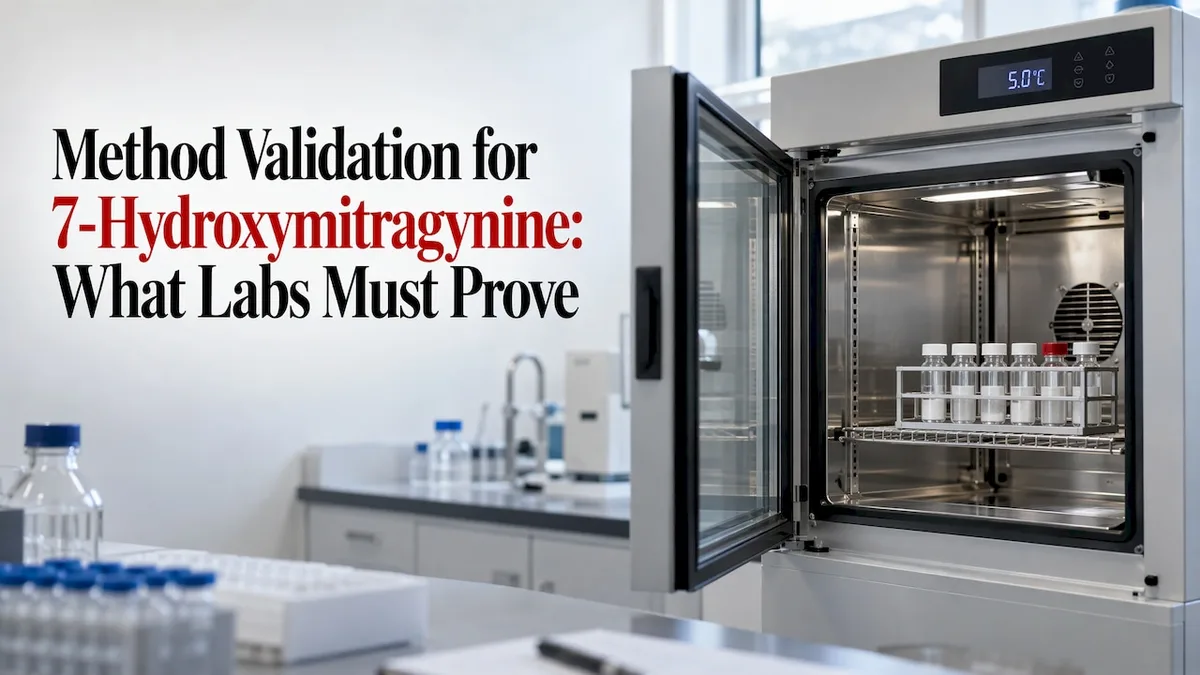
Method Validation for 7-Hydroxymitragynine: What Labs Must Prove

Regulators are suddenly paying attention to 7-hydroxymitragynine, and that puts a spotlight on the labs that measure it. In July 2025, the FDA recommended Schedule I status for concentrated 7-OH, and the DEA now has to decide what to do with that recommendation. Whatever happens next, one thing doesn’t change: a number about 7-OH is only worth as much as the validated method behind it.
This article is about analytical chemistry, not use. Our products are for research use only, not for human consumption.
7ohyeaChoose Consistent 7-OH Research Material7ohyea offers research-grade 7-OH tablets and powders in customizable dosage options for analytical work, sourced domestically from British Columbia.
VisitTL;DR
- Method validation means proving, with data, that your assay measures 7-hydroxymitragynine accurately, precisely and repeatably in your specific sample type.
- Published methods exist for rat plasma, human urine and forensic casework, and each reports different limits, ranges and recovery figures.
- 7-OH is a fragile analyte. Heat, strong acid or alkali, and long storage can wreck results, so stability testing isn’t optional.
- AOAC has published performance targets for Mitragyna alkaloids in botanical products. They’re a useful yardstick for raw materials and finished products.
- A validated method doesn’t transfer automatically to a new matrix. Re-check it before you trust it.
Table of Contents
- Quick facts
- Why is everyone suddenly talking about 7-OH testing?
- What does “method validation” actually mean?
- What do published methods actually report?
- What benchmarks exist for raw materials and finished products?
- Why does 7-OH keep tripping labs up?
- How should a lab build the validation plan?
- What about reference materials and certificates?
- Does a validated method travel to a new matrix?
- What does the legal picture look like for labs in Canada?
- What this means for readers
- Our view: validate for the analyte you actually have
- Where to get documented 7-OH reference material in Canada
- FAQ
- Sources
Quick facts
| Item | What to know |
|---|---|
| Analyte | 7-hydroxymitragynine (7-OH), an alkaloid related to mitragynine |
| Usual platforms | LC-MS/MS, UPLC-MS/MS, LC-HRMS, UHPLC-QTOF-MS |
| Benchmark document | AOAC Standard Method Performance Requirements for Mitragyna alkaloids (2015) |
| Biggest pitfall | Analyte instability during extraction, evaporation and storage |
| U.S. status | FDA recommended Schedule I for concentrated 7-OH in July 2025; the DEA process is separate and its outcome isn’t confirmed here |
| Canadian status | Health Canada has stated it hasn’t authorized health products containing kratom |
| Our products | Research use only, not for human consumption |
Why is everyone suddenly talking about 7-OH testing?
Because the molecule moved from the lab bench to the headlines. Reporting on the FDA’s move described 7-OH as a concentrated substance and said scheduling would apply only to concentrated 7-OH, not to kratom leaf products. That distinction is an analytical question at heart. Where does a trace amount in a plant end and a concentrated product begin? Only a validated, quantitative method can draw that line.
Here’s the myth worth clearing up. People assume that any lab with a mass spectrometer can “just run” 7-OH. They can run it. Whether the result holds up is another matter.
What does “method validation” actually mean?
It’s a documented set of experiments showing your method is fit for its purpose. You’re answering plain questions:
- Selectivity: can you see 7-OH without interference from similar alkaloids or the sample background?
- Linearity and range: across what concentrations does the response behave predictably?
- Accuracy: how close is your result to the true value?
- Precision: how tightly do repeat measurements cluster?
- LOD and LOQ: what’s the lowest amount you can detect, and the lowest you can reliably quantify?
- Recovery and matrix effects: does extraction lose analyte, and does the sample itself suppress or boost the signal?
- Stability: does 7-OH survive long enough to be measured?
That last one is where 7-OH earns its reputation.
What do published methods actually report?
Three published studies show how different the answers can look. We’re keeping this to a few facts, because the point is the pattern.
The rat plasma method: a clean baseline
A 2013 paper described a UPLC-MS/MS method in rat plasma. It was linear from 10 to 4,000 ng/mL, had a 10 ng/mL lower limit of quantification, and reported accuracy of 96.5 to 104.0% with precision under 15%. Recovery was 62.0 to 67.3%.
Notice the recovery. It’s modest, and that’s acceptable when it’s consistent and corrected by an internal standard. Validation doesn’t demand perfect recovery. It demands predictable recovery.
The urine method that flagged a problem
A 2018 study built an HRMS urine method for five Mitragyna alkaloids using solid-phase extraction and deuterated internal standards. It reported extraction efficiencies of 63 to 96% and acceptable precision, bias and matrix effects for the panel. But it also found 7-hydroxymitragynine notably unstable under that method, and the authors judged it unsuitable for quantitative urine analysis there.
That’s a headline most summaries skip. A method can validate well for most analytes and still fail for the one you care about.
The 2026 forensic method: modern acceptance criteria
A 2026 paper described a UHPLC-QTOF-MS method for forensic casework. Its calibration ran from 1 to 1,000 ng/mL with a weighted quadratic fit and r² above 0.999. Precision and bias stayed below 15%, with a wider ±30% allowed at the lowest level for two analytes. It found no carryover after the top calibrator and no significant ion suppression or enhancement. Processed samples stayed stable for up to 96 hours.

The takeaway: acceptance criteria are chosen by the lab and justified in advance. A looser limit at the lowest level isn’t cheating. It’s declared and documented.
What benchmarks exist for raw materials and finished products?
If your samples are plant material, extracts or finished products rather than biological fluids, AOAC’s Standard Method Performance Requirements for Mitragyna alkaloids are the closest thing to a consensus target. They cover plant material, extracts and finished products, and they require quantitation of 7-hydroxymitragynine while accounting for interfering compounds.
The headline numbers:
| Parameter | AOAC target |
|---|---|
| Analytical range | 0.01 to 0.5% |
| LOQ | ≤ 0.005% |
| LOD | 15 ppm |
| Recovery | 90 to 110% at 0.01 to 0.1%; 95 to 105% above 0.1 to 0.5% |
| Repeatability | ≤ 5% and ≤ 4% across those ranges |
| Reproducibility | ≤ 8% and ≤ 6% across those ranges |
AOAC also recommends blank check samples and check standards at the lowest and midrange points of the analytical range. That’s a cheap habit with a big payoff: it catches drift before it becomes a bad batch of data.
Why does 7-OH keep tripping labs up?
Stability. A 2023 peer-reviewed review on kratom analysis, Kratom: The analytical challenge of an emerging herbal drug, warns that 7-hydroxymitragynine is unstable. Strong acid or alkali and high temperatures during hydrolysis or evaporation can compromise results, and long-term stability hasn’t been studied enough case by case.
The same review reports that 7-OH in heparinized rat plasma stayed constant for 12 hours at room temperature and for 30 days at 20 °C. In simulated gastric fluid at pH 1.2, it dropped 27% after two hours. The lesson isn’t that 7-OH is hopeless to measure. It’s that the conditions you pick change the answer.
We’ve written more on this in our piece on 7-OH degradation and artifact risk, which covers why a fast-degrading analyte can produce misleading numbers if sample handling is sloppy.

A myth worth busting: “If the peak is there, the number is right”
Not necessarily. A peak can be inflated by an interfering compound, shrunk by matrix suppression, or created by conversion from mitragynine during prep. Our overview of mitragynine versus 7-hydroxymitragynine explains why labs need to keep the two apart analytically. Validating selectivity is how you prove the peak is what you say it is.
How should a lab build the validation plan?
There’s no single recipe, but the published work points to a sensible order.
- Define the purpose and matrix first. A method for tablet content uniformity looks nothing like one for biological fluid. Write down the sample type, the expected concentration range and the decision the result supports.
- Set acceptance criteria before you run anything. The urine study, for example, planned for ±25% accuracy and under 25% CV, then reported results well inside that: within ±10% and CV below 10% for 7-OH. Pre-set limits keep you honest.
- Choose your extraction with stability in mind. A review notes that solid-phase extraction generally gives cleaner extracts and better sensitivity, precision and accuracy for biological samples. Skip aggressive heat and harsh pH where you can.
- Use isotope-labelled internal standards where available. The 2018 method used deuterated mitragynine and 7-hydroxymitragynine for exactly this reason.
- Test selectivity, linearity, accuracy, precision, LOQ, carryover and matrix effects. Run blanks, spiked samples at low, mid and high levels, and the highest calibrator followed by a blank.
- Run stability experiments that mirror real handling. Bench-top, autosampler, freeze-thaw and long-term storage, each with the same conditions your samples will see.
- Document everything. Raw data, integration rules, deviations and the final limits go in the validation report.
What about reference materials and certificates?
Your calibration is only as good as the material behind it. Reference standards need an identity and purity statement you can trace, and each lot you buy should come with its own certificate of analysis (COA). Our batch-specific COAs are built for exactly that documentation step. For a deeper look at what to demand from tablet testing, see our three nonnegotiables for 7-hydroxymitragynine tablet testing.
For a broader walk through instruments and approaches, our guide to laboratory detection methods for 7-hydroxymitragynine in Canada is a good companion to this piece.
Does a validated method travel to a new matrix?
No. This is the quiet trap. A method validated in rat plasma says nothing about a tablet, a powder or a different biological fluid. Matrix effects, recovery and stability all have to be shown again, at least in a partial validation.
Reporting matters as much. The American College of Medical Toxicology notes that a positive urine opioid test doesn’t identify dose, route, source or impairment, and that screening results used for high-consequence purposes should be followed by chromatographic confirmation. Your report should say what the number does and doesn’t show, and state the method’s limits plainly.
What does the legal picture look like for labs in Canada?
Canadian context first. Health Canada has said it has not authorized health products containing kratom, in an advisory about products seized from two Edmonton stores. That advisory is about kratom products sold for consumption. It doesn’t say anything about analytical reference materials, and we aren’t giving legal advice here. If you’re unsure how your lab’s work fits the rules, talk to a lawyer or contact Health Canada directly.
The U.S. is second in line. The FDA’s July 2025 recommendation went to the DEA, which would launch a public rulemaking process with a comment period. We can’t tell you how that ends, and nobody else can say for certain either.
What this means for readers
- If you’re an analytical chemist: treat 7-OH as a stability problem first and a sensitivity problem second. Validate against criteria you set in advance.
- If you’re a researcher in Canada: keep paperwork tight. Lot-specific COAs, validation reports and clear sample handling records protect your data.
- If you work with kratom products: expect scrutiny of the line between trace and concentrated 7-OH. Quantitative methods will be what’s asked for.
- If you came here looking for use guidance: this isn’t it. Our materials are for research use only, not for human consumption, and we don’t give instructions for use.
Our view: validate for the analyte you actually have
We think the field has been too casual about 7-OH. Labs borrow a kratom method, see a peak and move on. The published record shows why that’s risky: an analyte that degrades with heat and harsh conditions needs a method built around that fact.
That’s why we pair our research-grade materials with batch-specific certificates of analysis, and why we source domestically in British Columbia so materials reach Canadian labs quickly and without border fees. A reference material you can document is the first line of any validation report.
Our range includes 7OH tablets and powders, mitragynine reference materials and bulk options for research teams. They’re designed for analytical and laboratory use only, never for human consumption.
John
Where to get documented 7-OH reference material in Canada
If your validation needs a traceable starting material, our 81% pure 7OH powder is listed at $50 CAD. It’s sourced and manufactured in Canada for laboratory use, and it’s not for human consumption. You can see the full range on 7ohyea.ca, including mitragynine and MGM-15 materials for research teams.
FAQ
What’s the difference between LOD and LOQ for 7-OH?
The limit of detection (LOD) is the lowest amount you can reliably tell apart from nothing. The limit of quantification (LOQ) is the lowest amount you can measure with acceptable accuracy and precision. In the 2013 rat plasma study, the LOD was 2 ng/mL and the LLOQ was 10 ng/mL.
Which instrument do most validated 7-OH methods use?
Liquid chromatography coupled to mass spectrometry dominates. The studies cited here used UPLC-MS/MS, HRMS and UHPLC-QTOF-MS. The choice depends on sensitivity needs, matrix and whether you want targeted or broader screening.
Why did one study say 7-OH wasn’t suitable for quantification?
The 2018 urine study found 7-hydroxymitragynine notably unstable under its conditions, even though the other alkaloids in the panel validated well. It’s a reminder that stability has to be tested for each analyte and each procedure, not assumed.
Can I reuse a published method as is?
Use it as a starting point, not a finish line. A new matrix, instrument or extraction step calls for at least a partial re-validation. AOAC’s performance requirements give you targets for botanical products to measure yourself against.
Are your products meant for people to take?
No. They’re for research use only and not for human consumption.
7ohyeaQuestions About 7-OH Materials?Email us to discuss research-grade 7-OH tablets and powders, dosage options, and materials for analytical purposes.77ohyea
Email us7ohyea@gmail.comSources
- FDA Seeks Schedule I Status for ‘Legal Morphine’ (Medscape, July 30, 2025)
- Health Canada advisory on unauthorized kratom products seized in Edmonton
- Development and validation of an UPLC-MS/MS method for 7-hydroxymitragynine in rat plasma (2013)
- Screening and identification of mitragynine and 7-hydroxymitragynine in human urine (2015)
- Identification of five Mitragyna alkaloids in urine using HRMS (2018)
- Quantification of kratom alkaloids by UHPLC-QTOF-MS in forensic casework (2026)
- Kratom: The analytical challenge of an emerging herbal drug (2023)
- AOAC SMPR 2015.008: Alkaloids in Mitragyna speciosa
- ACMT Position Statement: Interpretation of Urine Opiate and Opioid Testing
So here’s our question for you: should 7-OH methods be held to one shared validation standard, the way AOAC did for botanicals, or should every lab write its own?