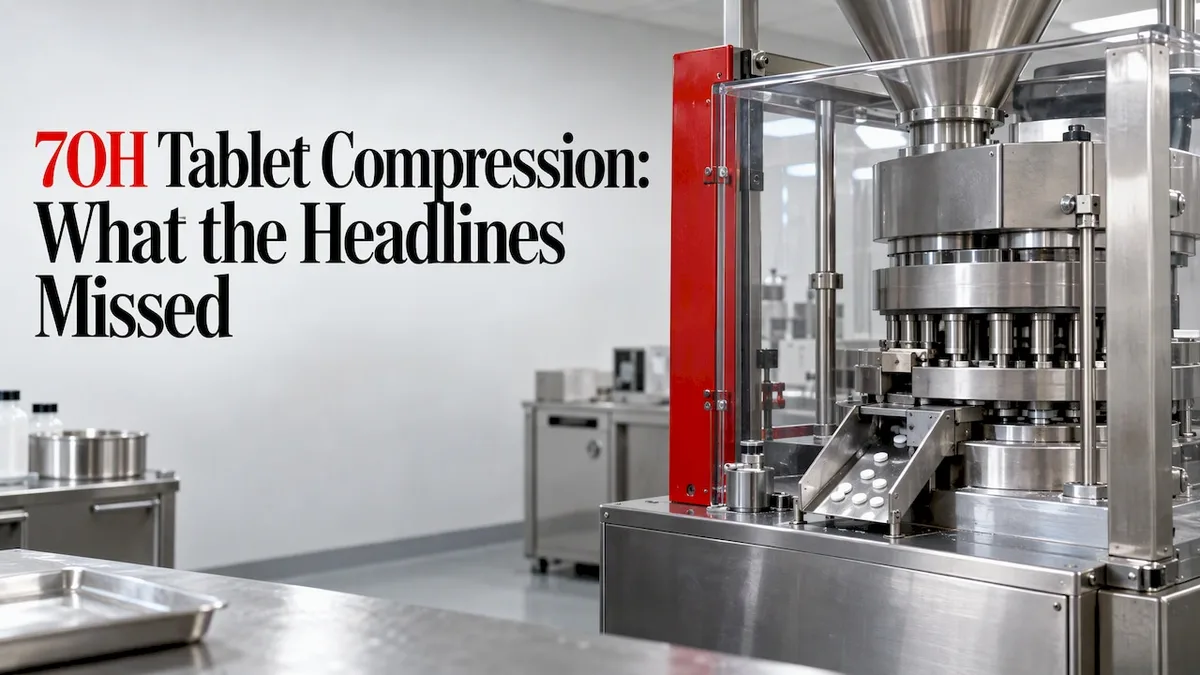
7OH Tablet Compression: What the Headlines Missed

7-hydroxymitragynine, better known as 7OH, is back in the news. On July 1, 2026, the US Drug Enforcement Administration announced its intent to temporarily place 7-OH in Schedule I, according to a Library of Congress research brief. Search interest in “7OH tablet compression” is small but telling. People want to know how these tablets are made, and a lot of the answers floating around online are wrong.
Here’s the short version. Tablet compression is an ordinary, well-documented manufacturing step. It’s a way of turning loose powder into a solid unit of defined shape. For research materials, it’s a quality-control question, not a do-it-yourself project. Our products are for research use only, not for human consumption.
7ohyeaResearch-Grade 7OH for Laboratory Work7OHyea offers research-grade 7OH tablets and powders for analytical purposes, with customizable dosage options for different research protocols.
Explore 7OH materialsTL;DR
- Tablet compression presses powder in a die between two punches. It’s standard pharmaceutical science and not exotic.
- Online forum threads about “pressing your own tabs” dominate search results. They’re not a reliable guide, and we don’t endorse them.
- The US has announced a scheduling intent for 7-OH. What Canada will do is unconfirmed, so watch official Health Canada notices.
- For labs, the real questions are uniformity, hardness, friability, dissolution and documentation.
- 7OHyea products are for research use only, not for human consumption.
Table of Contents
- Quick facts
- Why is everyone suddenly talking about 7OH?
- What did the headlines get wrong?
- What is tablet compression, in plain English?
- Why does a research lab care about tablet form at all?
- How do labs check that compressed tablets are consistent?
- What equipment sits behind a pressed tablet?
- What does Canadian law say about lab-scale handling?
- What about the US?
- Is the science settled?
- What this means for readers
- Our view: documentation beats hype
- Where can research teams find tablets and reference materials?
- FAQ
- Sources
Quick facts
| Item | Detail |
|---|---|
| Topic | Tablet compression of research-grade 7-hydroxymitragynine |
| Use | Analytical and laboratory research only |
| Human consumption | Not intended, not supported |
| US news hook | DEA notice of intent to temporarily schedule 7-OH, July 1, 2026 |
| Earlier US step | FDA scheduling recommendation, July 29, 2025 |
| Canadian status | No confirmed federal scheduling announcement found for this article |
| Key lab checks | Weight variation, content uniformity, hardness, friability, dissolution |
Why is everyone suddenly talking about 7OH?
Because regulators in the US have moved from talking to acting. In July 2025, the FDA said it was recommending a scheduling action for certain 7-OH products under the Controlled Substances Act. The agency also said there are no FDA-approved 7-OH drugs.
Then came the DEA notice a year later. It’s a notice of intent, not a finished rule. The Library of Congress brief explains that DEA must publish notice at least 30 days before a temporary scheduling order takes effect, and that an initial order can last up to two years.
There’s a history here too. The same brief notes that DEA tried something similar in 2016, then withdrew the notice after heavy public comment. So “it’s happening” and “it’s settled” are two different claims.
That’s the first thing the headlines blur.
What did the headlines get wrong?
Most coverage treats 7OH as one thing. It isn’t. A few myths keep coming up.
Myth: “A notice of intent means a ban is in force.”
Fact: A notice of intent is a signal. The process has steps, and the brief we cited lays them out. Anyone telling you the outcome is already locked in is guessing. We don’t predict it either.
Myth: “7OH and kratom are the same product.”
Fact: They’re related, not identical. The Library of Congress brief describes 7-OH as a chemical found in the kratom plant, and the DEA notice names it alongside three related substances. Mitragynine is another alkaloid, which is a naturally occurring plant compound, from the same plant. Concentration is exactly what the US notices focus on. The FDA’s recommendation, as reported by the trade outlet, targets concentrated amounts and not trace amounts.
Myth: “If it’s pressed into a tablet, it’s been made safe.”
Fact: Compression changes the form of a material. It doesn’t change what the material is. We don’t make safety claims about any of our products, and nobody else should either without evidence from a regulator.
Myth: “Anyone can press tablets at home.”
Fact: Look at what ranks for this keyword. Several results are forum threads where people trade tips on pressing their own tablets. We’re not going to repeat or build on that. It’s personal-use talk, and our materials aren’t for personal use. Controlled, documented manufacturing is a different world from a kitchen-table experiment.
What is tablet compression, in plain English?
It’s squeezing powder into a solid shape. According to Aulton’s Pharmaceutics, a standard university pharmaceutics text, compression forces powder particles into a compact specimen of defined geometry inside a die, using upper and lower punches.
A die is just a hole in a metal block. The punches are the pistons that squeeze the powder from above and below.
The same text breaks the process into three steps: the die fills, the punches compress, and the finished tablet is ejected. A peer-reviewed chapter by Bogda describes the same three stages.

That’s the whole idea. The craft is in everything around it.
How is that different from a capsule?
A capsule doesn’t compress anything. Contract manufacturer AbbVie explains that encapsulation encloses dry powder or pellets in a hard shell. Tablet compression presses the powder itself into a solid.
For a research lab, the difference matters because each format creates different things to test. A tablet is a single dense unit, so hardness and breakage become measurable questions. A capsule shifts attention to fill weight and shell behaviour.
Why does a research lab care about tablet form at all?
Consistency. A lab running a protocol wants every unit of material to match the one before it. That’s the entire appeal of a standardized format, and it’s why analytical chemists ask about process and not marketing.
The things that go wrong in compression are well known. A 2022 quality study of marketed tablets found that poor granulation and poor powder flow cause weight variation. It also described hardness as an indicator of a tablet’s physical strength. Granulation, in simple terms, means turning fine powder into slightly larger, more free-flowing clumps before pressing.
That’s a useful reality check on any tablet claim you read. If the powder doesn’t flow evenly, the tablets won’t match each other.
How do labs check that compressed tablets are consistent?
They test them. A 2023 study of paracetamol tablets shows the typical menu: weight variation, content uniformity, hardness, friability, disintegration, dissolution and FT-IR identification, all measured against USP specifications. FT-IR is a technique that reads a material’s chemical fingerprint with infrared light.
We’ve written practical guides on several of these checks:
- Tablet friability testing covers how well a tablet resists chipping and crumbling.
- Tablet hardness testing looks at setting reproducible specifications.
- Content uniformity is about whether each unit holds the same amount of the target compound.
- Blend uniformity covers the step before pressing, when the powder is mixed.
- Dissolution testing is about how a tablet breaks down in a lab test medium.
These are analytical methods. They describe how to measure a tablet, not how to use one.
What equipment sits behind a pressed tablet?
There’s a wide range. Aulton’s text describes single-punch and rotary presses for small and large production runs. It also describes computerized hydraulic presses that act as compaction simulators for research and development.
Bogda’s chapter adds that these simulators let researchers study how loading patterns affect tablet properties and spot scale-up problems early. That’s the kind of equipment a development lab uses.
The top Google result for this keyword is a listing for a ten-station mini press. It’s a reminder that this machinery is sold openly as industrial equipment. Owning a press isn’t the hard part. Running a documented, controlled process is.
The University of Michigan’s chemical engineering encyclopedia also notes that blending and milling steps come before compression. Their purpose is to improve the density and uniformity of the mixture.
What does Canadian law say about lab-scale handling?
Here we need to be careful, because we’re not giving legal advice and the picture is incomplete.
What we can point to is general lab and drug-manufacturing rules. Under the Food and Drug Regulations (current to June 17, 2026), equipment used to fabricate a drug has to be designed, maintained and operated so it can be cleaned effectively and avoid contamination. The same regulations require a separate quality control department to approve drug lots before sale or further use.
Health Canada’s GMP guidance, GUI-0001, calls for validated test methods, qualified equipment and documented procedures for sampling and testing raw materials and finished products.
Those rules describe regulated drug manufacturing. They don’t tell you how a specific research chemical is classified. We haven’t found a confirmed Health Canada scheduling announcement for 7-OH, so we won’t claim one exists. If you buy or handle this compound, check Health Canada’s official pages directly and speak to a lawyer who knows controlled substances.
On the lab side, the Government of Canada’s laboratory inspection guideline (2019) says appropriate protection includes lab coats, goggles and impermeable gloves, plus fume hoods where airborne contaminants are generated. It also checks that hazardous containers are labelled and that safety data sheets are on hand. Our guide to analytical-use-only labelling goes deeper on that side.
What about the US?
The US picture is moving faster, and it’s documented.
- July 29, 2025: The FDA announced it was recommending a scheduling action for certain 7-OH products. It said no FDA-approved 7-OH drugs exist and that 7-OH isn’t lawful in dietary supplements.
- July 1, 2026: DEA announced its intent to temporarily place 7-OH, with three related substances, in Schedule I. Temporary orders can last up to two years under the process described by the Library of Congress.
What happens after a notice of intent isn’t ours to say. Check the Federal Register and DEA for the current status.
Is the science settled?
No, and anyone who says it is should be treated with suspicion.
The science debate sits on two tracks. One is about how 7-OH differs from mitragynine and how regulators should treat concentrated versus trace amounts. The FDA’s reasoning, as reported, rests on a medical and scientific analysis that included animal studies. We’re not going to weigh in on pharmacology here. That’s not our lane, and it’s not what this page is about.
The other track is about manufacturing quality. That’s where compression lives. It’s less dramatic, but it’s testable.
What this means for readers
If you’re a researcher in Canada: Treat the US notices as a signal to tighten your paperwork. Keep batch records, certificates of analysis and storage logs in order. Confirm the current federal status with Health Canada and your institution’s compliance office before ordering.
If you’re an analytical chemist: Focus on what you can verify, which is uniformity, hardness, friability and dissolution data from a documented batch. Marketing language about “precision pressing” means nothing without numbers.
If you landed here from a forum thread about pressing tablets at home: This isn’t the place for that. Our materials are for research use only, not for human consumption, and we won’t give instructions that suggest otherwise. If you have health questions, talk to a doctor or pharmacist.
If you’re just curious: Good. Keep reading official sources, and be wary of any headline that treats a proposal as a finished law.
Our view: documentation beats hype
We think the loudest voices in this debate are missing the dull part. Whatever regulators decide, labs will still need traceable materials and honest paperwork.
That’s why we put batch-specific certificates of analysis at the centre of what we do. Domestic sourcing within Canada also means fewer border steps and no cross-border fees, which keeps your records simpler. We supply research-grade materials for analytical use, and we say so plainly on every product.
We also think the “press your own” trend is a bad sign for the whole category. It blurs the line between controlled research supply and personal use, and that blurring is exactly what draws regulators’ attention. We’d rather be boring, documented and clearly labelled.
— John
Where can research teams find tablets and reference materials?
If your lab needs research-grade 7-hydroxymitragynine or related alkaloid reference materials, our full range sits on the research-grade product category page. It includes tablets and powders, plus related mitragynine and SR17018 materials, with bulk options for research teams. Everything is sold for analytical and laboratory use only, not for human consumption.
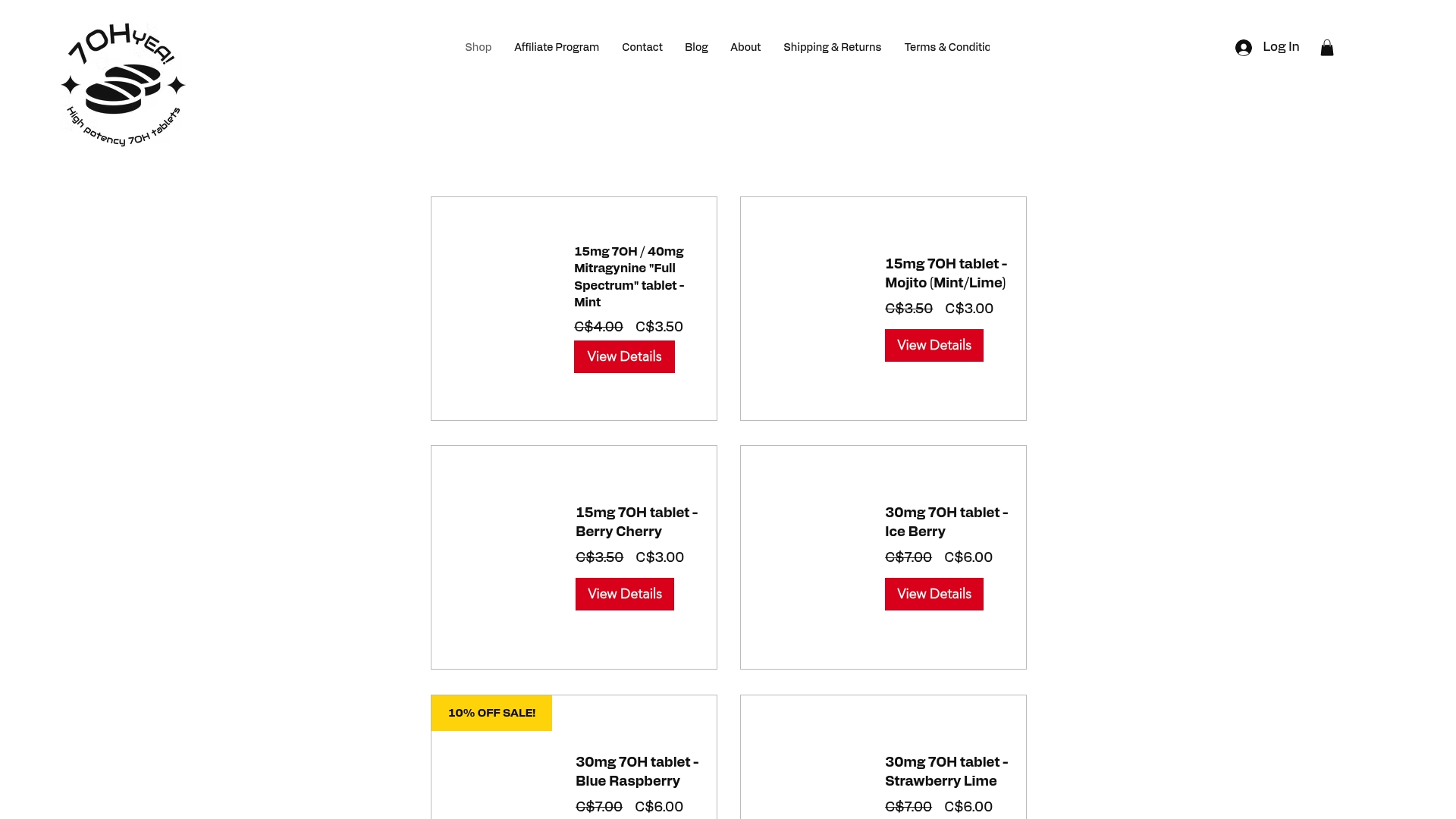
Published prices include our 81% pure 7OH powder at 50 CAD and our 99% pure SR17018 powder at 48 CAD, each as a one-off purchase. Our shipping documentation guide explains what Canadian labs should expect on paperwork and bilingual WHMIS labelling.
FAQ
Is tablet compression the same as pressing a pill at home?
No. In a regulated setting, compression is a documented process with qualified equipment, validated test methods and quality approval of each lot. Home pressing has none of that. We don’t provide instructions for it.
Is 7OH banned in Canada?
We haven’t confirmed a federal scheduling announcement for 7-OH in Canada, so we can’t say it’s banned or not. Rules can change, and we don’t give legal advice. Check Health Canada’s official notices and consult a lawyer before ordering.
What’s the difference between a tablet and a capsule?
A tablet is powder compressed into a solid shape. A capsule encloses powder, pellets or liquid in a shell, as AbbVie’s contract manufacturing team describes. Each format brings its own lab tests.
Are your products for human use?
No. They’re for research use only, not for human consumption. We don’t make safety or effectiveness claims about them.
What tests matter most for compressed tablets?
Labs commonly check weight variation, content uniformity, hardness, friability, disintegration and dissolution, as in the paracetamol study cited above. Documentation of each batch ties them together.
Sources
- Temporary Control of 7-Hydroxymitragynine (7-OH) and Other Kratom-Related Substances, Congress.gov
- FDA recommends scheduling action for 7-OH products, NutraIngredients
- Aulton’s Pharmaceutics, tablet compression chapter
- Tablet Compression: Machine Theory, Design and Process Troubleshooting, Taylor & Francis
- Tableting vs Encapsulation in Oral Drug Products
- Pharmaceutical quality evaluation of marketed vildagliptin tablets, PMC
- In-Vitro Comparative Quality Evaluation of Paracetamol tablets
- Tablets, Visual Encyclopedia of Chemical Engineering, University of Michigan
- Food and Drug Regulations, Justice Laws Website
- GUI-0001, Health Canada GMP guidance
- Laboratory Inspection Guideline, Government of Canada
So here’s our question for you: if the rules keep shifting, should the research-chemical industry police itself with better paperwork, or wait for regulators to do it?
7ohyeaQuestions About 7OH Research Materials?Email 7OHyea to ask about research-grade tablets and powders, dosage options, or analytical use for your laboratory work.77ohyea
Email us7ohyea@gmail.com