15 mg vs 50 mg 7OH: What the Label Number Tells You

People are searching “15 mg vs 50 mg 7OH” right now because 7-hydroxymitragynine (7-OH) went from a niche alkaloid to a regulatory headline in a matter of months. In July 2026 the U.S. Drug Enforcement Administration announced its intent to put 7-OH under temporary Schedule I control, and Canadians noticed. Here’s the honest answer to the comparison: the number on a label is a manufacturer’s claim about content, and we won’t rank, compare or predict what any product does. Our products are for research use only, not for human consumption.
7ohyea7ohyea.caRead 7OH Labels With Research in MindExplore research-grade 7OH tablets and powders with customizable dosage options, sourced in British Columbia for analytical purposes.
Explore 7OH materialsTL;DR
- A “15 mg” or “50 mg” label states what a maker says is in a unit. It isn’t a verified result, and a 2026 lab analysis found big gaps between labels and measured content in commercial products.
- The U.S. DEA announced its intent in July 2026 to temporarily control 7-OH. That’s an announcement of intent, not a Canadian rule.
- In Canada, we haven’t found a Health Canada announcement scheduling 7-OH under the Controlled Drugs and Substances Act. Unauthorized health products are still a Health Canada enforcement matter.
- For a lab, the number that matters is the one on a batch-specific Certificate of Analysis (CoA), backed by independent testing.
Table of Contents
- Quick facts
- Why is everyone suddenly comparing 7OH numbers?
- What does “15 mg vs 50 mg” actually measure?
- Myth vs fact: does the label tell you what’s inside?
- What did the headlines get wrong?
- What’s the legal landscape in Canada?
- So what is the science debate, in two minutes?
- How should a lab read a 7OH label?
- Does a bigger label number mean a better research material?
- What does this mean for readers?
- Our perspective
- Where can research teams find our materials?
- FAQ
- Sources
Quick facts
- Topic: how to read dose labels on 7-hydroxymitragynine (7-OH) products
- Use: research use only, not for human consumption
- U.S. news hook: DEA notice of intent to temporarily schedule 7-OH, announced July 1, 2026
- Canadian status: no scheduling announcement found by us; confirm on canada.ca before you act
- What we won’t do: compare product effects, describe what to expect, or give use instructions
Why is everyone suddenly comparing 7OH numbers?
Blame the news cycle. The U.S. Food and Drug Administration published an assessment that calls 7-OH an emerging opioid threat, and then the DEA followed with a scheduling notice. According to the Congressional Research Service, the DEA announced on July 1, 2026 its intent to temporarily place 7-OH and three related substances in Schedule I. The CRS analysis was updated on October 26, 2026.
When a compound hits the headlines, search traffic follows. A lot of people type a pair of numbers into Google and hope for a verdict.
That’s the trap. A pair of numbers feels like a comparison. It isn’t one, because a label number only describes what’s claimed to be in a tablet. It says nothing reliable about anything else.
What does “15 mg vs 50 mg” actually measure?
Less than you’d think. Milligrams (mg) are a unit of mass. A tablet’s label is saying how many milligrams of a compound the maker intends it to contain. That’s it.
For an analytical chemist, that’s a specification. It’s the starting point for a purchase order, a calibration plan or a method validation. It’s not a conclusion.
To be clear about the line we draw: we don’t compare what different strengths do, and we don’t describe what anyone should expect. Nobody at 7OHYEA can responsibly do that, and nobody should be selling it. The responsible comparison is about verification.
Myth vs fact: does the label tell you what’s inside?
Myth: If the label says it, the unit contains it.
Fact: Not always. A 2026 quantitative analysis of commercial 7-OH products found substantial discrepancies between labels and measured 7-OH. It also detected related compounds and oxidized byproducts, and the labelled amounts it recorded were all over the map.
In plain terms: two products can carry similar labels and still differ in what a lab would measure. That’s the real story behind any number-versus-number debate.
This matters most to the people we actually serve. A research team that builds a protocol on a label alone is building on an assumption. A team that builds on a CoA from a tested batch is building on data.
What did the headlines get wrong?
Three things keep showing up in the coverage and in the search results.
“7-OH is just kratom.”
Not quite. Kratom is a plant. 7-OH is one alkaloid (a naturally occurring, nitrogen-containing compound) that occurs in the plant in tiny amounts. The FDA’s assessment says concentrated 7-OH products can differ from botanical kratom and describes 7-OH as a potent mu-opioid agonist, meaning it activates a receptor that opioid drugs also target. The FDA also notes that human data are limited, with much of the evidence coming from preclinical work.
That last point deserves emphasis. “Limited human data” means anyone who tells you precisely what a given amount does is overreaching.
If you want the lab-focused version of the plant-versus-isolate distinction, we’ve written about it in mitragynine vs 7-hydroxymitragynine for Canadian labs.
“The DEA banned it.”
Not as stated. What’s been announced is an intent to temporarily schedule. Whether, when and how a final measure applies is a question for the U.S. Federal Register and the DEA, and we’re not going to predict it. If you handle anything cross-border, read the notice itself.
“It’s legal in Canada, so it’s regulated like groceries.”
Also wrong. Canada doesn’t treat “not scheduled” as “approved.” We’ll get to that below.
What’s the legal landscape in Canada?
Canada first, then the U.S., as the story should be told for Canadian readers.
Canada. As far as we can confirm, there’s no Health Canada announcement placing 7-OH on a schedule of the Controlled Drugs and Substances Act (CDSA). We can’t point you to an official page that says either way with certainty, so treat this as unconfirmed and check canada.ca before you rely on it. Some secondary sources say the same, but we don’t treat a blog as the final word on law.
What’s on firmer ground is Health Canada’s general position. It warns that unauthorized health products haven’t been assessed for safety, effectiveness or quality and may contain undeclared ingredients, and that selling them is illegal. It tells consumers to look for an eight-digit DIN, NPN or DIN-HM.
Imports have their own rules. Health Canada’s import guidance for health products says non-compliant goods can be detained, seized, returned, disposed of or forfeited. That’s one reason domestic sourcing matters to a lab: fewer border surprises.
One more thing, and we’ll be blunt. Critics argue that a “not for human consumption” label can be a wink-and-nod way around the rules. That’s a fair public debate. Our position is that the label has to mean what it says: products sold for analytical work, to buyers who use them for analytical work, with documentation to match.
United States. The DEA’s July 1, 2026 notice, as summarized by the Congressional Research Service, targets 7-OH above a specified concentration threshold, along with related substances. The FDA’s separate assessment, linked above, is the scientific backdrop.
None of this is legal advice. If you’re unsure how a rule applies to your lab, talk to a lawyer who works in controlled substances or to your institution’s compliance office.
So what is the science debate, in two minutes?
Two camps, roughly.
The first camp, including the FDA, sees concentrated 7-OH as a distinct and potentially risky substance that deserves tight control. Its assessment cites preclinical evidence of respiratory depression, physical dependence and withdrawal.
The second camp argues that regulators are lumping a whole plant, with its traditional history, in with a purified isolate, and that blanket bans will drive people to unregulated sources. That argument is about policy design, and reasonable people disagree.
We’ll take a side on one narrow point. Whatever you think about scheduling, bad labelling helps nobody. The 2026 analysis shows the labelling problem is real, and it’s the most solvable part of this whole story.
How should a lab read a 7OH label?
Think of the label as the question, and the CoA as the answer. Here’s what an analytical buyer should look for, with no use instructions attached.
- A batch-specific CoA. Not a generic one for the product line. It should carry a batch or lot number that matches your order.
- Independent testing. Third-party laboratory results beat a maker’s own say-so.
- Method disclosure. Which technique measured it, and what was the reported uncertainty?
- Impurity and byproduct data. The 2026 analysis found related compounds and oxidized byproducts in the products it tested, so a single headline number isn’t enough.
- Purity, not just amount per unit. A tablet label and a powder purity percentage answer different questions. We explain the difference in our guide to 7-hydroxymitragynine purity levels for analytical labs.
- Storage and stability notes. The same 2026 analysis reported that 7-OH degraded under simulated gastric conditions. Stability is a live chemistry question, so ask your supplier how they handle it.
We’ve also laid out the testing basics in three nonnegotiables for tablet testing. If you’re budgeting a project, our lab buyer’s guide to cost explains what drives price.
Does a bigger label number mean a better research material?
No, and that’s the point of this piece. “Better” in analytical work means traceable, consistent and documented. A research team picks a specification because its protocol calls for it, whether that’s a reference standard, a spiking solution or a stability study.
A protocol-driven choice looks like this: define the analytical need, choose the format (tablet or powder), set the acceptance criteria, then verify each batch against them. The number on the front of the package comes last, not first.

That’s also why we publish a range of research materials, including related reference alkaloids, and why research teams can ask about customization and bulk purchasing. We’d rather you pick the right specification for your method than the biggest-sounding one.
What does this mean for readers?
Here’s the short version, depending on who you are.
- If you’re a researcher or analytical chemist in Canada: Treat labels as claims and CoAs as evidence. Keep your documentation tidy, because regulatory attention on 7-OH is rising on both sides of the border. Check the current status on canada.ca and with your institution before ordering.
- If you’re a procurement lead: Ask suppliers for batch-specific CoAs and independent testing before you compare anything else. Ask where the material is sourced and how it ships.
- If you’re just curious about the headlines: The comparison you came for isn’t one a responsible company can give you. The FDA says human data on 7-OH are limited, and we aren’t going to fill that gap with guesses.
- If you’re reading this for personal use: Our products aren’t for you. They’re research materials, not for human consumption. If you or someone you know is struggling with opioid or kratom use, talk to a doctor or call your provincial health line.
The unresolved question is where Canada goes next. We won’t predict it. We’ll say that a clear, documented, research-only supply chain is the best position any supplier can be in whichever way policy moves.
Our perspective
We’ve watched the 7-OH conversation turn into a numbers contest, and we think that’s backwards.
A milligram figure on a package is where documentation starts. A supplier earns trust through batch-specific Certificates of Analysis, third-party laboratory verification and honest limits on what the material is for. Ours is for research use only, not for human consumption, and we say so everywhere.
We source and manufacture in Canada, which means shorter shipping times and no border fees for our domestic customers. Just as important for a lab, it means a supply chain you can ask questions about.
Our range of 7-OH tablets and powders, related mitragynine alkaloid reference materials, and options for bulk orders exist because research teams need consistent materials and a supplier who’ll talk specifications rather than hype. We think that’s the right way to do this work, and we’d like to be the supplier you can call about it.
John
Where can research teams find our materials?
If you’re a lab buyer, our full catalogue of research-grade 7-OH tablets and powders, with related mitragynine alkaloid reference materials, is on the 7OHYEA home page. Every item is for analytical use only, and not for human consumption.
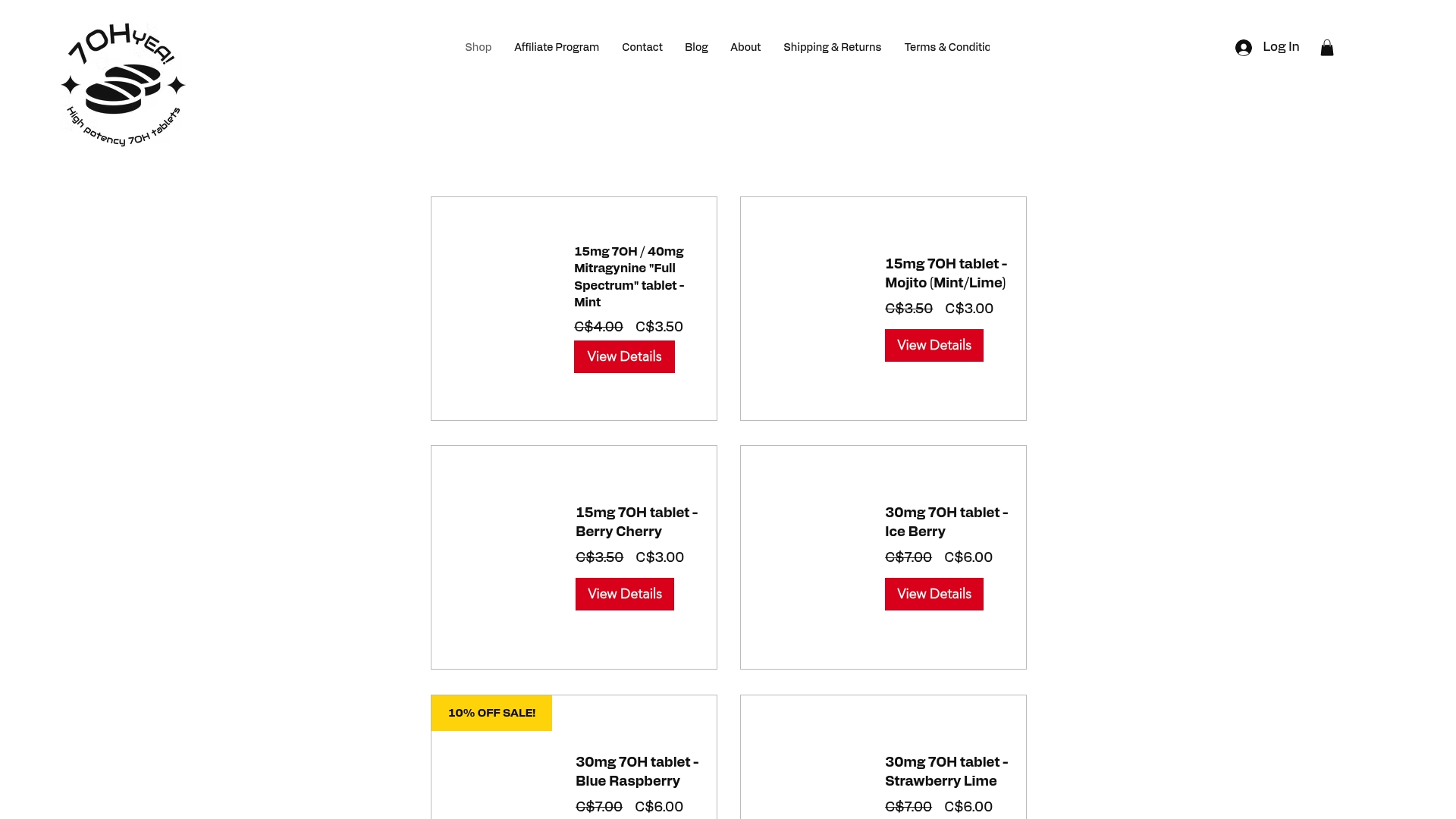
Bulk purchasing and customized specifications are available for research teams. Ask for the batch-specific CoA that goes with your lot before you finalize a protocol, and read our pieces on 7OH vs 7-hydroxymitragynine and the pharmacology for clinicians and researchers if you want more background.
FAQ
Is there a verified difference between a 15 mg and a 50 mg 7OH product?
The only verified difference is what a lab measures in a specific batch. Labels are claims, and a 2026 analysis found large gaps between labelled and measured content in commercial products. We don’t compare effects between strengths, and the FDA says human data on 7-OH are limited.
Is 7-OH the same as kratom?
No. Kratom is a plant, and 7-OH is one alkaloid found in it in small amounts. The FDA’s assessment says concentrated 7-OH products can differ from botanical kratom. Our materials are research chemicals, not for human consumption.
Is 7-OH illegal in Canada?
We haven’t found a Health Canada announcement scheduling it under the CDSA, but we can’t call that confirmed. Health Canada does say selling unauthorized health products is illegal, and imports must meet the Food and Drugs Act. Check canada.ca or ask a lawyer, because this isn’t legal advice.
What did the DEA announce about 7-OH?
On July 1, 2026, the DEA announced its intent to temporarily place 7-OH and three related substances in Schedule I, according to the Congressional Research Service. That’s a notice of intent, and we won’t predict the outcome. Read the official notice if it affects your work.
What should a lab look for before ordering?
Ask for a batch-specific Certificate of Analysis, independent test data, the analytical method and impurity information. Then confirm that the supplier’s stated use matches yours. So here’s our question for you: what’s the one document you wish every supplier handed over without being asked?
Sources
- Quantitative analysis of 7-hydroxymitragynine in commercial products (PubMed, 2026)
- FDA: 7-Hydroxymitragynin (7-OH), an assessment of the scientific data and toxicological concerns
- Congressional Research Service: Temporary Control of 7-Hydroxymitragynine (7-OH) and Other Kratom-Related Substances
- Health Canada: Unauthorized products may pose serious health risks
- Health Canada: Guidance document on the import requirements for health products
7ohyeaAsk About 7OH Research MaterialsEmail 7ohyea with questions about research-grade 7OH tablets and powders, customizable dosage options, or analytical use.77ohyea
Email us7ohyea@gmail.com