Analytical Alkaloid Orders for Canadian Labs: Avoid a 70 Day Reset

Analytical use only alkaloids are research-grade alkaloid materials supplied strictly for controlled laboratory analysis, never for human consumption. Before placing an order, confirm that your institution holds the correct licence or a subsection 56(1) exemption, because Health Canada’s rules determine who may legally receive these substances, and complete documentation from the outset is what keeps your timeline intact.
TL;DR:
- Choose a dealer licence for ongoing institutional handling or a subsection 56(1) exemption for a defined study tied to its named investigator, protocol, and site.
- A complete subsection 56(1) application must name the product, CAS number, quantity, packaging, principal investigator, and protocol; Health Canada’s target is 70 calendar days.
- Before ordering, verify supplier licensing and domestic sourcing, and require a shipment specific certificate listing identity, assay method, purity, impurities, expiry, and batch number.
- Validated chromatographic methods report intra and interday precision below 15% RSD and an example plasma quantification limit near 10 ng/mL; compare these benchmarks with protocol needs.
- For exempted work, limit access to personnel named under the protocol, log each withdrawal, and document disposal under institutional hazardous waste procedures.
7ohyeaSource Research-Grade 7OH Materials7OH Canada supplies research-grade 7-hydroxymitragynine tablets and powders for analytical purposes, with domestic sourcing from British Columbia.
Visit 7OH CanadaTable of Contents
- Procurement checklist: documents and supplier assurances to request before ordering
- Health Canada licensing and exemptions: what labs must submit and expect
- Technical quality and testing expectations for research-grade alkaloids
- Storage, security and record-keeping: practical must-dos for compliance
- Procurement workflow and realistic timelines: from internal approval to delivery
- Standard analytical methods and protocols for testing and validating alkaloid samples
- Safety protocols for handling analytical use only alkaloids in the laboratory environment
- Detailed guidelines on waste disposal and environmental considerations for alkaloid research materials
- Expert perspective: balancing compliance, quality and experiment timelines
- How 7OH Canada supports labs seeking research-grade 7-hydroxymitragynine and related materials
- FAQ
- Sources
Procurement checklist: documents and supplier assurances to request before ordering
Ordering research-grade alkaloids is less about finding a catalogue and more about assembling the paperwork that proves your laboratory is entitled to receive them. A supplier that takes compliance seriously will ask for nearly as much documentation as it provides, and that exchange protects both sides.
Before you commit to an order, gather the following and confirm the supplier can match it:
- A batch-specific certificate of analysis (COA) listing CAS number, declared purity or potency, and batch identification.
- A current safety data sheet (SDS) describing handling, storage and disposal properties for the specific material.
- An institutional letter or protocol excerpt naming the principal investigator, since suppliers of Part J restricted substances are required to verify purchaser standing before supply.
- Confirmation of the supplier’s own licence status and whether sourcing and shipping are domestic, which tends to shorten delivery windows.
- Clarity on chain-of-custody and packaging, and written confirmation that the supplier ships only to licensed entities or exemption holders.
Our guide to tablet testing requirements walks through how these documents map onto a real tablet order, which is worth reviewing before you submit a purchase request to your procurement office.
Health Canada licensing and exemptions: what labs must submit and expect
Two distinct pathways govern lawful access to restricted alkaloid materials, and choosing the right one early avoids weeks of back-and-forth. A dealer licence suits organizations that routinely handle controlled substances as part of ongoing operations, while a subsection 56(1) exemption suits a defined research project with a named principal investigator and protocol.
- Determine which pathway fits your work: ongoing institutional handling generally points to a dealer licence, while a single study or defined protocol points to a scientific research exemption.
- Assemble a complete application package, since Health Canada aims to process complete scientific research exemption requests within a 70 calendar day target, and incomplete submissions restart the clock.
- Include the fields reviewers expect: product name, CAS number, quantity, packaging details, and a signed institutional letter tying the request to a specific protocol and principal investigator.
- Remember that an exemption is tied to the protocol, the PI and the site named in the application, so any change to substance, dose, route, site or investigator typically requires an amendment rather than an informal update.
Restricted drugs under Part J of the Food and Drug Regulations have no approved therapeutic use in Canada, and their supply is limited to laboratory research and clinical testing conducted by licensed dealers or exemption holders. Building your application around those specific fields, rather than a general description of your research, is what moves a file through review efficiently.
Technical quality and testing expectations for research-grade alkaloids
A certificate of analysis is only useful if it answers the questions your method validation plan actually asks. At minimum, expect a COA to state an identity test, the assay method used, declared purity, known impurities, expiry date and a batch identification number that ties the document to the physical material in hand.
Purity statements matter more than they first appear: powder purities can vary significantly and must be stated per unit weight so dilution calculations start from a known baseline. When comparing suppliers, request:
- The declared purity or potency expressed as a percentage or mg per unit.
- The analytical method used to establish that figure, ideally UPLC-MS/MS or an equivalent chromatographic method.
- Batch-level impurity profiles rather than a generic specification sheet.
Pro Tip:Ask suppliers whether their COA reflects the specific batch shipped to you, not a representative or historical batch, since the two can differ meaningfully.
Validated UPLC-MS/MS methods for quantifying 7-hydroxymitragynine report intra- and inter-day precision under 15% RSD, with an example lower limit of quantification around 10 ng/mL in plasma.This benchmark gives labs a practical yardstick when evaluating whether a supplier’s own validation data meets the standard your protocol requires. Our reference standards guidance covers the specific COA fields worth demanding before you accept a shipment.
Storage, security and record-keeping: practical must-dos for compliance
Once materials arrive, the compliance work shifts from paperwork to practice. Licensed dealers and exemption holders are expected to maintain controls that would satisfy an audit on short notice, and the habits that make this manageable are straightforward rather than exotic.
- Store materials in a locked, access-controlled location with inventory logs that record every withdrawal and the researcher responsible.
- Retain every COA, permit, exemption letter, transfer record and disposal document for the full duration your institution’s retention policy requires.
- Treat an exemption as covering only the personnel named under the approved protocol, with the principal investigator responsible for any delegated user’s access.
Pro Tip:Keep a single binder, physical or digital, that pairs each batch’s COA with its corresponding inventory log entry, so an auditor can trace material from delivery to disposal in one pass.
Procurement workflow and realistic timelines: from internal approval to delivery
Research teams that treat procurement as a scheduling problem, not just a purchasing one, tend to avoid the scramble that comes from assuming materials will arrive within days of deciding to order.
- Secure internal sign-off from your principal investigator and institutional compliance office before approaching any supplier.
- Vet the supplier against the checklist above, confirming licence status, COA practices and domestic sourcing where available.
- Submit a complete licence or exemption application, budgeting for the 70 calendar day processing target plus the supplier’s own shipping lead time.
- Track milestones explicitly: PI sign-off, submission date, Health Canada acknowledgement, and supplier shipping confirmation, so delays are visible early rather than discovered at the point an experiment is scheduled to start.
Our compliance playbook breaks these steps down further and is worth bookmarking alongside your protocol documents.
Standard analytical methods and protocols for testing and validating alkaloid samples
Validating an alkaloid sample before it enters a study protocol generally follows a chromatographic path, most often liquid chromatography paired with tandem mass spectrometry. UPLC-MS/MS is the method most frequently referenced for quantifying 7-hydroxymitragynine and related alkaloids because it separates closely related compounds and offers the sensitivity needed at low concentrations.
A sound validation protocol establishes a calibration curve across a defined concentration range, confirms linearity, and checks recovery against a known standard. Intra-day and inter-day precision are measured by running replicate samples on the same day and across multiple days, with results typically expressed as relative standard deviation. The lower limit of quantification marks the smallest concentration the method can measure reliably, which matters when your study involves trace-level detection rather than bulk material characterization.
Identity confirmation is a separate step from quantification: a mass spectrum or retention time match against a certified reference standard establishes that the compound present is actually the one labelled, independent of how much of it is there. Labs building a new protocol from scratch often start with a published validation method as a template, then adapt calibration ranges to their own instrument and matrix. Our laboratory detection methods overview walks through how these steps apply specifically to 7-hydroxymitragynine testing.
Safety protocols for handling analytical use only alkaloids in the laboratory environment
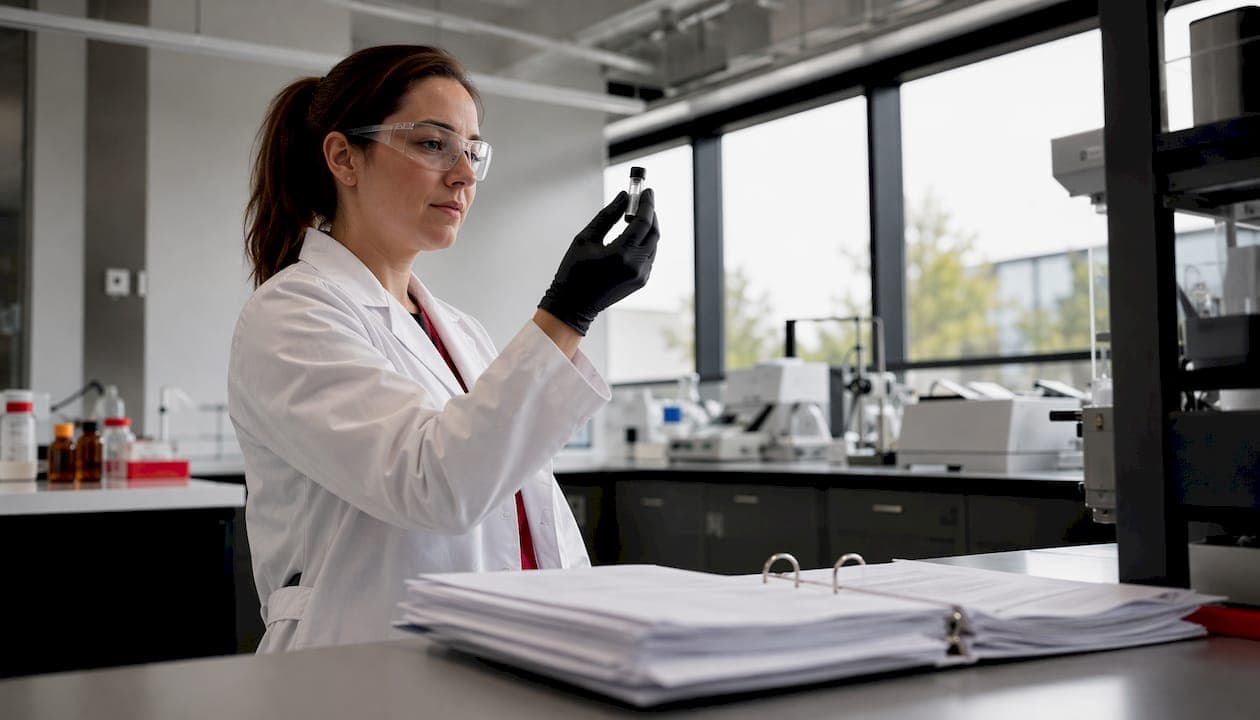
Handling research-grade alkaloids safely starts with the same baseline practices used for any potent, pharmacologically active compound: closed-handling procedures, appropriate personal protective equipment, and a fume hood or similar containment for powder work where airborne exposure is a concern.
Personnel should wear nitrile gloves, lab coats and eye protection as a minimum, with respiratory protection added for procedures involving fine powders or weighing outside a containment enclosure. Because these materials are not characterized for human exposure, spill and skin-contact procedures should be written and rehearsed before the material arrives, rather than improvised afterward.
Clear signage and segregated storage help prevent cross-contamination with other lab materials, and a dedicated weighing station reduces the chance of residue transferring to shared equipment. Access should be limited to personnel named under the governing exemption or licence, consistent with the record-keeping practices described earlier in this guide. Any adverse exposure, however minor, should trigger your institution’s standard incident reporting process immediately, both for the safety of the individual involved and to maintain a clean audit trail for your compliance file.

Detailed guidelines on waste disposal and environmental considerations for alkaloid research materials
Disposal of alkaloid research waste follows the same logic as disposal of any controlled pharmacological substance: it cannot go into general laboratory waste streams, and the method of destruction should be documented as carefully as the material’s receipt.
Most institutions route controlled substance waste through a licensed hazardous waste contractor rather than handling destruction in-house, and this is typically the safer and more defensible choice for a small research quantity. Where in-house destruction is permitted under your institution’s own environmental health and safety policy, the method and quantity destroyed should be logged and witnessed, with the record retained alongside your COAs and permits.
Liquid waste containing alkaloid residues, such as rinsate from glassware or mobile phase from chromatographic runs, should be collected separately from general solvent waste when the concentration is meaningful, since local wastewater regulations typically restrict discharge of pharmacologically active compounds. Checking with your institution’s environmental health and safety office before establishing a disposal routine is worth the short delay, because disposal practices that satisfy a research exemption on paper still need to satisfy municipal wastewater rules in practice.
Expert perspective: balancing compliance, quality and experiment timelines
The labs that move fastest are not the ones that skip documentation, they are the ones that treat it as the first experiment. A complete application package and a validated COA in hand on day one will outrun a cheaper order that arrives without either.
We’d encourage any team starting this process to engage suppliers early about domestic sourcing and pre-verified batch documentation, since that conversation often reveals gaps before they become delays. And it’s worth building in time for amendments: an exemption tied to one protocol, dose or site does not flex automatically when a study design changes, so budget for that administrative step rather than treating it as a surprise.
— Deek
How 7OH Canada supports labs seeking research-grade 7-hydroxymitragynine and related materials
We supply research-grade 7-hydroxymitragynine tablets and powders built for laboratory analysis, never for human consumption, and we back every batch with a certificate of analysis specific to that shipment. Sourcing domestically lets us keep delivery times shorter than cross-border alternatives, which matters when a protocol timeline is already tight against Health Canada’s own processing windows.
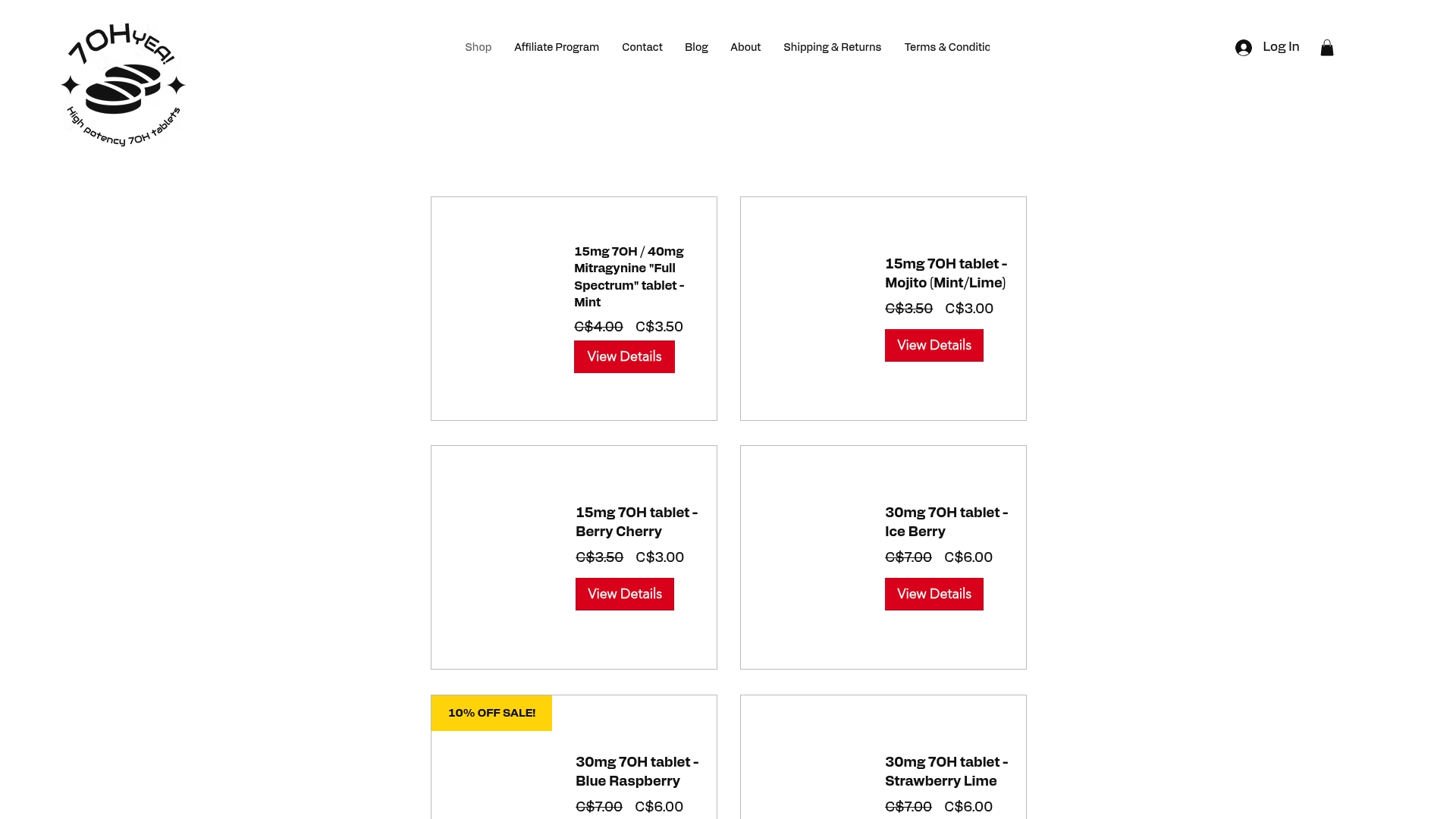
Our offering includes:
- 7OH tablets, “Full Spectrum” 7OH/mitragynine tablets, MGM-15 tablets and mitragynine tablets in customizable dosing, including 15 mg, 30 mg and 50 mg formats.
- 81% pure 7OH powder and 43% pure “Full Spectrum” mitragynine powder for labs that calibrate their own dosing.
- 99% pure SR17018 powder and SR17018 tablets for related alkaloid research protocols.
Once your licence or exemption documentation is in order, browse our research-grade product catalogue to see current dosing options and begin procurement.
This article is general information, not a substitute for advice from a qualified lawyer. Consult a qualified legal professional about your own circumstances before acting on anything here.
FAQ
What does “analytical use only” mean for alkaloid materials?
It means the material is supplied solely for laboratory analysis, such as method validation, reference standard work or controlled research, and never for human consumption. Suppliers of restricted substances are required to confirm a purchaser’s licensed or exempted standing before shipping, as outlined in Health Canada’s licensing guidance.
How long does a subsection 56(1) exemption take to process?
Health Canada’s stated target is 70 calendar days for a complete scientific research exemption application. Incomplete documentation extends that timeline, so submitting all required fields, including the institutional letter and protocol details, the first time matters.
Who is eligible to receive restricted or Part J substances?
Eligibility generally extends to licensed dealers, institutions and individuals holding a valid exemption tied to a named protocol and principal investigator. Part J restricted drugs have no approved therapeutic use in Canada and are limited strictly to laboratory research and clinical testing by authorised parties.
What should a certificate of analysis include?
A usable COA states an identity test, the assay method, declared purity, known impurities, an expiry date and a batch identification number specific to the shipment received. Matching those fields against a validated method, such as a UPLC-MS/MS approach with intra- and inter-day precision under 15% RSD, gives a lab confidence the material will perform as expected in its own protocol.
Does 7OH Canada provide batch-specific documentation with its products?
Yes, we provide a batch-specific certificate of analysis with our research-grade 7-hydroxymitragynine and mitragynine materials, sourced domestically from British Columbia. Current product listings and dosing options are available on our product catalogue.
Sources
- Canada
- Development and validation of a UPLC-MS/MS method for the determination of 7-hydroxymitragynine