Assay Recovery for 7OH: What the Headlines Miss

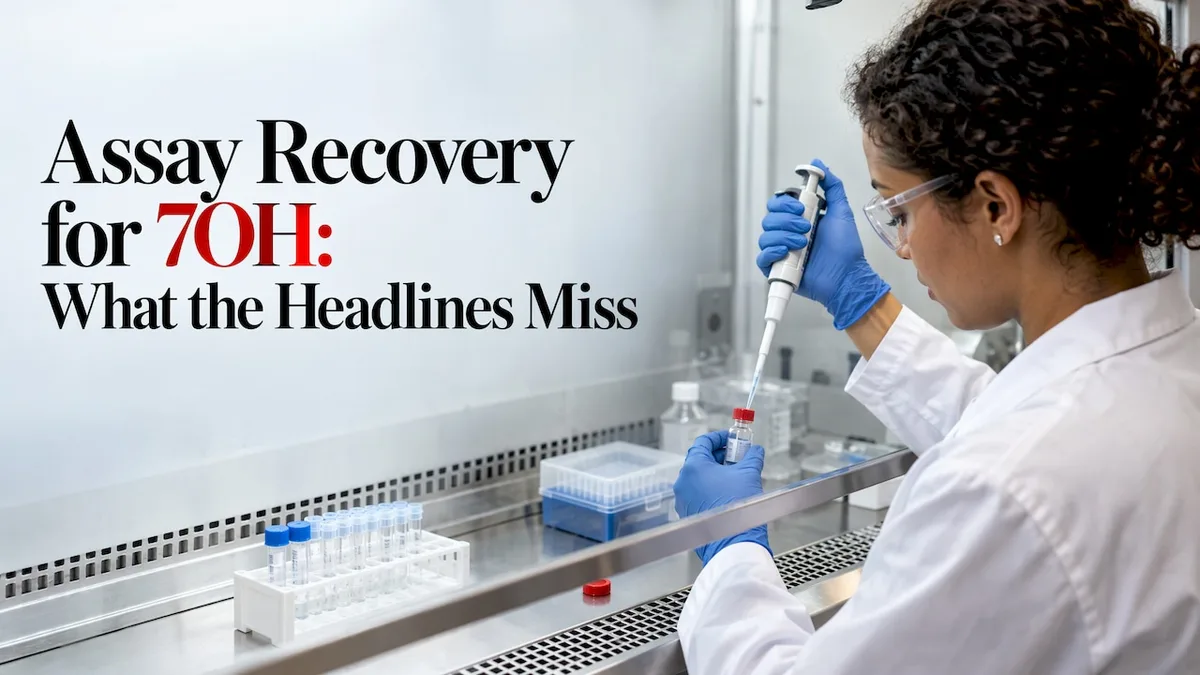
On November 3, 2026, a Tyendinaga police warning about kratom made the local news after two medical calls, and 7-hydroxymitragynine (7OH) is back in Canadian feeds. Many people typing “assay recovery 7OH” are really looking for something else. Search results for the phrase are crowded with withdrawal and detox pages. But assay recovery is a laboratory term, and it matters a lot to anyone who has to measure this compound accurately.
Here’s the plain-language version. Assay recovery asks one question: if you know how much compound went into a sample, how much does your method actually find? We’ll cover that, the news, the Canadian legal picture and what it all means for you. Our products are for research use only, not for human consumption.
7ohyea7ohyea.caSupport More Precise 7OH AnalysisExplore research-grade 7OH tablets and powders from 7OH Canada, with customizable dosage options for analytical research.
Explore 7OH productsTL;DR
- Assay recovery is the percentage of a known, spiked amount of 7OH that a lab method actually measures. It has nothing to do with personal recovery or treatment.
- Published methods report very different recovery figures, and a lower number isn’t automatically a failure if accuracy and precision hold up.
- Canadian and US regulators are both under pressure over 7OH products, and some timelines you’ll see online are unconfirmed.
- If you’re a researcher, documented batch testing and method validation matter more than any headline.
Table of Contents
- Quick facts
- Why is everyone suddenly talking about 7OH again?
- What does assay recovery actually mean?
- Myth vs fact: what people get wrong about this phrase
- What do real recovery numbers look like?
- Why is 7OH a tricky compound to measure?
- What did the headlines get wrong?
- Where does Canadian law stand?
- And in the United States?
- What does this mean for readers?
- Our take: measurement is where the real debate should be
- Need research-grade material for your method work?
- FAQ
- Sources
Quick facts
- What it is: 7-hydroxymitragynine, a compound found in tiny amounts in kratom leaf and also made in concentrated form.
- What “assay recovery” means: the share of a spiked amount that a full analytical method recovers.
- Our status: research use only, not for human consumption.
- US milestone: on July 29, 2025, the FDA recommended scheduling 7OH products to the DEA.
- Canada: we haven’t confirmed a 7OH-specific federal order. Check Health Canada directly for the current position.
Why is everyone suddenly talking about 7OH again?
Because the story has moved from the margins to local police bulletins. The Tyendinaga report is a small item, but it shows the topic is now an ordinary community-safety story in Ontario, not just an internet argument.
South of the border, the story has been bigger. On July 29, 2025, the U.S. Department of Health and Human Services announced that the FDA was recommending scheduling action on 7OH. The FDA also published a scientific assessment of the compound’s toxicological concerns.
Researchers in Canada are watching too. A BCIT team has warned about kratom imposters, and one researcher quoted there argues that 7OH isn’t present in the plant at pharmacologically relevant levels and shouldn’t be confused with natural kratom. That’s a point of view, but it’s a useful one: the fight over the label is half the debate.
So why does “assay recovery” show up in the middle of all this? Because every claim in this debate, from what’s in a product to what’s in a sample, depends on someone measuring 7OH correctly.
What does assay recovery actually mean?
It’s a quality-control number. Imagine a chemist adds a known amount of 7OH to a blank sample, runs the whole method, and then checks how much shows up. If 100 units went in and 90 came out, recovery is 90%.
AOAC International, a standards body for analytical methods, defines recovery in its 2015 requirements as the fraction or percentage of spiked analyte recovered when the sample goes through the entire method. Same idea, official wording.
Two terms are worth defining:
- Analyte: the thing you’re trying to measure. Here, it’s 7OH.
- Matrix: everything else in the sample, such as plasma, urine or a tablet’s binders. The matrix can interfere with the measurement.
Recovery is the number that tells you how much the method and the matrix together are costing you.
Myth vs fact: what people get wrong about this phrase
Myth: “Assay recovery 7OH” is about getting better after using 7OH. Fact: In chemistry, it’s about how much of a spiked compound a test finds. The top search results for the phrase are mostly withdrawal and treatment pages, so the confusion is understandable. If you or someone you know is dealing with dependence, a doctor, pharmacist or local health service is the right call, not a lab guide.
Myth: A recovery below 100% means the method is broken. Fact: Not necessarily. A review of bioanalytical method validation notes that recovery isn’t among the parameters regarded as essential by FDA and EMA conference reports. Most authors agree the exact value matters less, as long as sensitivity, precision and accuracy are acceptable.
Myth: One published number applies to every sample. Fact: Recovery depends on the method, the extraction and the matrix. A figure from rat plasma tells you little about a pressed tablet.
Myth: Lab results are the same thing as a roadside or cup test. Fact: Rapid cups and confirmatory lab methods are different tools. More on that in the FAQ.
What do real recovery numbers look like?
We’re keeping the science light here. Three data points tell the story.
A standards body sets the bar. AOAC’s 2015 requirements for 7OH and mitragynine in single-laboratory validation call for recovery of 90 to 110% at lower concentrations and 95 to 105% at higher ones. Those are targets for method developers, not guarantees about any product.
A published research method sits well below that. In a 2013 peer-reviewed rat plasma method, extraction recovery for 7OH ranged from 62.0% to 67.3%. Yet accuracy was within 96.5 to 104.0%. In other words, the method lost some compound in extraction but did so consistently, and the results still checked out.
A forensic urine method lands closer to the target. A Fisher Scientific application note on kratom components in urine reports 90.3% recovery for 7OH at one calibration level, and a matrix factor of 1.01, which indicates very little matrix interference.

The takeaway for a general reader: a recovery figure alone doesn’t tell you whether a result is trustworthy. You need to see it next to precision, accuracy and the method’s limits.
Why is 7OH a tricky compound to measure?
Because it can change. Labs that handle 7OH worry about stability, sample handling and the possibility that the compound appears or disappears between collection and analysis. We’ve written about this from a lab perspective in our piece on 7OH degradation and artifact risk.
It’s also easy to mix up with its parent compound. Mitragynine and 7OH are related but distinct, and a method that doesn’t separate them cleanly produces muddy data. Our explainer on mitragynine versus 7-hydroxymitragynine walks through why labs treat them as separate analytes.
For the bigger picture of how labs approach this, see our overview of laboratory detection methods in Canada. And if you’re weighing what to test for in a finished tablet, we’ve laid out three nonnegotiables for tablet testing.
What did the headlines get wrong?
Three things keep tripping people up.
They blur kratom and 7OH. News items often use the words as if they were one product. Researchers and regulators don’t. The FDA’s 2025 assessment treats concentrated 7OH as its own concern, separate from the leaf. Our breakdown of 7OH versus 7-hydroxymitragynine covers how the naming trips up readers.
They quote timelines as settled. Online, you’ll find confident claims about when a US federal order for 7OH takes effect. Some come from retail and content sites, and others from outdated copies of earlier notices. We haven’t been able to confirm a specific date from an official source, so we’re not giving one. The Federal Register is the place to check.
They skip the lab side. Detection claims, content claims and “lab tested” claims all hinge on validated methods. Without recovery, accuracy and precision data, a number is just a number.
Where does Canadian law stand?
Start with what’s confirmed: we haven’t found a Health Canada notice we can point to that announces a 7OH-specific scheduling order. Things may have moved since this was written, so check Health Canada’s own pages for the current position. We aren’t giving legal advice, and nobody should treat a blog post as a substitute for it.
What we can say is that the debate is live. Local police are issuing warnings, Canadian academics are publicly pushing back on how 7OH is labelled, and the US action has put Canadian regulators and retailers under a spotlight. Whether Ottawa follows Washington is an open question. We won’t predict it.
What we do stand behind is how we operate: products are sold for analytical and laboratory use only, not for human consumption, and we emphasize compliance with Canadian legal guidelines for lawful laboratory use.
And in the United States?
The US picture is more developed on paper. The HHS announcement of July 29, 2025 said the FDA was recommending that the DEA classify 7OH as a controlled substance, and the FDA released a scientific assessment of 7OH laying out its toxicological concerns. A recommendation isn’t a final rule. What happens next runs through the DEA and the Federal Register.
You’ll see some sites claim a temporary order is days away. Treat those dates as unconfirmed until you see them in the Federal Register itself. Other sites describe a different sequence of notices altogether, which is a good reason to go to the primary source.
It’s also worth knowing that US rules don’t apply in Canada. A US scheduling order, if one comes, wouldn’t change Canadian law by itself.
What does this mean for readers?
It depends on who you are.
If you’re a researcher or lab professional. Focus on method validation. Ask for batch-specific certificates of analysis and look for recovery, precision, accuracy and limits of quantitation, not just a purity percentage. Keep records of your sample handling, since stability can skew results. Our pharmacology overview for clinicians and researchers is a good starting point.
If you searched this phrase hoping for personal recovery help. You landed in the wrong aisle, and that’s fine. Talk to a doctor, nurse practitioner or pharmacist, or contact your provincial health line. They can give you advice for your situation. We can’t, and we don’t make health claims.
If you’re just following the news. Expect more headlines, more conflicting dates and more arguments over labels. Check the primary source before you share a claim.
If you’re a student or a journalist. Learn the vocabulary: analyte, matrix, recovery, precision, limit of quantitation. It’ll save you from being misled by a confident-sounding number.
Our take: measurement is where the real debate should be
We think the public conversation about 7OH spends too much time on slogans and too little on measurement.
Every serious question, from how much of a compound is in a batch to how much shows up in a sample, comes down to whether a method was validated and whether the data were documented. That’s why we supply research-grade material with batch-specific certificates of analysis, and why we focus on lab use only.
Being based in Canada, with domestic sourcing from British Columbia, means researchers can get material quickly and without border fees. Our tablets and powders are designed for analytical work, and our mitragynine reference materials give teams something to calibrate against. They’re not intended for human consumption.
We’d rather the argument be about evidence than volume. Regulators will decide what’s lawful, and we intend to follow their lead on lawful laboratory use. Meanwhile, the labs doing careful work are the people best placed to tell everyone else what’s actually in the material.
John
Need research-grade material for your method work?
If your team is building or checking an analytical method, you need a consistent, documented starting material. We offer research-grade 7OH and related alkaloid reference materials for laboratory use only, not for human consumption. Our 81% pure 7OH powder is listed at $50 CAD, and our 99% pure SR17018 powder is $48 CAD. Bulk purchasing is available for research teams.
Browse the full research-grade catalogue or go straight to the 81% pure 7OH powder. If you’re in the capital region, we also have a page for Ottawa labs.
FAQ
Does assay recovery mean getting over 7OH?
No. Assay recovery is a laboratory measurement: the percentage of a known, spiked amount of 7OH that an analytical method finds. If you’re looking for help with dependence or withdrawal, speak to a doctor, pharmacist or local health service.
Will 7OH show up on a drug test?
It depends on the test. One US laboratory, Testr, says 7OH is not picked up on a rapid cup but is on its confirmation menu at a 10 ng/mL cutoff, reported as its own analyte. Policies vary by employer and lab, so ask the testing body directly.
How long does 7OH stay in the body?
There’s no single validated answer. The International Society of Substance Use Professionals notes that no single number exists for concentrated retail 7OH, and reported half-lives vary by product and dosing pattern. A doctor or pharmacist can speak to an individual situation.
Is a lower recovery percentage always a problem?
Not always. A well-cited method review says recovery is less critical as long as sensitivity, precision and accuracy are acceptable. Consistent, reproducible loss can be corrected for, for example with an internal standard.
Is 7OH banned in Canada?
We haven’t confirmed a 7OH-specific federal order, and the situation can change. Check Health Canada and your provincial authority for the current position, and speak to a lawyer if you need advice. Our products are for lab research use only, not for human consumption.
So here’s our question for you: should the 7OH debate be settled by headlines, or by whoever can show their method, their recovery data and their batch records?
Sources
- Tyendinaga Police warn about kratom after two medical calls
- FDA Takes Steps to Restrict 7-OH Opioid Products (HHS press release)
- BCIT researchers sound alarm on kratom imposters
- AOAC SMPR 2015.008, alkaloids in Mitragyna speciosa
- Bioanalytical method validation: An updated review
- UPLC-MS/MS method for 7-hydroxymitragynine in rat plasma
- Quantitation of kratom components from urine by LC-MS/MS
- FDA assessment of 7-OH scientific data and toxicological concerns
- Does Kratom or 7-OH Show Up on a Drug Test? (Testr)
- How Long Does 7-OH Last? (ISSUP)
7ohyeaDiscuss Your 7OH ResearchEmail 7OH Canada with questions about research-grade 7OH tablets and powders for analytical purposes.77ohyea
Email us7ohyea@gmail.com