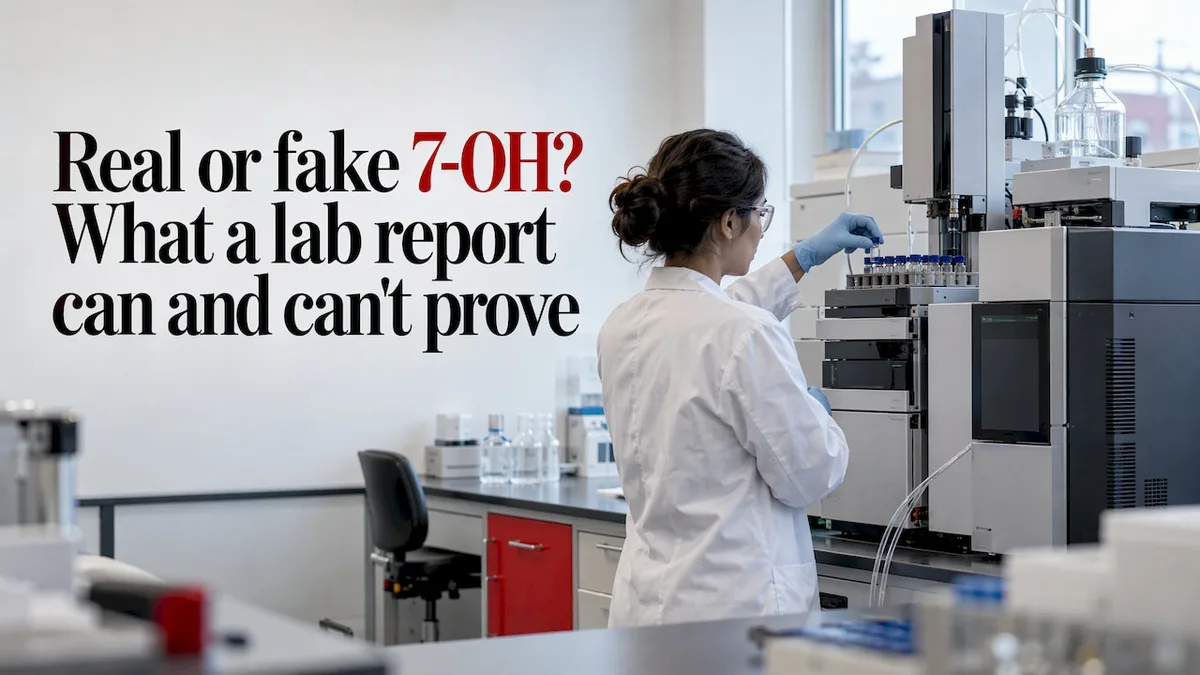
Real or fake 7-OH? What a lab report can and can’t prove
The U.S. is moving to control 7-hydroxymitragynine (7-OH), and the headlines keep asking one thing: is what’s in the package actually what the label says? The Federal Register shows the DEA issued a new notice of intent on October 14, 2026 to temporarily schedule 7-OH above a set threshold. When rules tighten, paperwork gets scrutinized. So here’s the short answer for Canadian labs: you can’t tell a real 7-OH material from a fake by looking at it. You can only tell by reading the batch documents and the method behind them.
Everything we sell is research-grade, for analytical and laboratory use only, and not for human consumption. This article is about verifying materials and documents, nothing else.
7ohyeaChoose Research-Grade 7-OH7OH Canada supplies research-grade 7-OH tablets and powders for analytical and laboratory use, with customizable dosage options.
VisitQuick facts
- Product type: research-grade 7-hydroxymitragynine, for lab use only, not for human consumption.
- Best proof of identity: a batch-specific certificate of analysis (CoA) from an independent lab, matched to the lot on your package.
- What eyes can’t do: colour, shape, tablet stamp and branding aren’t identity tests.
- Latest U.S. news: DEA notice of intent published October 14, 2026 (Federal Register). It is a proposal stage, not a final outcome.
- Canadian context: we don’t give legal advice. Check current Health Canada notices for your own situation.
Table of Contents
- TL;DR
- Why is everyone suddenly asking if 7-OH is “real”?
- Myth: “If the packaging looks professional, it’s genuine”
- Myth: “A natural kratom product with high 7-OH is just a stronger one”
- What does a real certificate of analysis look like?
- How do labs actually measure 7-OH, and where can they get it wrong?
- Which red flags should make you put a report down?
- What this means for readers
- Our perspective
- Where to get research-grade material
- FAQ
- Sources
TL;DR
- Packaging, logos and tablet looks can be copied in an afternoon. A lab result tied to your lot can’t be faked as easily.
- The lot number on the CoA must match the lot on your package. If it doesn’t, the report says nothing about what you hold.
- A potency-only report is half a report. Look for the method, the lab and the contaminant panels.
- A 2026 peer-reviewed study shows that a common mass spec shortcut can produce false 7-OH positives, so how the lab identified the compound matters.
- Natural kratom leaf contains almost no 7-OH, so a high 7-OH number on a “leaf” or “extract” label is a red flag about the label, not a bargain.
Why is everyone suddenly asking if 7-OH is “real”?
Because the market got loud. In July 2025 the FDA recommended that the DEA schedule certain 7-OH products as controlled substances, and it sent warning letters to companies distributing them. Florida moved on its own that August. In the DEA’s October 2026 filing, the agency points to a threshold approach, meaning a limit above which 7-OH would be controlled.
A threshold changes the game for analysts. If the legal line is a percentage, then the number on your report suddenly matters, and so does whether the lab measured it correctly.
What’s confirmed: the DEA has published notices of intent, as the Federal Register shows. What isn’t: the final outcome. We won’t guess at it.
Myth: “If the packaging looks professional, it’s genuine”
Fact: packaging proves nothing about chemistry.
Health Canada’s guidance on natural health product quality draws the line clearly. Appearance, colour, shape and odour count as organoleptic and visual checks, which means anything your senses can pick up. The same guide says identity tests need to be specific enough to tell the right ingredient from likely substitutes, and that a chemical test, such as matching a chromatography peak to a reference standard, is the stronger check for a defined chemical like 7-OH.
So a sharp label and a neat tablet are the first layer at best. They’re the layer a counterfeiter copies first.
Myth: “A natural kratom product with high 7-OH is just a stronger one”
Fact: that’s one of the biggest tells in the whole category.
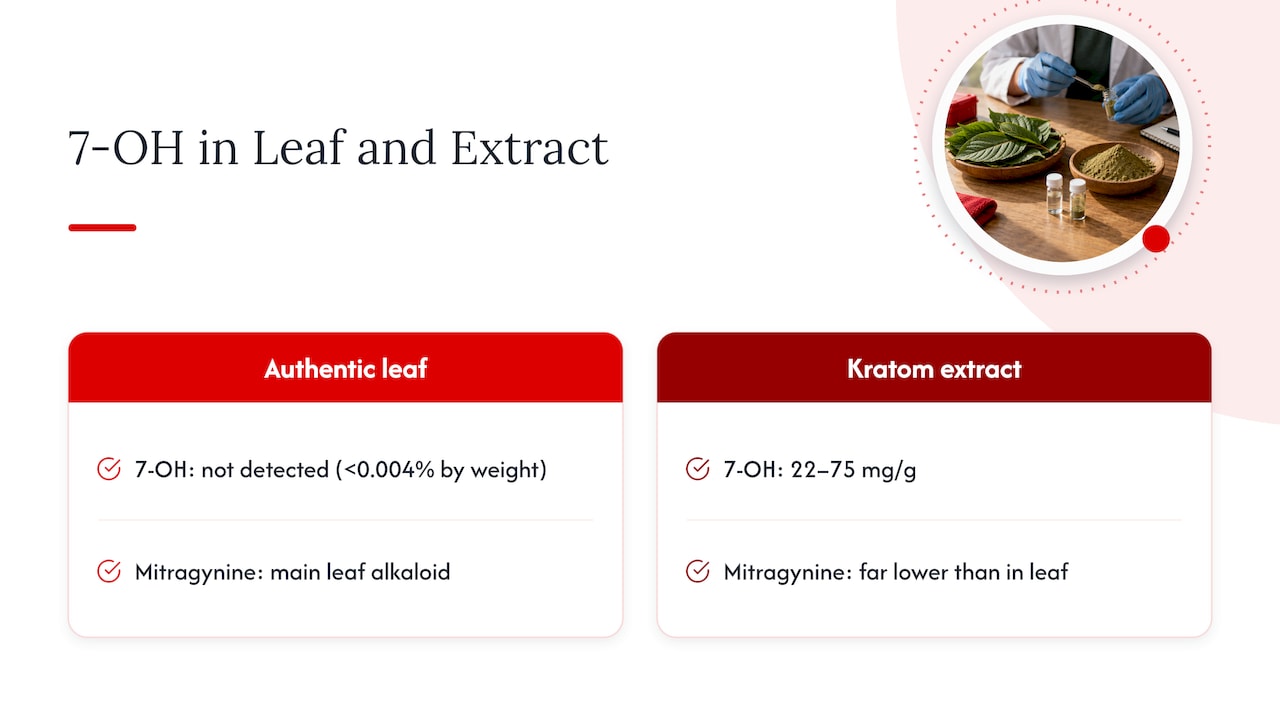
A 2025 peer-reviewed study by Brown and colleagues looked at the numbers. In authentic kratom leaf, 7-OH wasn’t detected at all at their detection limit of under 0.004% by weight. Yet products labelled “kratom extract” held 22 to 75 mg of 7-OH per gram. Their mitragynine, the main leaf alkaloid, was far lower than in leaf. The authors concluded those levels could only be reached synthetically.
Why this matters for authenticity: a document claiming a plant origin for a 7-OH-rich material is describing something the chemistry doesn’t support. The honest label is a concentrated, lab-prepared material, and an honest vendor documents it that way.
What does a real certificate of analysis look like?
A CoA is a lab’s report on one specific batch. Health Canada defines a batch as a specific quantity of material made so that it is expected to be uniform within set limits. That’s the whole logic: a report about one batch tells you nothing about another.
Use this checklist, top to bottom.
- Lot number. It must match the lot on your package exactly. This is the single most useful cross-check. A vendor that posts one old, favourable report across many production runs is giving you a document for a different batch.
- Date and product name. The sample description should match what you hold: material type, form and purity claim.
- Laboratory identity. A named lab with an address and contact details, ideally independent of the seller. Health Canada’s GMP guide lists failure to make sure a third-party lab is acceptable for its intended use as a major observation. If regulators care, so should you.
- Analytes. These are the compounds measured. A good report names 7-OH and mitragynine, and ideally related compounds such as mitragynine pseudoindoxyl.
- Result and units. A percentage or mg/g, with the method’s reporting limit.
- Method. HPLC, LC-MS/MS or similar, with the reference standard named.
- Contaminant panels. Heavy metals, microbials and residual solvents. A potency-only sheet leaves out everything that tells you whether the material is clean.
The same logic applies across regulated categories. A Canadian guide to lab-tested cannabis and what it means covers the same habit of matching lot codes and checking whether safety panels are included.
Our own approach follows this pattern: we supply research-grade materials with batch-specific certificates of analysis. If you want the deeper version of what a lab should document, our write-up on tablet testing requirements walks through it.
How do labs actually measure 7-OH, and where can they get it wrong?
This is the part headlines skip. Plenty of labs can produce a number. Fewer can prove the number belongs to 7-OH.
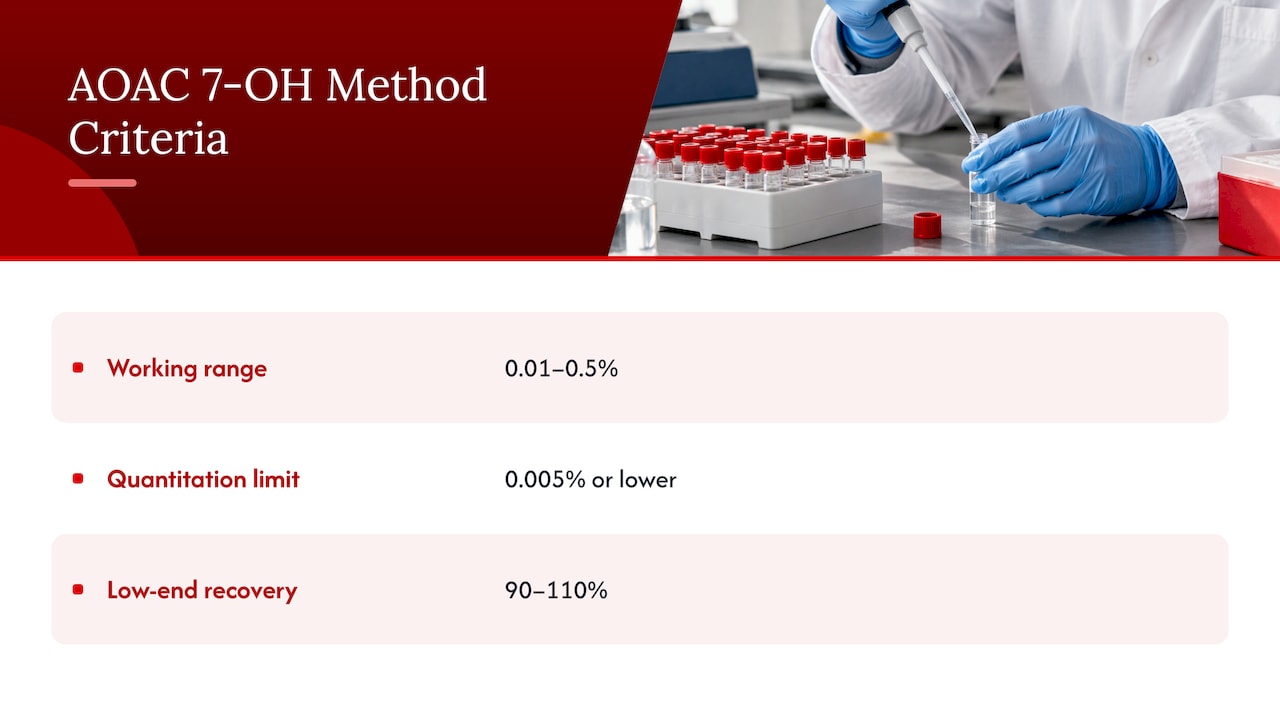
AOAC International, a standards body for analytical methods, publishes performance requirements for this exact job. Its SMPR 2015.008 says a method must quantify mitragynine and 7-OH and separate other related alkaloids. For 7-OH it sets a working range of 0.01 to 0.5%, a limit of quantitation of 0.005% or lower, and recovery of 90 to 110% at the low end. In plain terms: the method has to be sensitive, accurate and able to tell similar molecules apart.
Now the twist. A 2026 paper in the Journal of the American Society for Mass Spectrometry, by Sheehan and colleagues, found that relying on mass alone, or on a common fragment transition, can give false-positive 7-OH identifications in complex kratom samples. Their fix is to match retention time against authentic standards and confirm with diagnostic fragments. They say it works on routine triple-quadrupole instruments, not just high-end ones.
What that means when you read a CoA: a result is only as good as the identification behind it. Look for a named reference standard and a method description, not just a bold number.
For more on this, see our pieces on laboratory detection methods for 7-hydroxymitragynine in Canada and what labs must prove in method validation.
Which red flags should make you put a report down?
- No lot number, or one that doesn’t match. The report can’t be tied to your material.
- Only a potency figure. No metals, microbials or solvents.
- No lab name, or the lab is the seller. Nothing independent to check.
- A plant-origin label with a very high 7-OH figure. The leaf chemistry above doesn’t support it.
- Round, perfect numbers across every batch. Real batches vary within limits.
- A purity claim with no method. A percentage means little without how it was measured.
On purity claims specifically, our guide to 7-hydroxymitragynine purity levels for analytical labs explains how to read them.
What this means for readers
If you’re a lab or analytical team in Canada, the practical takeaways are simple.
Treat documents as part of the material. A batch without a matching CoA is an incomplete batch.
Ask what was measured, and how. Identity by retention time plus diagnostic fragments is stronger than mass alone.
Keep the paper trail. With U.S. rules still moving and Canadian expectations around lab use, a clean record of lot, lab and method protects your work.
Remember the boundaries. These are research materials, not for human consumption. Nothing here is legal advice, and the final shape of the U.S. rules isn’t settled. For your own compliance questions, check Health Canada’s current notices or speak with a lawyer.
If you’re here for personal use, this isn’t a page for you. We supply laboratories and qualified professionals only.
Our perspective
Authenticity in this field is a documentation problem before it’s a chemistry problem. A tablet can look right and still be unverifiable. A batch with its own certificate of analysis, a lot number that matches and a named method is something a lab can actually build on.
That’s the standard we hold ourselves to. We make and source research-grade 7-hydroxymitragynine in Canada, supply it with batch-specific certificates of analysis, and offer related reference materials for teams that need consistency from one study to the next. Domestic sourcing also means no border fees and fast shipping, which matters when a protocol is waiting on material.
The industry is heading toward tighter scrutiny. We think that’s healthy for serious research, and we’d rather be judged on the paperwork.
John
Where to get research-grade material
Our range covers research-grade 7OH tablets and powders, mitragynine reference materials, MGM-15 and SR17018 products, all sourced and manufactured in Canada and sold for laboratory use only. For example, our 81% pure 7OH powder is listed at $50 CAD, one-off. You can browse the full range from our research-grade 7OH catalogue, and we also take bulk orders for research teams.
FAQ
Can I tell if 7-OH is real by its colour, taste or tablet shape?
No. Those are organoleptic checks, and Health Canada’s quality guidance treats them as only a first layer. Identity rests on chemical tests compared against a reference standard. Research materials aren’t for tasting or consumption in any case.
What’s the most important line on a 7-OH lab report?
The lot number. A certificate only covers the batch it names, so it must match the lot on your package. After that, check the lab, the method and whether contaminant panels are included.
Does natural kratom leaf contain 7-OH?
Only in trace amounts. A 2025 study found none detectable in authentic leaf at a limit of under 0.004%, while products labelled as extracts held far more. The authors said such levels required synthetic means.
Why can two labs report different 7-OH numbers?
Method and identification differ. A 2026 study showed that using accurate mass or one common fragment transition alone can overstate 7-OH. Labs that confirm with retention-time matching and diagnostic fragments reduce that risk.
7ohyeaQuestions About 7-OH Materials?Email us with questions about research-grade 7-OH tablets and powders for analytical and laboratory use.77ohyea
Email us7ohyea@gmail.comSources
- Federal Register: DEA temporary placement of 7-hydroxymitragynine and mitragynine pseudoindoxyl, October 14, 2026
- News brief: FDA recommends scheduling 7-OH products
- Health Canada: Quality of Natural Health Products Guide
- Health Canada: Quality of natural health products draft guide, glossary
- Health Canada: GMP guide for natural health products, risk classification
- Brown et al.: Elevated 7-hydroxymitragynine levels found in products
- Sheehan et al.: Avoiding false identification of 7-hydroxymitragynine
- AOAC SMPR 2015.008: alkaloids in Mitragyna speciosa
So here’s our question: should a lot-matched, method-named CoA be the minimum for every research chemical sold in Canada? Tell us what you think.