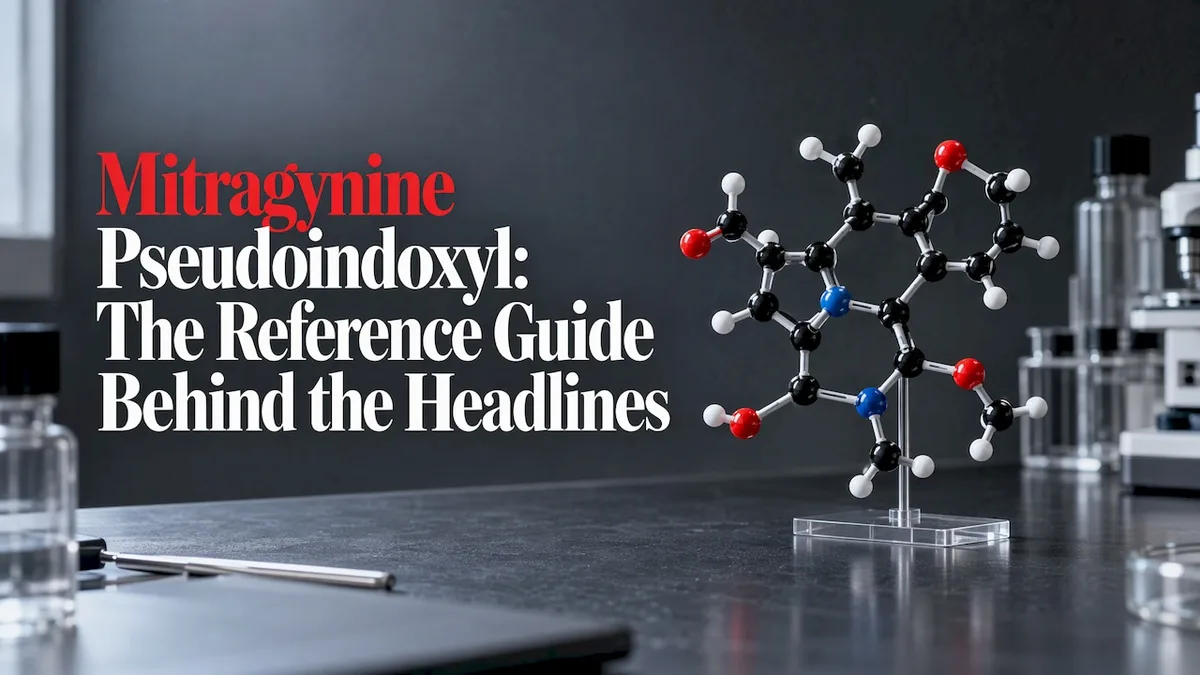
Mitragynine Pseudoindoxyl: The Reference Guide Behind the Headlines

A compound most people couldn’t pronounce a year ago is now showing up in toxicology reports and product tests. Mitragynine pseudoindoxyl, usually shortened to MP, was first flagged by a U.S. forensic lab in September 2025, and it’s been climbing the research agenda ever since.
The Canadian conversation is a step behind, which is exactly why a clear reference list matters. This guide points you to the papers that define MP, explains what the headlines got wrong, and covers the legal picture in Canada first and the U.S. second. Everything here is for research context. Our products are for research use only, not for human consumption.
7ohyeaExplore Research-Grade 7OH Materials7OH Canada supplies research-grade 7OH tablets and powders for analytical purposes, with customizable dosage options and domestic sourcing from British Columbia.
Visit 7OH CanadaTL;DR
- Mitragynine pseudoindoxyl (MP) is a rearranged form of a kratom alkaloid. It isn’t a natural leaf ingredient, according to a 2025 academic review.
- A 2020 lab study found human plasma converted 7-hydroxymitragynine into MP far more than plasma from other species.
- A 2026 toxicology paper reports MP in over 200 authentic cases and says analysis is tricky because compounds can convert during testing.
- In the U.S., the FDA recommended scheduling 7-hydroxymitragynine on July 29, 2025. Canadian rules are different and should be checked at the source.
- All our materials are for research use only, not for human consumption.
Table of Contents
- Quick facts
- Why is everyone suddenly talking about mitragynine pseudoindoxyl?
- What actually is mitragynine pseudoindoxyl?
- Myth vs. fact: is MP just “kratom”?
- What do the key references say?
- What did the headlines get wrong?
- How do labs identify MP?
- What’s the legal picture in Canada?
- What’s happening in the U.S.?
- What this means for readers
- Our perspective
- Where to find research-grade materials in Canada
- Where should you read next?
- FAQ
- So where do you land?
- Sources
Quick facts
| Item | Detail |
|---|---|
| Full name | Mitragynine pseudoindoxyl (MP) |
| What it is | A spiroindole alkaloid derived from mitragynine |
| Found in fresh kratom leaf? | No, per a 2025 review of 7-OH and MP |
| First flagged by the CFSRE lab | September 2025 |
| Best-known reference papers | Váradi et al. 2016, a 2020 human plasma study, Eccarius et al. 2026 |
| Our products | Research use only, not for human consumption |
Why is everyone suddenly talking about mitragynine pseudoindoxyl?
Blame the labs. The Center for Forensic Science Research and Education (CFSRE) says it first identified MP in September 2025 and confirmed it after getting a standard reference material. Its public monograph reports detections in more than 10 toxicology cases and more than 10 drug materials so far, according to the CFSRE NPS Discovery monograph.
That’s a small number on paper. But it changed the question. Until then, most of the public debate focused on kratom and one of its alkaloids, 7-hydroxymitragynine (7-OH). Now researchers are asking what else is in the mix, and what else forms along the way.
An alkaloid, quick definition, is a naturally occurring nitrogen-containing compound, often with strong biological activity. Mitragynine is the main one in kratom leaf. MP is a chemical cousin that shows up further down the chain.
What actually is mitragynine pseudoindoxyl?
Short answer: it’s a spiroindole alkaloid derived from mitragynine. A 2026 review in ChemistrySelect summarizes its chemistry, synthesis, metabolism and preclinical pharmacology. If you only read one paper, start there.
“Spiro” just means two rings share a single atom. That odd shape comes from a rearrangement of mitragynine’s core structure. The CFSRE monograph describes MP as a semi-synthetic analogue of mitragynine, formed when the hydroxyl-imine of 7-hydroxymitragynine rearranges into a spiropseudoindoxyl core.
Semi-synthetic means a natural starting material has been chemically changed. That label matters in the debate, and we’ll come back to it.
Myth vs. fact: is MP just “kratom”?
Myth: MP is simply kratom by another name.
Fact: The scientific literature draws a line. A 2025 review says 7-OH is an artifact of drying and can also form when liver and gut enzymes oxidize mitragynine. It adds that 7-OH and MP aren’t found in fresh, native kratom leaf. Products that contain them because someone converted mitragynine can be considered semi-synthetic derivatives.
That’s the quiet point most headlines skipped. “Kratom” is a plant. A concentrated or converted alkaloid product is something else, and researchers increasingly say so.
We’ve covered the 7-OH side of this at length in our guide, 7OH vs 7-hydroxymitragynine, and in our research guide to 7-hydroxymitragynine for Canada.
What do the key references say?
We’re keeping the science tight on purpose. Three studies carry most of the weight, and each one is worth knowing in plain terms.
The 2016 paper that put MP on the map
Váradi and colleagues synthesized MP and related compounds and tested them in the lab. Their paper in the Journal of Medicinal Chemistry reports that the compounds were potent agonists at the mu opioid receptor in a standard assay, but didn’t recruit a signalling protein called β-arrestin-2. In animal work, they report slower analgesic tolerance than morphine and no reward or aversion signal in conditioned place tests.
Those are preclinical results from animals and cell assays. They aren’t evidence about people, and they don’t tell you how any real-world product behaves.
The 2020 study on human plasma
This one explains why the topic got so sticky. Researchers incubated 7-hydroxymitragynine in plasma from several species. After 120 minutes, the share converted to MP was 53.8% in human plasma, compared with between 1.7% and 4.3% in mouse, rat, dog and monkey plasma. The authors also confirmed the conversion is irreversible.

Read that carefully. It’s an in vitro result, meaning it happened in a test tube, not in a living person. But it shows why animal data may not map neatly onto humans, and why chemists want a proper MP reference standard on the shelf.
The 2026 toxicology paper
Eccarius and colleagues, in the Journal of Analytical Toxicology, describe a high-resolution mass spectrometry method for mitragynine, 7-OH, MP and a synthetic relative known as MGM-15. They report that some extraction and instrument techniques can make these compounds convert into each other mid-test. Their method is built to prevent that and to separate isomers, which are molecules with the same formula but different shapes.
They also report concentrations from more than 200 authentic cases. In a subset of 139 cases, mean blood MP was 194 ng/ml, with a wide range from 4.8 to 1900 ng/ml. The authors flag a lack of published concentration ranges overall, so treat those numbers as early data, not a benchmark.
What did the headlines get wrong?
Three things come up again and again.
“It’s all one thing.” Kratom leaf, 7-OH concentrates, MP and MGM-15 are different materials. The 2025 review above separates natural content from semi-synthetic derivatives for a reason.
“The science is settled.” It isn’t. The 2026 toxicology paper itself calls out analytical and interpretive challenges. Mixed signals in the animal literature sit next to concerning case reports. Anyone claiming certainty either way is ahead of the evidence.
“A lab result equals a verdict.” Not when the test can change the sample. If compounds interconvert during extraction, a number on a report needs context. That’s an argument for better reference materials, not for louder headlines.
How do labs identify MP?
Identification starts with a confirmed reference standard. The CFSRE says its September 2025 finding was confirmed only after it acquired standard reference material. Without a standard to compare against, you’re guessing.
The 2020 plasma study went further and used nuclear magnetic resonance (NMR) spectroscopy to characterize MP. NMR reads how atoms sit in a molecule. The team reported that a carbon signal near 81.0 ppm disappeared and a highly deshielded one near 199.5 ppm appeared, consistent with a hydroxylated carbon becoming a carbonyl in a rearranged ring structure.
You don’t need to memorize that. The takeaway is simple. MP has a distinct structural fingerprint, and labs that can see it can tell it apart from its neighbours.
For a Canadian angle on detection, see our overview of laboratory detection methods for 7-hydroxymitragynine in Canada.

What’s the legal picture in Canada?
Canada first. We’re not lawyers, and this isn’t legal advice. As commonly described, kratom and its main alkaloids haven’t been listed under the federal Controlled Drugs and Substances Act, while Health Canada has not authorized kratom as a food or natural health product. We couldn’t confirm the current federal wording on an official page for MP or related alkaloids specifically, so we aren’t going to guess.
What we can say plainly: we haven’t seen an announcement naming MP in Canadian federal rules. If something has changed, it will appear on Health Canada’s own pages first. Check there, and check your province, before you buy or handle anything.
This is also why we label everything we sell as research use only. Selling for human consumption raises a separate set of rules, and we don’t go there.
What’s happening in the U.S.?
The U.S. is moving faster on 7-OH. On July 29, 2025, the FDA recommended that the DEA classify 7-hydroxymitragynine as a Schedule I controlled substance, according to a law-firm analysis of the joint press conference. The same analysis notes that the DEA could use emergency scheduling or the full rulemaking route.
A recommendation isn’t a final rule. We won’t predict what the DEA does. For the current status, check the Federal Register and DEA notices directly, since this can change at any time.
The analysis also questions how strong the evidence base is compared with past emergency scheduling actions. That’s a live debate, and reasonable people land in different places.
What this means for readers
Here’s the practical read, depending on who you are.
- If you’re a lab or analytical chemist in Canada: Reference materials and clean methods are the story. Papers now warn about interconversion and instability, so method validation matters more than ever.
- If you’re a student or journalist: Separate the plant, the converted concentrates and the rearranged compounds. They aren’t the same thing, and the best sources keep them apart.
- If you’re a policy watcher: Track Health Canada and the U.S. scheduling process. Don’t treat a recommendation as a rule.
- If you’re a member of the public: Our materials aren’t for consumption, and nothing here is medical advice. If you or someone you know is struggling with opioid or kratom use, talk to a doctor or pharmacist, or call your provincial health line.
Our take: the next year will be decided by data quality, not hype. Good reference standards come first.
Our perspective
We think the MP story is, at heart, a measurement story. When a compound can form during drying, in a sample vial or in a test tube, the only honest way forward is to know exactly what’s in your material and to document it.
That’s the standard we try to hold. We supply research-grade alkaloid materials made and sourced in Canada, with batch-specific certificates of analysis, for laboratory and analytical work only. Domestic production means shorter shipping and no cross-border fees for Canadian research teams.
We’d rather see a lab working from a documented, consistent material than guessing from a mixed product of unknown origin. Researchers who need to separate 7-OH, mitragynine and related alkaloids in their own protocols deserve materials that make that job easier, and that’s what we aim to provide.
John
Where to find research-grade materials in Canada
If your lab works on kratom alkaloid analysis, our range includes research-grade tablets and powders for analytical use, plus related mitragynine alkaloid reference materials and bulk options for research teams. One example is our 81% pure 7OH powder, listed at 50 CAD. You can see the full catalogue on our main site, and our lab buyer’s guide to 7-hydroxymitragynine cost explains how research teams budget.
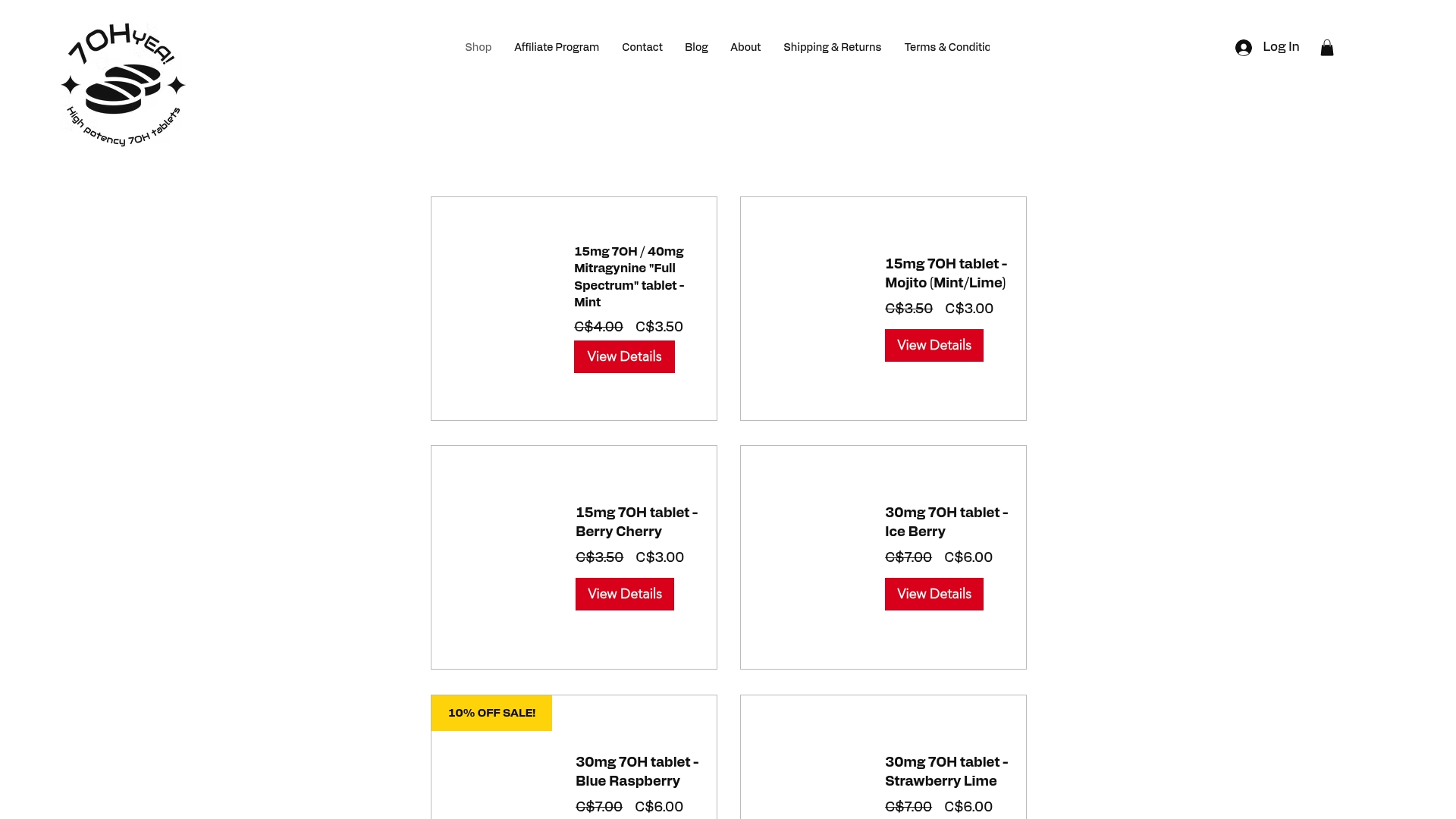
Everything we sell is for research use only, not for human consumption, and each batch comes with a certificate of analysis. Orders are intended for laboratories and qualified professionals.
Where should you read next?
A short reading list, in order:
- The 2026 ChemistrySelect review for the overall chemistry and pharmacology.
- The 2016 Váradi paper for the original preclinical work.
- The 2020 plasma study for the human-versus-animal conversion data.
- The 2026 Journal of Analytical Toxicology paper for methods and case data.
- The CFSRE monograph for the current detection picture.
For more of our own coverage, browse the 7OH Canada blog.
FAQ
Is mitragynine pseudoindoxyl found naturally in kratom?
A 2025 academic review says 7-OH and MP aren’t found in fresh, native kratom leaf. Products containing them that are made by converting mitragynine can be considered semi-synthetic derivatives. That’s a research classification, not a legal one.
Is MP the same as MGM-15?
No. They’re related but different. The 2026 toxicology paper treats MP and the synthetically derived MGM-15 as separate analytes, and it describes separating isomers as one of the challenges of testing for them.
Is mitragynine pseudoindoxyl legal in Canada?
We haven’t found an announcement naming MP in federal Canadian rules, and we can’t give legal advice. Check Health Canada’s official pages and your provincial rules for the current position.
Which reference paper should I read first?
Start with the 2026 ChemistrySelect review, which covers chemistry, metabolism and preclinical pharmacology in one place. Then read the 2016 Váradi paper and the 2020 plasma study for the underlying data.
Does your company sell MP?
We supply research-grade 7OH, mitragynine, MGM-15 and SR17018 materials, plus related mitragynine alkaloid reference materials, for laboratory use only. Check our catalogue for current listings. Nothing we sell is for human consumption.
So where do you land?
Should regulators treat converted kratom alkaloids as a category of their own, separate from the plant? Tell us what you think, and share this with someone in your lab who’s been asking.
7ohyeaAsk About Research MaterialsEmail 7OH Canada with questions about research-grade 7OH tablets and powders for analytical purposes and customizable dosage options.77ohyea
Email us7ohyea@gmail.comSources
- CFSRE NPS Discovery monograph: mitragynine pseudoindoxyl
- A Review on Chemistry, Pharmacological Profiles and Translational Prospects of mitragynine pseudoindoxyl (ChemistrySelect, 2026)
- De Facto Opioids: Characterization of Novel Kratom-Derived Products (2025)
- Mitragynine/Corynantheidine Pseudoindoxyls As Opioid Analgesics (2016)
- Metabolism of a Kratom Alkaloid Metabolite in Human Plasma (2020)
- Quantification of kratom alkaloids in authentic cases (Journal of Analytical Toxicology, 2026)
- FDA Announces Plan to Restrict 7-OH Opioid Products (Venable, 2025)