Salt vs Freebase 7OH: What the Labels Don’t Tell You

A 2026 study of commercial 7-hydroxymitragynine products found that more than 98% of items labelled for 7-OH looked semisynthetic, and that many contained oxidation byproducts. That’s one reason “salt vs freebase” is suddenly a search term. People see the words on product pages, assume they’re marketing, and move on. They aren’t. They describe real chemistry, and the difference matters to anyone who weighs, dissolves or tests this compound in a lab.
Here’s the short version. A freebase is the plain, uncharged molecule. A salt is that same molecule paired with a counter-ion. Which one you hold changes its mass, how it behaves in solvent and how it shows up on an instrument. Everything we sell is for research use only, not for human consumption.
7ohyeaChoose Research Materials With Care7ohyea offers research-grade 7OH tablets and powders for analytical purposes, with customizable dosage options and domestic sourcing from British Columbia.
Explore research materialsTL;DR
- Freebase means the uncharged form of 7-OH. A salt means the same molecule bonded to a counter-ion, which adds its own mass.
- The form can change solubility, stability and instrument readings, so analysts should know which one is on the certificate.
- No reliable evidence in our research shows that salt and freebase 7-OH differ in biological effects, and we make no such claims.
- In the Canadian schedule text we reviewed, 7-OH isn’t named as an entry. That’s an observation, not legal advice.
- All 7ohyea products are for research use only, not for human consumption.
Table of Contents
- Quick facts
- Why is everyone suddenly asking about salt vs freebase?
- What does “freebase” actually mean?
- Myth: “Salt just means purer”
- Fact: the form changes the numbers on the bench
- Can instruments tell salt from freebase?
- What did the headlines get wrong?
- Why do MGM-15 and 7-OH keep getting mixed up?
- Where does Canadian law stand?
- What this means for readers
- Our view: the form should be on the certificate, full stop
- Where can research teams source reference material?
- What should you watch for next?
- FAQ
- Sources
Quick facts
| Item | What we can say |
|---|---|
| Compound | 7-hydroxymitragynine (7-OH), formula C23H30N2O5, molecular weight 414.50 g/mol per the EUDA kratom profile |
| Freebase | The uncharged form of the molecule |
| Salt | The molecule paired with a counter-ion such as chloride |
| Why it matters | Mass, solubility, stability and spectra can all shift with the form |
| Canadian schedule check | Schedule page current to 2026-10-19; no named 7-OH entry in the retrieved text |
| Use | Research use only, not for human consumption |
Why is everyone suddenly asking about salt vs freebase?
Because 7-OH has moved from niche forums into the news cycle. The U.S. FDA published an assessment of the scientific data in 2025 that describes 7-OH as a potent mu-opioid agonist, meaning it strongly activates a receptor tied to opioid activity, with abuse-potential and respiratory-depression concerns. That got headlines.
In May 2026, a drug-monitoring lab flagged another name. The Center for Forensic Science Research and Education described MGM-15, a name used for dihydro-7-hydroxymitragynine, as a novel synthetic kratom alkaloid. Its early data suggest it’s roughly 30 times more potent than mitragynine, the main alkaloid in kratom leaf.
When a compound is this closely watched, buyers start reading labels. And the labels use chemistry words that few people have defined for them.
What does “freebase” actually mean?
It doesn’t mean what the street slang implies. In chemistry, a freebase is just the uncharged version of a compound. Many alkaloids have a basic nitrogen atom that can pick up a proton, a tiny positively charged particle. When that happens in the presence of an acid, the molecule becomes charged and pairs with a negative partner called a counter-ion.
That pairing is a salt. A salt-form primer describes it as a basic or acidic group paired with a counter-ion such as chloride, with the counter-ion contributing its own mass.
Think of table salt for a familiar picture. Sodium and chloride are different things alone and a different thing together. With 7-OH, the active molecule is the same backbone either way. What changes is the packaging around it.
Myth: “Salt just means purer”
Not so. This is the most common misreading we see.
A salt isn’t automatically cleaner, and a freebase isn’t automatically cruder. Purity is a separate question. It tells you how much of a sample is the target compound, as opposed to byproducts, solvents and water. Form tells you what shape the target compound is in.
A salt can be 99% pure. A freebase can be 70% pure. The reverse is just as possible. Only a certificate of analysis, backed by real testing, tells you which.
Fact: the form changes the numbers on the bench
Here’s where it gets practical for a lab. A peer-reviewed review on salt screening and solubility reports that salt forms can alter solubility, dissolution, melting point, crystallinity and hygroscopicity, which is how readily a solid pulls water from the air. It also reports that outcomes depend on the counter-ion, the solvent, the ratio and even timing and water.
A second review in Salts of Therapeutic Agents adds that salt formation can improve or worsen stability and solubility, depending on the counter-ion, humidity, temperature and formulation context.
In plain words: there’s no universal winner. Which form suits a protocol depends on the protocol.
The mass problem nobody mentions
Counter-ions weigh something. If you weigh out a salt, part of the powder is the counter-ion, not the compound you’re studying. The 7-OH molecule itself has a molecular weight of 414.50 g/mol according to the EUDA profile. A salt of it will have a higher total mass.
So a researcher who prepares a stock solution by weight needs a correction factor if the material is a salt. Skip it, and every concentration downstream is off by a consistent, avoidable amount. It’s boring chemistry, and it’s exactly the kind of error that ruins a calibration curve.
Can instruments tell salt from freebase?
Often, yes. That’s the good news for analysts.
Drug Checking BC, a Canadian service, notes in its FTIR guidance that infrared spectra can differ between salt, freebase and hydrated forms. FTIR is a quick method that fingerprints a sample by how it absorbs infrared light. So the same compound can look different depending on its form, which is useful for identification and a trap for anyone comparing against the wrong reference spectrum.
For measuring how much is there, labs lean on mass spectrometry. We’ll keep it short, since the details live in our guide to laboratory detection methods for 7-hydroxymitragynine in Canada. Two published examples show the range:
- A 2013 UPLC-MS/MS method for 7-OH in rat plasma reported a lower limit of quantification of 10 ng/mL and accuracy between 96.5% and 104.0%.
- A 2025 capillary electrophoresis method reported detection limits of 2 ng/mL for 7-OH and measured 7-OH at 0.43 to 0.72 µg/mg in six raw kratom samples.
That second number is worth pausing on. Raw leaf carries very little 7-OH. Anything sold at high concentration has been processed.
What did the headlines get wrong?
Three things, mostly.
Headline claim: “7-OH is just natural kratom.” The research doesn’t back that up. The 2026 study by Avula and colleagues, published in a quantitative analysis of commercial 7-OH products, reported that over 98% of products labelled for 7-OH appeared semisynthetic. Semisynthetic means made by chemically modifying a natural compound, in this case typically mitragynine.
Headline claim: “The label tells you what’s inside.” The same study found label inconsistencies and oxidation byproducts. Oxidation byproducts are unwanted compounds formed when the material reacts with oxygen. That’s an argument for validated testing, not for trusting a front-of-pack number.
Headline claim: “Salt and freebase are different drugs.” We found no reliable evidence in our research on whether the two forms differ in pharmacological effect. The FDA assessment speaks about 7-OH as a compound, not about form. Anyone who tells you one form is stronger or gentler is making a claim we can’t source, so we don’t repeat it.

Why do MGM-15 and 7-OH keep getting mixed up?
Because the names sound alike and the products sit side by side. They aren’t the same thing.
A 2026 forensic method report in the Journal of Analytical Toxicology treats mitragynine, 7-OH, MGM-15 and mitragynine pseudoindoxyl as separate analytes. It also flags interconversion between analytes and instability in blood as analytical headaches. For a lab, the takeaway is simple: confirm identity first, then worry about form.
Our explainer on mitragynine vs 7-hydroxymitragynine walks through that distinction for Canadian labs.
Where does Canadian law stand?
This is a fast-moving topic, so here’s what’s actually confirmed and what isn’t. None of this is legal advice.
The Controlled Drugs and Substances Act schedules page on Justice Laws was current to 2026-10-19 when we checked on 2026-11-06, and it was last amended 2026-10-01. The retrieved schedule text doesn’t show a named 7-hydroxymitragynine entry. The same goes for Schedule 1 of the Controlled Substances Regulations.
What we can’t confirm: how Health Canada or the courts would treat any specific product or form, or whether the schedules will change. We won’t guess. Nobody should state an outcome as fact.
Nor does the salt or freebase form appear to change that picture on its face. A schedule that names no entry doesn’t name a form either. Whether a related substance or analogue falls under a broader provision is a legal question for a lawyer.
In the U.S., the FDA’s 2025 assessment is the main federal document we’ve reviewed. We haven’t verified any further U.S. scheduling steps for this article, so we won’t describe any.

What this means for readers
Short and practical:
- If you work in a lab, ask any supplier which form the material is, and make sure the certificate of analysis says so. A purity percentage with no form is half an answer.
- If you prepare solutions by weight, account for the counter-ion mass in a salt. This is arithmetic, not a judgment call.
- If you match spectra, use a reference in the same form. FTIR can read a salt, a freebase and a hydrate differently.
- If you’re a curious reader, know that the 7-OH market is described in recent research as largely semisynthetic and inconsistent in labelling. Be sceptical of anyone who sells on vibes.
- If you’re wondering about the law, check the current Justice Laws schedules yourself and talk to a lawyer. Rules can change.
And to be clear, these materials are research use only, not for human consumption. Nothing here is guidance for personal use.
Our view: the form should be on the certificate, full stop
We think the salt vs freebase debate is really a transparency debate. The research is clear that form changes mass, solubility and spectra, so a lab deserves to know which one it’s holding before a single measurement is taken.
That’s why we ship with batch-specific certificates of analysis, and why we source and manufacture in Canada. Domestic supply means fast shipping and no border fees for the research teams that rely on us.
We’d rather see the whole industry hold itself to the standard the recent studies point toward: validated testing, honest labels and clear research-only positioning. Our materials are for analytical and laboratory use only, not for human consumption.
John
Where can research teams source reference material?
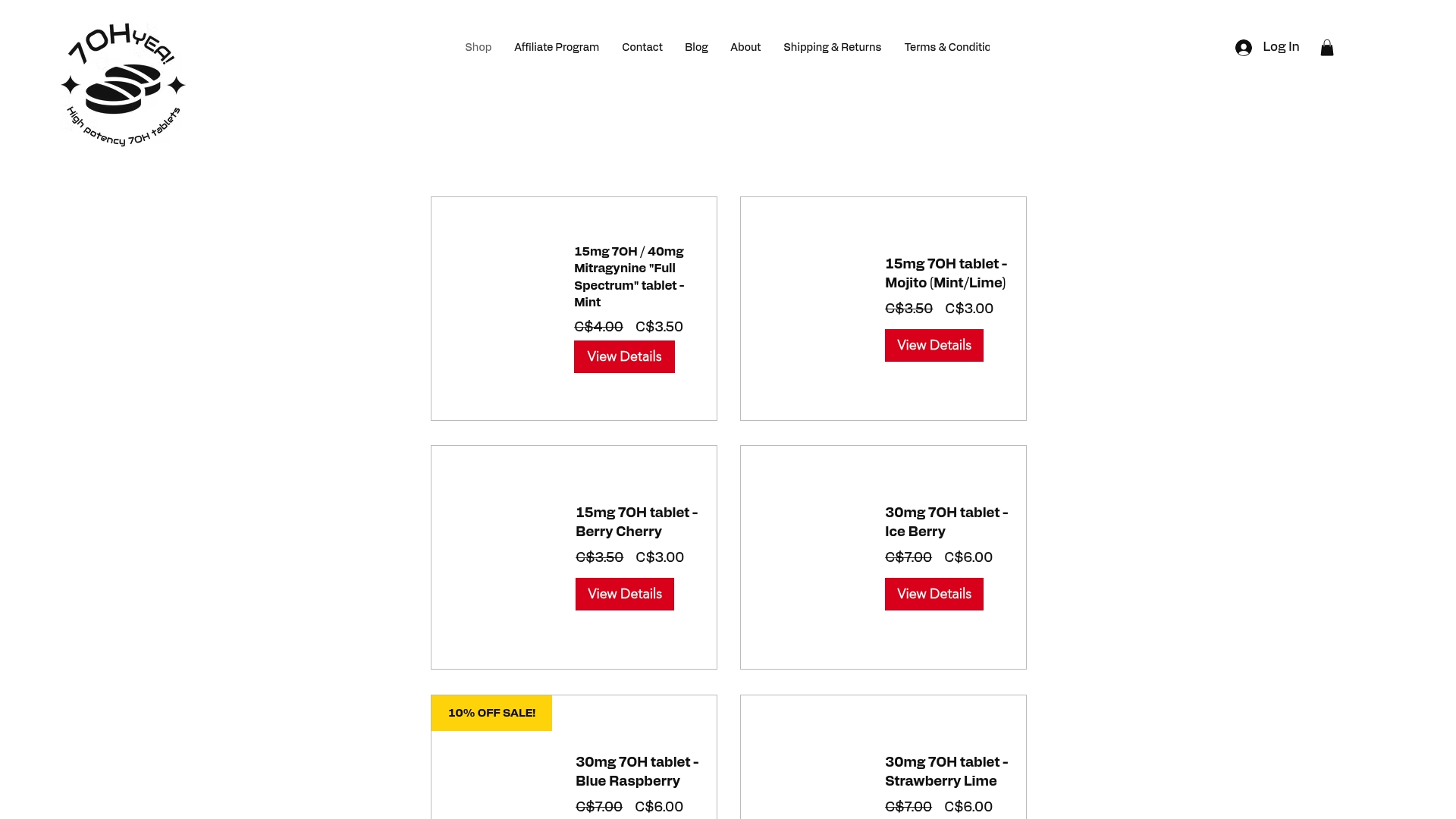
We supply research-grade 7OH tablets and powders, plus related mitragynine alkaloid reference materials, MGM-15 and SR17018 lines, and bulk options for research teams. Everything is made in Canada and intended for analytical and laboratory use only, not for human consumption.
Our 81% pure 7OH powder is listed at $50 one-off. You can see the full range, including the tablet lines, on the 7ohyea.ca site.
If you’re budgeting a project, our lab buyer’s guide to 7-hydroxymitragynine cost breaks down what drives pricing. New to the compound? Start with our complete research guide to 7-hydroxymitragynine.
What should you watch for next?
Three storylines are worth following.
- More product testing. The 2026 commercial-product study will likely not be the last. Expect more labs to publish quantitative work, though we can’t say how much or when.
- More naming confusion. With MGM-15 flagged as a new synthetic kratom alkaloid in 2026, analysts will have more near-identical compounds to separate.
- Regulatory attention. Governments in Canada and the U.S. are looking at this space. What they’ll decide is unconfirmed, and we won’t predict it.
One trend we do see in the published literature: analytical methods are getting more sensitive, with detection limits in the low ng/mL range. That makes form, purity and byproducts easier to pin down, and harder to hide.
FAQ
Is 7OH salt the same as 7OH freebase?
They share the same core molecule, but they aren’t the same material. A salt has a counter-ion attached, which adds mass and can change solubility, stability and spectra. Treat them as distinct reference materials in any analytical work.
Does the form change how a sample behaves in the lab?
It can. Reviews of salt formation report changes in solubility, dissolution, melting point, crystallinity and moisture uptake, depending on the counter-ion and conditions. Your solvent, humidity and temperature all play a part.
Is there proof that salt and freebase 7-OH differ biologically?
We didn’t find reliable evidence either way in the sources we reviewed, so we make no claim. Our products are for research use only, not for human consumption, and we don’t describe effects.
Is 7-OH listed in Canada’s drug schedules?
The retrieved text of the Controlled Drugs and Substances Act schedules, current to 2026-10-19, doesn’t show a named 7-hydroxymitragynine entry. That isn’t legal advice, and rules can change, so check the Justice Laws site and speak to a lawyer about your situation.
How do I know what form I’ve received?
Check the batch certificate of analysis for the stated form and purity. Analysts can also use FTIR and mass spectrometry to confirm identity and quantity against a matching reference.
So here’s our question for you: should every supplier be required to print the chemical form, not just the purity, on the label? Tell us what you think.
7ohyeaQuestions About 7OH Forms?Email us with questions about our research-grade 7OH tablets and powders for analytical purposes, including available dosage options.77ohyea
Email us7ohyea@gmail.comSources
- Kratom drug profile, EUDA
- 7-Hydroxymitragynin (7-OH): An Assessment of the Scientific Data, FDA
- Dihydro-7-hydroxy mitragynine (MGM-15), CFSRE
- Salt form, Psychedex
- Structure, solubility, screening, and synthesis of molecular salts
- Salts of Therapeutic Agents: Chemical, Physicochemical, and Biological Considerations
- Common Compounds in FTIR, Drug Checking BC
- UPLC-MS/MS method for 7-hydroxymitragynine in rat plasma
- Determination of Mitragynine and 7-Hydroxymitragynine by capillary electrophoresis
- Quantitative analysis of 7-hydroxymitragynine in commercial products
- Quantification of kratom alkaloids, Journal of Analytical Toxicology
- Controlled Drugs and Substances Act schedules, Justice Laws
- Controlled Substances Regulations, Justice Laws