Tablet Mass Variation in 7OH: What the Test Shows

The 7OH debate has moved from gas-station shelves to regulators’ desks. In July 2025 the U.S. FDA recommended scheduling concentrated 7-hydroxymitragynine under the Controlled Substances Act, and the argument over what’s actually inside these tablets hasn’t cooled since. For a Canadian lab, one question sits underneath the headlines: are the tablets in the bottle consistent with each other? Tablet mass variation is the first, cheapest check, and it’s widely misread. Everything here concerns research-grade material for laboratory use only, not for human consumption.
7ohyeaChoose 7OH for Analytical Work7OH Canada provides research-grade 7OH tablets and powders for laboratory analytical purposes, with customizable dosage options.
VisitTL;DR
- Mass variation tells you whether tablets weigh the same. It doesn’t, on its own, tell you they contain the same amount of 7-hydroxymitragynine.
- Pharmacopoeias limit the weight-only shortcut to tablets with a high drug load. Low-proportion actives need a content uniformity assay instead.
- The Ph. Eur. test weighs 20 tablets. The USP test weighs 10 and ties weight to an assay result.
- Good reporting names the method, the sample size, the average and the spread, not just “pass”.
- Canadian and U.S. rules on 7OH are still moving. Check official pages, not social posts.
Table of Contents
- Quick facts
- Why is a boring balance test suddenly newsworthy?
- What does “tablet mass variation” actually mean?
- Myth or fact: does a tight weight spread prove the 7OH content is even?
- How do labs run a tablet mass variation test?
- What does 7-OH content testing look like?
- What did the headlines get wrong about “consistent” tablets?
- What should a lab report about tablet uniformity?
- Where does Canadian law stand on 7OH right now?
- What does this mean for readers?
- Our view: uniformity is the whole point of research-grade
- Where can Canadian research teams source 7OH material?
- FAQ
- Sources
Quick facts
- Keyword focus: tablet mass variation (also called weight variation or uniformity of mass)
- Use: research and analytical only, not for human consumption
- Core Ph. Eur. test: 20 tablets weighed individually
- Core USP test: 10 tablets, then 20 more if the first round fails
- Key limit: weight-only testing applies to tablets with 25 mg or more of drug making up 25% or more of the tablet
- Latest U.S. headline: FDA scheduling recommendation, 29 July 2025, covering concentrated 7-OH
- Canada: check the Justice Laws CDSA page for current schedules
Why is a boring balance test suddenly newsworthy?
Because the 7OH story is now about consistency, not just legality.
When the FDA made its July 2025 announcement, the pitch was that 7-OH products sold as concentrated tablets and similar formats are a different thing from the kratom leaf. The agency said the scheduling would apply only to concentrated 7-OH, according to Medscape’s report of the press conference. A recommendation isn’t a final rule, and whatever happens next at the DEA is not something anyone can state as fact.
A California Senate background paper from early 2026 shows how fast the state-level patchwork is growing. It describes kratom and 7-OH rules that vary state by state. Fine, but what does that have to do with a balance?
Everything. In a climate where people argue about what a “unit” of 7OH even is, labs that can show their material is uniform have a real edge. Labs that can’t are guessing.
What does “tablet mass variation” actually mean?
It’s the spread in weight between individual tablets from the same batch. That’s it.
Pharmacopoeias, the official standard books for drug quality, use it as a quick proxy. If every tablet weighs the same and the blend was mixed evenly, each tablet should hold about the same amount of active ingredient. The USP tablet chapter spells out the catch: weight variation estimates content from individual weights where the blend is presumed uniform, while content uniformity assays each unit and doesn’t rely on that assumption.
So mass variation is an assumption test. It’s only as good as the assumption behind it.
Myth or fact: does a tight weight spread prove the 7OH content is even?
Myth. This is the biggest thing people get wrong.
Imagine two tablets that both weigh 200 mg. One was pressed from a well-mixed blend. The other came from a blend where the active clumped in one corner of the hopper. The scale reads the same. The chemistry doesn’t.
That’s why the harmonized USP chapter on uniformity of dosage units restricts the weight route. Under USP general chapter 905, weight variation applies to hard capsules and uncoated or film-coated tablets with 25 mg or more of drug that makes up 25% or more of the unit by weight. Everything else needs the content uniformity test, which assays individual units and can be used in every case.
The Indian Pharmacopoeia’s 2024 draft chapter mirrors the same split. Two major standards, same rule.
Why does it matter for 7OH? Because 7-hydroxymitragynine is a trace alkaloid by nature. Analytical standards for it work in fractions of a percent, as we’ll see below. A research tablet carrying a small active fraction in a bulk of excipients (the inert fillers and binders) will often sit outside the weight-only shortcut. A lab that reports only mass variation for such material is reporting the easy half.
How do labs run a tablet mass variation test?
Two pharmacopoeial approaches dominate. They look similar and aren’t.
The Ph. Eur. approach: 20 tablets, percentage deviation
The European Pharmacopoeia test, chapter 2.9.5, is the classic one. The steps:
- Pick 20 tablets at random.
- Weigh each one individually and record it.
- Calculate the average mass.
- Work out each tablet’s deviation: (individual weight minus average weight) divided by average weight, times 100.
- Compare against the limit for the tablet’s size.
The published limits are 10% for tablets of 80 mg or less, 7.5% for tablets over 80 mg and under 250 mg, and 5% for tablets of 250 mg or more. The batch passes when no more than 2 of the 20 tablets fall outside the limit and none falls outside twice the limit.
A quick worked example (hypothetical numbers). Say 20 tablets average 200 mg. That puts them in the 7.5% band, so the normal window is 185 to 215 mg. Up to two tablets may stray outside that window, but none may be below 170 mg or above 230 mg. If one tablet weighs 168 mg, the batch fails, even if the other 19 are perfect.
The USP approach: weigh, assay, then calculate
USP 905 takes a different path. You weigh 10 tablets individually and assay a representative sample of the batch for its content, expressed as a percentage of label claim. Each tablet’s content is then estimated from its weight and that assay result. From the 10 estimates you calculate an acceptance value, a single score that combines how far the average sits from target and how much the tablets scatter.
If that score is 15.0 or below, the sample passes. If not, you test 20 more. The 30-tablet set passes only if the score is still 15.0 or below and no single tablet falls outside 75 to 125% of the target, per the USP chapter.
The Ph. Eur. test is still popular for routine in-process checks, which is where a quick weight screen earns its keep.
Don’t forget the odd ones out
Two more references turn up in research settings. The British Pharmacopoeia describes a break-mark subdivision test for scored tablets: 30 tablets, one part from each weighed individually, and the batch complies if no more than one part falls outside 85 to 115% of the average. And USP 2091 covers weight variation in dietary-supplement tablets, a different regime from pharmaceutical tablets. Neither is the default for a research-chemistry tablet, so name the one you used.
What does 7-OH content testing look like?
This is where the real answer lives.
The Ph. Eur. content uniformity test assays 10 individual tablets. The batch passes if every tablet’s content lands within 85 to 115% of the average. It fails if more than one tablet is outside that range, or if any one is outside 75 to 125%. A borderline result triggers 20 more tablets. The full rules are in the Ph. Eur. text.

For the assay itself, there’s a published yardstick specific to this alkaloid. AOAC International’s SMPR 2015.008 sets method performance requirements for quantifying 7-hydroxymitragynine and mitragynine in plant material, extracts and finished products. For 7-OH it calls for an analytical range of 0.01 to 0.5%, a limit of quantitation at or below 50 ppm, and a limit of detection of 15 ppm. Recovery should run 90 to 110% at the low end of the range, tightening to 95 to 105% above it. Repeatability and reproducibility ceilings are also set.
Plain translation: a method that can’t see 7-OH down to the parts-per-million level, with tight repeatability, can’t support a uniformity claim. We’ve covered the instrument side in our guide to laboratory detection methods for 7-hydroxymitragynine in Canada, and the wider testing checklist in what labs need for 7-hydroxymitragynine tablet testing.
What did the headlines get wrong about “consistent” tablets?
Three things.
“Same weight means same content.” Covered above. It doesn’t, and the standards themselves say so.
“Passing once means the batch is fine.” A pass tells you about the sample you pulled. Sample size, random selection and method all shape how much that pass is worth.
“Splitting is harmless.” A peer-reviewed study of lorazepam half-tablets points out that the 25 mg and 25% threshold means weight variation isn’t treated as interchangeable with content uniformity in every ICH region for low-drug-content products. It also notes that uneven splitting can cause large swings for narrow-range drugs. The lesson for a research setting is about measurement, not usage: if you subdivide a tablet for an analytical purpose, test the pieces, don’t assume them.
What should a lab report about tablet uniformity?
A result that can be audited beats a result that sounds good. Here’s a short reporting list a reviewer would nod at:
- The standard used: Ph. Eur. 2.9.5, USP 905, or another, with edition or year.
- Sample size and selection: how many tablets, and how they were drawn at random.
- Raw numbers: individual weights, the average, and the spread (standard deviation or range).
- Pass or fail, plus the margin: “passed with the widest deviation at 3.1%” says more than “passed”.
- Content data where needed: the assay method, its validation against a benchmark like the AOAC requirements, and each unit’s result.
- Batch identity: lot number and the Certificate of Analysis (a document from the lab or manufacturer listing the batch’s test results) the data came from.
Health Canada’s GMP guidance on process performance qualification, GUI-0029, is aimed at drug manufacturers, not research suppliers. Still, it shows how Canada’s regulator thinks: acceptance criteria should demonstrate a controlled process, with batch-to-batch and within-batch variability inside limits set in advance. That’s a good model for any lab writing its own protocol.
Where does Canadian law stand on 7OH right now?
Canada first, as it should be.
The Justice Laws page for the Controlled Drugs and Substances Act, current to October 19, 2026, lists a series of recent amending regulations, including SOR/2025-64 (April 14, 2025), SOR/2026-38 (April 12, 2026) and SOR/2026-71 (June 5, 2026). We haven’t confirmed that any of those specifically address 7-hydroxymitragynine. If you’re making decisions, read the schedules on that page directly.
What’s confirmed is narrow: the amendment list exists and it’s active. What’s unconfirmed is whether and when 7-OH will be added to a schedule. Anyone telling you they know is guessing.
This isn’t legal advice. If your lab needs certainty about import, possession or sale, a lawyer who works in controlled-substance law is the right call.
And in the U.S.?
The FDA’s July 2025 move, reported by Medscape, was a recommendation to schedule concentrated 7-OH, not the leaf. State rules differ widely, as the California Senate background paper lays out. For a Canadian lab, the practical takeaway is to document everything, including where your material came from and how you tested it.
What does this mean for readers?
If you’re a lab or research team in Canada: treat mass variation as a screen, not a verdict. Run it if your tablets qualify for the weight route, and run a validated content assay if they don’t. Keep raw data. Ask any supplier for batch-specific Certificates of Analysis and read them like a reviewer would.
If you’re an analytical chemist: map your method against the AOAC performance requirements before you report uniformity figures. Name your standard and sample size.
If you’re here from the 7OH versus kratom argument: remember that the leaf and the concentrated alkaloid are different materials, a distinction we unpack in 7OH versus 7-hydroxymitragynine and mitragynine versus 7-hydroxymitragynine. This page doesn’t cover personal use. These products are for research use only, not for human consumption.
If you’re following the regulation story: watch the Justice Laws page and official FDA and DEA notices. Treat anything else as unconfirmed.
Our view: uniformity is the whole point of research-grade
We think the most honest sentence a supplier can offer a lab is a number you can check. Research-grade only means something if two tablets from the same lot behave as the same material on your bench.
That’s why we pair our tablets with batch-specific Certificates of Analysis, and why we keep the work domestic: material sourced and manufactured in Canada, which means fast shipping and no border fees for research teams.
Our tablets and powders are for analytical and laboratory use only, not for human consumption. We’d rather a team ask hard questions about uniformity than take anything on trust, and we’d rather the conversation about 7OH stay grounded in method.
John
Where can Canadian research teams source 7OH material?
Our 7OH research tablets are made for laboratory and analytical use only, not for human consumption. We also carry related mitragynine reference materials and bulk purchasing options for research teams. On the powder side, the 81% pure 7OH powder is listed at $50 CAD one-off, the 43% pure mitragynine full-spectrum powder at $6.75 CAD, and the 99% pure SR17018 powder at $48 CAD. Tablet lines, including 7OH, MGM-15 and SR17018, are listed without a published price on our category page.
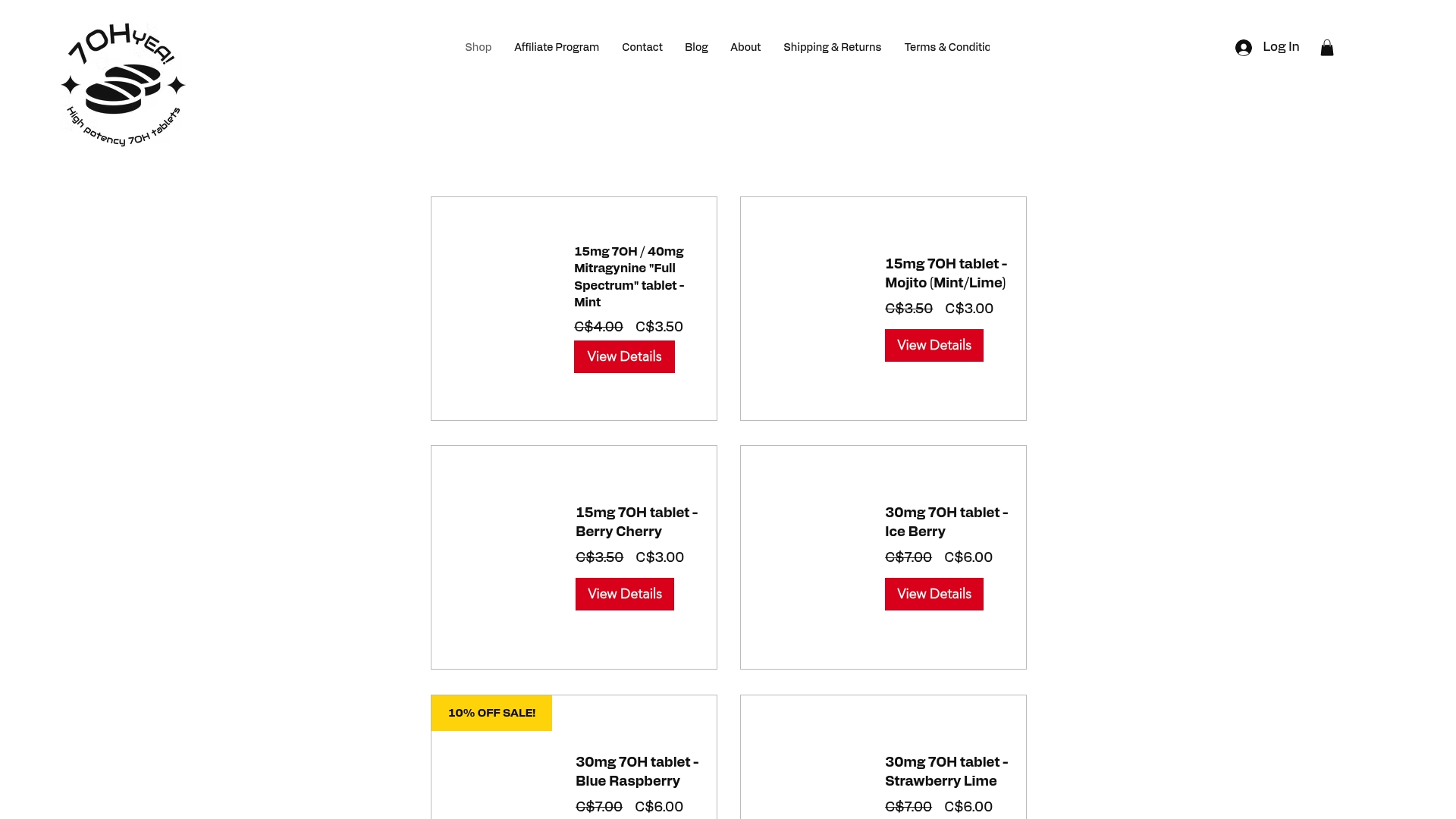
If you’re designing a uniformity study, the 50 mg 7OH tablet page shows what a product listing for a lab looks like, and our team can talk through batch documentation for your protocol.
FAQ
Is tablet mass variation the same as content uniformity?
No. Mass variation measures how much tablets weigh. Content uniformity measures how much active ingredient each one holds. Weight can stand in for content only when the blend is presumed uniform and the tablet has a high enough drug load, as the USP tablet chapter explains.
How many tablets do I need to test?
It depends on the standard. The Ph. Eur. weight test uses 20 tablets. The USP route starts with 10 and extends to 30 if the first round doesn’t pass. Whichever you choose, state it in your report.
Does a mass variation test replace a Certificate of Analysis?
No. A Certificate of Analysis summarizes a batch’s lab results, usually including identity and assay. Mass variation is one input, and a supplier’s certificate and your own bench data should be read together.
Which limits apply to a tablet around 200 mg?
Under the Ph. Eur. test, tablets over 80 mg and under 250 mg use a 7.5% limit. No more than 2 of 20 may exceed it, and none may exceed 15%. The Ph. Eur. text has the full rule.
Is 7OH legal in Canada for research?
We can’t give legal advice. The Justice Laws page for the CDSA is the place to read the current schedules, and a lawyer can confirm how they apply to your lab.
7ohyeaAsk About 7OH Research MaterialsEmail your questions about research-grade 7OH tablets and powders, customizable dosage options, or domestic sourcing from British Columbia.77ohyea
Email us7ohyea@gmail.comSources
- FDA Seeks Schedule I Status for ‘Legal Morphine’ (Medscape, July 30, 2025)
- Kratom and 7-Hydroxymitragynine background paper (California Senate)
- USP tablet general chapter 1151
- USP Uniformity of Dosage Units (905)
- Indian Pharmacopoeia draft 2.5.4
- European Pharmacopoeia 2.9.5 Uniformity of Mass
- British Pharmacopoeia 2012, Tablets
- USP 2091 Weight Variation of Dietary Supplements
- AOAC SMPR 2015.008
- Weight and content uniformity of lorazepam half-tablets (PMC3745048)
- Health Canada GUI-0029
- Controlled Drugs and Substances Act (Justice Laws)
Your turn: should a research supplier have to publish individual tablet data with every batch, or is a summary Certificate of Analysis enough?