Winter Shipping of Research Chemicals in Canada: What Labs Need to Know

Canada’s dangerous-goods paperwork rules got a rewrite this year, and the cold season is when labs feel every gap. On June 4, 2026, the federal government registered SOR/2026-112, which replaced the sections of the Transportation of Dangerous Goods Regulations (TDGR) on shipping documents. At the same time, regulators in both Canada and the US keep a close eye on concentrated 7-hydroxymitragynine (7OH), which means anyone ordering it for analytical work has to be able to prove what’s in the box and why it’s there. Winter adds delays, freezing temperatures and storm backlogs on top. So here’s the plain version of what matters.
All products we discuss are for laboratory research use only. They are not for human consumption.
7ohyeaPlan Research Shipments With ConfidenceExplore research-grade 7OH tablets and powders sourced in British Columbia for laboratory analytical purposes.
VisitTL;DR
- The shipper decides the classification of a chemical and must be able to produce proof of it. Labs should ask for that proof before ordering, not after a storm.
- Documents changed in 2026. Check that your receiving procedures match the current TDGR text.
- Domestic sourcing keeps a shipment inside one country’s rules, with no customs clearance and no border fees.
- Winter doesn’t change the law. It changes the odds of delay, so build buffer days and a written plan for late or damaged parcels.
- Nothing here is legal advice. Your institution’s EHS office has the final word on your lab.
Table of Contents
- Quick facts
- Why is everyone suddenly talking about shipping paperwork?
- Myth or fact: does winter change the rules?
- What did the headlines get wrong?
- What does Canadian law actually require for a shipment?
- Domestic or imported: does it matter in January?
- Does cold weather hurt chemicals?
- What should a lab check before dispatch?
- What if a parcel arrives late or damaged?
- What this means for readers
- Where do the US rules fit in?
- What we think
- Where to order for the lab
- FAQ
- Sources
Quick facts
| Topic | What’s confirmed |
|---|---|
| Governing rules | TDGR, SOR/2001-286, covers importing, offering for transport, handling and moving dangerous goods |
| Latest paperwork change | SOR/2026-112, registered June 4, 2026, replaced the shipping-document sections |
| Who classifies | The consignor (the sender), per CCOHS |
| Proof of classification | Kept for 5 years after shipping, per Thompson Rivers University guidance |
| Training certificates | Valid for 3 years, per the same guidance |
| Our products | Research use only, not for human consumption |
Why is everyone suddenly talking about shipping paperwork?
Because the story around 7OH has moved from the shelf to the rulebook. Regulators have been going after concentrated 7OH products sold to the public. A February 2026 California Senate background paper notes that the US Food and Drug Administration has deemed such products unlawful in retail settings, and describes a patchwork of state responses.
Here in Canada, Health Canada’s long-standing position is that kratom isn’t approved as a food, natural health product or drug. We won’t guess how the rules for 7OH will develop. Nothing here predicts an outcome, and where something is unconfirmed, we say so.
What’s certain is this. When scrutiny rises, the lab that can show clean paperwork for every parcel is the lab that doesn’t lose weeks.
Myth or fact: does winter change the rules?
Myth: There’s a special winter regime for chemical shipments.
Fact: There isn’t. The TDGR applies all year. Section 1.7 says a person can’t import, offer for transport, handle or transport dangerous goods unless the safety requirements are met, the right documents travel with the goods, and the containment and safety marks meet the standard. The regulations don’t care what the thermometer says.
Myth: Small research quantities are exempt.
Fact: Queen’s University’s chemical shipping SOP says that, as a rule, all research-associated products fall under some TDG category. Size changes the packaging route, not whether the rules exist.
Myth: The 2026 update only matters to freight companies.
Fact: The change to shipping documents touches senders and receivers. It added mandatory control and emergency temperatures for certain temperature-stabilized goods, such as some self-reactive substances and organic peroxides. Most analytical alkaloid orders won’t fall in those classes, but your EHS office should confirm that for each chemical.
What did the headlines get wrong?
The loudest headlines treat 7OH as one story: a consumer product panic. For a lab buyer, that framing hides the dull but decisive part. A shipment is a legal object. It has a classification, a document trail and a sender who answers for it.
The second thing headlines miss is geography. Plenty of coverage is about US states and the FDA. Canadian labs get dragged into that noise even though their daily reality is TDGR, provincial rules and institutional SOPs.
If you read only the headlines, you’d think the risk is the news cycle. In practice the risk for most labs is a parcel stuck at a depot with a missing safety data sheet.
What does Canadian law actually require for a shipment?
Start with the sender’s duty. CCOHS explains that the consignor must work out the classification: shipping name, class, UN number and packing group. For products not on the lists, that can mean laboratory testing against the hazard criteria. The consignor must also provide proof of classification to Transport Canada on request.
What counts as proof? Queen’s says it should show the classification date, the technical name and the classification itself. A safety data sheet (SDS, the standard document that lists a chemical’s hazards and handling) can serve if the CAS number matches (the CAS number is the chemical’s unique registry ID) and it’s less than 3 years old.
Thompson Rivers University adds a record-keeping point: keep proof of classification for 5 years after shipping. Its guidance also says TDG training certificates last 3 years, and that untrained people may only handle dangerous goods with a trained, certified person present.
That’s a lot of paper. It’s also exactly why we publish shipping documentation guidance for Canadian labs, and a TDG compliance guide that goes further.

Domestic or imported: does it matter in January?
It does, and not only for customs. TRU’s guidance lays out how the rules stack up by mode:
| Route | What applies |
|---|---|
| Ground only, within Canada | TDG Clear Language rules and Transport Canada’s small-container standard |
| Air | IATA requirements |
| Domestic marine | TDGR |
| International marine | TDGR plus the IMDG code |
Each added layer is another hand-off where winter can slow things down: more terminals, more transfers, more chances for a document to go missing. A shipment that starts and ends in Canada by ground keeps that chain short.
That’s the reasoning behind our own setup. Our products are sourced and manufactured domestically in British Columbia, which means fast shipping and no border fees. For a lab planning around storm season, a shorter chain is a practical advantage.
Does cold weather hurt chemicals?
There’s no one answer, and we won’t invent one. How cold, wind and delays affect a given material depends on its form, its container and its specification. That’s why the starting point is the SDS and the supplier’s stated storage range, not a rule of thumb you read online.
What we can source is the packaging side. The Canadian Conservation Institute’s shipping guidance and Concordia University’s dry-ice ground shipping procedure describe a layered approach: leak-proof primary containers, a Styrofoam secondary box that lets carbon dioxide escape, and a cardboard outer box. Concordia notes dry ice sits at about -78°C, so it’s a hazard in its own right, and national ground shipments follow a specific provision of the TDGR.

Most analytical alkaloid orders don’t involve dry ice at all. If yours does, work it out with your EHS office before the order goes in. Our temperature-controlled shipping article covers the planning side for labs.
What should a lab check before dispatch?
This is a routine you can run in ten minutes per order.
- Get the SDS. Simon Fraser University requires labs to give EHS an SDS for dangerous-goods shipments, since it may be needed in an emergency. Match the CAS number to the label.
- Confirm the classification. Ask the sender for the classification date, technical name and class. File it for five years.
- Check the transport document. Queen’s says the air waybill or bill of lading must carry the information TDG or IATA requires, depending on the mode.
- Check training. Whoever receives or ships needs a current TDG certificate, or a certified person beside them.
- Check the labelling. Outer packages should show the shipping name in upper case, hazard labels, UN number and packing group where those apply, per Queen’s SOP. Our packaging inspection checklist walks through what to look for on arrival.
- Check the purpose label. Research materials should be clearly marked for analytical use. See our analytical-use labelling guide.
The same sources say some shipments above set quantities also need an Emergency Response Assistance Plan (ERAP). Your EHS office can tell you whether yours do.
What if a parcel arrives late or damaged?
The regulations we reviewed don’t hand labs a winter-delay checklist, and no official page we found sets one out. So treat this as sensible practice, not law.
- Photograph the outer box before opening.
- Note the delivery date, the carrier’s tracking history and any weather notice.
- Keep the transport document and the SDS with the record.
- Quarantine the material and tell your EHS office.
- Contact the supplier with the batch number and the photos.
The habit that pays off is the same as with classification: write it down at the time. Records made on the day are worth more than memories a month later.
What this means for readers
If you’re a researcher, analytical chemist or lab manager in Canada, three takeaways:
- Plan for buffer. Order earlier in winter. Delays come from weather and backlogs, not from the rules.
- Own your paperwork. Classification proof, SDS and training certificates are yours to hold, not just the supplier’s.
- Watch the news, not the rumours. Regulatory announcements about 7OH are moving. Check Health Canada and Transport Canada pages for what has actually been announced, with dates, and ask your institution for guidance. We don’t offer legal advice and no one should read this as a prediction.
If you’re an individual hoping to use these materials yourself: our products are for laboratory research only and are not for human consumption. We don’t supply them for that purpose.
Where do the US rules fit in?
Second to Canada, but they shape the conversation. The FDA’s position on concentrated 7OH products at retail, as summarised in the California background paper, is a big reason the topic is in the news. US federal scheduling proposals are, as of writing, something we’d tell you to confirm directly on FDA and DEA pages, because we can’t responsibly state their status from memory.
For a Canadian lab, the point is practical. Sourcing inside Canada avoids cross-border handling, which is a separate set of paperwork and a separate set of delays.
What we think
Winter doesn’t break good shipping. Missing paperwork does.
We’ve built our offer around the things a lab can verify. Our products are research-grade, sourced and manufactured in Canada, and supplied with batch-specific certificates of analysis. Domestic sourcing means fast shipping and no border fees, so a parcel doesn’t have to clear customs in the middle of a January storm.
Our position is simple: a lab buying analytical alkaloids should expect clear labelling, traceable batches and documentation it can file. We design our listings for research and laboratory use only, and we’re clear that they aren’t for human consumption.
The contested part of this story is the public debate about 7OH. The part we can do something about is making the lab side boring, organized and compliant.
John
Where to order for the lab
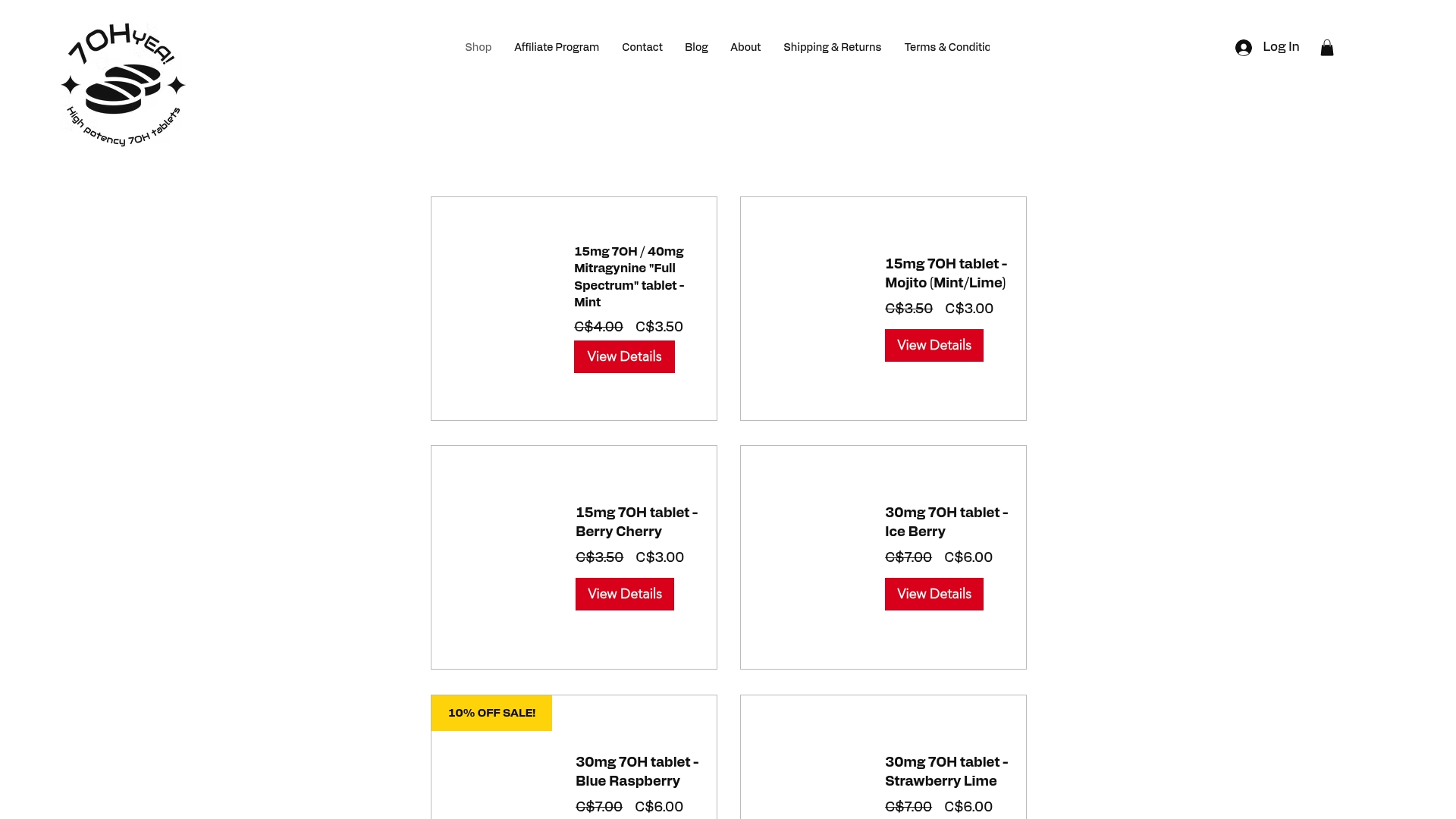
Research teams can see our full range of research-grade tablets and powders on our product category page. Among the listed powders, the 81% pure 7OH powder is 50 CAD one-off, the 99% pure SR17018 powder is 48 CAD one-off, and the 43% pure mitragynine “Full Spectrum” powder is 6.75 CAD one-off. Each product is for analytical and laboratory use only, and our homepage has the rest of the range, including MGM-15 and SR17018 lines.
Bulk purchasing is available for research teams, and our bulk alkaloid standards article explains how reference materials fit into lab workflows. For a broader view of the legal side, read our Health Canada compliance playbook.
FAQ
Do research chemicals need special paperwork in winter?
No extra paperwork is created by the season. The TDGR applies year-round, and the consignor must be able to prove the classification. What changes in winter is the cost of a gap, since delays give a missing document more time to cause trouble.
Who is responsible for classifying a shipment?
The consignor, meaning the sender. CCOHS says this includes determining the shipping name, class, UN number and packing group, and providing proof of classification to Transport Canada on request. Receiving labs should still file a copy.
How long should a lab keep classification records?
Thompson Rivers University’s guidance says five years after the shipment. Check your own institution’s policy too, since it may be stricter.
Are domestic shipments simpler than imports?
Generally the chain is shorter. Ground-only shipments within Canada follow the TDG Clear Language rules and Transport Canada’s small-container standard, while international marine adds the IMDG code and air adds IATA rules. Fewer layers mean fewer hand-offs.
Are your products for personal use?
No. They’re sold for laboratory research and analytical work only, and they’re not for human consumption. So here’s a question for you: should Canada’s regulators treat research-grade supply chains differently from retail ones, and what would that look like?
77ohyeaQuestions About Lab Research Materials?Email us with questions about our research-grade 7OH tablets and powders for analytical laboratory use.
7ohyea@gmail.comSources
- Canada Gazette, Part 2: SOR/2026-112
- Transportation of Dangerous Goods Regulations (SOR/2001-286)
- CCOHS: TDG classification
- Queen’s University: Transportation and shipment of dangerous goods
- Simon Fraser University: Transport
- Canadian Conservation Institute: Five steps to safe shipment
- Concordia University: National ground shipments on dry ice
- California Senate: Kratom and 7-hydroxymitragynine background paper