7OH Handling Procedures: What Canadian Labs Should Know

The DEA’s July 2026 announcement about 7-hydroxymitragynine (7-OH) put this compound in headlines again. When a substance makes headlines, lab managers ask a plain question: how do we handle it properly? The answer is mostly ordinary chemical hygiene. That means a risk assessment, WHMIS labels, written procedures, secure storage and a spill plan that people have actually practised. 7OH from 7ohyea.ca is sold for research and analytical use only, and it is not for human consumption.
Quick facts
- What it is: 7-hydroxymitragynine, an alkaloid (a naturally occurring nitrogen-containing compound) found in trace amounts in kratom leaf.
- Use: research and analytical work only. Not for human consumption.
- Canada: kratom’s natural alkaloids are not listed in Canada’s Controlled Drugs and Substances Act schedules, according to one 2026 legal guide. Check the current schedules yourself.
- US: on July 1, 2026, the DEA announced its intent to temporarily place 7-OH above a specified threshold in Schedule I, according to a 2026 forensic toxicology review.
- Workplace rules: WHMIS and provincial occupational health and safety (OHS) rules apply to labs.
7ohyea7ohyea.caSource 7OH for Laboratory ResearchExplore research-grade 7OH tablets and powders from a British Columbia source, with customizable options for analytical work.
VisitTL;DR
- Handle 7OH as a hazardous chemical: assess the risk, keep WHMIS labels and safety data sheets (SDSs) in place, and write the procedure down.
- BC’s OHS Regulation expects written procedures, trained staff and spill cleanup plans. Other provinces have equivalents.
- Store minimum quantities, in labelled, screw-cap containers, away from incompatible materials.
- After a skin or eye splash, flush with water for at least 15 minutes, then report it.
- The legal picture is moving, especially in the US. Read the official notices, not the social media summaries.
Table of Contents
- Why is everyone suddenly talking about 7OH?
- What did the headlines get wrong?
- What does a sensible 7OH handling procedure look like?
- What if something goes wrong?
- Does the science debate change how you handle it?
- What does this mean for readers?
- A note from us
- Where can you source research-grade material?
- FAQ
- Sources
Why is everyone suddenly talking about 7OH?
Because regulators in the US have started separating two things that used to get lumped together: kratom leaf and concentrated 7-OH. According to a 2026 forensic toxicology review, the DEA announced on July 1, 2026 that it intends to temporarily place 7-OH above a specified threshold into Schedule I. The same announcement distinguishes it from botanical kratom below that threshold.
An announced intent is not a final rule. We won’t predict how it ends. Check the Federal Register and DEA notices for the current status.
North of the border, the story is quieter but not simple. One 2026 legal guide says kratom’s natural alkaloids are not scheduled under the CDSA. That’s a snapshot of a shifting situation, not legal advice, and it doesn’t replace reading the CDSA schedules yourself. Under the Act, possession of Schedule I to III substances is prohibited unless authorized (s. 4(1)). Whether anything you hold falls under a schedule is a question for your institution’s compliance office or a lawyer.
What did the headlines get wrong?
A lot of the noise online is about what 7OH does to people. That’s the wrong frame for a laboratory. This article doesn’t cover use, effects or experiences, and the products we make are not for human consumption. The top-ranked pages for this keyword are mostly user guides. They aren’t handling procedures.
Here’s a quick myths versus facts round for lab readers.
Myth: “Not scheduled means no rules.” Fact: Workplace law applies to every chemical, scheduled or not. WHMIS, the national hazard communication system, applies to hazardous products used, handled or stored in all Canadian workplaces, including laboratories. That covers supplier labels and SDSs. CCOHS also lists special situations such as small containers, decanted products and laboratory samples.
Myth: “Small research quantities don’t need a procedure.” Fact: Quantity changes the scale of the risk, not the need for a plan. In BC, the OHS Regulation (section 5.2) expects written procedures that eliminate or minimize exposure and cover emergency and spill cleanup. It also expects supervisors and workers to be trained in safe handling, use, storage and disposal.
Myth: “A confirmed 7-OH result tells you everything.” Fact: Forensic toxicologists say a confirmed finding can support exposure to 7-OH, metabolism of mitragynine, or use of a product containing 7-OH. By itself it doesn’t establish the exact product, dose, timing or cause, per the same 2026 review. Good lab records matter for this reason.

What does a sensible 7OH handling procedure look like?
Think of it as five steps, from the loading dock to the waste stream. None of this is specific to one product. It’s standard chemical hygiene, and your institution’s safety office has the final say.

1. Receiving and identifying the material
Check that the container arrives with a supplier label and an SDS. In BC, the OHS Regulation expects the identity of a chemical agent, its health effects and its precautions to be indicated by labels, SDSs or similar means. Log the batch number and keep the certificate of analysis (COA) with the record. A COA is the document that reports the batch’s tested purity and identity.
If you split material into smaller containers, WHMIS decanting rules apply. Label every secondary container so nobody has to guess what’s inside. Our shipping documentation overview for Canadian labs covers what arrives with an order, including bilingual WHMIS paperwork.
2. Risk assessment before the first weighing
A risk assessment is a short written look at what could go wrong and how you’ll prevent it. For a fine powder, the obvious questions are dust, skin contact and eye contact. Ask who is handling it, how much, where, and what the exit plan is if something spills.
Workplace rules lean on this step. The BC regulation ties the choice of emergency washing facilities to a workplace risk assessment. Ontario’s guidance says employers must identify and assess chemical risks, provide suitable skin and eye protection, and train workers in PPE care and emergency procedures.
3. Weighing and transfer
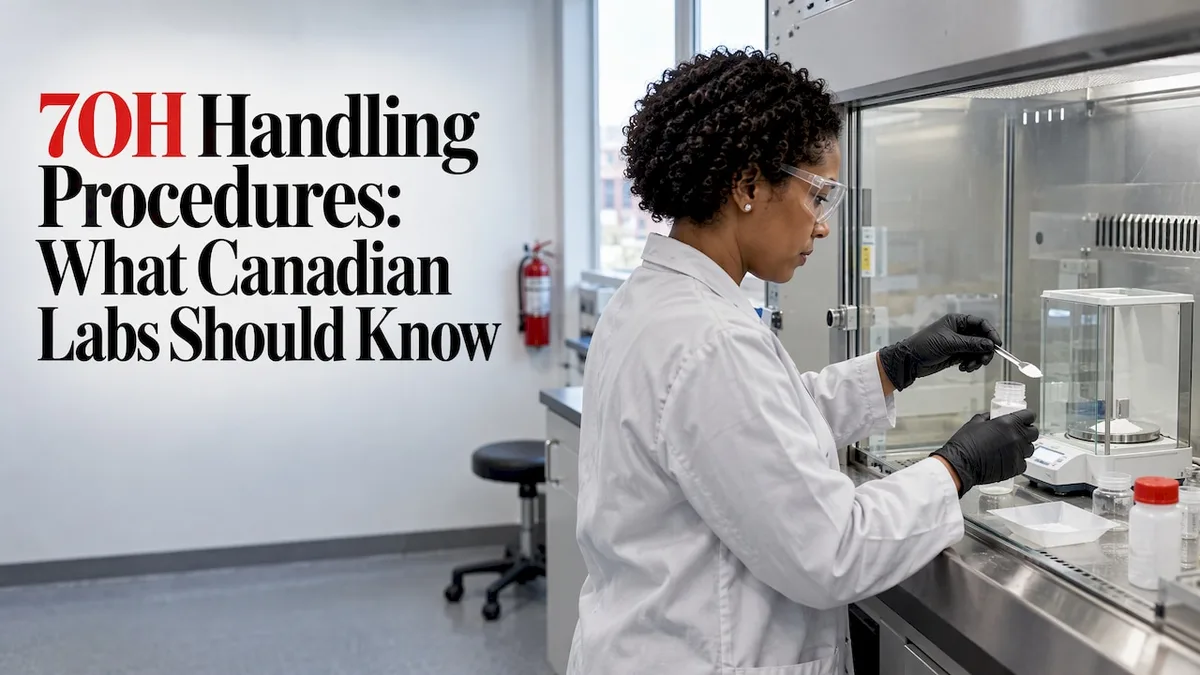
Keep the work in an area designed for it, with minimal air movement disturbance, and use the controls your risk assessment names. Wear the personal protective equipment (PPE) your procedure specifies. At minimum, one university’s spill guidance lists gloves, eye protection and a lab coat, with respiratory protection added for volatile toxic or corrosive materials.
Keep only what you need at the bench. The UNBC lab safety manual, citing BC’s OHS Regulation (section 30.15), says only the minimum necessary amounts of toxic or hazardous substances belong in the working area.
4. Storage and labelling
The same UNBC manual is a good model for a lab. All stored chemicals carry WHMIS labels. They’re stored by compatibility, with physical separation of incompatible materials. Shelves are chemical-resistant, spill-lipped and wall-bolted, and containers use screw-cap closures only.
For a compound that attracts public attention, add a simple inventory log and limit access to trained staff. That’s good practice rather than a legal quote, so write it into your own procedure as your institution sees fit.
5. Analysis and disposal
Analytical work on kratom alkaloids usually relies on liquid chromatography with tandem mass spectrometry (LC-MS/MS), a method that separates compounds and measures them by mass. The 2026 forensic review calls validated, targeted LC-MS/MS well suited to separating and quantifying these alkaloids. It points to a 2024 validated method that quantified 11 kratom alkaloids and metabolites in plasma. Our guide to laboratory detection methods for 7-hydroxymitragynine goes further on the analytical side.
For waste, follow your institution’s hazardous waste stream and the BC-style expectation that disposal is part of the written, trained procedure. Don’t pour anything down a drain unless your chemical hygiene officer says so.
What if something goes wrong?
Plan this before you open a container. The Canadian guidance on this is consistent, and it’s worth printing next to the eyewash station.
| Situation | What the Canadian guidance says |
|---|---|
| Skin or eye contact | CCOHS says first aid is the top priority: remove contaminated clothing immediately, use the emergency shower, flush eyes for at least 15 minutes, and check the SDS for rinse times. |
| Powder on skin | CCOHS first-aid guidance says brush powdered chemicals off with a gloved hand or cloth before rinsing, and remove clothing without contaminating the rescuer. |
| Medical attention | The University of Toronto procedure says to give the SDS to the treating physician and go to the nearest emergency department for systemically toxic chemicals. |
| Larger spill | One BC university says to notify people and the supervisor, evacuate if needed, and call the fire department through campus security for spills over 1 L or highly toxic materials. |
| Afterwards | Report spills and near-misses through your workplace procedure. |
Two more points matter. CCOHS says only trained people with proper tools and PPE should clean up a spill, and if in doubt, evacuate and call for help. And BC’s OHS Regulation (sections 5.85 to 5.89) expects appropriate emergency washing facilities wherever eyes or skin may be exposed to harmful materials, with unblocked access.
An eyewash that’s blocked by a box of gloves is not an eyewash. Walk the route once a month.
Does the science debate change how you handle it?
It changes how you interpret results, not how you wear gloves. Here are the two findings worth knowing, in plain language.
Mitragynine can turn into 7-OH in the body. A 2019 study by Kruegel and colleagues found that liver enzymes (the CYP3A family) convert mitragynine to 7-hydroxymitragynine in mouse and human liver preparations. They also stress that species differences and route of administration matter when you read preclinical results. For analysts, that’s a reminder not to treat a 7-OH peak as proof of where it came from.
Context beats a single number. The forensic review’s point is that a defensible interpretation needs to name the product, the alkaloids actually measured, the specimen type, the method validation and what the data can support. That’s a documentation standard any lab can adopt. Our explainer on mitragynine versus 7-hydroxymitragynine for Canadian labs walks through the difference at lab level.
We’re keeping the science light on purpose. This article is about procedures, and it makes no claims about what any compound does in people.
What does this mean for readers?
Here’s the practical read, depending on who you are.
If you run or work in a lab in Canada:
- Treat 7OH like any other hazardous research chemical: label it, log it, store it properly and write a procedure.
- Know your provincial OHS rules. BC and Ontario are linked above, but each province has its own regulation.
- Keep COAs and SDSs on file with the batch record.
- Watch for changes. US scheduling moves could affect cross-border shipping, supplier practices and institutional policies, though we can’t say how.
If you came here looking for how to use 7OH: you won’t find that here. Our products are research-grade and not for human consumption. We don’t give use, dosing or effects guidance, and nothing here should be read as health advice. If you’re worried about your own or someone else’s substance use, talk to a doctor or a local health service.
If you’re a compliance officer or student: the key point is that “unscheduled” and “unregulated” are different things. Workplace law, supplier law and your institution’s rules all still apply. For anything legal, ask your institution’s counsel. This isn’t legal advice.
A note from us
Most of the 7OH handling advice on the internet is written for people who want to use the compound. That’s not our audience, and it isn’t what our products are for. We supply research-grade 7-hydroxymitragynine and related alkaloid reference materials for analytical and laboratory work, sourced and manufactured in Canada, with batch-specific certificates of analysis.
We think a lab should be able to get its paperwork, its material and its answers in one country. Domestic supply means no border fees and faster shipping, and it means the SDS and COA you need for your procedure arrive with the order. We’d rather you build a clean, documented workflow than a rushed one.
The legal picture is shifting, so we stay close to official sources and say so when something is unconfirmed. Our products are for research use only, not for human consumption, and we build our guides around that.
John
Where can you source research-grade material?
If your protocol needs analytical-grade alkaloids, 7ohyea.ca sells research-grade 7OH tablets and powders made for laboratory use, plus mitragynine reference materials and bulk options for research teams. The 81% pure 7OH powder is listed at $50 CAD. You can see the full range on the 7ohyea.ca store, or go straight to the 81% pure 7OH powder.
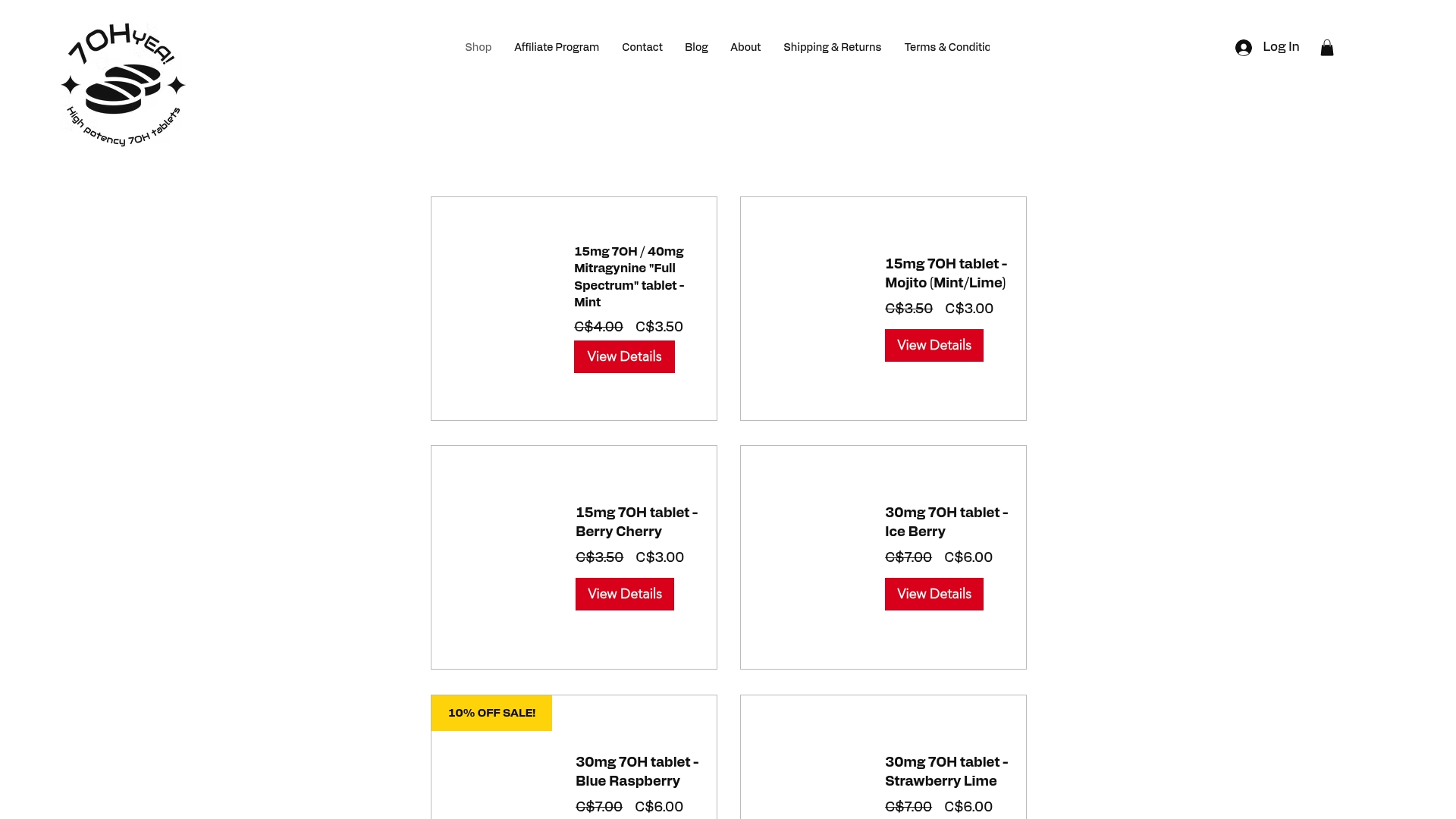
Orders are for laboratories and qualified professionals only. For a longer background read, see our research guide to 7-hydroxymitragynine for Canada.
FAQ
Do I need an SDS for 7OH in my lab?
Yes. WHMIS applies to hazardous products in Canadian laboratories, and suppliers must provide labels and SDSs unless an exemption applies. Keep the SDS where staff can reach it, since first-aid guidance repeatedly tells responders to check it. Your safety office can confirm the details for your province.
How much 7OH should be kept at the bench?
As little as the work needs. One BC university manual cites the OHS Regulation in saying only the minimum necessary amount of a toxic or hazardous substance belongs in the working area. Keep the rest in labelled, compatible storage.
What should I do after skin or eye contact in the lab?
Start flushing with water straight away. Canadian guidance says at least 15 minutes for eyes, with contaminated clothing removed, and the SDS consulted. Report the incident and give the SDS to any treating physician. For eye splashes, seek medical attention.
Is 7OH legal to hold in Canada?
We can’t give legal advice. One 2026 legal guide says kratom’s natural alkaloids are not scheduled under the CDSA, and the CDSA prohibits possession of scheduled substances unless authorized. The rules can change, so read the current schedules and ask your institution’s compliance office. In the US, the DEA announced on July 1, 2026 its intent to temporarily schedule 7-OH above a threshold, and the outcome isn’t confirmed here.
Can analytical labs tell 7OH from mitragynine?
Validated targeted LC-MS/MS methods are used to separate and quantify kratom alkaloids, according to a 2026 forensic review. Interpretation still depends on the product, the specimen and the method validation.
So here’s our open question for you: if US rules tighten while Canada’s stay quiet, should Canadian labs write their handling procedures to the strictest standard anyway? Tell us what your lab is doing.
7ohyeaAsk About Research-Grade 7OHEmail us with questions about 7OH tablets and powders for analytical purposes, including available dosage options.77ohyea
Email us7ohyea@gmail.comSources
- Prohibition of possession under the CDSA (Canada, consolidation current to October 19, 2026)
- 7-Hydroxymitragynine (7-OH) in Forensic Toxicology
- CCOHS: WHMIS - Laboratories
- BC Occupational Health and Safety Regulation, section 5.2
- BC Occupational Health and Safety Regulation, sections 5.85 to 5.89
- Hazards in the industrial sector, Ontario
- UBC Okanagan: General Chemical Spill Procedures
- UNBC Chemical Laboratory Safety and Methodology Manual
- CCOHS: Spill Response - Chemicals
- CCOHS: First Aid for Chemical Exposures
- University of Toronto EHS: Chemical Spills on Body
- Kruegel et al. (2019): 7-Hydroxymitragynine Is an Active Metabolite of Mitragynine