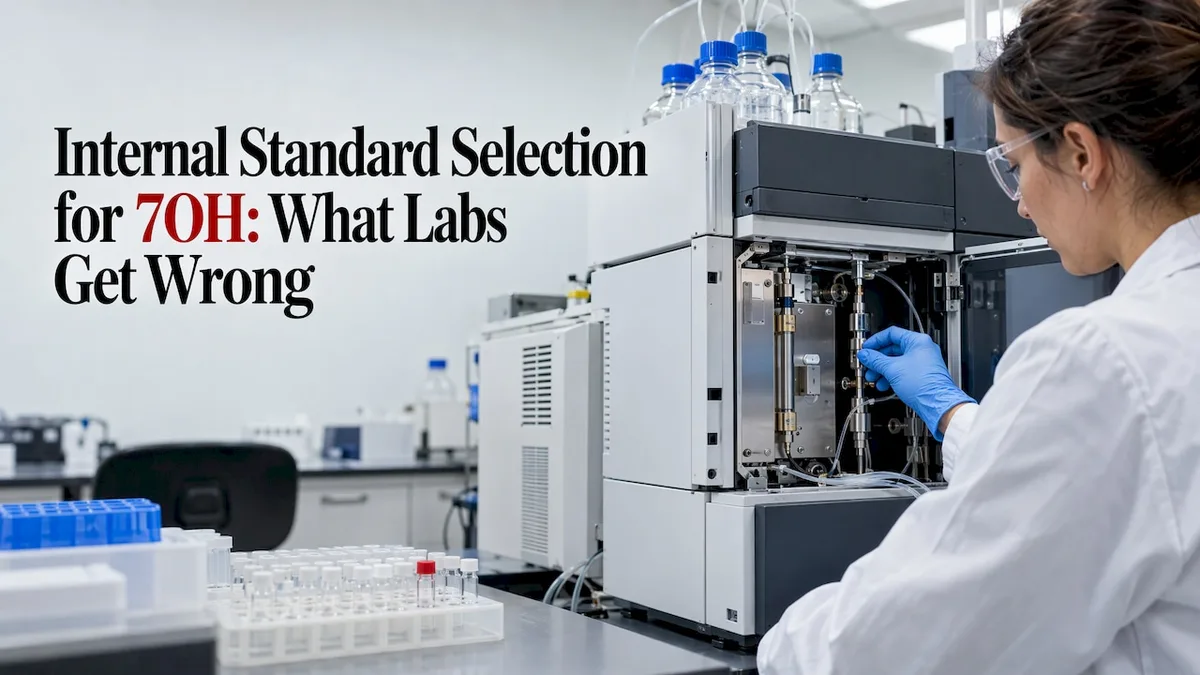
Internal Standard Selection for 7OH: What Labs Get Wrong

On July 1, 2026, the U.S. Department of Health and Human Services and the FDA publicly backed the DEA’s notices of intent to begin temporary scheduling of certain kratom-related substances, including 7-hydroxymitragynine (7OH) above a threshold. Suddenly, everyone wants to measure 7OH, and a lot of people are measuring it badly.
The quiet culprit is usually the internal standard. Pick the wrong one and your numbers look precise while being wrong. This guide explains what an internal standard is, which ones have actually been used for 7OH, and how to choose. Everything here concerns analytical work. Our products are for research use only, not for human consumption.
7ohyea7ohyea.caSupport Reliable 7OH Research7OH Canada offers research-grade 7OH tablets and powders, with customizable dosage options for laboratory analytical work.
Explore 7OH materialsTL;DR
- An internal standard is a known compound added at a constant amount to every sample, so you can correct for losses and signal swings.
- For 7OH, a stable-isotope-labelled version of the analyte is the published norm in LC-MS/MS work, and for good reason: 7OH is unstable.
- An analog compound can work in simpler methods, but it has to be validated against the matrix you actually run.
- Retention time and one transition aren’t enough to call a peak 7OH. A 2026 study showed false positives in crude kratom matrices.
- Report your validation data, not just “we used an internal standard.”
Table of Contents
- Quick facts
- Why is everyone suddenly talking about measuring 7OH?
- What does it mean for Canadians?
- What is an internal standard, in plain English?
- Myth vs. fact: “Any similar compound will do”
- Which internal standards have actually been used for 7OH?
- Why is 7OH such a tricky analyte?
- When is an isotope-labelled standard the right call?
- What did the headlines get wrong?
- How do you check that your internal standard is working?
- What validation numbers should you report?
- Does the reference material matter as much as the internal standard?
- What does this mean for readers?
- Perspective
- Where can research teams get Canadian-made 7OH materials?
- FAQ
- Sources
Quick facts
| Item | Detail |
|---|---|
| Topic | Choosing an internal standard (IS) for 7-hydroxymitragynine quantification |
| Typical technique | LC-MS/MS, with UPLC, CZE-MS/MS and LC-Q/TOF also reported |
| Common IS choice | Deuterated 7OH (7-OH-MG-D3), often with mitragynine-D3 for the parent alkaloid |
| Key trap | 7OH is unstable and can convert to mitragynine |
| U.S. context | HHS/FDA backed DEA notices of intent on July 1, 2026 |
| Canadian context | Check Health Canada directly for current status; we cite no Canadian notice here |
| Our products | Research use only, not for human consumption |
Why is everyone suddenly talking about measuring 7OH?
Because regulators are drawing a line, and a line needs a ruler.
The HHS announcement says the DEA’s notices start a process. After comments and at least 30 days, the Attorney General may issue a temporary scheduling order. It also says the aim isn’t to capture the kratom leaf itself, because 7OH occurs naturally in trace amounts. That’s a very specific claim about concentration. It only works if labs can tell “trace” from “enhanced” reliably.
That’s where analytical chemistry stops being background noise. A threshold means somebody has to quantify. And quantification lives or dies on calibration choices that most headlines never mention.
We’re not predicting how this plays out. A notice of intent isn’t a final order, and what happens next is unconfirmed.
What does it mean for Canadians?
Here’s the honest answer: the U.S. action is not Canadian law. We haven’t verified a Health Canada notice that mirrors it, so we won’t claim one exists. If you work in a Canadian lab, the official Health Canada pages are the place to confirm current status before you order or ship anything.
What does carry across the border is the science. Canadian labs that run kratom alkaloid assays face the same chemistry problems as U.S. ones. And a Canadian lab asked to show its numbers will be judged on its validation package, not its headlines.
This isn’t legal advice. If your work touches regulated substances, talk to your institution’s compliance office.
What is an internal standard, in plain English?
Think of it as a ruler you hide inside every sample.
An internal standard is a substance added in a constant amount to samples, blanks and calibration standards. Its job is to correct for analyte lost during sample prep, injection and ionization. Ionization is how the instrument gives molecules an electric charge so it can detect them.
If your sample loses 20% of everything during extraction, the internal standard loses about 20% too. The ratio between the two stays put. You quantify with the ratio, not the raw signal.
That only works if the internal standard behaves like the analyte. Which brings us to the real argument.
Myth vs. fact: “Any similar compound will do”
Myth: An internal standard just needs to be roughly similar to 7OH.
Fact: The closer the behaviour, the better the correction. The UNC Mass Spectrometry Core Laboratory recommends an isotope-labelled internal standard with a structure identical to the analyte and three or more heavy atoms, so the two co-elute from the LC column. Co-eluting means they leave the column at the same moment and face the same conditions in the instrument.
A 2019 conference presentation from the MSAcL community adds some practical rules. Prefer stable isotopes in the order 13C, 15N, 18O, 2H, use a mass shift above +3 amu, avoid labels that can exchange hydrogen and deuterium, and add the standard as early as possible.
That last point matters most. An internal standard added after extraction can’t correct for extraction loss. It only corrects for what happens later.
Which internal standards have actually been used for 7OH?
The published record is useful, and it points mostly one way.
Deuterated 7OH. Fu and colleagues (2015) built an LC-MS/MS method for urine using 7-hydroxymitragynine-D3 and mitragynine-D3. For 7OH they reported accuracy within ±10%, relative standard deviation (RSD) below 10% at every concentration, and an R² of 0.9951. RSD is just a measure of how scattered repeat results are.

The same pairing in an application note. A Thermo Scientific application note also used 7-OH-MG-D3 and MG-D3 for urine, with a calibration range of 15.0 to 1000 ng/mL.
A non-isotopic analog. Vuppala and colleagues (2013) measured 7OH in rat plasma with tryptoline as the internal standard. Their method reported extraction recoveries of 62.0 to 67.3%, precision under 15% RSD and accuracy of 96.5 to 104.0%. It’s a legitimate, validated method. It’s also a different bargain, which we’ll get to.
Isotope-labelled reference materials aren’t exotic, either. The WHO’s 44th ECDD pre-review report notes that commercial standards exist for mitragynine, 7-hydroxymitragynine and their deuterated forms.
Why is 7OH such a tricky analyte?
Because it won’t sit still.
Citi and colleagues’ 2023 review says lower extraction efficiencies can be expected for 7OH because its chemistry makes it markedly unstable, which requires choosing the appropriate internal standard. In simulated gastric fluid at pH 1.2, it dropped 27% after two hours, and 23 percentage points of that was conversion into mitragynine.
Translate that: your analyte can turn into a different analyte while you’re handling it. The Thermo note says 7OH is notably unstable unless stored in a basic environment, preferably at -20°C.
This is the strongest argument for a labelled 7OH internal standard. It degrades through the same routes as the analyte, so it flags problems an analog never sees. We’ve covered the artifact risk in more depth in our piece on 7-hydroxymitragynine degradation.
When is an isotope-labelled standard the right call?
Here’s our blunt rule of thumb, based on the published guidance above.
Choose a labelled 7OH standard when:
- Your matrix is complex (biological fluids, crude extracts, finished products).
- You need low limits of quantitation.
- Your method will be audited or published.
- Sample prep involves extraction steps where 7OH could degrade.
An analog can be defensible when:
- A labelled version isn’t available for your budget or timeline.
- The matrix is simple and well characterized.
- You’ve shown, with data, that the analog tracks 7OH through your entire workflow.
The second list has a catch. “Defensible” means you did the work to defend it. An analog with a different retention time faces different matrix effects at the moment of ionization. That’s the single biggest reason analog-based numbers drift.
What did the headlines get wrong?
Most coverage treats “detecting 7OH” as a yes-or-no question. It isn’t.
A 2026 study by Sheehan and colleagues in the Journal of the American Society for Mass Spectrometry found that the m/z 415→190 transition, the most intense fragment for 7OH, isn’t structurally unique. Other closely related alkaloid isomers in kratom extracts can produce it. Relying on that transition plus retention time can produce false-positive identification in crude matrices.
The authors recommend chromatographic resolution, high-resolution accurate mass, and a secondary diagnostic fragment. Their future plans include stable-isotope-labelled internal standards to improve quantitative accuracy and compensate for matrix effects.
So the story isn’t “labs can find 7OH.” It’s “labs can think they’ve found 7OH when they’ve found a cousin.” An internal standard fixes quantitation. It doesn’t fix identity. You need both.

How do you check that your internal standard is working?
Don’t assume. Test.
The UNC core lab’s preferred approach is external calibration with internal standardization, where calibrators are prepared in the same biological matrix as the unknowns and put through the same processing. If a blank matrix isn’t available, the standard addition method or neat-solvent calibrators are options, at the risk of lower accuracy.
In practice, a sound check looks like this:
- Compare internal standard response across blanks, calibrators and real samples. Big swings signal matrix effects or prep problems.
- Confirm the standard co-elutes with the analyte.
- Confirm no label exchange or cross-talk between the analyte and internal standard channels.
- Spike at several levels and check recovery against your acceptance criteria.
Fu and colleagues compared five injections of standards with human urine samples. They saw a 35% difference, which met the 40% requirement in their validation plan. The takeaway isn’t the number. It’s that they set a criterion in advance and reported against it.
What validation numbers should you report?
Don’t write “validated per internal protocol” and stop. Give the figures.
The AOAC’s SMPR 2015.008, a standard for kratom alkaloid methods, sets targets for 7OH including an analytical range of 0.01 to 0.5%, an LOQ of 0.005% or lower, and recovery of 90 to 110% at 0.01 to 0.1%. Repeatability RSD should be 5% or lower at that level. Multi-laboratory reproducibility should be 8% or lower. It also says methods must separate other relevant indole alkaloids across plant material, extracts and finished products.
Other published methods show what’s achievable in different settings:
| Study | Matrix | Technique | Reported highlights |
|---|---|---|---|
| Fu et al., 2015 | Human urine | LC-MS/MS | Accuracy within ±10%, RSD below 10% |
| Basiliere et al., 2020 | Postmortem blood and liver | LC-Q/TOF-MS | LOQ 0.5 to 2 ng/mL across five alkaloids |
| Horniakova et al., 2025 | Raw kratom plant material | CZE-MS/MS | LOD 2 ng/mL for 7OH, recovery 85.1 to 99.7% |
The table shows something useful. Techniques, matrices and limits vary widely, so a number only means something next to its matrix and method. Always report both.
Does the reference material matter as much as the internal standard?
Yes, and people forget it. Your internal standard corrects for process variation. It can’t fix a calibrator whose identity or purity is uncertain.
A batch-specific certificate of analysis, a stated purity and a clear identity statement are the minimum we’d expect. We’ve written about what labs should require in our guide to mitragynine reference standards and about 7-hydroxymitragynine purity levels. If you’re building a method from scratch, our notes on laboratory detection methods in Canada and on the difference between mitragynine and 7OH are worth a read first.
What does this mean for readers?
Short version, depending on who you are:
- Analytical chemists: Default to a labelled 7OH internal standard in complex matrices, add it first, and keep samples basic and cold. Report recovery, precision and matrix-effect data.
- Lab managers: Ask method owners how identity was confirmed, not only how quantity was calculated. One transition isn’t a confirmation.
- Researchers in Canada: The U.S. scheduling process is unconfirmed as to its outcome and isn’t Canadian law. Check Health Canada for the current Canadian position, and involve your compliance office.
- Curious readers: A headline number for “7OH content” is only as good as the calibration behind it. Our products are for research use only, not for human consumption.
Perspective
Here’s where we stand. When the regulatory conversation depends on thresholds, sloppy calibration is the real risk, and the fix is boring: a well-characterized reference material, an internal standard that tracks the analyte, and honest validation data.
We supply research-grade 7OH and related alkaloid materials made in Canada for analytical and laboratory use only. Our approach is built around batch-specific certificates of analysis and domestic sourcing from British Columbia, so research teams can build methods on materials they can document. Fast domestic delivery also means no border fees, which matters when a method is waiting on a reference lot.
We think Canadian labs deserve better than guesswork. Our view is that the field will reward the teams who publish their recovery, precision and matrix-effect numbers, and we’d rather help you do that than pretend it’s easy.
John
Where can research teams get Canadian-made 7OH materials?
If you’re setting up or revalidating an assay, you’ll need analytical materials with documentation behind them. Our 81% pure 7OH powder is listed at $50 CAD, and our full range of research-grade tablets and powders is on the 7OHyea homepage. All products are for laboratory and analytical use only, not for human consumption.
For bulk purchasing for research teams, use the site to get in touch. Our tablet testing guidance explains what labs should insist on before they run a single injection.
FAQ
Do I need a deuterated internal standard to measure 7OH?
Not always, but it’s the published norm for LC-MS/MS in complex matrices. Studies in urine used deuterated 7OH, and one rat plasma method used an analog. If you choose an analog, validate it against your own matrix.
When should the internal standard be added?
As early as possible. The UNC core lab advises adding it to every calibrator, quality control and unknown before extraction. That way it corrects for loss during prep as well as for ionization effects.
Can I identify 7OH by retention time and one transition?
That’s risky in crude kratom matrices. A 2026 study found the common 415→190 transition isn’t unique to 7OH. Add accurate mass and a secondary diagnostic fragment.
Is 7OH stable enough to leave in a sample vial?
Published work says to be careful. One application note says 7OH is notably unstable unless stored in a basic environment, preferably at -20°C. Design your storage and run times around that.
Is 7OH scheduled in Canada?
We can’t confirm a Canadian scheduling decision, and we won’t guess. The U.S. steps described above are notices of intent, not a final order. Check Health Canada for the current Canadian position.
So here’s our question for you: if regulators set a numeric threshold for 7OH, should labs be required to publish their internal standard and validation data? Tell us what you think.
7ohyeaDiscuss 7OH Research MaterialsEmail 7OH Canada with questions about research-grade 7OH tablets and powders for analytical work.77ohyea
Email 7OH Canada7ohyea@gmail.comSources
- HHS, FDA Commend DEA Action Against Dangerous Enhanced 7-OH Products
- Everything You Wanted to Know About Internal Standards (MSAcL, 2019)
- UNC Mass Spectrometry Core: LC-MS/MS Quantitative Assays
- Fu et al., Screening and Identification of Mitragynine and 7-Hydroxymitragynine (2015)
- Thermo Scientific application note: Quantitation of Kratom Components from Urine
- Vuppala et al., UPLC-MS/MS method for 7-hydroxymitragynine (2013)
- WHO ECDD 44th Pre-Review Report on kratom
- Citti et al., Kratom: The analytical challenge of an emerging herbal drug (2023)
- Sheehan et al., Avoiding False Identification of 7-Hydroxymitragynine (2026)
- AOAC SMPR 2015.008
- Basiliere et al., Identification of five mitragyna alkaloids in blood and liver (2020)
- Horniakova et al., Determination of Mitragynine and 7-Hydroxymitragynine in raw kratom (2025)