How Does Kratom Make 7-OH? The Biosynthesis Story

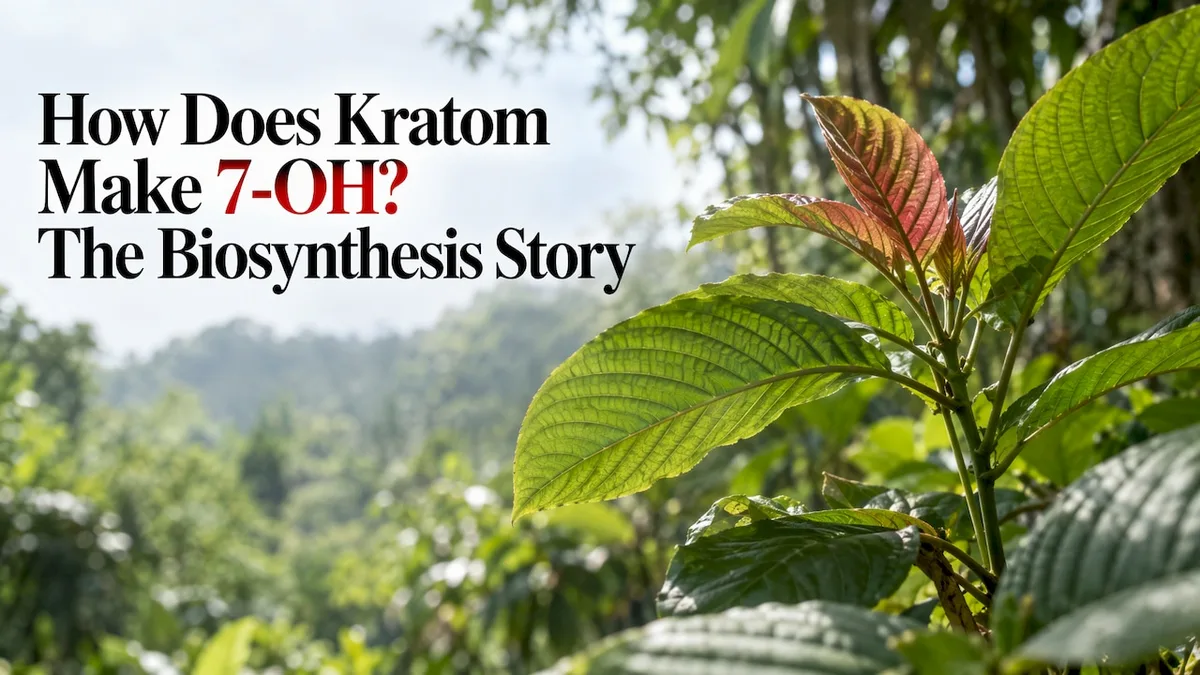
The 7-OH debate is loud right now. In July 2025, the US FDA recommended placing 7-hydroxymitragynine under Schedule I of the Controlled Substances Act, and the headlines blurred two very different things: what the kratom leaf makes naturally and what ends up concentrated in a product. Biosynthesis, the way a plant builds its own molecules step by step, is where that confusion starts. This guide sorts it out for Canadian researchers and analytical chemists. Our materials are for research use only, not for human consumption.
7ohyea7ohyea.caSupport Precise Alkaloid AnalysisExplore research-grade 7-OH tablets and powders, domestically sourced in British Columbia for analytical purposes.
VisitTL;DR
- Biosynthesis means the plant’s own enzyme-driven assembly line. Mitragynine is a major alkaloid in the leaf, and 7-hydroxymitragynine is only a trace one.
- Researchers have mapped much of the mitragynine pathway since 2023, but a couple of native enzymes in the last steps are still unidentified.
- A 2025 study found kratom can flip some alkaloids into a mirror-image form, opening the door to a whole family of compounds.
- Harvest and leaf processing shift alkaloid profiles, which is why batch documentation matters in the lab.
- The FDA’s 2025 scheduling recommendation is a US matter. Canadian readers should check Health Canada’s current notices.
Table of Contents
- Quick facts
- Why is everyone suddenly talking about where 7-OH comes from?
- What does “biosynthesis” actually mean?
- Myth or fact: does kratom make 7-OH the same way it makes mitragynine?
- What have scientists actually confirmed about the mitragynine pathway?
- Can yeast make kratom alkaloids? (And why that matters)
- What did the 2025 study change about other kratom alkaloids?
- Does harvest and drying change what’s in the leaf?
- Where does the 7-OH in the lab come from, then?
- How do analysts confirm what’s in a sample?
- What does this mean for readers?
- Where can research teams find reference materials?
- FAQ
- Sources
Quick facts
- Plant:Mitragyna speciosa, a tropical tree native to Southeast Asia.
- Known compounds: a 2024 review counts 54 monoterpene indole alkaloids isolated from the plant.
- Main alkaloid: mitragynine. 7-hydroxymitragynine occurs only in trace amounts in the leaf.
- Our status: research-grade materials for laboratory and analytical use only. Not for human consumption.
- Legal note: this article reports announcements. It isn’t legal advice.
Why is everyone suddenly talking about where 7-OH comes from?
Because the word “natural” is doing a lot of heavy lifting in the argument.
When the FDA made its recommendation, it drew a line. Per coverage of the announcement, the agency said trace amounts of 7-OH exist in the kratom leaf, and that its recommendation targeted concentrated 7-OH rather than kratom products. The DEA was then to review the recommendation and start a public rule-making process, which can take months. Whether and when that ends in a final rule is unconfirmed, and we won’t guess.
That line between “in the leaf” and “concentrated” is a biochemistry question. So let’s talk about the biochemistry, in plain language.
What does “biosynthesis” actually mean?
It’s how a living thing builds a molecule from simpler parts. Think of a factory line where each worker is an enzyme, a protein that speeds up one specific chemical step.
Kratom belongs to a big family of plant compounds called monoterpene indole alkaloids, or MIAs. Alkaloids are nitrogen-containing plant molecules, and the MIA family includes many well-known plant chemicals. According to a 2026 review of Mitragyna alkaloids, the pathway starts with two building blocks, tryptamine and a sugar-linked compound called secologanin. Those join up and the plant decorates the result in stages.
That’s the whole idea. Everything else is detail about which enzyme does which step.
Myth or fact: does kratom make 7-OH the same way it makes mitragynine?
The myth: 7-OH is just another leaf alkaloid, made on the same line as everything else, in the same amounts.
The fact: The same 2026 review describes mitragynine as the major alkaloid and 7-hydroxymitragynine as a minor one found only in trace amounts. A 2025 Frontiers in Plant Science study put numbers on it: average 7-hydroxymitragynine in leaf alkaloid extracts ranged from 0.02 to 0.04 percent, and it was detected only in certain seasons and varied by cultivar (a cultivar is a named plant variety).
So the headline version, “kratom is full of 7-OH,” gets the leaf wrong. The leaf is mostly about other compounds. That’s a point of view we’ll defend: the accurate story is more interesting than the viral one.

What have scientists actually confirmed about the mitragynine pathway?
A lot, and quite recently. This is the first of the few studies worth knowing.
In 2023, a team led by Schotte published in the Journal of the American Chemical Society. They identified the enzymes that turn a precursor called strictosidine into the core scaffold of mitragynine. Here’s the plain-English version:
- An enzyme strips the sugar off strictosidine.
- Two newly found enzymes, MsDCS1 and MsDCS2, reduce the result. Which one acts decides the 3D shape at one carbon, so the plant ends up with either the mitragynine precursor or the one for its sibling, speciogynine.
- A third enzyme, MsEnolMT, adds a methyl group (a small carbon unit) to finish the intermediate, corynantheidine.
A Nature Chemical Biology commentary on that work noted the team also confirmed the alkaloids accumulate mainly in leaf and stem.
What’s still missing?
The last two steps. Mitragynine needs a hydroxyl group (an oxygen-hydrogen unit) added at one spot on the molecule, then a methyl added to it. The Schotte team tested 172 candidate oxidases and a fungal enzyme from psilocybin biosynthesis, and none hydroxylated corynantheidine at that position. A 2024 yeast engineering paper in Metabolic Engineering likewise lists the last two native kratom enzymes as unknown.
That’s the honest state of play: a mostly solved puzzle with a stubborn gap near the end. Anyone telling you the whole pathway is fully mapped is ahead of the literature.
Can yeast make kratom alkaloids? (And why that matters)
Yes, in small amounts, and it’s a bigger deal than it sounds.
The same 2024 paper engineered baker’s yeast to build the early stretch of the pathway from scratch. Its refactored core reached 0.9 mg/L of de novo corynantheidine. Those are lab-scale numbers, nowhere near an industrial process. Still, it shows researchers are trying to make these compounds without depending on harvested leaf, which is a real industry trend to watch.
What did the 2025 study change about other kratom alkaloids?
It added a twist most headlines missed.
In July 2025, McDonald and colleagues reported in Nature Chemical Biology that kratom flips some of its alkaloids into a mirror-image form using a pair of enzymes, MsCO and MsDCR1. A further enzyme, MsSAS, can then convert those flipped molecules into spirooxindole alkaloids, a ring-twisted subfamily. The team also found the flip happens only in specific tissues, and that the enzymes accept a broad range of starting molecules.

Why should you care? Because the plant’s chemistry is wider than the two names everybody knows. It’s also why researchers interested in minor alkaloids, MGM-15 among them, follow plant biochemistry closely. Our analysis of mitragynine and 7-hydroxymitragynine for Canadian labs covers how the two are treated differently on the bench.
Does harvest and drying change what’s in the leaf?
It does, and this is the finding with the most direct bearing on lab work.
The 2025 Frontiers study found that withering, the controlled wilting of leaves after picking, generally raised mitragynine concentrations by 14 to 65 percent in one cultivar and 3 to 8 percent in another. Twelve hours of withering followed by drying below 40 °C also lifted two other alkaloids, speciogynine and paynantheine, in the first cultivar.
The takeaway is simple. Two leaf batches can look alike and read differently. For a lab, that makes batch-level documentation more than paperwork.
Where does the 7-OH in the lab come from, then?
The leaf contains a little. Other routes exist too. Research groups have reported converting mitragynine in solution, and a 2024 study on electrical breakdown in liquid reported enhanced mitragynine-to-7-hydroxymitragynine conversion in kratom leaf powder solutions. We’ve written about the bench side of this in our guide to mitragynine to 7-OH conversion, COAs and Health Canada.
That’s also the pivot point of the policy fight. Plant-derived trace amounts and concentrated materials are different things, and regulators are treating them differently. Our post on 7OH versus 7-hydroxymitragynine and Canadian law goes deeper.
How do analysts confirm what’s in a sample?
With difficulty, and with documentation. Kratom extracts hold many closely related molecules, some of which differ only in 3D arrangement. The 2020 Flores-Bocanegra characterization of 19 kratom alkaloids by NMR and mass spectrometry is a reminder of how much instrument work it takes to tell mitragynine from its diastereoisomers (molecules with the same atoms but a different spatial layout).
For labs building methods, a reference standard and a batch-specific certificate of analysis do much of the heavy lifting. Our overview of what kratom alkaloid panels labs actually use is a practical starting point.
What does this mean for readers?
Here’s the plain version, split by who’s reading.
If you’re a scientist or analytical chemist: the pathway literature is moving fast, and the unknown last steps are an open research problem. Track the 2025 epimerization work if you study minor alkaloids. Document batch, season and processing, because the data show they matter.
If you’re a Canadian lab buyer: the news cycle is mostly American. The FDA’s July 2025 recommendation is a US process with a DEA step still following. We can’t predict what Canada does, and we aren’t giving legal advice. Check Health Canada’s current notices and your institution’s compliance office.
If you came here wondering about personal use: this site doesn’t offer guidance on that. Our products are research-grade materials for analytical purposes and are not for human consumption. If you have questions about your own health or substance use, talk to a doctor or pharmacist.
If you’re comparing 7-OH and kratom as topics: they’re linked but not the same. Our explainer on kratom alkaloid tablet blends and the 2026 7-OH debate takes that on directly.
Our take
We think the 7-OH conversation has been poorly served by slogans. “It’s natural” and “it’s just morphine in disguise” are both shortcuts, and the plant science doesn’t fit either one. What the literature does show is a trace alkaloid, a well-mapped but unfinished pathway and strong batch-to-batch variation in leaf.
That’s why we focus on what a laboratory needs: Canadian-sourced, research-grade materials, batch-specific certificates of analysis, and domestic supply that avoids border fees and delays. Researchers can’t build clean data on vague inputs, and we’d rather give them documentation than marketing.
We also say it plainly every time: our products are for research use only, not for human consumption.
John
Where can research teams find reference materials?
We supply research-grade 7OH, mitragynine, MGM-15 and SR17018 materials in tablet and powder formats for laboratory and analytical work, with Canadian sourcing and batch-specific certificates of analysis. For method development, our 43% pure mitragynine full spectrum powder is listed at 6.75 CAD, and our 81% pure 7OH powder at 50 CAD. Bulk purchasing options exist for research teams. Browse the full range at 7ohyea.ca.
All materials are intended for laboratory use only and not for human consumption.
FAQ
Is 7-hydroxymitragynine made by the kratom tree itself?
In trace amounts, yes. A 2026 review describes it as a minor alkaloid, and a 2025 study measured it at 0.02 to 0.04 percent in leaf alkaloid extracts, detected only in some seasons. Levels vary by cultivar.
Have scientists mapped the full mitragynine pathway?
Not quite. The early steps from strictosidine to corynantheidine are identified, but the final two native enzymes remain unknown according to the 2024 yeast engineering work. It’s an active research area.
What did the FDA actually announce about 7-OH?
In July 2025 it recommended Schedule I status for concentrated 7-hydroxymitragynine, and said kratom products themselves wouldn’t be affected. The DEA then had to review it and open a public rule-making process. This is a US process and doesn’t set Canadian law.
Are your products meant for people to take?
No. They’re research-grade materials for laboratory and analytical purposes only, not for human consumption.
7ohyeaQuestions About 7-OH Research?Email us with questions about research-grade 7-OH materials for laboratory and analytical purposes.77ohyea
Email us7ohyea@gmail.comSources
- FDA Seeks Schedule I Status for ‘Legal Morphine’, Medscape
- A review on Mitragyna alkaloids: pharmacology, biosynthesis and more (2026)
- Directed Biosynthesis of Mitragynine Stereoisomers (JACS, 2023)
- Monoterpene metabolism unmasked, Nature Chemical Biology (2023)
- Metabolic engineering of yeast for de novo production of kratom alkaloids (2024)
- Enzymatic epimerization of monoterpene indole alkaloids in kratom (2025)
- Alkaloid biosynthesis in kratom, Frontiers in Plant Science (2025)
- Electrical breakdown in liquid-phase processing of kratom (2024)
- The Chemistry of Kratom: Updated Characterization (2020)
So here’s our question for you: should policy treat a trace leaf alkaloid and a concentrated lab material as the same thing, or is that distinction the whole debate?