Kratom Alkaloid Tablet Blends: What 2026’s 7-OH Debate Means

In August 2026, the American College of Medical Toxicology put out a position statement on 7-hydroxymitragynine, the compound at the centre of the kratom tablet boom. That’s why “alkaloid blends” suddenly sound like a headline and not a footnote. A kratom alkaloid tablet blend is a pressed tablet made from kratom-derived compounds, sometimes a spread of several alkaloids, sometimes a boosted amount of one. Here’s what that means, what the headlines got wrong, and where Canadians stand.
One line first. Everything 7ohyea sells is research-grade material for laboratory and analytical use only. It is not for human consumption.
7ohyea7ohyea.caSupport Alkaloid Research With 7-OHExplore research-grade 7-OH tablets and powders for laboratory and analytical purposes, with dosage options of 15mg, 30mg, and 50mg.
Explore research materialsTL;DR
- “Alkaloid blend” has no legal or scientific standard definition. Two tablets with the same label can contain very different things.
- Kratom leaf holds more than 50 alkaloids, and mitragynine is the most abundant. 7-OH is a minor one in the natural leaf.
- Researchers are warning that concentrated and semi-synthetic products are a different category from leaf, and the clinical data on them is thin.
- In Canada, kratom isn’t scheduled under the Controlled Drugs and Substances Act, but it isn’t authorized for human use either.
- Our products are for research use only, not for human consumption.
Table of Contents
- Quick facts
- Why is everyone suddenly talking about alkaloid blends?
- What actually is a kratom alkaloid tablet blend?
- Myth vs. fact: is 7-OH just “natural kratom”?
- What did the headlines get wrong?
- Why do two “identical” blends differ so much?
- How do labs tell what’s actually in a tablet?
- What do toxicologists say about 7-OH?
- Is any of this legal in Canada?
- What this means for readers
- Perspective
- Where can research teams find clearly labelled materials?
- FAQ
- Sources
Quick facts
| Question | Short answer |
|---|---|
| What’s an alkaloid? | A naturally occurring, nitrogen-containing plant compound. Kratom has dozens. |
| Most abundant kratom alkaloid? | Mitragynine, per a 2023 critical review. |
| Is a “blend” standardized? | No. Composition depends on the maker and the method. |
| Is kratom scheduled in Canada? | No, not under the CDSA, as reported in 2026. |
| Can it be sold for consumption in Canada? | Health Canada hasn’t authorized it for that, per the same source. |
| Our stance | Research use only. Not for human consumption. |
Why is everyone suddenly talking about alkaloid blends?
Because the market changed faster than the vocabulary.
A few years ago, “kratom” mostly meant ground leaf. Now shelves and websites carry tablets, shots, gummies and powders, many described as “full spectrum” or “alkaloid blends.” Researchers say some of those products have little to do with the plant they’re named after.
A 2025 paper on diverse kratom products and use patterns notes that commercial products marketed as kratom can contain derivatives that aren’t naturally present in leaf. It singles out mitragynine pseudoindoxyl as one example.
That’s the real story under the buzzword. The label “kratom” is covering a lot of ground, and the word “blend” tells you almost nothing about what’s inside.
What actually is a kratom alkaloid tablet blend?
Let’s define terms. An alkaloid is a naturally occurring plant compound with a nitrogen atom in its structure. Caffeine is one. Kratom (Mitragyna speciosa) has dozens.
A “blend” can mean at least three different things:
- A leaf-derived extract blend. A maker pulls alkaloids out of the leaf with a solvent and presses the result. The mix depends on the plant and the process.
- A formulated blend. Isolated compounds, such as mitragynine and 7-hydroxymitragynine, are combined in set ratios.
- A semi-synthetic product. According to a pharmacology presentation to Washington’s Liquor and Cannabis Board, semi-synthetic products can be derived from mitragynine and mostly contain 7-OH or related derivatives.
Same word, three very different materials. Anyone writing a spec sheet, a protocol or a lab order needs to know which one they’re dealing with.
Myth vs. fact: is 7-OH just “natural kratom”?
Myth: 7-OH is simply a natural part of the plant, so a 7-OH tablet is basically kratom.
Fact: It’s a minor constituent, and concentrating it is a different thing than grinding leaf.
Researchers at BCIT in British Columbia raised the alarm on kratom imposters. They describe mitragynine converting into 7-OH to some degree in the human body. They add that 7-OH appears in post-harvest kratom only at trace levels, and that some companies make synthetic 7-OH and sell it as a “natural” extract.
We think that’s a fair thing to flag. Honest labelling matters, and it’s one reason we’re clear about what our materials are: research-grade compounds with batch-specific certificates of analysis, sold to labs.
What did the headlines get wrong?
Three things come up again and again.
“It’s all one substance.” It isn’t. Mitragynine, 7-OH, paynantheine, speciogynine and speciociliatine are separate compounds with their own properties. Lumping them together hides the one question that matters for any analytical work: which compound, in what amount, at what purity?

“If it’s on a shelf, someone checked it.” Not so. Experts cited in a 2025 review say concentrated and semi-synthetic derivatives lack standardized manufacturing. They also say clinical data to assess their safety is limited.
“Leaf and concentrate are the same, just stronger.” Pharmacologists including Dr. Oliver Grundmann argue otherwise. In a 2023 paper in Addiction, they say concentrated extracts sidestep the plant’s natural limits, such as bitter taste and bulk. That, they argue, raises the risk of overdose and dependence.
We’re not here to relitigate that debate. We sell reference and research materials, not consumer products. But it’s the context any serious buyer should understand.
Why do two “identical” blends differ so much?
Part of it is biology. A 2020 study in Scientific Reports lists genetic variation, plant age, growing conditions and processing methods as factors that change a kratom product’s alkaloid content.
Part of it is manufacturing. There’s no universal recipe for a blend. One maker’s solvent system and method will capture a different spread than another’s.
For a lab, that means the certificate of analysis matters more than the marketing word. A Canadian research team should be asking for batch-level data, the testing method and the reference standards behind the numbers. Our guides on kratom alkaloid panel standards and on what labs need for 7-hydroxymitragynine tablet testing go through that in detail.
How do labs tell what’s actually in a tablet?
The short version: chromatography. In plain terms, it separates a mixture into its parts so each can be measured.
A WHO expert committee pre-review report on kratom says laboratories identify and quantify kratom alkaloids using chromatographic methods paired with spectrophotometric or mass-spectrometric detectors.
Why does it matter for blends? A proper panel can show which alkaloids are present and in what amounts. That’s the difference between a label that says “full spectrum” and a document that says what the material is.
If your work involves the differences between the two best-known compounds, see our piece on mitragynine vs. 7-hydroxymitragynine for Canadian labs. For researchers who need the pharmacology background, there’s also a 7-hydroxymitragynine pharmacology overview.
What do toxicologists say about 7-OH?
This is the part that drives most of the headlines, so here it is plainly.
The ACMT’s 2026 statement describes 7-OH as a potent mu-opioid receptor agonist. That’s a compound that activates the same receptor type opioid drugs act on. The statement says preclinical studies, meaning lab and animal work, have shown opioid-like respiratory depression, physical dependence and withdrawal.
The same document says animal studies and clinical case reports show that naloxone can reverse the respiratory depression linked to 7-OH and related compounds.
There’s also a Canadian data point, with a caveat. A Canadian addiction-treatment site reports that about one in four patients exposed to kratom or 7-OH alone were hospitalized. That’s a secondary summary, not a primary dataset, so treat it as unconfirmed until you’ve seen the original numbers.
We take this seriously. It’s exactly why our materials are sold for analytical work with controlled handling, not as consumer goods.
Is any of this legal in Canada?
The honest answer is “it’s complicated,” and nobody should sell you a tidy one.
As of 2026 reporting, kratom and its alkaloids aren’t scheduled under the Controlled Drugs and Substances Act. The same source says Health Canada treats kratom as an unauthorized natural health product. It says selling it for consumption, or making health claims about it, runs against the Food and Drugs Act and the Natural Health Products Regulations. It also describes 7-OH as unscheduled in Canada but flagged as high risk.
That’s a secondary source, not a Health Canada notice, so check Health Canada’s own pages for the current position. We haven’t confirmed any pending federal change to the status of 7-OH, and we won’t guess at one.
On the US side, the ACMT statement shows that American clinicians are treating 7-OH as a distinct and serious concern. We aren’t going to predict what regulators do next. Laws shift, and nothing here is legal advice. If you’re unsure how a purchase fits your institution’s rules, ask your compliance office or a lawyer.

What this means for readers
Here’s the practical takeaway, depending on who you are.
- If you’re a researcher or analytical chemist in Canada: the word “blend” isn’t a specification. Define the compound, the purity and the method, and insist on batch-specific documentation.
- If you’re a lab buyer: keep records of what you ordered, why, and under which institutional approval. The rules around these materials are unsettled.
- If you’re a curious reader following the headlines: the debate is about concentrated and semi-synthetic products versus the plant, not just “kratom, yes or no.” Look for primary sources, and be wary of anyone claiming certainty about the science or the law.
- If you’re thinking about consuming any of this: these products aren’t made for that. Our materials are for research use only. If you or someone you know is struggling with opioid or kratom use, talk to a doctor or pharmacist, or call your provincial health line.
For a wider view of where the field is heading, our overview of kratom research trends in 2026 is a good next stop.
Perspective
We sit in an odd spot. The public conversation treats every kratom-derived tablet as one thing, and the toxicology community, rightly, is asking tough questions about concentrated products. We agree that precision matters.
That’s the whole reason we exist as a research supplier. Our materials are research-grade, for analytical and laboratory use only, and not for human consumption. We make them in British Columbia and ship them within Canada, so research teams don’t deal with border fees or long waits.
Every product ships with a batch-specific certificate of analysis, because a lab can only do good work if it knows exactly what’s in the vial. Our line covers 7-hydroxymitragynine, mitragynine, MGM-15 and SR17018, so teams can build a protocol around a clearly named compound instead of a vague “blend.”
We think the best answer to a confusing market is clarity: name the compound, document the batch, and keep the material in the lab where it belongs.
John
Where can research teams find clearly labelled materials?
If you’re setting up an analytical protocol, we supply named compounds with batch-specific certificates of analysis, made in Canada. Our range includes 7OH, mitragynine, MGM-15 and SR17018 tablets, plus powders. Published prices include 43% pure mitragynine “full spectrum” powder at 6.75 CAD, 81% pure 7OH powder at 50 CAD, and 99% pure SR17018 powder at 48 CAD. Bulk purchasing is available for research teams.
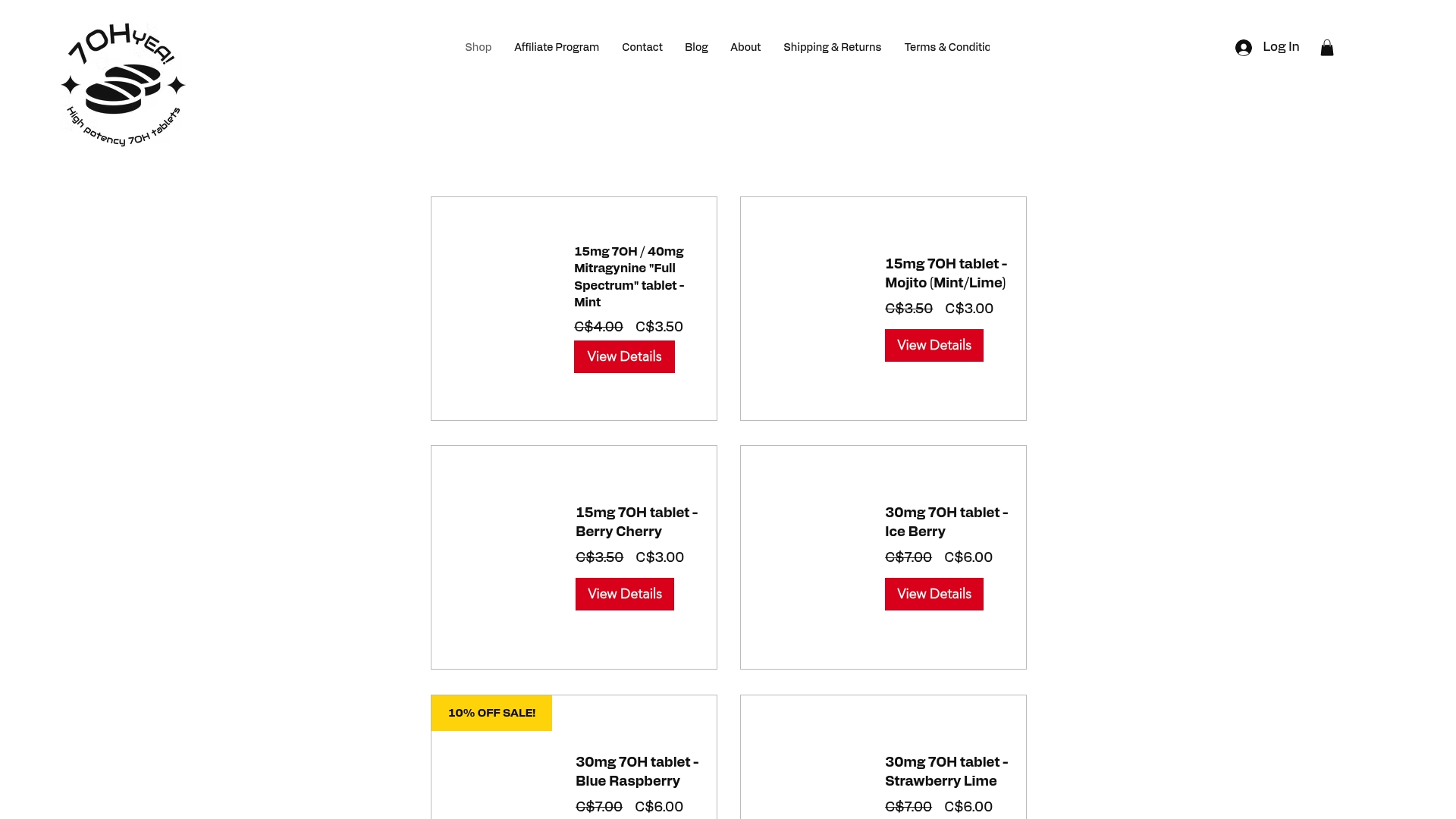
Browse the full range on the 7ohyea research catalogue. Everything is sold for laboratory and analytical use only, not for human consumption.
FAQ
Are kratom alkaloid tablet blends standardized?
No. There’s no single definition of a “blend,” and composition depends on the source plant, the extraction method and the maker. A 2020 study found that plant age, genetics, growing conditions and processing all change alkaloid content. A batch-specific certificate of analysis is the best way to know what a given lot contains.
Is 7-OH the same as kratom?
Not exactly. 7-OH is one alkaloid, and it’s a minor one in the natural leaf. BCIT researchers say it shows up in post-harvest leaf only at trace levels, and that some sellers make it synthetically and market it as natural. Mitragynine is the main alkaloid in the plant.
Is kratom legal in Canada?
It isn’t listed under the Controlled Drugs and Substances Act, according to 2026 reporting. Health Canada hasn’t authorized it as a product for human consumption, though. Check Health Canada’s own pages for the current position, and ask a lawyer about your specific situation.
How do labs measure alkaloids in a tablet?
Mostly with chromatography paired with a spectrophotometric or mass-spectrometric detector, as described in the WHO pre-review report. That splits a mixture into its components so each can be identified and quantified.
Are your products for human consumption?
No. Every 7ohyea product is research-grade material for laboratory and analytical use only. It is not for human consumption.
So here’s our question for you: should the word “blend” on a kratom-derived product come with a legal requirement to say exactly what’s inside? Tell us what you think.
7ohyeaDiscuss 7-OH Research MaterialsEmail 7ohyea with questions about research-grade 7-OH tablets and powders for laboratory and analytical purposes.77ohyea
Email us7ohyea@gmail.comSources
- ACMT Position Statement on 7-Hydroxymitragynine (August 2026)
- A Critical Review of the Neuropharmacological Effects of Kratom (2023)
- The Impact of Diverse Kratom Products on Use Patterns (2025)
- Pharmacology of Kratom, Patterns of Use, and Diversity of Products in the U.S.
- BCIT researchers sound alarm on kratom imposters
- Not all kratom is equal (Addiction, 2023)
- Chemical composition and biological effects of kratom (Scientific Reports, 2020)
- WHO ECDD pre-review report on kratom
- Kratom Addiction and Withdrawal in Canada