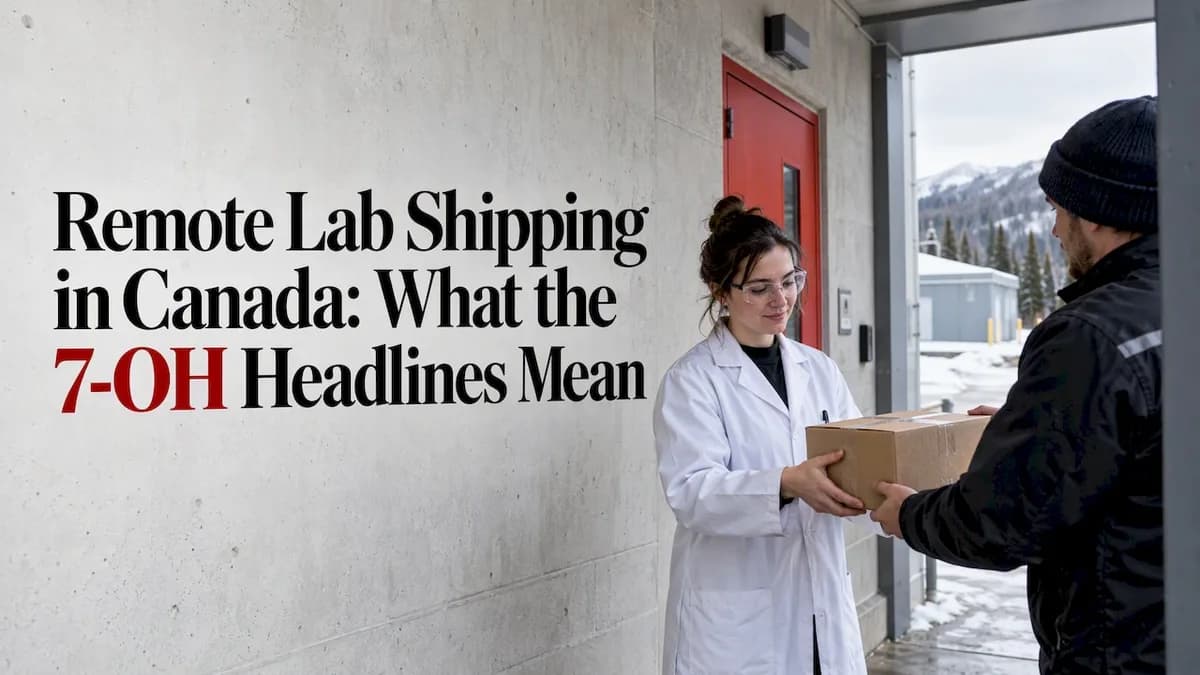
Remote Lab Shipping in Canada: What the 7-OH Headlines Mean

A U.S. headline is making Canadian labs rethink how they receive research alkaloids. On July 1, 2026, the DEA announced its intent to temporarily place 7-hydroxymitragynine (7-OH) and three related substances in Schedule I, according to the Congressional Research Service. Border-crossing parcels suddenly look riskier, and “remote lab shipping” has become a real question for researchers outside the big university hubs.
Here’s the plain version. Shipping to a lab in Canada is mostly about paperwork, classification and carrier rules. A product that’s made and shipped domestically sidesteps one layer of that, the border. It doesn’t remove the rest. And everything we sell is for research use only, not for human consumption.
7ohyeaExplore 7-OH Research Materials7ohyea supplies research-grade 7-OH tablets and powders, domestically sourced in British Columbia for laboratory analytical purposes.
View research materialsTL;DR
- The DEA’s July 2026 notice is a U.S. action. We haven’t confirmed a matching federal announcement in Canada, so treat any “Canada is next” claim as speculation.
- In Canada, the Controlled Drugs and Substances Act (CDSA) governs what can move and who can move it. Check current Health Canada notices before any order.
- Dangerous goods rules put classification and paperwork on the shipper (the consignor), not the courier.
- Remote labs lose the most time to receiving rules, weekend depot holds and missing contact details.
- All 7ohyea products are for research use only, not for human consumption.
Table of Contents
- Quick facts
- Why is everyone suddenly talking about shipping research alkaloids?
- What does “remote lab shipping” actually mean?
- Myth or fact: can anyone just ship a research chemical in Canada?
- What did the headlines get wrong?
- What should a lab check before a shipment goes out?
- How do you confirm a carrier will deliver to a remote lab?
- What delays should Canadian labs plan for?
- What does domestic sourcing change?
- Our perspective
- Where can you see what we supply?
- What does this mean for readers?
- FAQ
- Sources
Quick facts
- Keyword context: shipping research materials to labs across Canada, including labs far from major cities.
- U.S. news hook: DEA notice of intent to temporarily schedule 7-OH, announced July 1, 2026.
- Canadian framework: the CDSA, border memoranda from the CBSA, and Transport Canada’s dangerous goods rules.
- Who carries the paperwork duty: the shipper, for classification, packaging and documents.
- Our status: research-grade materials for laboratory use only, not for human consumption.
Why is everyone suddenly talking about shipping research alkaloids?
Because scheduling decisions change what can cross a border, and what a courier will touch.
The DEA notice is the latest step in a U.S. story that started earlier. In July 2025, the FDA recommended a scheduling action on 7-OH products, with the recommendation aimed at concentrated amounts rather than trace levels found naturally in the plant. The 2026 DEA notice builds on that. Under U.S. law, the DEA must notify the Secretary of Health and Human Services and publish its intent in the Federal Register at least 30 days before a temporary scheduling takes effect, as the CRS explains.
What’s confirmed: an announced intent. What’s not: how it plays out, and when. We won’t guess.
For Canadians, the practical effect is indirect. Labs that used to order from U.S. suppliers are looking north for domestic options. That’s one reason “remote lab shipping Canada” is a live search.
What does “remote lab shipping” actually mean?
It’s not an official term. Readers use it for a few related situations, and it helps to separate them.
- A lab outside a major hub. A field station, a northern campus or a regional facility where couriers run less often.
- A lab with a restricted receiving process. A university building with central receiving, a core-facility appointment desk, or controlled door access.
- A remote-access lab. Some search results are about remote desktop labs for students. That’s a computing service, not a shipping one, and it’s not our topic.
The first two are what we mean here. In both, the courier is only one link. The lab’s own receiving rules matter just as much. Research-courier guidance notes that deliveries may go to central receiving, a lab door or a core-facility appointment desk, and that procedures differ between buildings and can change timing.
Myth or fact: can anyone just ship a research chemical in Canada?
Myth. It’s not a free-for-all, and the headlines often skip this part.
Under the CDSA, activities involving controlled substances and precursors are prohibited unless the Act, a regulation or an exemption authorizes them, according to the CBSA’s Memorandum D19-9-2. The same memorandum says controlled substances or precursors can generally be imported or exported only by a licensed dealer, licensed producer or registered dealer, and each shipment needs a valid permit.
Two things follow.
- Whether a substance is controlled is the first question, and it can change. Check Health Canada’s current guidance, not a forum post.
- Import and export are one thing. Domestic shipping between labs is another, and it still has to respect classification and carrier rules.
Health Canada’s Office of Controlled Substances says it works to keep controlled substances in legal distribution channels without interfering with valid commercial, medical and scientific activities. That’s the balance labs are working inside.
We’re not lawyers, and nothing here is legal advice. If your lab’s status is unclear, ask your institution’s compliance office or a lawyer who works in this field.
What did the headlines get wrong?
Three things come up again and again.
“A U.S. ban means a Canadian ban.” It doesn’t. The DEA acts under the U.S. Controlled Substances Act. Canada has its own law, its own regulator and its own process. Anyone telling you the outcome is certain is guessing.
“Domestic means exempt.” It doesn’t. Domestic sourcing removes the border step, which cuts out import permits and customs timing. Classification, labelling and carrier acceptance still apply.
“The courier handles the paperwork.” Usually not. For domestic courier shipments, classification, packaging and paperwork are the shipper’s responsibility, and a courier may decline a shipment if the shipper can’t identify what’s inside.
What should a lab check before a shipment goes out?
Think of it as a short pre-flight list. Every item is about compliance and logistics, not about how any material gets used.
1. Is the substance classified, and under what rules?
Start with the legal status of what you’re ordering. A moving target is a risk for you, not just the seller. Our own write-up on Health Canada compliance for research chemicals walks through the questions a lab should ask any supplier.
There’s also a regulatory change on the horizon worth knowing about. The Controlled Substances Regulations (SOR/2025-242) aren’t yet in force, and they exempt government laboratories from dealer-licence requirements for delivering, sending or transporting controlled substances. We can’t tell you how that will affect your lab. Read the text and ask your compliance office.
2. Does the shipment count as dangerous goods?
Transport Canada’s guidance says the consignor decides whether a material is dangerous goods and completes classification, documentation, marks and containment before the carrier takes possession. If it is, the consignor must give the carrier a shipping document first. That document includes the consignor’s Canadian address, the preparation date, the UN number, the shipping name, the class, the quantity, a 24-hour contact number and a certification, per Transport Canada’s Part 3.

Many research reference materials won’t fall into dangerous goods at all. But the decision belongs to whoever ships, and it should be documented either way.
3. Are the documents in order?
If you’re receiving from a supplier, ask for the batch-specific certificate of analysis (CoA, the lab report on a specific batch), a safety data sheet and the shipping documents before the parcel leaves. We’ve broken down what we send in our guide to shipping documentation for Canadian labs, including bilingual WHMIS labelling.
4. Does the label say what the material is for?
Research-use labelling matters for carriers, receiving staff and auditors. Our guide to analytical-use-only labelling in Canada covers what a clear label looks like.
5. Will the carrier accept it, and will anyone be there to sign?
This is where remote labs get caught out. More on that next.
How do you confirm a carrier will deliver to a remote lab?
Ask before you ship. Don’t assume.
A research-courier guide lists what to give the carrier: the temperature class, whether there’s dry ice or biological material, building access details, receiving hours, appointment rules and contact information. That list is written for Montréal, but the logic holds anywhere.
A few practical habits that help:
- Give the courier a named person and a direct phone number at the lab, not a general switchboard.
- Confirm whether the building has a loading dock, a staffed receiving desk or neither.
- Ask about rural or remote surcharges and delivery-day limits before you pick a service.
- Have a backup contact in case the first one’s away.
Some labs rely on a single courier with Canada-wide coverage, including rural areas, according to a courier’s own guide for medical labs. That’s one approach. Whatever you choose, get the carrier’s acceptance in writing.
What delays should Canadian labs plan for?
The boring ones, mostly.
Weekend depot holds. UNBC’s chemical stores advises that perishable or sensitive packages should go early in the week, so they arrive on a business day instead of sitting in a depot over the weekend.
Unprepared shipments. The same UNBC procedure advises arranging the shipment in advance, leaving the package unsealed for inspection by the consignor, and making sure the packaging prevents damage and leakage. At UNBC, the dispensing chemist reviews the packaging and paperwork, completes a waybill and adds hazard stickers where needed.
Receiving quirks. A building that only takes deliveries 9 to 3 will turn a Friday afternoon arrival into a Monday problem.
Temperature-sensitive materials. If your protocol needs a controlled temperature, read our guide to temperature-controlled shipping for Canadian research labs.
One more thing worth saying. In a research setting, deadlines are often set by experiments, so reliable timing and correct handling can matter more than the cheapest delivery price.

What does domestic sourcing change?
Less than the marketing suggests, but something real.
When material is sourced and made in Canada, you don’t need an import permit for it and you aren’t waiting on customs. That’s the whole point of the claim, and it’s why we say our domestic sourcing from British Columbia means fast shipping and no border fees. It doesn’t change the rules about classification, labelling or carrier acceptance. It also doesn’t change the legal status of the substance itself.
For bulk orders, reference-standard sourcing and fewer import delays is a topic we’ve covered in detail. And if you’ve ever had an order stall for weeks, our piece on avoiding a long reset on analytical alkaloid orders explains where those delays tend to come from.
Our perspective
We think the most useful thing a supplier can do for a remote lab is remove surprises. That means being clear, up front, that our products are research-grade materials for analytical use only and not for human consumption.
It also means documentation that travels with the parcel: batch-specific certificates of analysis, clear labelling and shipping details the receiving desk can act on. A lab three provinces from the nearest courier hub shouldn’t have to chase paperwork after the box has left.
Domestic production in British Columbia is the part we’re proudest of. It keeps shipping times shorter and takes the border out of the equation, which matters when the 7-OH headlines are changing what labs feel comfortable ordering from abroad.
We’d rather a researcher ask us ten questions before ordering than one after. Our team is built for that conversation.
John
Where can you see what we supply?
We supply research-grade alkaloid tablets and powders to Canadian laboratories, with batch-specific certificates of analysis and customizable options for research protocols. Everything is for laboratory use only, not for human consumption.
Published powder prices at the time of writing: our 81% pure 7OH powder is $50 CAD one-off, and our 43% pure Mitragynine full spectrum powder is $6.75 CAD one-off. Our tablet lines carry no published price, so ask us for a quote.
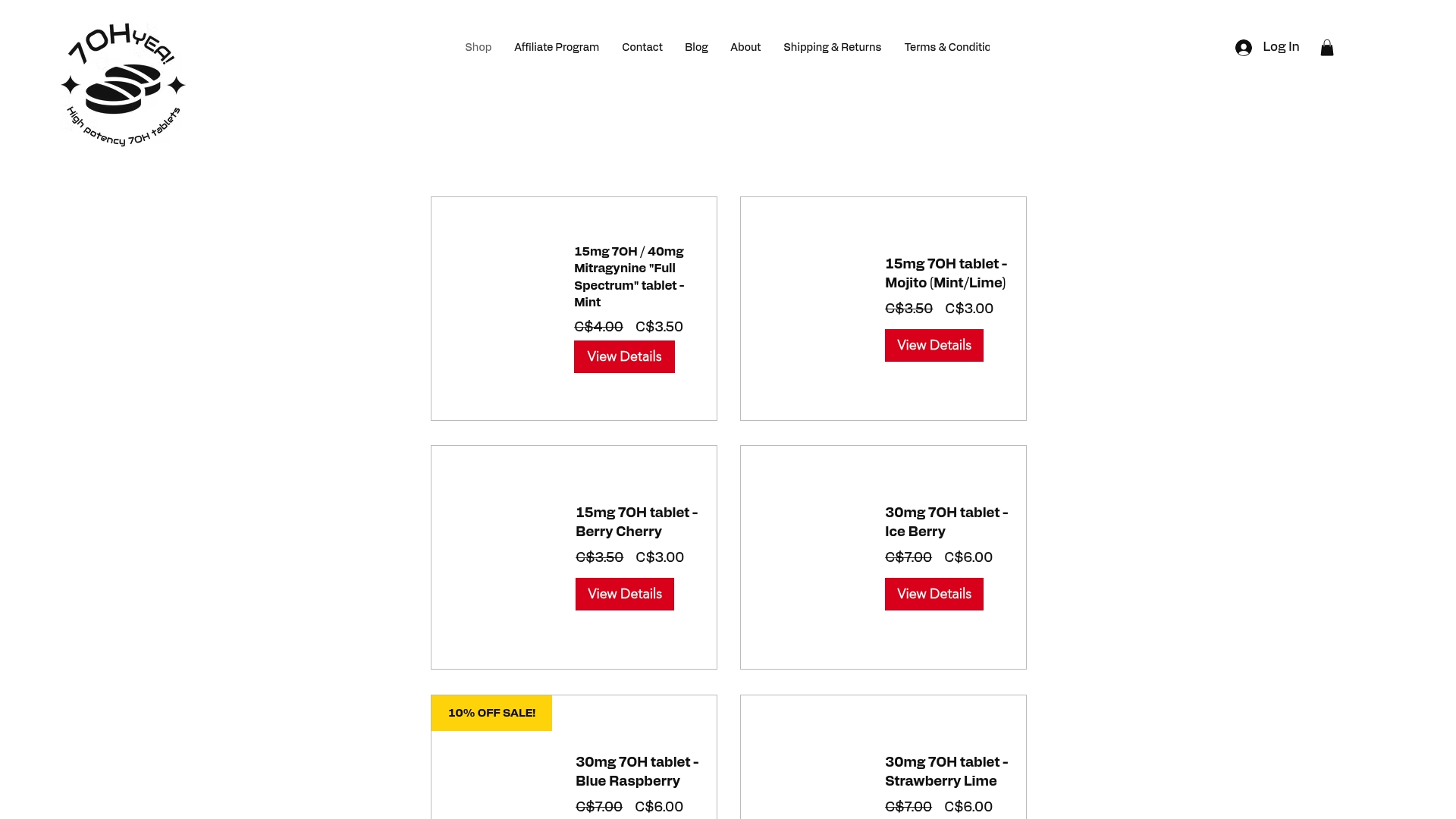
Browse the full range on our research-grade catalogue, and contact us about bulk purchasing for research teams.
What does this mean for readers?
Here’s the short version, written for a lab manager or a researcher who just wants to order correctly.
- If you’re in Canada: the DEA notice doesn’t change Canadian law. Watch Health Canada’s own announcements, and don’t act on rumours.
- If you’re ordering from the U.S.: a cross-border shipment means import rules, permits where required, and customs timing. Domestic supply removes that step.
- If you’re remote: confirm carrier acceptance, receiving hours and a named contact before anything ships. Ship early in the week.
- If you’re unsure of status: ask your institution’s compliance office. We can’t give legal advice, and we won’t pretend to.
We can’t predict what regulators will do next, and neither can anyone writing a headline. What we can say is that labs that keep their paperwork, labelling and carrier arrangements tidy are the ones least surprised by a change.
So here’s our question: if scheduling rules keep shifting in the U.S., should Canadian labs lean harder on domestic supply, or is that just trading one risk for another? Tell us what you think.
FAQ
Can research alkaloids be shipped within Canada?
It depends on the substance’s legal status and the shipping rules that apply to it. Under the CDSA, activities with controlled substances are prohibited unless authorized, and import or export generally needs a licensed dealer and a permit. Check Health Canada’s current guidance and your institution’s compliance office before ordering.
Who is responsible for classifying a shipment?
The shipper. Transport Canada’s guidance puts the decision on whether a material is dangerous goods on the consignor, who must complete classification, documents and containment before the carrier takes possession. A courier can also refuse a parcel if the contents can’t be identified.
What should I tell the courier about a lab delivery?
Give the temperature class, any dry ice or biological content, building access details, receiving hours, appointment rules and a contact person. For remote sites, also ask about rural delivery days and whether anyone is on site to sign.
Does domestic sourcing mean there are no rules?
No. It removes the import step and customs timing, but classification, labelling, carrier acceptance and the substance’s legal status still apply. Our products are for research use only, not for human consumption.
Sources
- Temporary Control of 7-Hydroxymitragynine (7-OH) and Other Kratom-Related Substances, Congressional Research Service
- FDA recommends scheduling action for 7-OH products, NutraIngredients
- Memorandum D19-9-2, Importation and Exportation of Controlled Substances, CBSA
- Controlled substances guidance, Health Canada
- Controlled Substances Regulations, SOR/2025-242
- Classification scheme, Transport Canada
- Part 3, Transport Canada
- Shipping Samples and Chemicals, UNBC
- Research Lab Courier in Montréal
- Medical Shipping Solutions for Biological Substances, Purolator
7ohyeaAsk About 7-OH Research SupplyEmail 7ohyea with questions about its research-grade 7-OH tablets and powders for laboratory analytical purposes.77ohyea
Email us7ohyea@gmail.com