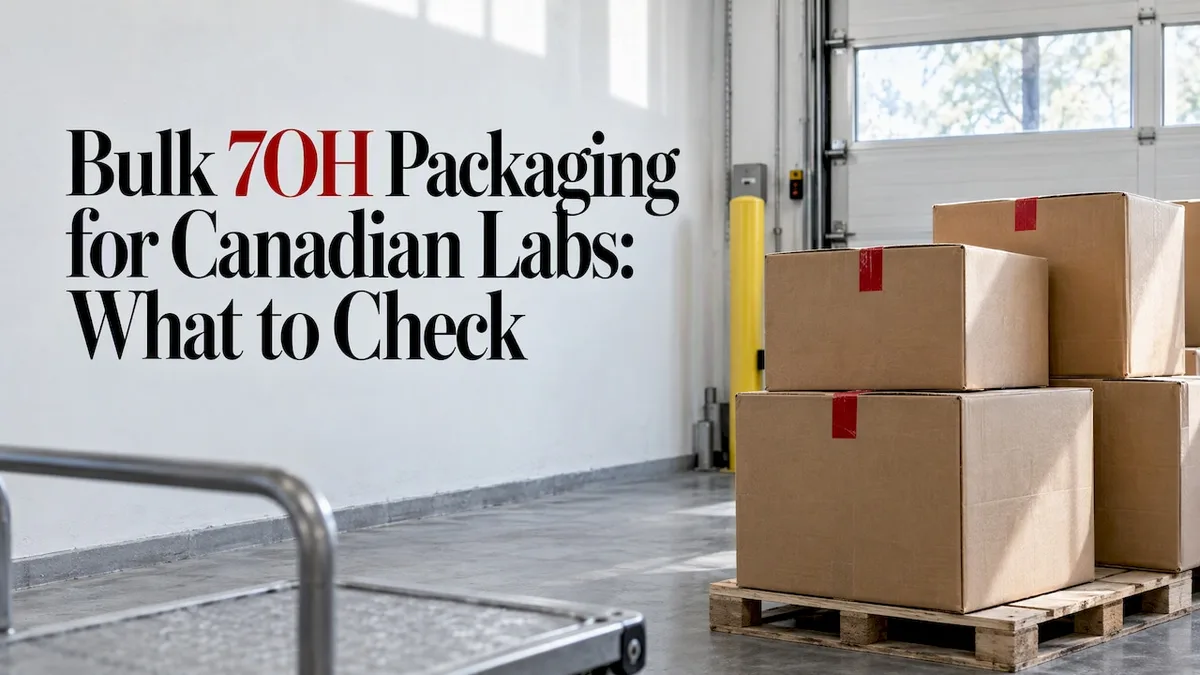
Bulk 7OH Packaging for Canadian Labs: What to Check

The US government is moving to put 7-hydroxymitragynine (7OH) in Schedule I, and Canadian labs are asking what that means for their orders. The short answer on packaging: bulk research material should arrive with batch-specific paperwork, clear labels and containers built for storage. A big order is a records exercise as much as a shipping one. Everything we sell is for research use only, not for human consumption.
7ohyeaFind 7OH for Lab ResearchExplore research-grade 7OH tablets and powders, with customizable dosage options and domestic sourcing from British Columbia for analytical laboratory work.
Explore research productsTL;DR
- Bulk 7OH for research means larger-format containers plus the paperwork that proves what’s inside: labels, batch numbers, a Certificate of Analysis (CoA) and a safety data sheet (SDS).
- Heat is the enemy of this compound in the lab. Published stability work shows real losses at elevated temperatures, so storage planning belongs in the purchase decision.
- Canada hasn’t scheduled 7OH under the CDSA as of mid-2026 reporting, while the US DEA has announced plans to schedule it. Neither fact is legal advice.
- Ask for batch traceability before you ask for a volume discount.
- All products are for research use only, not for human consumption.
Table of Contents
- Quick facts
- Why is everyone suddenly talking about 7OH?
- What did the headlines get wrong?
- What does “bulk packaging” even mean for research material?
- What should a Canadian lab verify before accepting a bulk shipment?
- Does storage really change which pack size makes sense?
- How should a lab handle and dispose of it?
- What does this mean for readers?
- Why we think Canadian-sourced bulk makes sense
- Ready to scope a research order?
- FAQ
- Sources
Quick facts
| Item | Detail |
|---|---|
| What 7OH is | 7-hydroxymitragynine, a minor alkaloid (a plant-derived compound) found in kratom leaf |
| Intended use of our products | Analytical and laboratory research only, not for human consumption |
| Canadian status | Not scheduled under the CDSA per July 2026 reporting; no authorized kratom product exists in Canada |
| US status | DEA announced intent to temporarily schedule on July 1, 2026 |
| Key packaging checks | Label, batch number, CoA, SDS, container integrity, storage conditions |
| Bulk purchasing | Available for research teams; contact us for formats |
Why is everyone suddenly talking about 7OH?
Because Washington changed the conversation. In July 2025, the FDA recommended Schedule I status for concentrated 7OH, with its commissioner saying the move would not cover ordinary kratom leaf products. The DEA then announced on July 1, 2026 its intent to temporarily control 7OH above a set concentration threshold. The notices ran in the Federal Register on July 6, 2026.
That’s the headline. The detail is messier. A temporary order, once published, would last two years with a possible one-year extension if permanent proceedings were pending. Bills in Congress would write similar limits into law. We can’t tell you how any of it ends, and neither can anyone else.
What did the headlines get wrong?
A few myths keep circulating. Here’s the fact-check.
Myth: “7OH and kratom are the same thing.” Fact: Kratom leaf contains mitragynine and only trace amounts of 7OH. The US scheduling push targets concentrated 7OH, not the leaf. That’s a distinction labs should respect, because findings on one material don’t automatically carry over to the other. We unpack it in our guide to mitragynine versus 7-hydroxymitragynine for Canadian labs.
Myth: “Canada just banned 7OH.” Fact: Nothing we’ve found says so. Reporting dated July 13, 2026 states that neither 7OH nor kratom is scheduled under the Controlled Drugs and Substances Act. The same report says no kratom or alkaloid product is authorized in Canada and that sale for human consumption is prohibited. That’s why a research-only framing isn’t a technicality for us. It’s the whole basis of what we do.
Myth: “Unscheduled means unregulated.” Fact: Health Canada has a track record of acting on unauthorized products. In one earlier case, it seized unauthorized kratom products and worked with the Canada Border Services Agency to help stop further imports. Rules on a substance can change quickly, and paperwork is your first line of defence.

What does “bulk packaging” even mean for research material?
It’s less glamorous than the term suggests. For a lab, bulk means a larger quantity of one batch, so a project runs on consistent material from start to finish. That consistency is the real product.
Consumer-style retail packaging is built to sell. Research packaging is built to document. Here’s the difference in practice:
| Feature | Retail-style packaging | Research bulk packaging |
|---|---|---|
| Main job | Shelf appeal | Identity and traceability |
| Batch information | Often minimal | Batch number tied to a CoA |
| Paperwork | Marketing claims | CoA and SDS on request |
| Labelling | Brand-led | Compound name, batch, “research use only” statement |
| Container logic | One-off use | Storage stability and inventory control |
We offer bulk purchasing for research teams, and the exact formats depend on the material and the project. Rather than guess at sizes here, we’d rather you tell us what your protocol needs. Our products ship with batch-specific CoAs.
What should a Canadian lab verify before accepting a bulk shipment?
Treat receiving day like a mini audit. Federal-jurisdiction labs have written expectations here. Employment and Social Development Canada’s laboratory inspection guideline says hazardous-substance records must be kept current, applicable containers labelled and SDSs available. Provincial and private labs have their own rules, but the habits carry over.
A practical receiving checklist:
- Label match. Does the compound name on the container match your purchase order and the CoA?
- Batch number. Is it printed on the container and identical to the CoA?
- CoA content. Does it report purity by a named analytical method, and does the stated purity match what you ordered?
- SDS on file. Is it available before the container goes on a shelf?
- Seal and condition. Any damage, moisture or tampering evidence?
- Inventory entry. Is the material logged the day it arrives?
If a supplier can’t give you items two and three, that’s your answer about the supplier. Our post on three nonnegotiables for 7-hydroxymitragynine tablet testing goes deeper on testing documentation.
Does storage really change which pack size makes sense?
Yes, and this is the one science point worth knowing. A 2020 study by Basiliere and Kerrigan found 7-hydroxymitragynine is highly acid-labile and loses significant amounts when held at 40°C or higher for eight hours. In plain terms, it doesn’t like heat or acidic conditions.

For packaging, that cuts two ways. A very large container that gets opened again and again has more exposure than several smaller ones. And a shipment left in a hot vehicle or loading dock is a risk to your data, not just your inventory.
Reference-standard suppliers set a useful benchmark. Cayman Chemical’s 7-hydroxy mitragynine CRM is a certified reference material (a standard used to calibrate instruments) supplied as a solution stored at -20°C. That’s a different format from a tablet or powder, so don’t copy it blindly. But it shows how seriously the analytical world treats storage conditions.
Our own research note on 7OH degradation and artifact risk explains why a result can reflect handling rather than the sample. An artifact is a false signal created by the process, not by the material.
How should a lab handle and dispose of it?
Follow your institution’s chemical hygiene plan, and where you’re federally regulated, follow the federal guideline. It says to run processes that generate airborne contaminants under fume hoods, use proper personal protective equipment, and keep a waste program that covers waste categories, containers, labelling and records. It also says to store and handle inter-reactive chemicals properly.
Bulk quantities raise the stakes on each of those points. More material means a bigger spill and a bigger inventory record. Decide who owns the inventory before the order goes in.
What does this mean for readers?
Here’s our plain read, and it isn’t legal advice.
- If you’re a Canadian researcher: the Canadian picture, as reported in mid-2026, is that 7OH isn’t scheduled. Rules can change, so check the Health Canada and Justice Laws websites yourself, and ask your institution’s compliance office before a big purchase.
- If you work with US partners: the DEA’s announced plans mean cross-border shipping of anything containing 7OH deserves a conversation with your legal or compliance team first. We can’t predict how the US process ends.
- If you buy in volume: paperwork first, price second. A cheap batch with no CoA is expensive when your results can’t be defended.
- If you’re not a researcher: our products aren’t for you. They’re research materials, not for human consumption, and we don’t give guidance on personal use.
For wider context, see our read on 2026 kratom research trends and what Canadian law says about 7OH.
Why we think Canadian-sourced bulk makes sense
We say this as people who sell into labs every week. A bulk order is a promise that batch twelve will match batch one, and the packaging is where that promise starts. Clear labels, a batch-specific Certificate of Analysis and containers you can store properly aren’t extras. They’re the product.
We source and manufacture in Canada, which means shorter transit times and no border fees. Shorter transit matters when your material is sensitive to heat. It also means one fewer customs question for your compliance team.
We’d also argue labs should be pickier than they are. Ask any supplier for the CoA before you ask for the price. If they hesitate, move on. If you’re comparing options, our guide to what labs should require from mitragynine reference standards gives you a ready checklist.
John
Ready to scope a research order?
We supply research-grade 7-hydroxymitragynine and related alkaloid materials for laboratory use only, with batch-specific CoAs and Canadian sourcing. Bulk purchasing is available for research teams, so tell us your protocol and we’ll talk formats.
Browse the full range on 7ohyea.ca, or start with our 43% pure mitragynine powder, listed at 6.75 CAD. Our order guide on analytical-use-only alkaloid orders explains how to avoid delays. Not for human consumption.
FAQ
Is bulk 7OH legal to buy in Canada?
As of July 2026 reporting, 7OH isn’t scheduled under the CDSA, but no authorized kratom or alkaloid product exists for human consumption in Canada. Our materials are sold for laboratory research only. Laws change, so confirm the current position with your compliance office or a lawyer.
What documents should come with a bulk order?
At minimum, a batch-specific Certificate of Analysis, a safety data sheet and a label showing the compound name and batch number. Your institution may require more. Ask for these before you pay.
Does the DEA’s plan affect Canadian orders?
Not directly, since the DEA covers the US. It can matter if you ship to, or collaborate with, a US lab, because the announced temporary order would apply there. We can’t predict the outcome, and you should get legal advice for cross-border questions.
How should bulk material be stored?
Follow your lab’s chemical storage plan and the supplier’s CoA or SDS. Published stability research shows 7OH loses material at higher temperatures, so keep it away from heat and log every opening.
With the US moving and Canada watching, should research suppliers be held to a documentation standard before the law forces one? Tell us what you think.
Sources
- FDA Seeks Schedule I Status for “Legal Morphine” (Medscape)
- Temporary Control of 7-Hydroxymitragynine (7-OH) and Other Kratom-Related Substances (Congressional Research Service)
- 7-Hydroxymitragynine (7-OH) in Canada: is it legal?
- Unauthorized kratom and sexual enhancement products seized (Health Canada)
- Laboratory Inspection Guideline (Employment and Social Development Canada)
- Temperature and pH-Dependent Stability of Mitragyna Alkaloids (PubMed)
- 7-hydroxy Mitragynine (CRM) (Cayman Chemical)
7ohyeaDiscuss Your Lab’s 7OH NeedsEmail us about research-grade 7OH tablets and powders, dosage options, and your analytical laboratory requirements.77ohyea
Email us7ohyea@gmail.com