
Is 7-OH Safe? What the Headlines Missed

No regulator, toxicologist or manufacturer can honestly call 7-OH safe right now. In August 2026, the American College of Medical Toxicology (ACMT) put that in writing, stating that no safe dose can be recommended because the toxic dose is unknown. That’s the real answer to the question, and it’s why 7-hydroxymitragynine (7-OH, a potent alkaloid related to kratom) belongs in laboratories under proper oversight. Our 7-OH is sold for research and analytical use only, not for human consumption.
7ohyeaExplore 7-OH for Laboratory Research7ohyea offers research-grade 7-OH tablets and powders for analytical use, with customizable dosage options for diverse research protocols.
VisitTL;DR
- No safe dose of 7-OH has been established. The ACMT’s August 2026 position statement says so directly.
- 7-OH is a trace compound in kratom leaf. The concentrated products on the market are a different thing from the leaf.
- In Canada, Health Canada hasn’t approved kratom as a food, natural health product or drug, and says it isn’t permitted for sale for human consumption.
- Our 7-OH products are for research use only, not for human consumption.
Table of Contents
- Quick facts
- Why is everyone suddenly talking about 7-OH?
- Myth or fact: is 7-OH just kratom?
- Myth or fact: is it “legal morphine”?
- What does the science debate actually look like?
- What are the risks regulators actually name?
- Where does Canadian law stand?
- And the U.S. picture?
- What does Canada’s own data say?
- What does this mean for readers?
- Our view on where this is heading
- Where can research teams source 7-OH?
- FAQ
- Sources
Quick facts
Compound: 7-hydroxymitragynine, a minor alkaloid linked to kratom.
Natural abundance: under 2% of total alkaloids in kratom, typically 0.01 to 0.04% by dry weight, per the FDA assessment.
Canada: not approved by Health Canada for human consumption of any kind.
U.S.: the FDA says 7-OH isn’t lawful as a dietary supplement or as an additive to conventional foods.
Our products: research-grade, for laboratory and analytical use only.
Why is everyone suddenly talking about 7-OH?
Because regulators and doctors finally started using blunt language.
In July 2025, FDA Commissioner Marty Makary said that, scientifically, 7-OH is an opioid by definition. That’s the tone of the FDA’s consumer update, which urges people to avoid 7-OH products and notes that the agency has sent warning letters to companies illegally distributing them.
Then came the ACMT statement in August 2026. It said 7-OH carries no proven therapeutic benefit and should only be handled within clinical research that has institutional, regulatory and ethical oversight. It also backed measures to stop unrestricted, nonprescription sale of opioid agonists (compounds that switch on opioid receptors).
The heat is understandable. Online shops had been selling 7-OH in candy-like formats while borrowing kratom’s friendly reputation. A peer-reviewed marketplace study found 304 semi-synthetic 7-OH and related products sold online between September 2024 and February 2025. Most were 7-OH-only tablets, shots or gummies, and nearly three in four made effect claims.
Myth or fact: is 7-OH just kratom?
Myth. This is the headline most people got wrong.
Kratom is a plant. 7-OH is one tiny molecule that can be found in it. The FDA assessment says it makes up less than 2% of the alkaloids in natural kratom. The marketplace study goes further: 7-OH isn’t found in fresh native leaf. It appears as an artifact of drying and can also form when the body processes mitragynine, kratom’s main alkaloid.
The concentrated stuff is another story. The FDA says commercial 7-OH products are likely made by chemically oxidizing mitragynine, because extracting enough from the plant would cost too much. The study authors call these products semi-synthetic.
So “it’s natural, it’s just kratom” doesn’t hold up. If you want the biosynthesis background, our piece on how kratom makes 7-OH walks through it.
Myth or fact: is it “legal morphine”?
Also a myth. The nickname spread fast and it’s sloppy.
The National Institute on Drug Abuse (NIDA) explains that mitragynine and 7-OH both activate mu-opioid receptors, the same family of brain-cell receptors that opioids target. But their effects only partially compare to those of drugs like heroin or oxycodone. That’s a long way from “legal morphine.”
The flip side matters just as much. Calling 7-OH harmless because it isn’t morphine is the opposite error. Nobody has run proper human studies on these concentrated compounds, and the marketplace study’s authors say so plainly.
What does the science debate actually look like?
We’ll keep this to the findings that matter most.
Fact one: 7-OH and mitragynine aren’t twins. The Washington Poison Center points to a 2024 rat study in which pure mitragynine stimulated breathing while pure 7-OH reliably suppressed it. Lumping the two together hides a real pharmacological split.
Fact two: animal data raise flags. The ACMT cites preclinical work in which intravenous 7-OH in rats reduced breathing in an opioid-like way, and naloxone (the overdose-reversal medicine) fully reversed it. It also cites mice that developed tolerance and withdrawal after repeated exposure.
What’s still unconfirmed: how any of that maps onto people. Human data on concentrated 7-OH are thin, and the Cleveland Clinic Journal of Medicine’s 2026 review notes that naloxone has worked in some kratom cases but not all. That’s partly because these compounds are partial agonists, and partly because many cases involve other sedating substances. Anyone claiming certainty either way is ahead of the evidence.
For a deeper technical read, see our 7-hydroxymitragynine pharmacology page.
What are the risks regulators actually name?
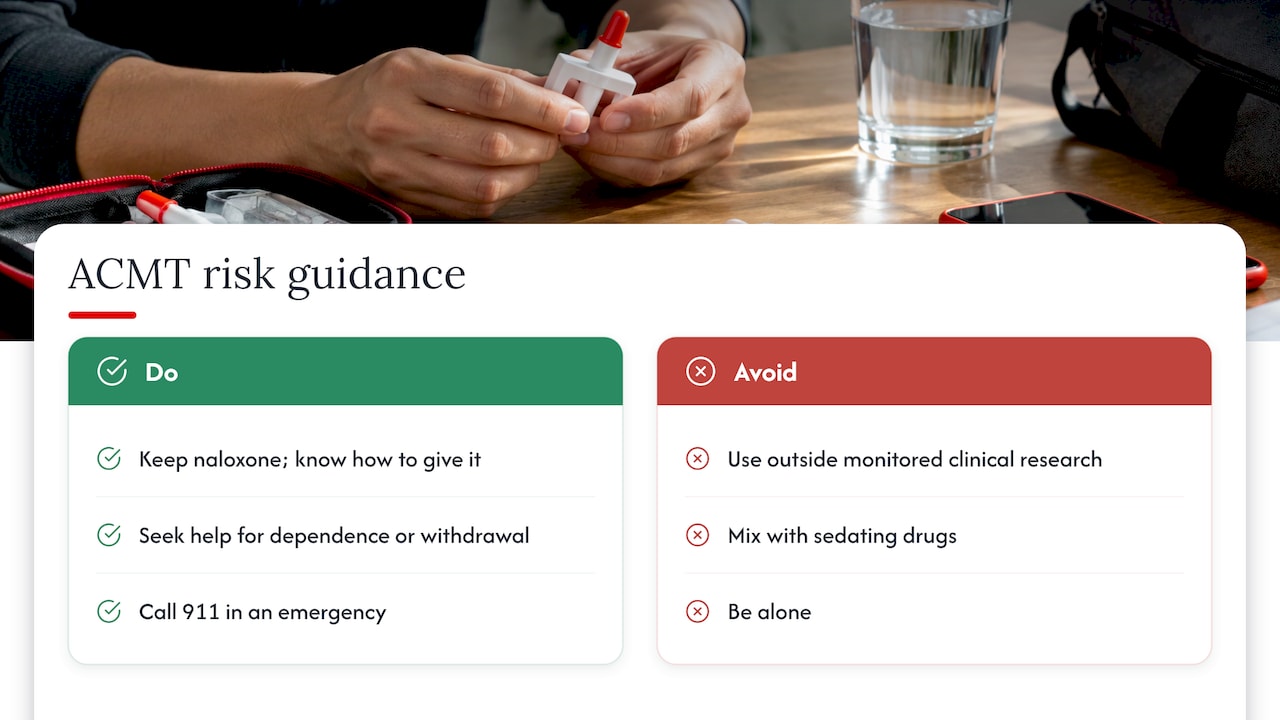
The ACMT lists opioid-like intoxication, respiratory depression, dependence, tolerance and withdrawal. It says concentrated products have been linked to overdose and death. It also says dependence and withdrawal have been treated with buprenorphine or methadone.
Combining 7-OH with other sedating substances is called out specifically. Alcohol, benzodiazepines and other opioids would be expected to raise the risk of dangerously slowed breathing, according to the ACMT. The group advises against use outside monitored clinical research, against mixing with sedating drugs, and against being alone. It also says to have naloxone and know how to give it.
The Cleveland Clinic review adds an interaction flag. Mitragynine inhibits an enzyme family called CYP3A, which processes many medications, so it can change how drugs such as certain benzodiazepines, methadone, quetiapine and trazodone behave in the body.
If you or someone near you is struggling with dependence or withdrawal, talk to a doctor or pharmacist, or call your local poison centre. In an emergency, call 911. Some background on kratom products and dependence from the Canadian market can also help you understand what people are being sold.
Where does Canadian law stand?
This part gets garbled constantly, so here’s the careful version.
According to the Canadian Association for Treatment of Addiction, Health Canada hasn’t approved kratom as a food, natural health product or drug. Kratom isn’t listed under the Controlled Drugs and Substances Act (CDSA), Canada’s main drug-scheduling law. But Health Canada has stated kratom isn’t permitted for sale for human consumption. That’s why Canadian vendors often use labels like botanical, aromatic or incense, with not-for-human-consumption disclaimers.
The same source notes that Canadian surveillance data specific to 7-OH aren’t currently published. So there’s no Canadian equivalent of the U.S. poison-centre numbers. That gap is part of the story.
We can’t tell you how this will play out. Whether Canada tightens or loosens anything is unannounced and unconfirmed. If you need to know whether a particular activity is lawful, a lawyer is the right person to ask, and what’s written here isn’t legal advice.
And the U.S. picture?
South of the border, the FDA’s position is clearer on paper. Its consumer update says 7-OH isn’t approved for medical use and isn’t lawful as a dietary supplement or when added to conventional foods. It recommends consumers avoid products containing it, whether they’re sold as foods, supplements or as something to treat an ailment.
The FDA’s scientific assessment adds that poison-centre reports, DEA toxicology testing and social media monitoring show increasing human exposure. That surveillance is U.S. data, and it shouldn’t be treated as a direct read on Canada.
What does Canada’s own data say?
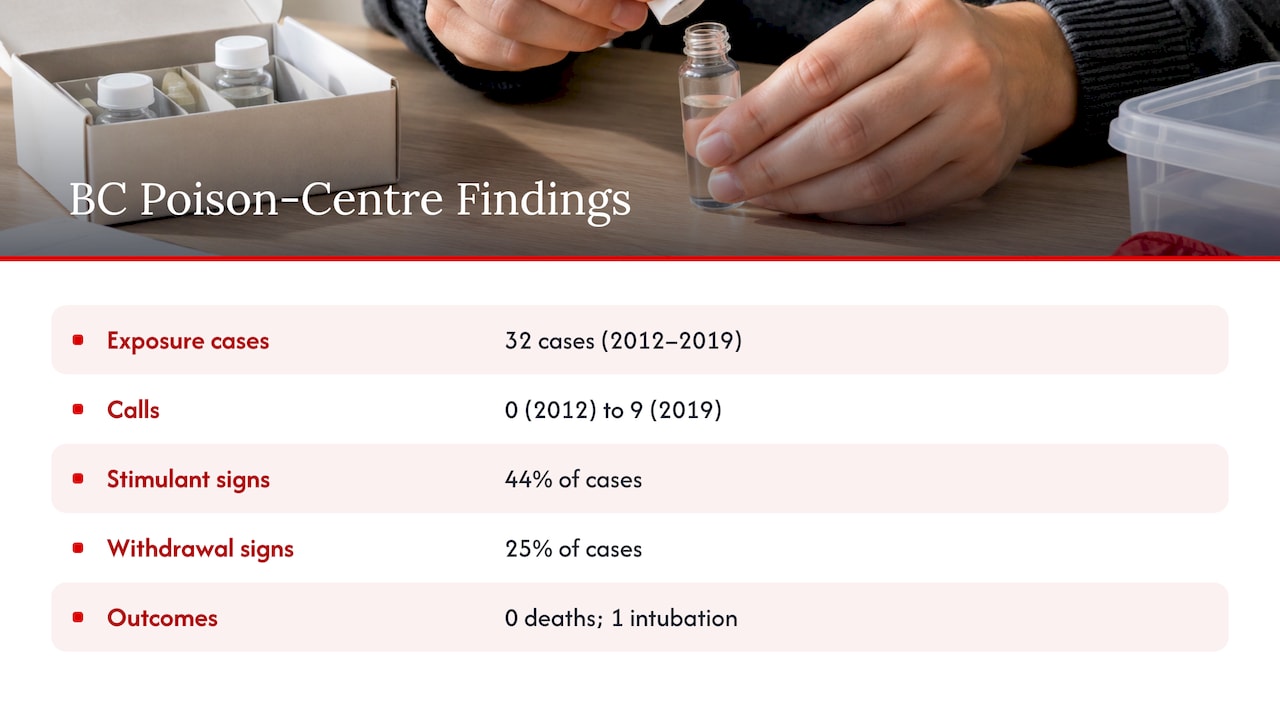
The best Canadian evidence is older and about kratom broadly, not concentrated 7-OH. A CMAJ Open analysis of the British Columbia Drug and Poison Information Centre found 32 kratom exposure cases between 2012 and 2019. Calls climbed from none in 2012 to nine in 2019. There were no deaths, though one case needed intubation to manage agitation after kratom withdrawal.
Presentations varied. Stimulant signs showed up in 44% of cases and withdrawal signs in 25%. Four young men had elevated liver enzymes.
The authors suggested the rise may reflect growing availability, and might connect to BC’s opioid crisis, with some people using kratom to ease opioid withdrawal. That’s their interpretation, not a proven cause. And it predates the concentrated 7-OH boom entirely.
What does this mean for readers?
It depends who you are.
If you’re a scientist or analytical chemist. The story strengthens the case for rigorous documentation. Batch-specific certificates of analysis, clear labelling as research material and a clean chain of custody matter more than ever. So does a clear line between mitragynine and 7-OH in your protocols, since the science shows they behave differently.
If you’re a lab team buying alkaloid reference material. Expect more scrutiny from suppliers, institutions and regulators. Keep your research purpose documented.
If you came because you or someone you know uses 7-OH or kratom. Our products aren’t for human consumption, and we won’t tell you what to expect from any compound. What the medical bodies say is that no safe dose is established, that mixing with sedatives raises risk, and that help exists for dependence. A doctor, pharmacist or poison centre is the place to start.
If you’re a biohacker or bodybuilder looking for an edge. The evidence above doesn’t support treating 7-OH as a wellness tool. The ACMT says there are no proven therapeutic benefits.
If you’re curious about the 7-OH versus kratom debate. Keep the distinction straight: the plant, the main alkaloid and the concentrated derivative are three different things.
Our view on where this is heading
We think the best thing that came out of this year’s headlines is a sharper line between research material and consumer product. That line is where we’ve always stood.
Our 7-OH tablets and powders are made for laboratories and analytical work, not for human consumption. We source and manufacture domestically in Canada, which means fast shipping and no border fees for research teams. Every product comes with a batch-specific certificate of analysis, because reproducible work starts with knowing exactly what’s in the vial.
We also think the mitragynine and 7-OH split deserves more bench time. That’s why we offer related mitragynine reference materials and bulk purchasing for research teams, so a lab can compare the compounds side by side under its own protocols.
Our take: the future of this compound belongs in properly overseen research. That’s the kind of customer we want to serve.
John
Where can research teams source 7-OH?
If your lab needs analytical-grade material, our research-grade 7OH tablets and powders are made in Canada, supplied with batch-specific certificates of analysis, and sold for laboratory use only. Our 81% pure 7OH powder is listed at 50 CAD one-off. We also carry mitragynine, MGM-15 and SR17018 materials for research teams.
For cost planning, our lab buyer’s guide breaks down what research buyers usually weigh. You can also read what Canadian labs need to know about the two alkaloids, and our 2026 research trends piece.
FAQ
Is 7-OH safe to take?
No safe dose has been established. The ACMT says the toxic dose is unknown and that it can’t recommend any dose. Our products are for research use only, not for human consumption.
Is 7-OH the same as kratom?
No. Kratom is a plant, and 7-OH is a trace compound in it, under 2% of its alkaloids according to the FDA. Concentrated 7-OH products are likely made by chemically converting mitragynine.
Is 7-OH legal in Canada?
Health Canada hasn’t approved kratom as a food, natural health product or drug, and says it isn’t permitted for sale for human consumption. It isn’t listed under the CDSA, per the Canadian Association for Treatment of Addiction. For anything specific to your situation, ask a lawyer.
What should I do if someone has a bad reaction?
Call 911 right away. The ACMT notes naloxone should be available, but the Cleveland Clinic review says it hasn’t worked in every kratom case, so emergency care matters either way. Your local poison centre can also advise.
Why do researchers still study 7-OH?
Because the science is unsettled. Animal studies show distinct breathing effects for 7-OH versus mitragynine, and human data are thin. The ACMT says any use should happen inside clinical research with proper oversight.
So here’s our question for you: should Canada wait for its own data on 7-OH, or act on the U.S. evidence now? Tell us what you think in the comments.
7ohyeaQuestions About 7-OH Research?Email 7ohyea to ask about research-grade 7-OH tablets and powders intended for laboratory and analytical purposes.77ohyea
Email us7ohyea@gmail.comSources
- FDA: 7-OH scientific assessment
- FDA: Products Containing 7-OH Can Cause Serious Harm
- ACMT Position Statement on 7-Hydroxymitragynine, August 2026
- De Facto Opioids: marketplace study on 7-OH products
- NIDA: Kratom
- Washington Poison Center: Kratom and 7-hydroxymitragynine poisoning
- CMAJ Open: Kratom exposures managed by the British Columbia poison centre
- Canadian Association for Treatment of Addiction: What Is Kratom?