Standard Addition for 7-OH: How Labs Measure It Accurately

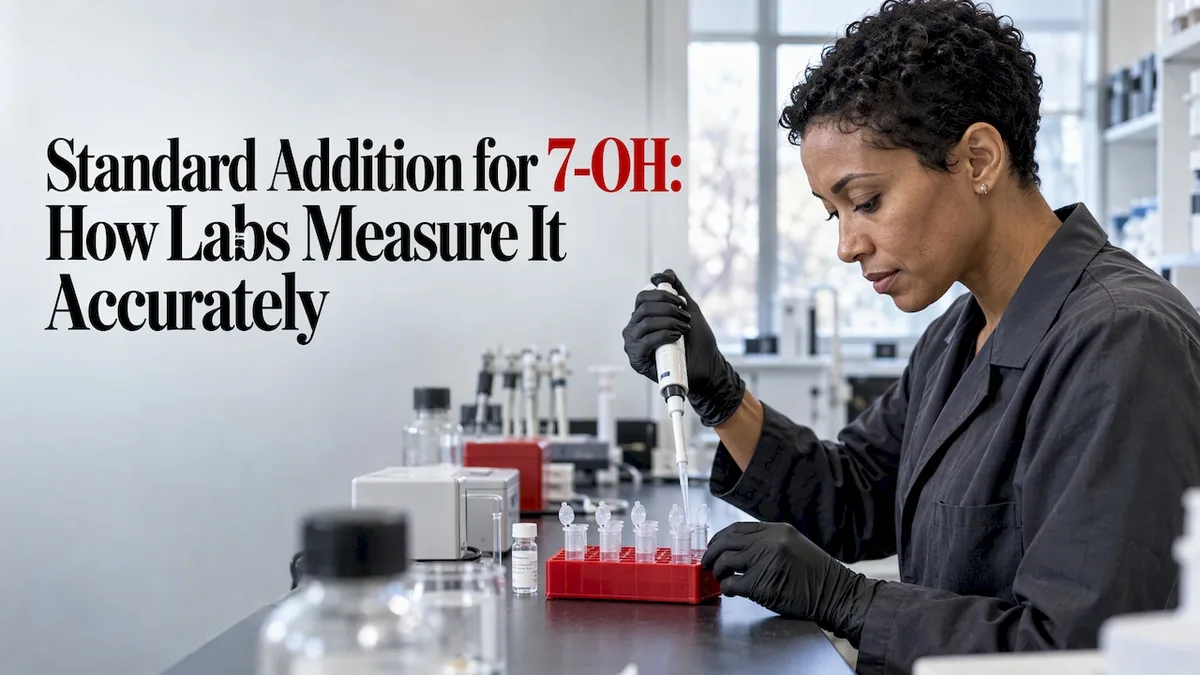
In June 2026, the US Association of Public Health Laboratories put out a bulletin on kratom alkaloids, and one detail jumped out: 7-hydroxymitragynine (7-OH) is a fragile molecule that can change during sample prep. If a lab’s own handling can shift the number, the way you calibrate matters. That’s where standard addition comes in. It’s a calibration trick where you spike the sample itself with known amounts of 7-OH, so the sample’s own chemistry gets built into the answer. All 7OH products from 7OHyea are sold for research use only, not for human consumption.
7ohyeaFind 7-OH Materials for Lab WorkExplore research-grade 7-OH tablets and powders from a Canadian supplier, with customizable dosage options for analytical work.
VisitTL;DR
- Standard addition means adding known amounts of a 7-OH standard to portions of your actual sample, then working backward to the original amount.
- It helps most when the sample is messy and no clean blank matrix exists to calibrate against.
- It fixes some matrix problems (slope changes) but not others (interferents that shift the baseline).
- 7-OH breaks down easily, so acid, base, heat and storage time can wreck a result before the instrument ever runs.
- Pair it with a well-characterized reference material and a batch-specific certificate of analysis.
Table of Contents
- Quick facts
- Why is everyone suddenly asking about measuring 7-OH?
- What is standard addition, in plain English?
- Myth vs fact: is standard addition just a fancier calibration curve?
- How does the calculation actually work?
- What does the 7-OH method itself need?
- Why is 7-OH such a tricky analyte?
- What can standard addition not fix?
- When should a lab pick standard addition over external calibration?
- How do you validate and report the result?
- What’s the legal landscape for Canadian labs?
- Promo: research-grade materials for your analytical work
- Perspective: why domestic sourcing matters for analytical work
- What this means for readers
- FAQ
- Sources
Quick facts
| Item | What to know |
|---|---|
| What it is | A calibration method that spikes the real sample with known analyte amounts |
| Best for | Complex or unknown matrices where a blank matrix isn’t available |
| Minimum design | One unspiked portion plus at least four spiked portions, per the EU reference laboratory guidance |
| Result | Original concentration is the negative intercept divided by the slope |
| Main 7-OH risk | Instability during prep and storage |
| Product status | 7OHyea products are for research use only, not for human consumption |
Why is everyone suddenly asking about measuring 7-OH?
Because 7-OH has moved from the lab bench into the headlines. Public health labs, regulators and journalists are all asking the same question: how much of this compound is actually in a given product or sample, and can you trust the number?
That’s a measurement question, not a political one. And the APHL bulletin from June 2026 is a good example of how seriously analysts now take it. It covers which sample prep steps are safe and which quietly change the chemistry.
For Canadian researchers, the legal picture around 7-OH and related alkaloids has been shifting, and we can’t tell you where it lands. Check Health Canada’s current notices directly before you plan any work. Nothing here is legal advice, and nothing here predicts how rules will change.
What is standard addition, in plain English?
Imagine you’re trying to weigh a fish, but the scale is wobbly and every reading comes out off by a different amount. You can’t fix the scale. So you add a few known weights next to the fish and watch how the wobbly scale responds. Now you know how this particular scale behaves.
Standard addition works the same way. You split your sample into equal portions. You leave one alone and add increasing, known amounts of 7-OH standard to the others. Then you measure them all.
The EU reference laboratory guidance says it plainly: because the spiked samples share the same matrix as the real sample, some matrix effects are corrected automatically. “Matrix” just means everything in the sample that isn’t the thing you’re measuring: plant material, plasma, binders, flavourings, whatever’s there.
Myth vs fact: is standard addition just a fancier calibration curve?
Myth: it’s the same as an ordinary calibration curve with extra steps.
Fact: an ordinary curve is built from clean standards, or standards spiked into a blank matrix, and then your sample is read against it. Standard addition builds the curve inside the sample. A 2025 paper in a mass spectrometry journal describes it as especially suitable when sample composition is unknown or complex and likely to affect the signal.
That’s the exact situation with many 7-OH samples. Tablets carry binders and flavours. Biological samples carry proteins and salts. Plant extracts carry dozens of related alkaloids.
How does the calculation actually work?
The steps are simple. The care is in the details.
- Estimate the concentration first. Standard addition needs a rough idea of how much analyte is there, so you can pick sensible spike levels.
- Prepare at least five equal portions. The EU guidance recommends one unspiked and four fortified portions with increasing amounts, adapted to the estimated concentration.
- Spike before sample preparation. This lets the extraction losses show up in the spiked portions too, instead of hiding.
- Add an internal standard if you have one. That’s a second compound, added at a fixed amount to every portion, that corrects for run-to-run drift.
- Plot signal against added concentration. Fit a straight line.
- Find where the line hits zero signal. The original concentration is the negative intercept divided by the slope.
A worked example from the literature
Chromatography columnist John Dolan walks through a real calculation for a different analyte. He split a sample into five parts: unspiked, plus spikes of 1, 2, 5 and 10 µg/g. The regression line came out as y = 463x + 213.

Set y to zero and you get x = −213/463, or about −0.46. Drop the minus sign, and the sample held 0.46 µg/g to begin with. The same arithmetic applies to 7-OH. Only the standard and the instrument method change.
Is there a faster way to check first?
Yes. A Japanese forensic toxicology group described a two-stage design: a quick one-point spike to confirm the compound is present, then the full multi-point curve only if it is. It saves time and sample when you’re screening many unknowns.
What does the 7-OH method itself need?
Standard addition isn’t a complete method. It’s the calibration layer on top of one. You still need a reference material, a sample prep, and an instrument method.
Reference materials. The AOAC performance requirements for kratom alkaloids list 7-hydroxymitragynine and a deuterated version (7-OH-D3), each at 100 µg/mL, as reference materials. The deuterated one acts as the internal standard. It’s the same molecule with a few heavier hydrogen atoms, so it behaves alike in the instrument but can be told apart by mass.
Instrument. Most published work uses liquid chromatography with tandem mass spectrometry (LC-MS/MS), which separates compounds and then identifies them by mass. A 2013 rat plasma study, for instance, used the 415 to 190 transition to track 7-OH.
Calibration range. The AOAC document sets a single-laboratory analytical range of 0.01 to 0.5%, with a limit of quantitation (the lowest amount you can reliably measure) at or below 50 ppm.
Our own guides on reference standards labs should require and on laboratory detection methods in Canada cover the buying and instrument side in more depth.

Why is 7-OH such a tricky analyte?
Because it doesn’t sit still. Two sources make this clear.
The APHL bulletin warns against using acid or base during sample prep. Acid can convert mitragynine into 7-OH, which inflates your number. Base can convert 7-OH into another compound called mitragynine pseudoindoxyl, which shrinks it. It recommends simple methanol dilution for drug products and an acetonitrile “crash” (protein precipitation) for biological samples. It also notes 7-OH is unstable in whole blood, while in urine it holds for 7 days at 4°C but loses more than half by 60 days.
A 2023 review of kratom analysis adds that extraction recoveries can be lower for 7-OH than for other alkaloids because of its marked instability, so internal standard choice needs care.
Here’s the good news for standard addition. Because you spike before prep, any loss the sample causes also hits your spike. The calibration sees the same trouble the analyte sees.
What can standard addition not fix?
This is where the headlines on “accurate testing” tend to oversimplify.
The EU guidance separates two kinds of matrix effect. Rotational effects change the slope of your calibration line, and standard addition corrects those. Translational effects come from co-eluting interferents, compounds that exit the column at the same time and add their own signal. Those shift the intercept, and standard addition can’t correct them.
There are other limits too:
- It’s more work. Dolan calls it quite simple in principle but usually more effort, since every portion must be extracted and injected on its own.
- One analyte at a time. The spike is specific to one compound, per the UNICORN software manual, which also lists limited precision against external or internal standard techniques.
- It needs a clean peak. The analyte peak must be fully resolved and the spike should be the same order of magnitude as the sample.
- Some biological work stays semi-quantitative. A 2020 urine study concluded 7-OH should be treated as semi-quantitative because matrix effects ran higher than acceptable.
When should a lab pick standard addition over external calibration?
Pick it when you can’t get a consistent blank matrix. A trade-journal review of matrix effects frames the choice this way: without a blank matrix, dilution and standard addition are what’s left. Dilution lifts your limit of quantitation. Standard addition needs an approximate concentration and at least three extra runs per sample.
If you’re running hundreds of near-identical tablet samples with a known excipient blend, matrix-matched calibration is usually faster. If every sample is different, such as a new extract, a new formulation or a new biological source, standard addition earns its extra runs.
It’s also the alternative when a labelled internal standard is too expensive or unavailable, a point made in the 2025 qSA paper.
How do you validate and report the result?
A number without validation is just a number. The AOAC requirements give a useful yardstick for 7-OH:
| Parameter | AOAC criterion |
|---|---|
| Analytical range | 0.01 to 0.5% |
| Limit of quantitation | 0.005% (50 ppm) or lower |
| Limit of detection | 15 ppm |
| Recovery | 90 to 110% (0.01 to 0.1%); 95 to 105% (above 0.1 to 0.5%) |
| Repeatability (RSDr) | 5% or lower (0.01 to 0.1%); 4% or lower (above 0.1 to 0.5%) |
| Reproducibility (RSDR) | 8% or lower; 6% or lower across labs |
Source for every row: the AOAC Standard Method Performance Requirements. RSD means relative standard deviation, a measure of how tightly repeat results cluster.
When you report, include the number of spike levels, the regression fit, the confidence interval on the intercept estimate, and the internal standard used. A 1999 university paper on precision in standard additions shows how to attach a 95% confidence interval to the result. Our guide to method validation for 7-hydroxymitragynine lays out what labs need to demonstrate.
What’s the legal landscape for Canadian labs?
We’ll be straight: this is a fast-moving area, and we won’t pretend to know the endpoint. Here’s how to read it without getting burned.
Canada first. Rules on 7-OH and related kratom alkaloids are set federally. Any announced change would come through Health Canada, and any statement about what is or isn’t lawful should be checked against the department’s current notices and, if you need to rely on it, a lawyer who knows the Food and Drugs Act and the Controlled Drugs and Substances Act. We’re not giving legal advice, and we’re not predicting outcomes.
The US second. American agencies, including the FDA and DEA, have been looking at 7-OH. The APHL bulletin even notes that the DEA threshold uses lab numbers when assessing products, which is one more reason accurate quantitation matters. Anything beyond that, confirm on the agencies’ own pages.
One thing that isn’t unconfirmed: these materials are for analytical work only. They’re not for human consumption.
Promo: research-grade materials for your analytical work
If you’re building a standard addition series, you need a source material you can characterize. 7OHyea supplies research-grade 7-hydroxymitragynine tablets and powders for laboratory use only, sourced and manufactured in Canada, with batch-specific certificates of analysis. We also offer related mitragynine alkaloid reference materials and bulk purchasing options for research teams.
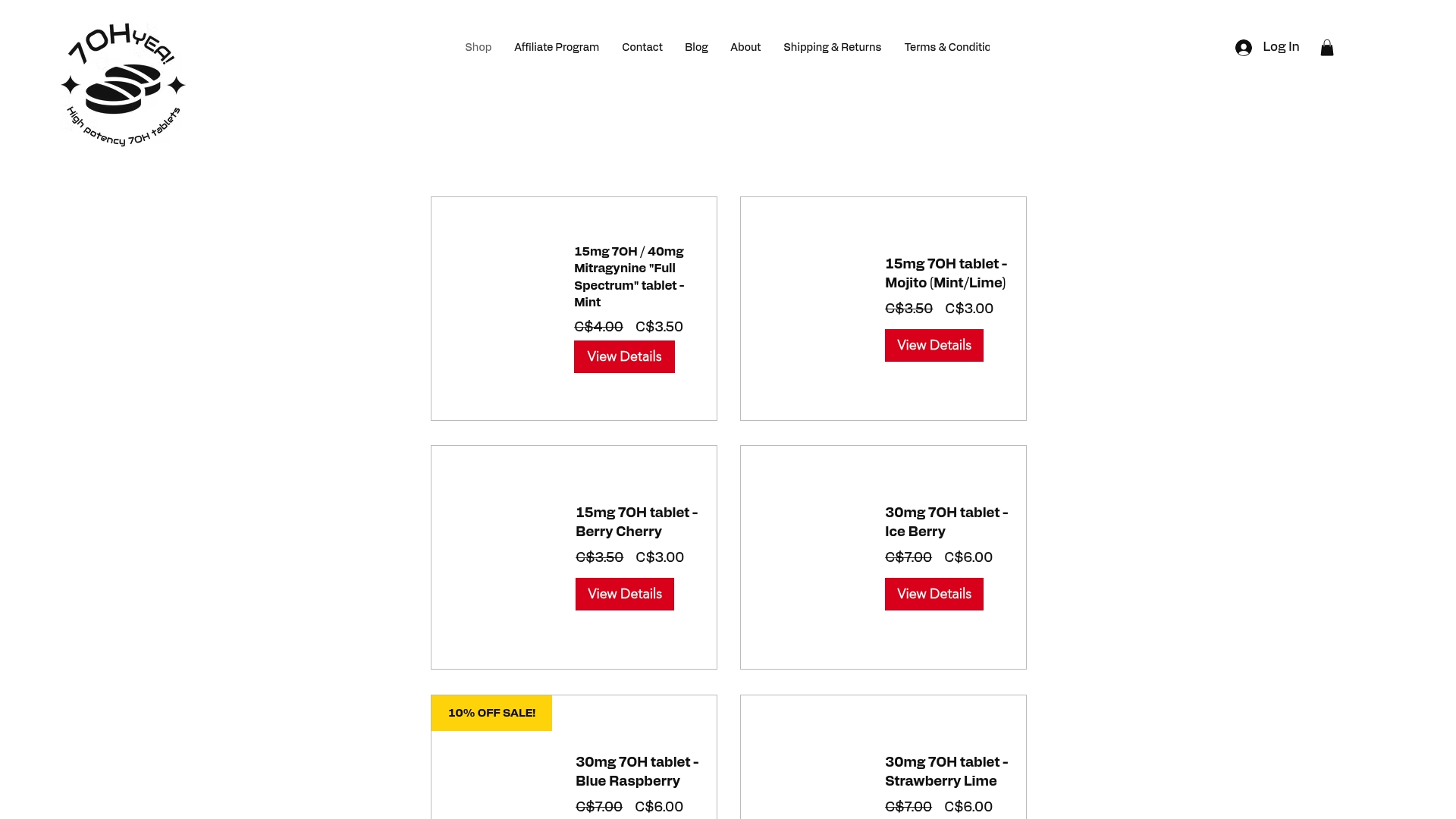
Our 81% pure 7OH powder is listed at 50 CAD, and our 43% pure mitragynine full spectrum powder at 6.75 CAD, both one-off. For tablet-format work, see the full 7OH range. Our notes on tablet testing for labs cover what to ask for in a COA.
Perspective: why domestic sourcing matters for analytical work
We think the most underrated part of a good 7-OH method is the paperwork that arrives with the material. A standard addition curve is only as trustworthy as the standard you spike with, and a batch-specific certificate of analysis is where that trust starts.
That’s why we source and manufacture in Canada. Domestic supply means fewer delays and no border fees, and for a lab running time-sensitive prep, a sample that sits in transit is a sample that may degrade. Given how unstable 7-OH can be, speed isn’t a convenience. It’s part of the method.
We also think labs deserve to buy in the form that suits the protocol, whether that’s powder for stock solutions or tablets for formulation studies, and to buy in bulk when a study needs consistency across many runs. Everything we sell is for research use only, not for human consumption, and we’d like Canadian analytical work to be held to the standards in the AOAC criteria above.
John
What this means for readers
- If you’re an analytical chemist: standard addition is worth the extra runs when your matrix is unpredictable. Spike before prep, avoid acid and base, and report your regression and confidence interval.
- If you’re a researcher buying materials: match your material to your method, and keep the certificate of analysis with your data.
- If you’re a curious reader following the headlines: a single reported 7-OH number means little without knowing the method, the matrix and how the sample was stored.
- If you’re thinking about personal use: this article isn’t for you. The materials discussed are for laboratory analysis only, not for human consumption. For questions about your own health, talk to a doctor or pharmacist.
So here’s the open question: as testing gets stricter and regulators lean harder on lab numbers, should every 7-OH result be published with its method and uncertainty attached? Tell us what you think.
FAQ
What is the standard addition method used for?
It measures how much of an analyte is in a sample when the sample’s own matrix would distort a normal calibration. You spike portions of the sample with known amounts and extrapolate back to the original concentration.
How many spiked samples do I need for 7-OH?
The EU reference laboratory guidance recommends at least five portions: one unspiked and four fortified at increasing levels. The Japanese forensic design uses a one-point check first, then a fuller series of six points for the final measurement.
Can standard addition correct every matrix effect?
No. It corrects effects that change the calibration slope, but not interferents that shift the intercept. If a co-eluting compound adds signal, you’ll need better chromatographic separation or a different technique.
Why does sample prep matter so much for 7-OH?
Because the compound is chemically unstable. The APHL bulletin warns that acid can turn mitragynine into 7-OH and that base can turn 7-OH into a different compound, so both change your result before measurement.
7ohyeaQuestions About 7-OH Materials?Email 7OHyea with questions about its research-grade 7-OH tablets and powders, including the available dosage options for analytical work.77ohyea
Email us7ohyea@gmail.comSources
- EURL Guidance Document on standard addition
- Standard Addition as a Method for Quantitative Mass Spectrometry (PMC, 2025)
- Standard Addition, Separation Science
- The standard addition method and its validation in forensic toxicology
- AOAC Standard Method Performance Requirements for kratom alkaloids
- UPLC-MS/MS method for 7-hydroxymitragynine in rat plasma (PMC)
- Kratom Alkaloids Substance Awareness Bulletin, APHL
- Kratom: The analytical challenge of an emerging herbal drug
- Matrix effects in residue method development, Chromatography Online
- Urine study on 7-hydroxymitragynine metabolites and biomarkers
- Standard addition quantitation, UNICORN manual
- Estimates of Precision in a Standard Additions Analysis